Top 7 CRM Systems for Business in 2026: Ranking and Comparison
Discover how to choose the best CRM system to boost sales, automate routine tasks, marketing, and customer service.
In the full article, you’ll find a detailed review of the top 7 CRM systems, selection criteria for your business type, and practical implementation tips👇
Admit it, do you still have salespeople working with Excel sheets and notebooks? If so, congratulations—you might just be a glutton for punishment with nerves of steel. But what if your top sales rep who manages all your contacts and contracts in Excel decides to quit? What guarantee do you have that all that data won’t disappear with them? Or if their computer crashes, all the work and data from several years could go up in smoke. If you’re still taking such risks, good luck. Because relying on simple Excel when there are amazing tools with extra features for analytics, automation, and data exporting is like staying in the last century while your competitors surge ahead.
You need a real powerhouse. Long sales cycles, complex deals, numerous contacts—all of this demands a robust CRM system for your business. If you’re looking for something truly top-notch and functional, this CRM guide will help you make the right choice.
“Statistics show that 27% of salespeople spend more than an hour each day on data entry, highlighting the need for a CRM.”
Why does a sales department need a CRM and what exactly is it? Let me explain as clearly as possible, without wasting time on lengthy explanations.
A CRM system is software that helps you manage customer interactions. It stores all the information about your clients and transactions—contacts, purchase history, negotiations, and more. It’s your personal archive that is always within reach.
But a CRM is not just a database. It helps with a range of tasks.
Centralizes customer data: A CRM keeps all the information about clients and interactions in one place. Your sales team can access the client’s history, their needs, and preferences, avoiding redundant work and speeding up deal closures.
Automates routine tasks: Things like scheduling meetings, reminders, and reporting are handled automatically, allowing sales reps to focus on high-quality customer service rather than mundane tasks.
Provides sales analytics: The system helps you analyze sales performance and identify trends, so you can see which products sell best, who your top performers are, and which clients generate the most revenue.
Offers cloud access: Modern CRMs are cloud-based, giving your team flexibility to access data from any device, anytime.
Let me share a story about Lotana Distribution, the official distributor of Korean cosmetics in Ukraine. Their problem was classic—a lack of systematization in customer relations. They had no CRM system and no unified sales approach across different channels. More importantly, the sales team couldn’t see how their efforts tied into real performance metrics.
Our “Rocket” team restructured the sales department’s architecture. We established new business processes, introduced a financial incentive system that pushed salespeople out of their comfort zones, and migrated the sales process to a CRM. The result? Lotana Distribution’s revenue grew 3.68 times and is still accelerating.
So, if you have issues with KPIs, need to systematize sales, or want a sales intensive for your team, get in touch. We’ll help you build an effective sales department that delivers real results. We don’t just share tips and tricks—we make things happen. With expertise in more than 14 business sectors and over six years in the market, we have optimized the sales operations of more than a hundred companies with an average revenue increase of 35%.
“A good CRM system should work for you, not the other way around.”
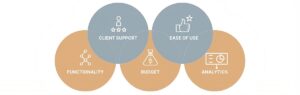
Don’t make hasty decisions when selecting a CRM. Consider all the factors. For example, if the system doesn’t integrate with other programs you use, you’ll end up wasting time on manual data entry. And time, as you know, is money. Here’s what else to keep in mind:
When it comes to selecting and implementing a CRM for your sales department, the size and industry of your business are key factors to consider. Why? Because different CRMs cater to different needs. A small business doesn’t need all the bells and whistles that a large corporation might require. At the same time, if you manage a chain of restaurants, you’ll need a CRM system specialized in customer experience management rather than B2B sales.
For a small business, choose a simple and affordable CRM that’s easy to set up and use. For a medium-sized business, look for a CRM with more extensive features that can scale with your company. If you’re running a large enterprise, invest in a powerful CRM with advanced analytics and integrations with other systems.
A cheap CRM might cost you more in the long run if it doesn’t meet your needs, while an expensive one could be a waste if you don’t use its full potential.
Determine which CRM features you actually need and avoid paying for extras you won’t use. Keep in mind that the more users you have, the more expensive the CRM will be.
Some CRMs offer monthly or yearly subscriptions. Choose one that fits your budget, but watch out for hidden costs like fees for training, integration, or technical support.
Don’t forget about ROI. Conduct a comparative analysis of CRM systems and invest in one that will give you the highest return. Calculate how much time and money you can save with a CRM and compare that to its cost.
It’s better to choose a less feature-rich CRM that fits your needs and budget than an expensive one that you can’t fully utilize.
How many clients are you losing because your managers keep databases in Excel, and data disappears along with departed employees? Do you feel your team spends more time searching for client information than actually selling? Statistics show that 27% of salespeople spend over an hour daily on manual data entry, while companies without CRM lose up to 30% of potential sales due to chaos in customer database management.
At “Raketa Prodazh,” we’ve developed a systematic methodology for CRM selection and implementation over 8+ years, which includes comprehensive business process analysis, optimal system selection for your industry specifics and team size, personalized sales funnel setup, and routine task automation.
Our experts don’t just help you choose a platform — we create a complete sales management ecosystem with integration of all communication channels, analytics systems, and manager performance quality control. We train your team to work in the new system, create CRM performance evaluation checklists, and provide ongoing support until full adaptation.
Lotana Distribution increased their revenue by 3.68 times thanks to our CRM implementation and systematic sales restructuring, and our clients on average achieve +35% revenue growth in the first months of working with a properly configured system.
This one is obvious. A complicated CRM will distract your sales team from their primary task—selling.
The CRM system should have a simple, intuitive interface that’s easy to get accustomed to. It should be straightforward to configure so you can tailor it to your needs.
Additionally, the CRM should have a mobile app, allowing your sales team to access data from anywhere. The system should come with comprehensive documentation and training materials to help your salespeople quickly learn how to use it.
Even the best CRM can encounter problems. When that happens, you’ll need reliable customer support to resolve issues quickly and effectively.
It’s great if customer support is available 24/7, so you can get help when you need it. Remember, good customer support not only solves problems but also helps you prevent them.
Choosing the right system is a strategic decision, especially if you’re fed up with Excel spreadsheets. But which CRM should you pick from the hundreds of options available to boost your sales team’s performance? Let’s take a look at who’s leading the Ukrainian market in the “Best CRM Systems” rankings.
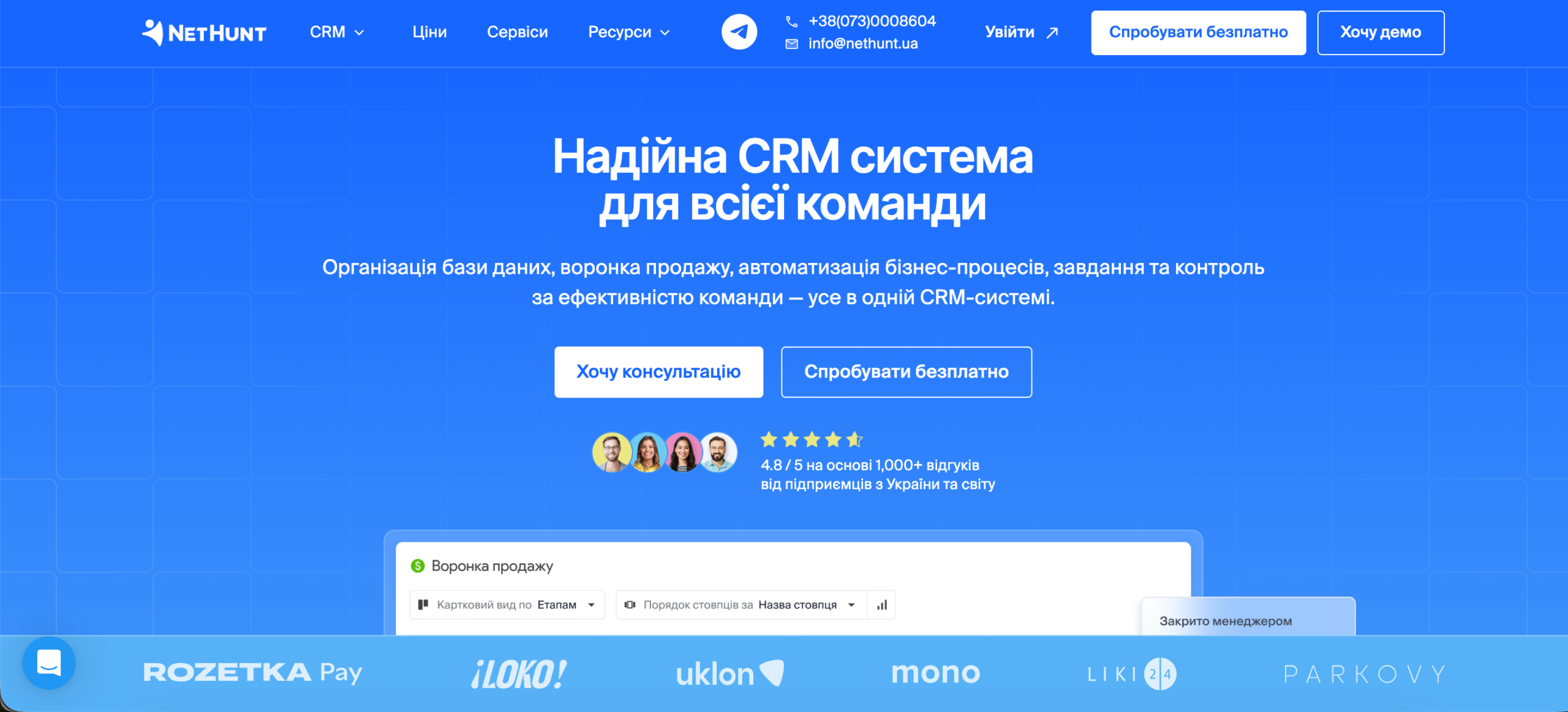
NetHunt CRM is a Ukrainian CRM system built around Gmail and Google Workspace. This cloud-based solution allows businesses to automate sales, organize customer databases, generate analytics, and launch email campaigns.
NetHunt is a modern CRM that addresses all key business needs—from customer management to process automation and analytics. It is ideal for companies in sales, service industries, healthcare, logistics, manufacturing, and HR. With integration with Gmail and Google Workspace, flexible customization options, and Ukrainian language support, NetHunt CRM is an optimal choice for businesses looking to work systematically, securely, and effectively.
The system features an intuitive interface, can be configured without developers, and allows quick adaptation to changes in business processes.
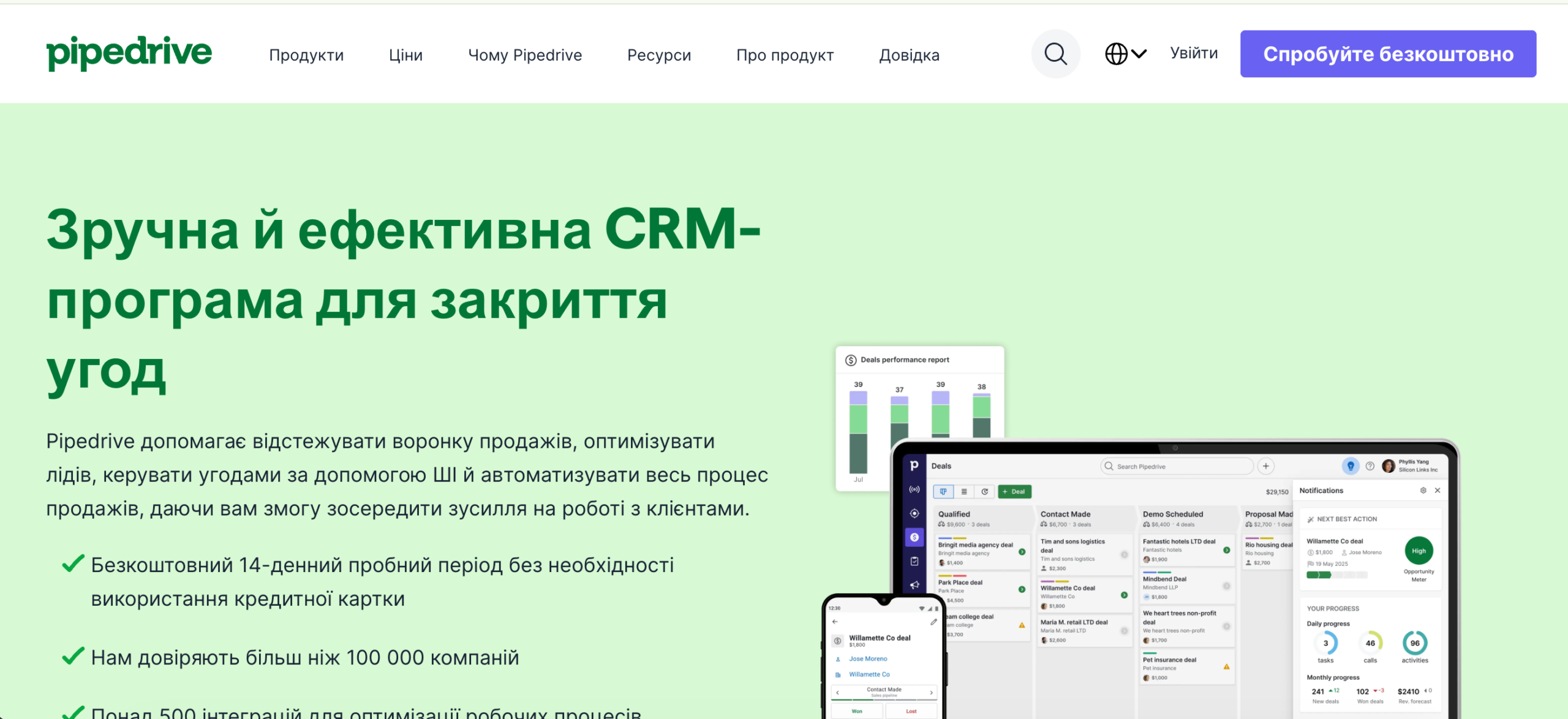
Pipedrive, the winner of the 2017 Expert’s Choice Award, has become one of the top CRM software providers. After thorough testing of all the popular solutions on the market, a team of experts identified Pipedrive as the most efficient system for managing sales pipelines. This applies to both suppliers and companies in their early growth stages.
Pipedrive offers a wide range of features, making it an indispensable tool for businesses. The CRM’s strengths include a focus on quickly closing deals, clear lead categorization, flexible settings, detailed statistics and reporting, and mobile optimization.
Pricing starts at $19 per month.
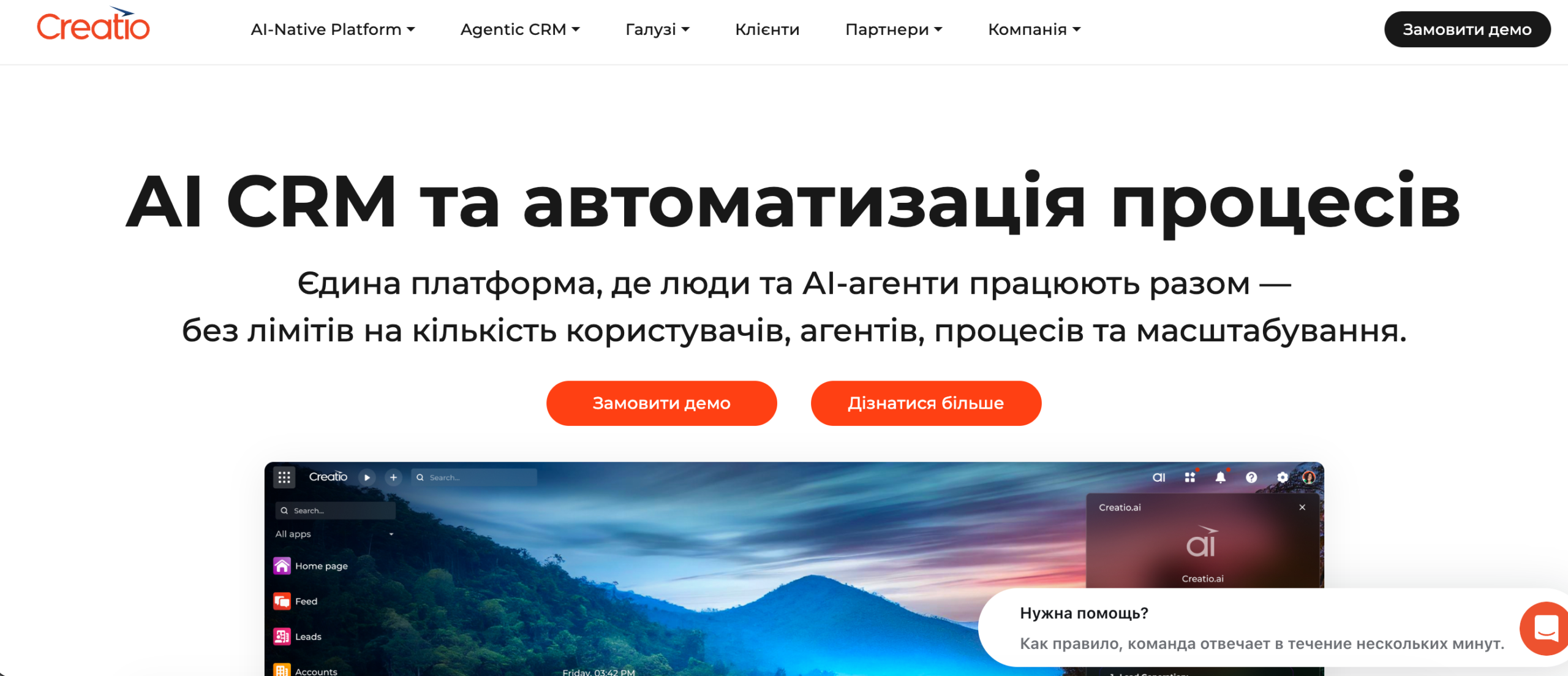
Creatio is a cloud platform for customer management that ranks among the top CRM systems. It optimizes and integrates key business processes for large and mid-sized companies. Unlike traditional CRMs, it combines customer relationship management (CRM) with business process management (BPM).
The platform’s developer, Terrasoft, offers three main products for different areas: Sales Creatio to optimize sales processes, Marketing Creatio to enhance marketing campaign effectiveness, and Service Creatio to improve customer service quality.
In addition, Studio Creatio allows for the rapid creation of new business processes and turnkey solutions. The platform also provides access to dozens of ready-made solutions for various industries in its online Marketplace catalog. Its advantages include an intuitive interface, smart technology, and the flexibility for customization and additional configurations.
The platform starts at $25 per user per month.
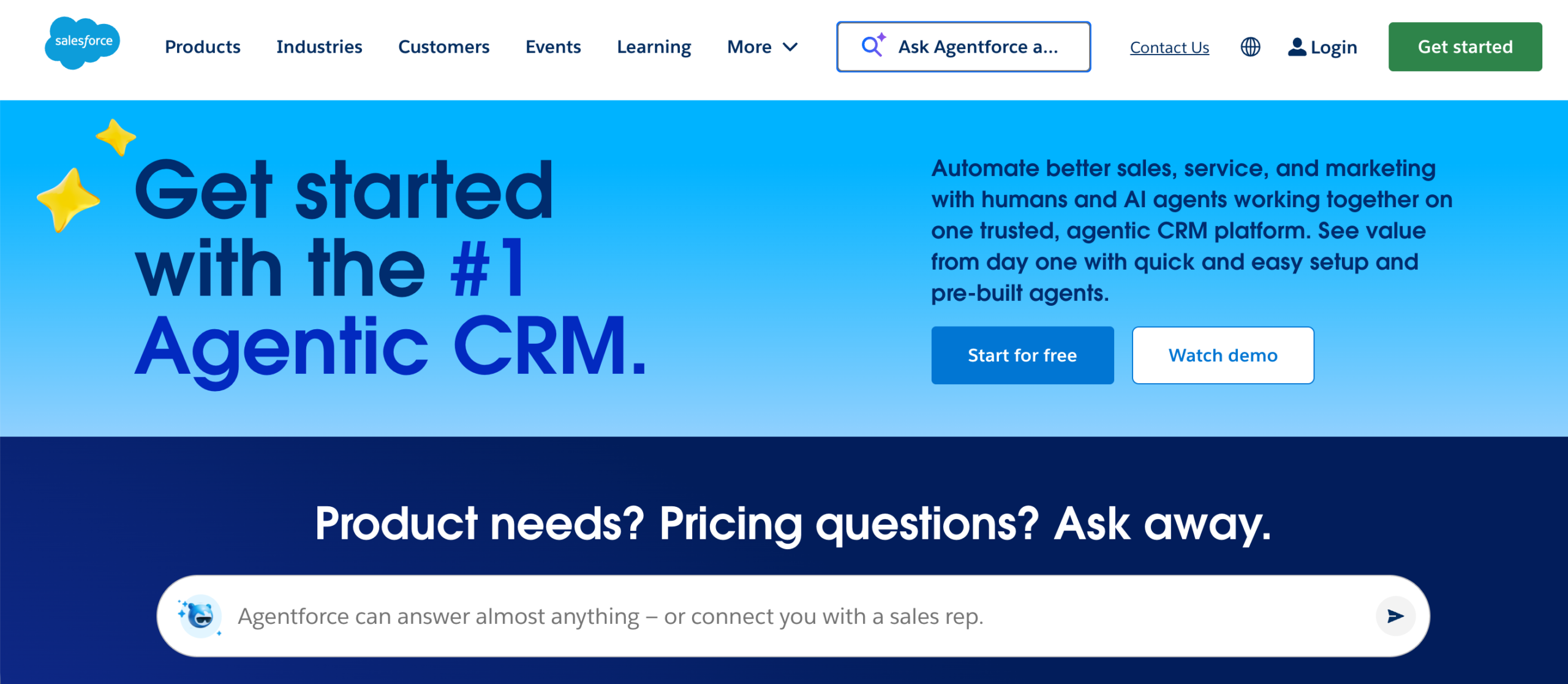
Salesforce is a cloud-based CRM platform that helps companies of all sizes manage customer relationships, automate sales, marketing, and customer service processes, making it ideal for companies of any scale.
Salesforce features a user-friendly interface and automates many routine tasks, such as handling incoming calls, sending commercial proposals, and tracking customers and deals. The CRM platform’s benefits include detailed analytics and reporting. It integrates with other popular systems such as telephony, email marketing, and accounting software. Salesforce is continuously updated with new features and capabilities.
Pricing starts at $80, depending on the chosen package.
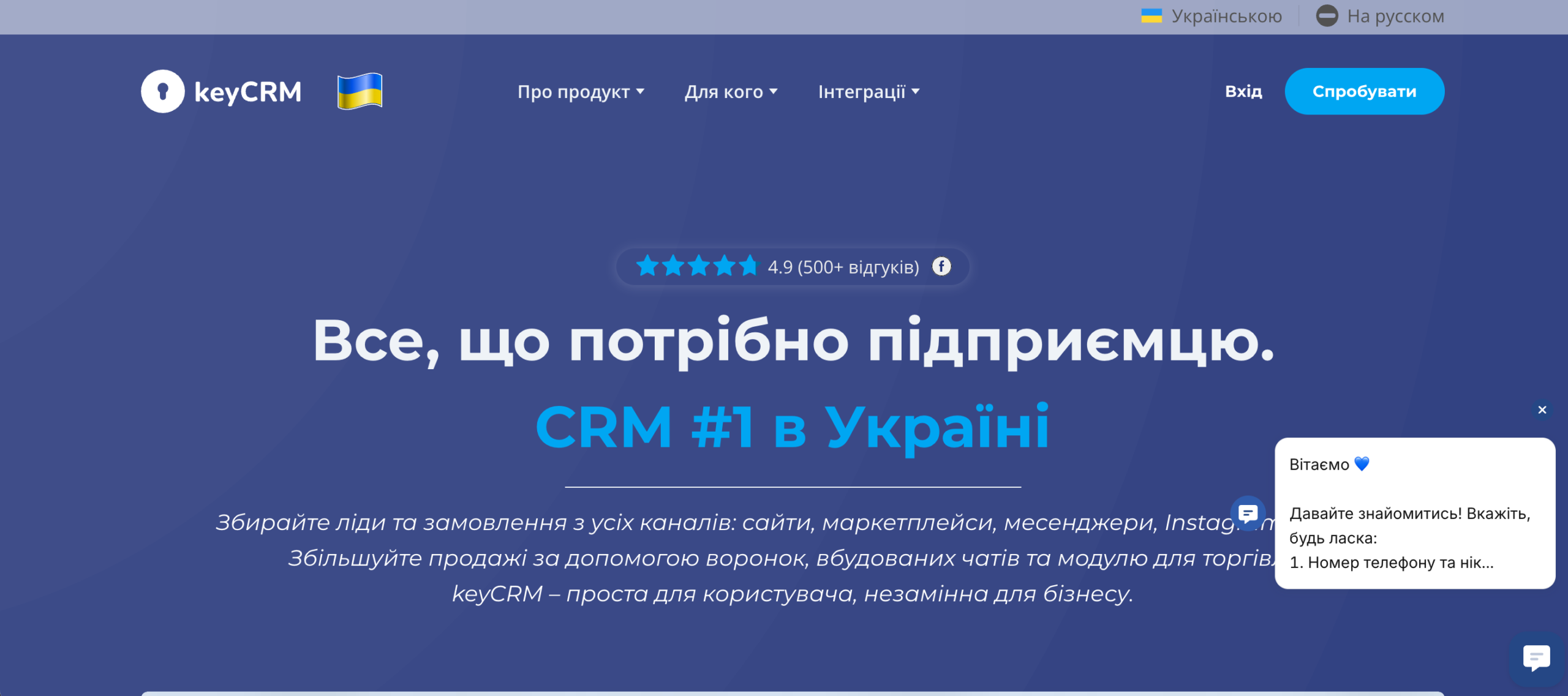
KeyCRM is a Ukrainian cloud-based CRM system designed for e-commerce, social media sales, and marketplaces. It brings together customers, orders, conversations, payments, and logistics into a single interface, helping businesses organize large volumes of incoming requests.
The system centralizes all communication channels – Instagram, Facebook Messenger, Telegram, Viber, email, and telephony – and stores a complete history of customer interactions.
KeyCRM offers a convenient set of tools for managing orders and products, including a product catalog, inventory tracking, payment statuses, and integrations with delivery services and marketplaces. The CRM automates routine processes, reducing manual work and minimizing manager errors.
Key advantages include a simple interface, fast implementation without complex setup, flexible sales pipelines, and clear analytics by orders, managers, and sales channels. It is well suited for small and medium-sized businesses scaling their online sales.
Pricing starts at approximately $19 per month. The cost depends on the order volume, while the number of users is unlimited.
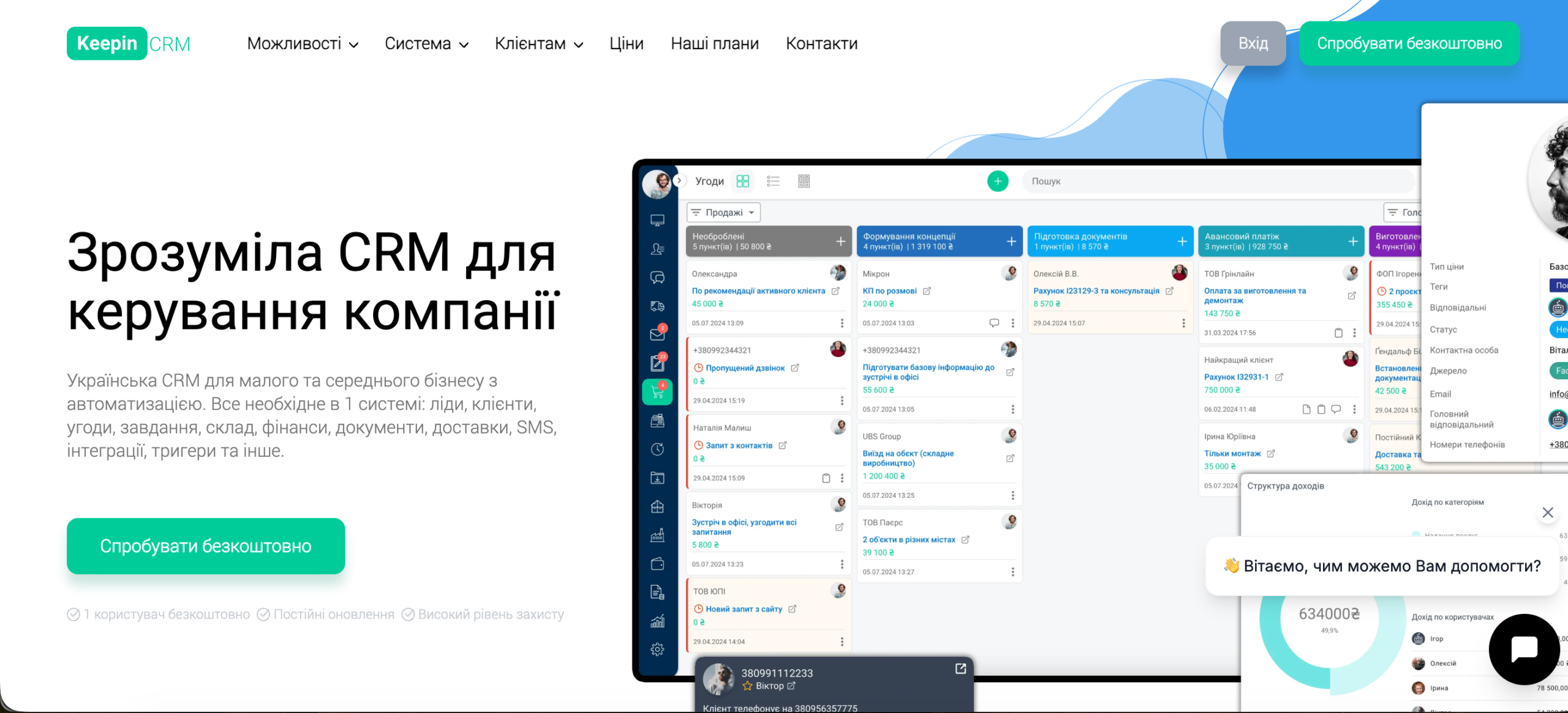
KeepinCRM is an easy-to-use yet powerful CRM system that automates and integrates all business processes into a single interface.
It includes essential features for working with leads, customers, and sales, including multi-sales funnels. The system also offers tools for managing finances, logistics, and document workflow.
This sales CRM system is constantly updated and offers a flexible pricing policy. Its advantages include process automation with triggers, integration with popular services, and the ability to manage business operations from different websites in a single, centralized interface. KeepinCRM is an effective tool for optimizing business processes for small and medium-sized companies.
The first user gets access to the full functionality for free, while each additional user will pay 250 UAH per month.
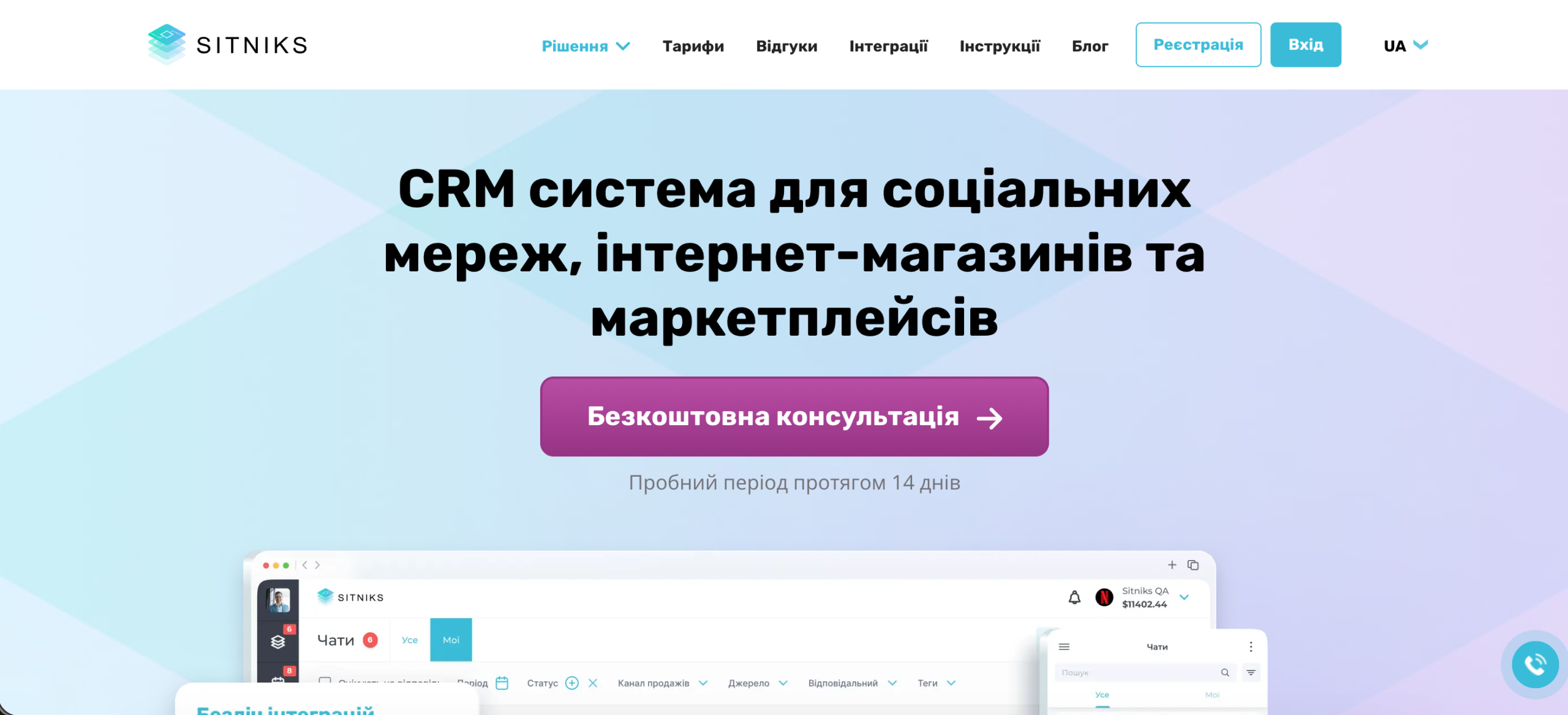
SITNIKS CRM is a Ukrainian CRM system for small and medium-sized businesses with a full-featured mobile application that unifies sales, communication, and operational processes in a single platform.
The system centralizes orders from Instagram, Facebook, TikTok, Telegram, Viber, WhatsApp, websites, and marketplaces such as Prom.ua and Rozetka, allowing businesses to manage all sales in one workspace.
SITNIKS CRM is designed for online stores, e-commerce, and dropshipping businesses and includes a full-featured inventory system, logistics management, custom sales funnels, and payment and financial management.
The platform has 100+ integrations, including telephony systems such as Binotel, Ringostat, and Phonet, CMS platforms like WooCommerce, Shopify, and Horoshop, as well as delivery services Nova Poshta and Ukrposhta, and others.
The system includes its own payment module, SITNIKS Pay, which allows sending a payment link in one click, automatically records payments in the CRM, supports automated fiscalization via Vchasno.Kasa and Checkbox, and increases payment conversion rates up to 87% without manual verification.
“Implementing a CRM successfully can increase sales by 29%, improve sales efficiency by 34%, and boost sales forecast accuracy by 42% .”
Which CRM system is the best? If you’re selling products or services to other businesses (B2B), you need a CRM that can handle long sales cycles, complex deals, and a large number of contacts. Look for systems with project management features, marketing automation, and sales analytics.
If you’re selling directly to consumers, you’ll need a CRM to manage a high volume of contacts, automate marketing campaigns, and deliver personalized service. Consider systems with built-in social media management, email marketing, and chatbot capabilities.
For e-commerce, choose a CRM that integrates seamlessly with your online store and helps you manage orders, customers, and delivery. Opt for modern CRM systems with inventory management, payment processing, and sales analytics functions.
For small and medium-sized businesses, it is crucial to find the right balance between functionality, cost, and ease of implementation. At this stage of growth, companies rarely need complex enterprise solutions with dozens of modules and lengthy setup processes.
The best choice is usually a CRM system that helps organize customer data, manage sales pipelines, automate routine tasks, and monitor team performance without significant investment. Popular options for small and medium-sized businesses include KeyCRM, KeepinCRM, NetHunt CRM, and SITNIKS CRM. These platforms offer affordable pricing, user-friendly interfaces, and the flexibility to scale as the business grows.
When choosing a CRM, it is important to consider not only your current business needs but also your future growth plans. A good system should easily adapt to new processes and support integrations with telephony, messengers, marketplaces, and other business tools.
Large organizations require CRM systems capable of handling significant volumes of data, supporting complex business processes, and providing a high level of automation. For such companies, flexible customization, advanced analytics, multi-department management, and enterprise integrations are essential.
Salesforce and Creatio are among the most popular CRM solutions for large businesses. These platforms help automate sales, marketing, and customer service processes, create sophisticated customer journeys, and provide detailed analytics across every stage of the sales funnel.
When selecting a CRM for a large enterprise, companies should evaluate not only licensing costs but also implementation, employee training, and ongoing support expenses. However, when implemented correctly, these systems can significantly improve operational efficiency, strengthen process control, and increase profitability.
Now you understand that choosing a CRM system isn’t just buying software — it’s a strategic decision that requires understanding business specifics, proper configuration, and professional implementation. By studying ratings and comparisons, you can navigate the variety of solutions, but achieving real results requires expert support at all implementation stages.
“Raketa Prodazh” specializes in comprehensive turnkey CRM implementation: we don’t just consult on system selection, but conduct deep analysis of current processes, select optimal solutions for your budget and tasks, configure personalized sales funnels, automate all routine processes, integrate CRM with existing company tools, train your team for effective system operation, and create ongoing quality control systems. Our methodology includes creating documented business processes, CRM performance evaluation checklists, regular analytics and reporting systems, plus personalized recommendations for each employee’s development.
Over 8+ years, we’ve implemented CRM in 208+ companies across various industries, our clients achieve an average revenue increase of +35%, and research shows that successful CRM implementation can increase sales by 29% and improve efficiency by 34%.
Among our clients are companies like Mitsubishi and Lotana Distribution, which dramatically increased their revenue through systematic CRM implementation approaches. Don’t waste time experimenting with unproven solutions.
A CRM system should solve specific problems and improve the performance of your sales department. So, before you invest, clearly identify what you need from your CRM.
Research each platform, read CRM reviews and comparisons, check out user feedback, and conduct test drives. Identify which features are critical for you and which are secondary. Don’t hesitate to invest more in a system that meets your requirements — it will pay off.
Implementing a CRM is a change, and changes can be intimidating. Involve your team in the integration process and explain how it will help them outperform competitors. With a CRM, they’ll always have access to all customer and deal information right at their fingertips. Offer incentives to those who quickly learn the system and fill the database with data. Turn CRM adoption into a competition.
Remind your sales team that using the CRM will soon be mandatory, so it’s better to get familiar with it now and be the first to master it.
The sales development consultant at “Rocket Sales” is always ready to help you establish effective sales processes and integrate a CRM into your business operations. We’ll analyze every aspect of your sales and identify what’s missing for top performance, where revenue is being lost, and which processes are holding back your sales department. We’ll create a motivational system, conduct sales manager training, and teach your team to sell like true professionals.
If sales aren’t “taking off,” don’t waste time and money — reach out to our experienced team for a consultation. Your system may need some fine-tuning and adjustments.
Kateryna Chabanova
When selecting a CRM for a small business, focus on simplicity, affordability, and real functionality. If you’re just starting out, avoid overcomplicated systems with features you won’t use. Instead, prioritize a tool that’s easy to learn, easy to customize, and actually helps you sell. Key criteria include:
Fortunately, there are several well-designed CRM systems on the Ukrainian market that are truly built with sales in mind. Here are some of the top options worth considering:
If you want your CRM to do more than just store customer data — and actively engage with clients — you need a system with built-in marketing automation. Here are two strong options:
Creatio – A robust CRM designed to manage customer relationships and key business processes. It empowers your sales and marketing teams to quickly build workflows and ready-to-use solutions. Standout features include an intuitive UI, AI-driven capabilities, and high flexibility for customization and personalization.
B2B and B2C sales operate in completely different ways — and your CRM should reflect that. It’s essential to choose a system that lets you tailor your sales funnel to match your specific processes. Here are a few CRMs that offer this flexibility:
Data is power — but only when it’s up to date. If you want to track performance in real time and visualize results clearly, choose a CRM system with built-in analytics capabilities. Here are some top options: