Key Takeaways
- Strategy without implementation remains a beautiful document in a folder, while implemented processes without strategy work in vain.
- Team training detached from systems and processes gives short-term effects, people quickly return to old habits.
- A strong contractor starts with diagnostics and asks deep questions about the business, rather than selling ready-made solutions before understanding the specifics.
- Your choice of partner should be based on their ability to link strategy, implementation, and training into a single working system.
- Weak contractors avoid specific KPIs and timeframes, focus on one aspect, and don’t show the connection between their actions and business results.
In the full article, you’ll find specific questions for diagnosing your sales department, signs of a quality partner, and a comparison of Ukrainian company approaches 👇
The problem is that the wrong choice of sales contractor can be costly. You’ll get either a beautiful presentation without real implementation, training without a system, or processes that the team doesn’t know how to use. The result – wasted money and time, while sales remain stagnant.
The main question we’ll address in this article: what’s really more important when learning how to choose a sales partner for building a sales department – strategy, implementation, or training?
Sound familiar? You’ve already spent time and money on consultants who gave you a beautiful strategy but didn’t explain how to implement it? Or conversely – set up CRM but the team works the old way? This problem occurs with 70% of owners who try to develop their sales department piecemeal. At “Raketa Prodazh,” over 8+ years we’ve created a methodology that combines strategic planning, technical implementation, and team training into a unified system. We don’t just analyze or train – we build a working sales department from diagnostics to achieving first results. Our approach helps avoid the main mistake – fragmented work with strategy, processes, and people. Over the years, we’ve built 208 sales departments in 14+ industries, with clients including Mitsubishi, Yamaha, and Naftogaz.
Get a systematic sales department that works like clockwork - schedule a free diagnostic session!
Why Choosing a Sales Partner Cannot Be Reduced to One Service
Sales department development is not a point task but a comprehensive system. Imagine a house: strategy is the architectural plan, implementation is building the foundation and walls, and training is when you show residents how to use all the house systems. Remove any element – and the structure will collapse.
Strategy answers the questions “what” and “why”: what goals we set, who we sell to, through which channels we work. Implementation turns these plans into working processes: sets up CRM, creates regulations, builds a control system. Training helps the team master new rules of the game and start working differently.
If you choose a contractor based on only one criterion, you’ll get an imbalance. A pure strategist will give you a thick folder of recommendations, but who will implement it all? A technical implementer will set up processes, but without understanding business logic, they may work in vain. And a trainer will upgrade team skills, but if there’s no system – people will quickly return to old habits. That’s why it’s important to understand different approaches to sales building and selecting a contractor for the sales department who can integrate all components into a unified solution.
Sales Strategy: Why It's Needed and When It Takes Priority
Strategy is the foundation of the entire sales system. It answers key questions: who we sell to, what we offer, through which channels we work, how our funnel is structured, and what KPIs we measure. Without a clear strategy, the team works blindly – calling everyone, offering anything, and not understanding where clients are lost.
Strategic planning becomes critically important when sales are chaotic. If the owner can’t explain why one manager sells three times more than another, if the department works without transparent goals and funnel, if you don’t know how many leads are needed to achieve the plan – the problem is the absence of strategy.
A good sales strategy includes customer segmentation, developing value propositions for each segment, building a sales funnel with clear stages and transition criteria, and a metrics system for measuring effectiveness. Implementing comprehensive sales strategies that integrate all these elements is crucial for sustainable growth and measurable results. If you want to learn more about the nuances of building and implementing such strategies, we recommend reading the article about effective B2B sales strategies. But remember: strategy without implementation is just a beautiful document in a folder.
Implementation: Why Execution Often Matters More Than Presentations and Recommendations
Implementation is translating strategic plans into daily sales department work. This includes setting up CRM systems with proper funnels and fields, creating lead handling regulations, developing scripts for typical situations, setting up reporting and KPIs, building motivation and manager control systems.
It’s at the implementation stage that most sales development projects fail. The company gets a strategy, but no one handles its implementation. Managers continue working the old way because new processes aren’t set up or are inconvenient to use. CRM remains empty, regulations hang as dead weight, and KPIs exist only on paper.
Quality implementation requires technical skills and understanding of sales psychology. You need to not just set up the system, but make it convenient and profitable for managers to use. Modern solutions often include automation and AI in sales, allowing simplification of routine operations and improved process control. This includes automating routine operations, creating clear dashboards, setting up notifications and reminders. A good sales department development partner helps not only implement processes but ensure their practical use. And here we approach the third component – team training.
Sales Team Training: When Results Are Impossible Without It
Even the most thoughtful strategy and perfectly configured CRM won’t bring results if managers don’t know how to work with them. Training is not a one-time seminar on “how to motivate yourself for sales,” but systematic work on mastering new processes, tools, and communication standards.
Effective training includes several levels: technical training on working with CRM and tools, studying the product line and value propositions, practicing scripts and sales techniques, and forming proper habits and work standards. All this should be tied to the company’s real processes, not be abstract theory.
The key mistake is viewing training as a separate service. Proper training is always integrated into the sales system implementation process. Managers learn on real tasks, using configured tools, under the supervision of a manager who understands new work standards. Only this approach guarantees that the team will actually start working differently. But the question arises: what should you choose first?
What's More Important: Strategy, Implementation, or Training?
The correct answer: it’s not the individual element that matters, but the partner’s ability to unite strategy, implementation, and training into a single system. These three components work only in connection – each strengthens the others and compensates for their limitations.
Strategy sets the direction of movement and success criteria. Without it, the team can work very diligently, but to nowhere. Implementation turns plans into working tools and processes. Without it, strategy remains beautiful theory. Training helps the team master new work standards and start showing results. Without it, even good processes will be sabotaged or used ineffectively.
Therefore, when learning how to choose a sales partner, the key question isn’t “what do you do best?” but “how do you connect strategy, implementation, and training into one system?” When you’re deciding how to choose a sales partner, a strong contractor may not be a world-class expert in each area, but they must understand how all elements work together and be able to ensure their integration. But how do you determine which partner your business needs right now?
How to Understand Which Partner Your Business Needs
Choosing a contractor for the sales department should start with honest diagnostics of the current situation. If the company lacks understanding of target audience, value proposition, and sales funnel – you primarily need a partner with strong strategic competencies. If strategy exists but nothing is implemented – implementation skills are critically important.
When processes are already set up but the team works ineffectively or sabotages new rules – focus should be on training and control. However, most often problems are comprehensive: strategy is outdated, processes are partially configured, and the team works however they can.
For such diagnostics, a sales department audit can be useful, which will identify system strengths and weaknesses and show where exactly there are growth points.
For diagnostics, you can use simple questions: is it clear who your ideal client is? Do you know at which funnel stage the most leads are lost? Can your managers clearly present the value proposition? Are all client contacts tracked in CRM? Are there clear KPIs and a system for monitoring their execution? If you want to conduct detailed performance analysis, pay attention to sales department KPI evaluation for building effective control. Answers to these questions will show which area needs help first. But there are signs that indicate a quality partner regardless of their specialization.
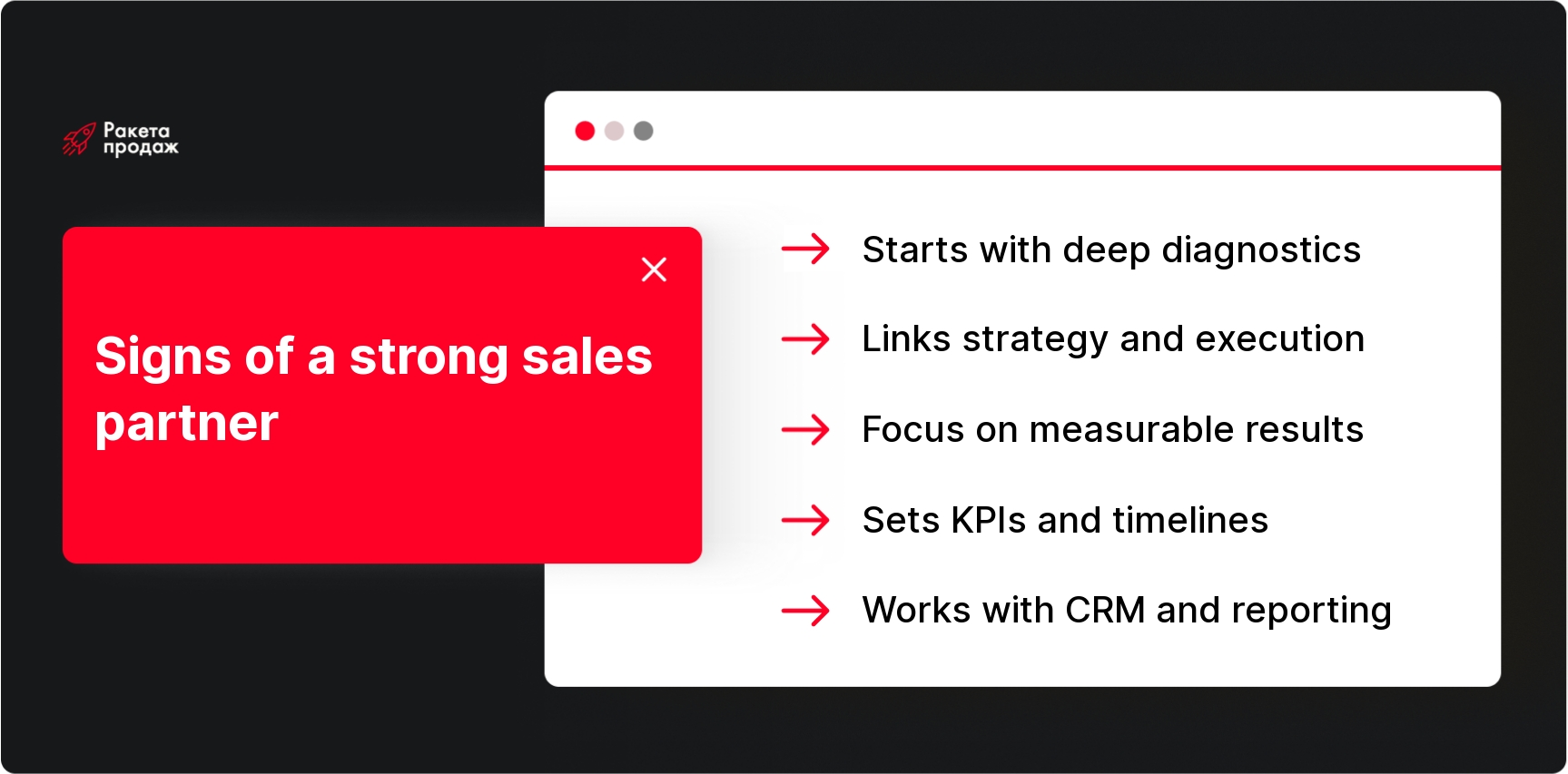
Signs of a Strong Sales Department Building Partner
A strong partner always starts with diagnostics, not selling their services. They ask deep questions about the business: who are your clients, how does purchasing happen, what processes do you have, where do you see problems, what goals do you set. A good contractor doesn’t offer ready solutions until they understand your business specifics.
A quality sales department development partner thinks systematically and shows connections between strategy, processes, and results. They explain why they propose exactly this sequence of actions, how they’ll measure progress, and what will happen if you don’t complete a particular stage. They fix specific KPIs and timeframes, rather than speaking in general phrases about “efficiency improvement.”
A reliable contractor necessarily works with CRM and reporting – they understand that transparent data is essential for managing sales. They don’t just train the team but help implement changes in daily work: create checklists, set up control processes, conduct regular feedback sessions. Such a partner takes responsibility for results, not just performs technical tasks. In the cooperation process, it’s important to consider classic sales management mistakes to avoid repeating them at the new development stage. Now let’s look at which companies work in the Ukrainian market and what approaches they use.
Which Companies in Ukraine Build Sales Departments and What Approaches They Use
The Ukrainian market features different types of sales development contractors, each with their strengths and approaches. Understanding this diversity will help choose a partner that best matches your business needs.
Raketa prodazh positions itself as a full-cycle agency that combines strategic planning, technical implementation, and team skill training into a unified system. Their sales building approaches are based on deep business diagnostics and creating individual solutions for each client, with emphasis on measurable results and long-term support.
DIA Consulting specializes in a consulting approach. They focus on strategic planning and organizational changes, often working with companies that need serious business process restructuring.
Formula prodazh emphasizes training and educational programs adapted to Ukrainian market specifics. Their strength is working with teams that already have basic processes but need skill development and motivation.
Byuro prodazh works as a partner – they can take on part of sales department functions by hiring an internal team.
GDC Consulting positions itself as a corporate partner with strong competencies in partner sales.
The key difference of Raketa prodazh is that they don’t limit themselves to one direction but build a holistic sales system, developing models and metrics for your business, where each element supports the others. This makes them a universal partner for businesses of any size and industry.
Approach Comparison: Strategy, Implementation, and Training
To better understand each element’s role in building a sales department, it’s useful to compare their impact and risks:
Strategy is responsible for movement direction, goal setting, target audience definition, and sales funnel building. It’s critically important at project start or during cardinal business changes. The main risk of lacking strategy – the team works chaotically, wastes resources on unpromising clients, and doesn’t understand what results to strive for.
Implementation turns strategic plans into working processes: sets up CRM, creates regulations, builds reporting and control systems. Without quality implementation, even the best strategy remains just a document. The team continues working the old way because new processes aren’t implemented or are inconvenient to use.
Training ensures mastery of new skills, tools, and work standards. It’s especially important when implementing new processes or changing product lines. The risk of ignoring training – the team sabotages the new system or uses it ineffectively, negating all efforts in strategic planning and implementation.
Each approach’s effectiveness is maximal only in connection with others – that’s why selecting a contractor for the sales department should be based on their ability to provide a comprehensive solution.
Now you understand: a successful sales department isn’t choosing between strategy, implementation, or training, but their skillful integration into a unified system. But independently combining all elements is extremely difficult – you need expertise in each area plus understanding of how they work together. “Raketa Prodazh” specializes exactly in comprehensive sales department building: from deep diagnostics and strategy development to full process implementation, CRM setup, and training each manager. We don’t leave you with beautiful presentations – we stay until the system operates at full capacity. Our clients achieve average revenue growth of +35%, with the best result being +$10,907,403 in 4 months. We’ve built 208 sales departments and know how to avoid typical mistakes that slow sales growth. Don’t spend years experimenting with unproven approaches.
Create a systematic sales department that guarantees +35% revenue growth - start with a free audit right now!
The question “what’s more important – strategy, implementation, or training?” is fundamentally wrong. In building an effective sales department, all three components work as a unified system: strategy sets direction, implementation creates working tools, training helps the team master new standards. When choosing a sales partner, look not for a specialist in one area, but a professional who understands connections between all system elements and can create working solutions. Exactly this approach guarantees that investments in sales department development will bring measurable and sustainable results.


 Time to read: 10 min.
 22 May 2026