icon

How Salespeople Management Differs from Managing Other Employees

If you’ve ever led a sales team, you know it’s a special world with its own rules. Sales management is not just another management function, but a separate profession requiring specific skills and approaches. Salespeople work under constant rejection, strict KPIs, and daily competition – creating a unique environment where standard management practices often fail.

Key Takeaways

  • Salespeople live in a world of tough KPIs and constant rejection, where administrative management style quickly fails.
  • Your task is to manage behavior, not tasks. A salesperson might know they should make 50 calls daily but only makes 20.
  • Weak leaders use only money as a motivator; strong ones add public recognition, excitement, and leaderboards.
  • Control in sales must be daily. Calls missed on Monday cannot be compensated for on Friday.
  • Feedback only works when delivered correctly: specificity plus support plus action plan, otherwise the salesperson will become defensive.

In the full article, you’ll find specific tools for building motivation, daily control, and feedback that will transform chaos into a system 👇

Unlike employees in other departments who can calmly complete assigned tasks according to a predetermined plan, salespeople must overcome customer resistance daily, deal with uncertainty, and maintain high emotional energy. For a manager, this means building a completely different type of leadership – more dynamic, motivating, and psychologically calibrated.

The features of sales department management lie in constantly balancing between demanding results and maintaining team morale. Let’s examine the key differences in approaches to salespeople management, the features of salesperson management that make this work so specific and challenging.

Salespeople Live in a World of Numbers, Goals, and Pressure

Imagine: an accountant can work calmly on documents, knowing they’ll receive their salary at the end of the month regardless of results. An IT specialist focuses on solving specific technical problems without constant concern about metrics. For salespeople, reality is completely different. Their work is measured by specific numbers: sales targets, call-to-meeting conversion, average check size, and final profit.

These indicators create constant pressure that other employees don’t experience. A salesperson can be on top on Monday after closing a major deal and in an emotional pit on Tuesday after a series of rejections. Such daily emotional swings require a special approach from the manager. You must simultaneously maintain a results focus while monitoring the team’s emotional state, preventing burnout.

Leaders coming from “calm” departments often make the same mistake: they try to apply an administrative management style to sales. They assign tasks, control their execution, and expect results as if salespeople were working with documents rather than live people. But this approach quickly fails because it doesn’t account for sales psychology and the emotional component of this work. To effectively control sellers, you need to understand that you’re working with a special category of employees who need a balance between strict requirements and support.

It’s critically important to implement effective control systems. For example, see how salespeople performance management works to see the relationship between employees’ daily activities and final results.

Salespeople Management = Behavior Management, Not Task Management

In a sales department, you manage people’s behavior, not tasks. These are fundamental features of salesperson management as opposed to managing other departments. An IT specialist might not know how to solve a problem, but if they know – they’ll solve it. With salespeople, things often work differently: they know perfectly well what needs to be done, but don’t do it.

A salesperson may understand perfectly that they need to make 50 calls daily, handle objections according to a specific scheme, and maintain the CRM system. But knowing this, they might continue calling only 20 clients, ignore scripts, and keep client data in their notebook rather than the shared database. Reasons vary from fear of rejection to simple laziness or disbelief in the effectiveness of suggested methods.

Have you wondered why salespeople so often ignore established processes? Even understanding they need to make 50 calls, maintain CRM, and follow scripts, many simply don’t do it. Managing salespeople’s behavior is a special competency requiring a systematic approach and specialized control tools.

At Sales Rocket, we’ve developed a comprehensive methodology for systematizing sales departments, including implementing a KPI system, quality call auditing, and creating an effective motivational model. Our quality control system allows not only tracking manager activity but also purposefully forming productive habits through regular feedback and personalized coaching.

During our work, we’ve implemented these tools in more than 158 sales departments across 14+ different niches, allowing our clients to increase turnover by an average of 35%. Instead of endless attempts to “reach” salespeople, you get a transparent and manageable system where each employee clearly understands their tasks and strives to complete them.

Transform salespeople management from a daily headache into a systematic process - order a free sales department audit right now!

Therefore, a sales department manager must focus on forming the right habits and behavioral patterns. This requires constant motivation, control of specific actions (not just results), regular feedback, and work with mindsets. Instead of simply saying “meet the target,” you must support and direct the process daily: control activity, correct behavior, encourage right actions, and create an environment where productive habits become the norm for every team member.

Salespeople Motivation Works Differently

image

Salespeople are the most motivation-sensitive employee category. While a programmer or designer might enjoy the process of work and product creation, for a salesperson, it’s not the process that matters but the result. And this result must be clearly linked to the motivation system.

Many managers mistakenly rely only on monetary motivation, believing that “money is the best motivator.” Indeed, financial incentives work better for salespeople than for many other specialists. A good salesperson wants to see a direct connection between their efforts and rewards. But money doesn’t work indefinitely. After a certain income level, its effectiveness as a motivator begins to decline.

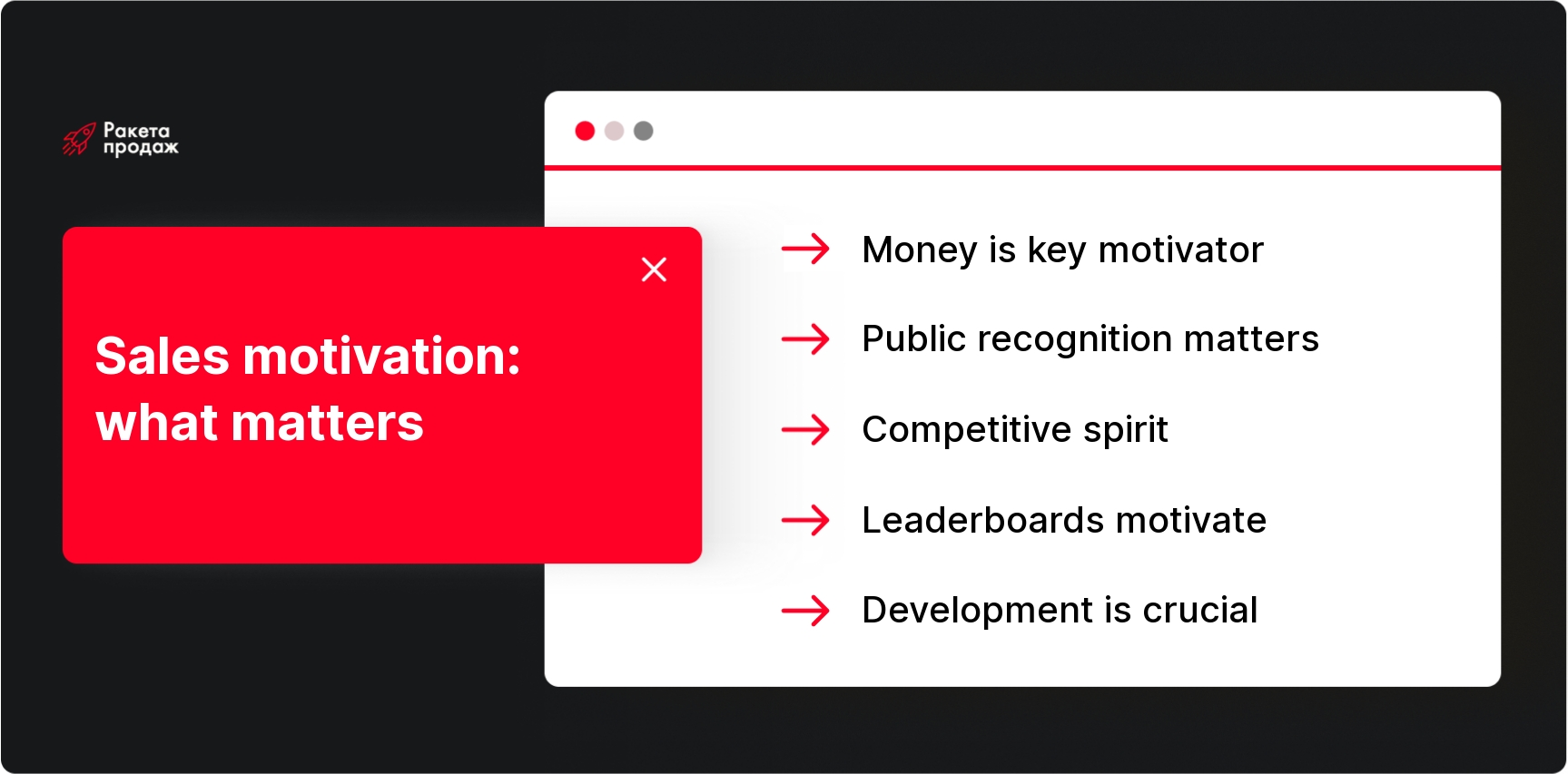
For salespeople, recognition, excitement, competitive spirit, and development opportunities are equally important. Leaderboards, where everyone can see their results compared to colleagues, often motivate more than just bonuses. Public recognition of achievements, even small ones, creates emotional uplift and desire to continue. Competitions and contests add a game element, turning routine work into an exciting process.

Learn more about modern approaches to sales department motivation in a separate article dedicated to non-standard tools for increasing team engagement.

How to motivate salespeople most effectively? The key principle: find balance so motivation doesn’t turn into team “overheating.” Constant pressure can lead to burnout even for the most resilient salespeople. The optimal approach is a combination of short-term incentives (bonuses for current results) and long-term perspectives (career growth, competency development, stability). Such multi-level motivation helps maintain salespeople’s enthusiasm in any market situation.

Control and Reporting in Sales Must Be Daily

In project departments, such as development or marketing, control usually happens weekly or even less frequently. The team receives a task, works on it, and shows results at the end of the period. In sales, this approach doesn’t work – control must be daily.

Sales is a process with a fast cycle where every day matters. If a salesperson doesn’t make planned calls on Monday, it’s impossible to compensate on Friday – missed opportunities simply disappear. Therefore, experienced sales team management professionals implement the principle of “daily sales rhythm” – a clear system for controlling key activity indicators: number of calls, meetings, presentations, conversion at each funnel stage.

How to control sellers effectively without slipping into micromanagement? It’s important to create a system of daily rituals: morning meetings for setting daily goals, evening summaries, individual check-in sessions with each salesperson. These regular contact points help maintain team focus and timely correct deviations.

In this process, implementing CRM systems for sales often becomes a key tool, allowing for transparency and operational monitoring of salespeople’s daily actions.

In this context, a CRM system becomes not a punishment tool but a means of conscious control. When salespeople understand that the manager uses data not to find the guilty but to analyze the process and help the team, they begin to see CRM as an ally, not an enemy. It’s important to explain to the team that data transparency is primarily needed for themselves – to understand their strengths and weaknesses, and for objective evaluation of results.

Emotional Dynamics of a Sales Team

Salespeople face rejection and customer resistance daily. Even the most successful sales specialists hear “no” more often than “yes.” This constant confrontation with negativity creates a specific emotional dynamic that doesn’t exist in other departments.

Emotional swings – from euphoria after a large sale to disappointment after a series of rejections – require special skills from the manager. You need to be an emotional stabilizer for the team: maintain fighting spirit during difficult periods, help deal with failures, and prevent emotional burnout.

Emotional intelligence skills and practical psychology are critically important for this. The manager must be able to recognize the first signs of demotivation or fatigue in each team member and respond promptly. Sometimes a simple one-on-one conversation is enough; in other cases, a temporary workload reduction or task change may be required.

A big mistake is ignoring salespeople’s emotional state, considering it “unimportant” against numbers and plans. In practice, emotional burnout can quickly lead to declining results and even loss of valuable employees. The ability to maintain team psychological resilience is one of the key competencies of a successful sales team management professional. Investments in salespeople’s psychological comfort pay off with stable results and low staff turnover.

In this regard, it’s worth paying attention to developing team culture so that emotional support becomes part of the department’s daily work.

Feedback: Salespeople Perceive It Differently

Feedback is a critically important tool for developing salespeople. But it only works when delivered properly. Unlike technical specialists who may perceive criticism as pointing out a work error, salespeople often take it personally. In sales, results directly depend on personal qualities and communication skills.

When improperly delivered, feedback causes defensive reactions and resistance in salespeople. They start making excuses, offering counterarguments, or simply internally reject criticism. The result is conflict instead of growth or, worse, apparent agreement with internal rejection.

For feedback to work as a growth tool rather than demotivation, it’s important to follow a specific formula: specificity + support + action plan. Instead of general phrases like “you handle objections poorly,” use specific examples from recent client conversations. Always note the salesperson’s strengths and successes to create a positive context for criticism. And conclude with a specific action plan – exactly what needs to be done differently.

Criticism without teaching kills results. If you point out a problem but don’t show the path to its solution, the salesperson is left alone with their weaknesses. Therefore, each feedback session should include a learning element: show exactly how to work, model the right approach, give the opportunity to practice in a safe environment. Such constructive feedback becomes a powerful tool for developing and motivating salespeople.

Salespeople Management Requires Continuous Training

The sales world changes at dizzying speed: new products appear, customer behavioral patterns change, familiar scripts and techniques become outdated. Without regular training and development, even the strongest sales team quickly begins to degrade.

Unlike other departments where training can happen periodically, in sales it must be a continuous process. The manager is responsible for making development part of team culture, not a one-time event. Regular training, work on specific skills, case studies, learning new methodologies – all this should happen systematically.

It’s important to understand that salespeople learn predominantly through practice, not theory. You can talk for hours about cold calling techniques, but real progress will only happen after the salesperson applies these techniques in live conversations and receives feedback. Therefore, effective salespeople training is always a combination of theory, practice, and immediate application of new skills at work.

If you want to build a working qualification improvement system, pay attention to experienced sales manager training methodologies: how to integrate training into daily processes and make development a regular part of department life.

Managing a sales team requires the manager to implement a system of weekly training or masterminds where the team can jointly analyze difficult cases, exchange experiences, and practice skills. Individual coaching sessions where you can work with specific challenges of each salesperson become an additional tool. This approach ensures constant growth of competencies and maintains a culture of continuous development.

Communication: Salespeople Require More Energy and Attention

Communication with a sales team has its specifics. Many salespeople are natural extroverts; dynamics, energy, and live communication are important to them. They become demotivated faster in “quiet” offices with minimal social interaction.

A sales department manager needs to be able to adapt to the “team pulse,” creating an atmosphere that energizes and motivates. This means more energetic and emotionally rich planning meetings, frequent individual conversations, and an open, direct communication style.

It’s important to understand that managing salespeople through letters and reports is simply impossible. This category of employees critically needs live communication where they can see your reaction, ask questions, and receive immediate feedback. Even in the remote work era, salespeople need opportunities for regular interaction – video calls, online meetings, virtual team activities.

Planning meetings for salespeople should be short, dynamic, and specific. Instead of long theoretical discussions, focus on clear goals, concrete steps, and quick wins. One-on-one meetings with each salesperson help maintain personal connection, identify problems in a timely manner, and work with individual motivation.

Consider the importance of individual approach to each person: modern methods of personalized approach in sales allow achieving greater engagement and understanding the motives of different employees in your department.

Properly structured communication creates an atmosphere of trust and support in the team, where salespeople feel heard and valued. This directly affects their motivation, loyalty, and ultimately, sales results.

Managing Other Employees is About Process, Salespeople - About Results

In classical departments (accounting, production, IT), the principle applies: if you build the process correctly and follow it, results will appear automatically. In sales, this logic often works in reverse: results are primary, and process is just a means to achieve them.

This fundamental difference changes the entire management paradigm. In technical departments, the manager can focus on optimizing processes, creating clear instructions, and controlling their execution. In sales, you constantly have to balance between strict result orientation and controlling key process elements.

On one hand, salespeople need certain freedom in choosing approaches to clients – too rigid regulation kills creative potential and ability to adapt to different situations. On the other hand, without controlling basic activities (number of calls, meetings, presentations), it’s impossible to guarantee stable results.

Successful sales department managers build balance by clearly defining “inviolable” process elements that must always be observed (CRM maintenance, minimum activity, adherence to pricing policy) and areas where salespeople are given freedom (individual approach to customers, presentation style, personal time management). This approach maintains the necessary level of control without killing initiative and the team’s creative potential.

Conclusion

Salespeople management is a special managerial discipline that cannot be mastered simply by following standard management textbooks. Salespeople truly differ from other employees: they work under constant stress, emotional swings, and strict result linkage. This requires specific skills and approaches from the manager.

The main competency of a sales department manager is the ability to manage people’s behavior through proper motivation and creating meaning. You must not just demand plan fulfillment, but build a system that naturally leads salespeople to the right actions and results. This is a complex task requiring deep understanding of psychology, communication skills, and emotional intelligence.

Don’t try to copy other managers’ styles or apply universal approaches. Build your own influence system, considering the specifics of your product, market, and team. Remember: a good sales department manager is not just a manager, but a leader, trainer, and psychologist in one person.

Effective salespeople management is indeed a separate managerial discipline requiring specific skills and tools. As we’ve seen in the article, salespeople need a special approach to motivation, control, and communication. But implementing these principles on your own can be complicated and time-consuming.

“Sales Rocket” offers a comprehensive solution for building a systematic sales department “turnkey.” We don’t just consult but fully implement business processes, regulations, scripts, and automation tools adapted to your business specifics. Our methodology includes developing an individual KPI system, regular auditing of managers’ work, and personalized coaching for each salesperson.

“Sales Rocket” clients, including Mitsubishi, Yamaha, and NaftoGaz, note not only turnover growth (35% on average) but also significant conversion increases – from 5% to 86% depending on the niche. Importantly, managers optimize their time through the implementation of clear management reporting and control automation.

Don't spend years experimenting with salespeople management - trust this task to professionals who have already proven their approach's effectiveness in more than 158 companies!
In this article:
See more
Book a FREE sales funnel audit
CONTACT US
FAQ
What does "managing behavior, not results" mean?

It means focusing attention not on final numbers but on specific salesperson actions that lead to results. You control the number of calls, presentation quality, objection handling – the behavior that ultimately forms the result.

Why does salespeople motivation work differently than for other employees?

Salespeople respond more strongly to direct incentives and recognition than employees in other departments. It’s important for them to see an immediate connection between efforts and rewards. Moreover, not only money matters to them, but also status, competitive elements, and public recognition of achievements.

How do you give feedback to a salesperson without demotivating them?

Use the formula: specificity + support + action plan. Point to specific areas that can be improved, always note strengths and successes, and conclude with a clear plan on how to develop needed skills.

Why is salespeople management a separate profession?

Because sales requires a special balance between strict results control and psychological support. A sales department manager must simultaneously be a demanding manager, motivating coach, and emotional leader – this rare combination of qualities forms a separate professional competency.

SUBSCRIBE TO MY TELEGRAM CHANNEL
The most valuable sales information right on your phone!
icon

LOTS OF USEFUL INFORMATION, FREE TEMPLATES, AND CHECKLISTS ON MY INSTAGRAM

Materials and practical advice on sales growth in our blog: