icon

How to Hire a Strong Salesperson Faster Than Competitors

In 2024-2025, the job market in sales has transformed into a real competition for talent, and hiring a strong salesperson faster than competitors has become a new advantage for businesses. Good salespeople make decisions about new jobs in 1-3 days, not weeks like before. The reason is simple – crisis times, market changes, micro and macro economic factors, and of course, the shortage of professionals and high competition for them between companies.

Key Takeaways

  • Strong salespeople make decisions about new jobs in 1-3 days, not weeks; a slow hiring process automatically eliminates the best candidates.
  • Referral programs bring candidates who are 82% more likely to pass selection and stay with the company 38% longer compared to other channels.
  • Your interview should include a short sales simulation (10-15 minutes) instead of abstract questions, which immediately shows real skills.
  • Combining selection stages and reducing time between interviews to 24-48 hours allows you to stay ahead of competitors without losing quality assessment.
  • Weak companies take weeks to approve offers, strong ones make offers within 24 hours after the final interview and win the battle for talent.

In the full article, you’ll find a step-by-step algorithm of where to look for strong salespeople in 2025, what questions to ask in interviews, and how to avoid typical mistakes that cause candidates to go to competitors 👇

The most frustrating thing in this situation is losing an excellent candidate not because you weren’t a good fit for each other, but simply because of slow hiring processes. While you’re coordinating a second interview, the salesperson may already have received and accepted an offer from your competitor.

In this article, you’ll find specific tools to accelerate hiring without sacrificing quality. We’ll look at where to find strong salespeople in 2025, how to quickly assess their skills, what mistakes lead to losing candidates, and how to build a hiring process that allows you to stay ahead of competitors. Ready to act quickly? Let’s begin.

Why Hiring Speed Decides Everything

Just a few years ago, the standard sales hiring cycle took 20-60 days. A company could afford to conduct 3-4 interview stages, give a test assignment, and take time to think about the decision. Now such luxury is available only to companies with unlimited resources or those willing to accept constant rejections from the best candidates.

The market has accelerated to the limit. Top sellers receive 2-3 offers simultaneously and make decisions in a matter of days. According to research, 57% of candidates who go through more than three interview stages drop out of the process in favor of faster companies. This means that in a slow hiring process, you simply won’t see the best specialists – they will leave in the early stages.

The second factor is high competition between employers. One strong salesperson with proven results may have 5-7 active job offers. In such a situation, even a small delay in response or rescheduling an interview can cost you the loss of a candidate.

Instant decision-making has become the new norm. Salespeople are people used to quickly assessing situations and acting. They’re not willing to wait for weeks while a company decides if they’re suitable. Moreover, they see a long hiring process as a sign of the company’s overall sluggishness – “If they take so long to make hiring decisions, how will they respond to market changes?”

To win in this championship for talent, companies have to completely reconsider their approach to hiring. Let’s look at what exactly has changed in the salespeople market over the past year.

What Changed in the Salespeople Market in 2024-2025

The labor market in sales has undergone dramatic changes that are important to consider when building a hiring strategy. The most noticeable change is the acute shortage of strong specialists. According to recent studies, the number of sales vacancies increased by 28% over the year, but the number of qualified candidates increased by only 3%.

This has led to a real talent shortage. Strong salespeople with proven results have become a real “scarce commodity.” Companies actively poach them from each other, offering increasingly attractive conditions. The average salary of an experienced sales manager has increased by almost 20% over the past year.

The hiring cycle has been radically shortened. If previously the process from first contact to starting work could take 30-90 days, now successful companies have reduced it to 10-15 days. This is caused not only by competition but also by changes in candidate behavior. Strong salespeople receive many offers and aren’t willing to wait long.

In addition, salespeople’s requirements for potential employers have increased. They are no longer willing to agree to just a high salary. Factors such as lead quality, the company’s technological equipment, remote work possibilities, and a transparent motivation system are important to them. Research shows that 68% of salespeople would rather choose a company with a good reputation and moderate salary than a dubious business with high income promises.

Another important change is the growing importance of employer branding. Candidates actively research the company before even responding to a vacancy. They read reviews from former employees, check the company’s reputation on social media, and look at the activities of its leaders. A poor employer brand becomes an insurmountable obstacle to hiring.

These changes require a new approach to finding candidates. Let’s look at where you can find strong salespeople now.

Where to Find Strong Salespeople in 2025

Finding strong salespeople in 2025 requires using different channels simultaneously. You can’t rely on just one source – in conditions of staff shortage, it’s too risky. Here are the most effective search directions that provide quick responses and quality candidates.

Referral recruiting remains the absolute champion in effectiveness. Research shows that recommendations from your current employees bring candidates who are 82% more likely to pass all selection stages and stay with the company 38% longer. Salespeople often have a wide network of contacts and know other strong specialists. If you don’t yet have a working referral program with clear bonuses – now is the time to implement it.

Professional communities in social networks have become a powerful search channel. In Telegram channels dedicated to sales, strong specialists often appear looking for new opportunities. The same applies to specialized groups in other social networks. Unlike job sites, here you can find not only those actively looking for work but also those who are just exploring the market.

LinkedIn remains an indispensable tool for finding mid and high-level salespeople. This platform has a huge number of registered professionals who often don’t post resumes on regular job sites. It’s important to use LinkedIn’s advanced search functions – filtering by companies, positions, skills. Direct outreach to candidates through this network often gives excellent results.

Traditional job portals still work but require more effort to filter candidates. The large flow of responses often contains many irrelevant resumes. However, a well-crafted job posting with clear requirements can attract exactly who you need.

Industry events and conferences are another good channel for finding strong salespeople. Here you can see specialists in action, evaluate their communication skills, and build initial contact in an informal setting. Even if a person isn’t looking for work right now, such an acquaintance can lead to cooperation in the future.

If you’re thinking about how to find a good salesperson, it’s worth paying attention to specialized platforms for sales professionals. Specialists who purposefully look for new opportunities to develop their sales career often register there.

When considering how to find a good sales manager, remember that understanding modern requirements for forming your team will help you find the right specialists much faster. You can learn more about modern approaches to building a sales department in an article dedicated to how to build a strong sales department.

Now that we’ve identified the search channels, let’s figure out how to quickly select suitable resumes.

The speed of resume processing is becoming a critical success factor in hiring strong salespeople. The best candidates often receive offers within a few days of appearing on the job market. So how do you quickly find and properly evaluate potential employees?

The first thing to do is determine key success markers in a salesperson’s resume. This will allow you to quickly separate promising candidates from the rest. These markers include: specific performance figures (exceeding targets, sales growth in percentages), length of employment in companies (too frequent job changes can be a warning sign), career progress, and clear description of achievements.

Automation of initial screening has become a necessity, not a luxury. Modern ATS (Applicant Tracking Systems) can automatically analyze resumes and highlight candidates that meet your criteria. They look not only for direct keyword matches but also analyze the overall context and semantic meaning.

When evaluating a salesperson’s resume, special attention should be paid to specifics. A good salesperson usually precisely describes their results – not “increased sales,” but “increased sales by 43% in 6 months” or “attracted 17 new clients with a total contract volume of $5.2 million.” The more concrete the achievements are described, the more likely it is that you’re looking at someone who is used to working with results, not processes.

Another important criterion is stability in previous companies. Of course, turnover in sales is higher than in many other areas. But if a candidate changes jobs every 2-3 months, this may indicate problems with adaptation or inability to achieve results in the long term.

Finally, pay attention to career progress. A strong salesperson usually shows growth – from sales manager to senior manager, team leader, or direction head. This indicates that the person is not just performing their duties but is constantly developing and taking on more responsibility.

Need to quickly hire a strong salesperson? This feeling is familiar to 8 out of 10 business owners. While you’re reading this article, the best candidates are already considering offers from your competitors. At “Sales Rocket,” we’ve created a systematic approach to hiring and developing sales managers that allows you to reduce the hiring cycle to 10-15 days without losing quality. Over 7+ years, we’ve built 158 sales departments for small and medium businesses in various industries, including market leaders such as Mitsubishi, Naftogaz, Yamaha, and others.

Our approach includes not only recruitment but also creating all the necessary infrastructure: scripts, sales funnels, sales playbook, and onboarding plan for new employees. This allows your new managers to quickly achieve results and start generating profit. The average revenue increase for our clients is +35%, and in some cases, we’ve achieved a monthly turnover increase of $1.6 million in just 4 months of work.

Stop wasting time and money on ineffective recruiting - get a systematic approach to hiring from experts!

Social Networks as an Accelerated Hiring Channel

Social networks have become one of the most effective tools for quickly finding strong salespeople. They provide a unique opportunity not only to find candidates but also to assess their real skills before the first interview. A modern salesperson often leads an active professional life on social networks, which allows you to see how they communicate, what knowledge they possess, and how developed their self-presentation skills are.

LinkedIn has become a gold mine for finding professional salespeople. The platform offers advanced search with many filters that allow you to precisely identify suitable candidates. You can search for people by current and former companies, industry, position, skills, and even by activity on the platform. For example, a salesperson who regularly publishes professional content or participates in industry discussions demonstrates an active position and expertise.

When searching through LinkedIn, it’s important to craft the right first message. General template invitations receive significantly fewer responses than personalized approaches. Mentioning specific details from the candidate’s profile, explaining why your offer might be interesting, and clearly describing the next step significantly increases the chances of a response.

Telegram has become another important channel for finding salespeople. Strong specialists often appear in professional chats and channels looking for new opportunities. Telegram’s advantage is in communication speed – people respond much faster here than on traditional platforms. You can quickly conduct preliminary screening right in the messenger and schedule an interview within a few hours.

An important aspect of working with social networks is the ability to check a candidate’s “digital footprint.” Publications, comments, activity in professional groups can tell a lot about a person. For example, a salesperson who regularly shares cases or helps others solve professional problems demonstrates not only expertise but also customer orientation.

For maximum effectiveness when working with social networks, it’s recommended to use automation tools. There are services that help find contacts based on specified criteria, send personalized messages, and track responses. This significantly speeds up the process of initial contact with potential candidates.

If you’re thinking about how to hire a sales manager through social networks, special attention should be paid to checking potential candidates’ activity in professional groups and discussions. This can give you an idea of their expertise and approach to solving business problems.

However, the most effective hiring channel is still recommendations from your current employees. Let’s look in more detail at how referral mechanics work.

Referral Mechanics

Referral programs are one of the most powerful and underrated tools in hiring salespeople. Statistics are relentless: referred candidates fill positions 55% faster, are 82% more likely to pass all selection stages, and stay with the company 38% longer compared to candidates from other sources.

The key advantage of referral programs is natural pre-filtering of candidates. Your current employee is unlikely to recommend a weak specialist because it will reflect on their own reputation in the company. In addition, the referrer can already tell the candidate about the company’s inner workings, which reduces the risk of unrealistic expectations and accelerates adaptation.

To quickly organize an effective referral program, you need to take several key steps. First, determine a clear reward system. The optimal option is a two-stage payment: the first part of the bonus is paid when the recommended employee starts work, the second – after successfully passing the probation period. The reward size can vary depending on the position level, but usually ranges from 10% to 30% of the new employee’s monthly salary.

Second, it’s important to make the program as simple and transparent as possible. Employees should clearly understand which recommendations will earn them a bonus and exactly how the process works. Overly complex rules and unclear criteria reduce motivation to participate in the program.

Third, it’s necessary to regularly remind people about the program’s existence. Practice shows that without constant communication, even the most generous referral program is quickly forgotten. Regular mailouts with current vacancies, mentioning the program at general meetings, success stories (for example, telling how Sergey received a bonus for recommending Maria, who became the best salesperson of the month) work effectively.

Special attention should be paid to referral searches for “cold” candidates. Often, employees don’t directly know suitable specialists but can recommend people from related fields or former colleagues. In such cases, it’s useful to conduct workshops on finding candidates, where employees together with HR specialists review their LinkedIn contacts or other social networks.

If you’re wondering where to find a good sales manager, be sure to activate a referral program – it’s one of the most effective channels for quickly finding quality candidates.

You can learn about the best techniques for hiring sales department managers in the material about hiring an effective sales department manager.

Now that we’ve figured out the candidate search channels, it’s important to understand how to quickly and effectively assess their skills.

How to Quickly Test a Salesperson's Skills in Practice

image

A salesperson’s skills assessment should be quick but as accurate as possible. Lengthy multi-stage testing not only drags out the hiring process but also scares away strong candidates. So how do you find a balance between speed and quality?

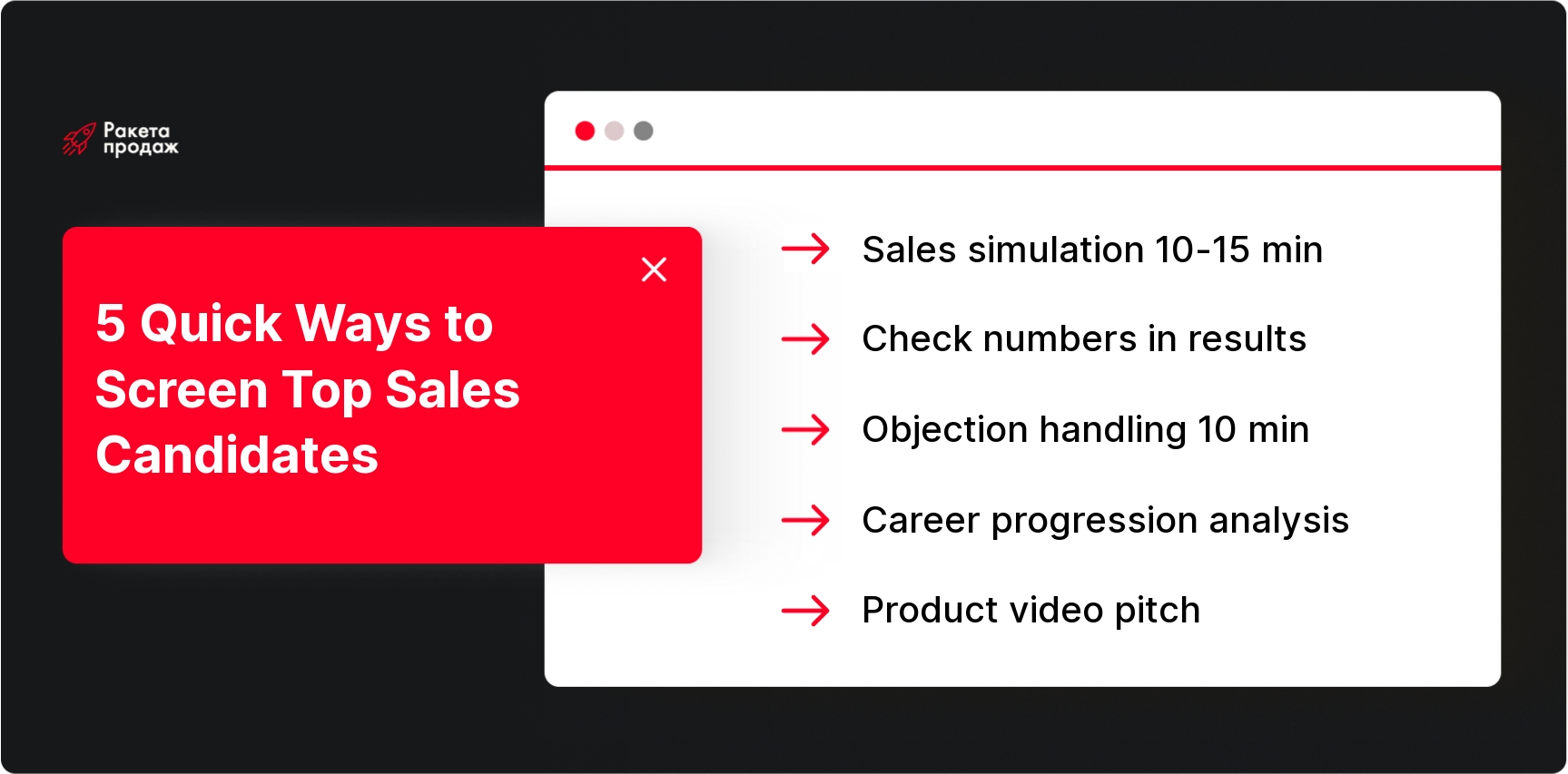
Short sales simulations have become the gold standard in evaluating salespeople. Instead of abstract questions or lengthy test assignments, offer the candidate a 10-15 minute role play. You act as a potential client, and the candidate must sell you your own product or service. This format allows you to see key skills in action: identifying needs, handling objections, ability to close deals.

It’s important to prepare clear criteria for evaluating the simulation in advance. For example, does the candidate ask open questions to identify needs? Do they listen to answers or immediately move to the presentation? How do they respond to objections – with standard phrases or looking for an individual approach? Specific metrics will help you objectively compare different candidates.

Testing objection handling skills is another quick and informative assessment method. Prepare 3-5 typical objections that your salespeople face and ask the candidate to address them. This takes no more than 10 minutes but provides very valuable information about the candidate’s approach to difficult situations.

Sales funnel analysis can also tell a lot about a salesperson. Offer the candidate to look at a simplified version of your sales funnel and ask them to comment on where they see problem areas and how they would improve conversion. This allows you to assess analytical abilities and systems thinking.

It’s important to note that all these assessment methods can be conducted remotely via video call. This saves time for all participants and allows for faster decision-making. In modern conditions, remote assessment often provides even more information, as many salespeople now work in this format.

Another effective technique is to ask the candidate to record a short video with a product presentation or response to an objection. This takes minimal time but allows you to assess self-presentation skills, structured thinking, and the ability to concisely convey key thoughts.

When you’re looking for how to find a good sales manager, it’s important to assess not only technical skills but also personal qualities, which often play a decisive role in a salesperson’s long-term success.

If you want to understand approaches to selecting the strongest salespeople, as well as see practical advice on conducting selection, we recommend the material on how to select a sales manager.

Now let’s look at common hiring mistakes that cause companies to lose strong candidates.

Hiring Mistakes That Cause Loss of Candidates

Despite the high competition for talent, many companies continue to make the same mistakes in the hiring process that lead to the loss of strong candidates. Understanding and eliminating these mistakes can significantly increase recruitment effectiveness.

A slow decision-making process is perhaps the most common and destructive mistake. When there’s a week between interview stages and you have to wait 10 days for results, strong candidates simply go to more responsive competitors. Research shows that 57% of candidates lose interest in a vacancy if the hiring process takes more than two weeks.

Vague position requirements create a situation where neither the recruiter, nor the manager, nor the candidate understands what exactly is expected from the future employee. As a result, unsuitable candidates are invited for interviews, while potentially strong salespeople are filtered out due to non-compliance with unclear criteria. A clear job profile with specific KPIs and competencies is a mandatory condition for effective hiring.

Poor communication with candidates often causes them to drop out of the process. Lack of feedback after an interview, uninformative template letters, lack of clear information about next steps – all this creates a negative impression of the company. For a strong salesperson, the quality of communication during the hiring process is an indicator of how work will be organized in the future.

Another common mistake is too many selection stages. Some companies create a real marathon of 4-5 interviews, test assignments, and assessment centers. As a result, even candidates who reach the finals are often disappointed in the company due to an overly bureaucratic process. The optimal process for salespeople usually includes no more than 2-3 stages.

An unattractive job offer also repels strong candidates. This refers not only to the financial component but to the full package of conditions: growth opportunities, lead quality, technological equipment, corporate culture. If a company offers an average market salary but cannot clearly explain what other benefits an employee will receive, the chances of attracting a top salesperson are minimal.

And finally, unprofessional interviewing. When the interviewer is late, unprepared, asks standard questions from the internet, or worse, shows disrespect to the candidate – this is a sure way to lose even the most interested specialist.

If you’re wondering how to quickly hire a sales manager, it’s important to avoid these typical mistakes and create a hiring process that is effective and respectful of candidates’ time.

Avoiding these mistakes will help prepare the company for the hiring process in advance.

How to Prepare a Company for Fast Hiring in Advance

Successful fast hiring begins long before a vacancy appears. Companies that prepare for this process in advance gain a significant advantage in the competition for talent. Preliminary preparation allows you to reduce reaction time and quickly launch an effective search when the need for a new salesperson arises.

A key preparation element is creating a library of pre-prepared templates and materials. This includes scripts for recruiters that describe the company, position, and working conditions; detailed forms for assessing salespeople’s competencies; offer templates for different position levels. This significantly speeds up the process when a vacancy appears – you don’t need to create everything from scratch, just adapt the ready materials for a specific position.

It’s also important to optimize the interview funnel in advance. Analyze which stages are really necessary for evaluating a salesperson and which can be reduced or combined. For example, the initial interview and assessment of basic skills can be conducted in one video call, rather than divided into separate meetings. Such optimization allows you to reduce the time from first contact to offer without losing quality of assessment.

Creating a talent pool is another important strategy for fast hiring. Even if you don’t have open positions right now, it’s worth maintaining a database of potential candidates. These can be specialists who impressed at interviews but weren’t hired for some reason, or passive candidates with whom you maintain regular contact. When there is an urgent need for a new salesperson, you will already have a list of people you can contact immediately.

Pre-approval of budgets and hiring conditions with management is also critical to speed up the process. There’s nothing worse than finding an excellent candidate and then spending weeks agreeing on their salary or working conditions. Pre-determined salary ranges, bonus schemes, and compensation packages allow you to quickly make competitive offers.

Automation of routine hiring processes significantly saves time. Using ATS systems for candidate management, tools for automatic resume screening, services for scheduling interviews – all this allows the recruiter to focus on interaction with candidates, not on administrative tasks.

Finally, it’s important to determine and train all participants in the hiring process in advance. Department heads who will conduct final interviews should be ready to allocate time in their schedules for urgent meetings with candidates. All interviewers should clearly understand what competencies they are assessing and how to do it.

For those wondering where to look for strong salespeople and how to find a good sales manager, preliminary preparation is a key success factor that will allow you to quickly respond to the appearance of interesting candidates.

Now that the company is prepared for fast hiring, let’s look at how to accelerate offer acceptance by the candidate.

How to Speed Up Offer Acceptance by a Strong Candidate

The final stage of hiring – making a job offer and its acceptance by the candidate – often becomes an unexpected obstacle. The company has done tremendous work to find, evaluate, and convince a strong salesperson, but then the offer “hangs” under consideration, and the candidate meanwhile receives and accepts an offer from a competitor. How can this process be accelerated?

The attractiveness of the offer is a key factor for quick acceptance. A strong salesperson is looking not just for a high salary, but a whole package of conditions. A competitive fixed part and a clear, transparent system of bonuses and commissions are a basic requirement. Equally important are growth and development prospects – strong salespeople are ambitious and want to see their career path in the company.

Working conditions are also important – lead quality, technological equipment of the sales department, level of administrative support. For many salespeople, work-life balance is critical, so a flexible schedule or the possibility of partial remote work can be a decisive factor.

Preliminary discussion of key conditions helps reduce the time for offer consideration. Experienced recruiters don’t wait for the final stage to start talking about salary expectations and other important aspects. They probe these issues as early as the primary interview stages. When it comes to a formal offer, the candidate doesn’t have any unpleasant surprises or the need to spend a long time considering the conditions.

The psychological aspect also plays an important role. Strong salespeople often receive several offers simultaneously and compare them. To make your offer stand out, it’s important to create an emotional connection between the candidate and the company. A personalized cover letter from the future manager, a small gift with company symbols, or an invitation to an informal meeting with the team – all this creates positive emotions and distinguishes your company among competitors.

A limited offer validity period is another acceleration tool. When an offer has clear time frames (for example, 2-3 days), it stimulates the candidate to make a decision faster. However, it’s important that this period is reasonable and not perceived as pressure – otherwise, the effect may be opposite.

And finally, proactive work with the candidate’s doubts and objections. A strong salesperson rarely accepts an offer immediately – they have questions and doubts. The recruiter’s task is to identify these doubts and actively work with them, not waiting for the candidate to voice them or, worse, silently go to a competitor.

When you’re thinking about how to hire a sales manager who will quickly accept your offer, remember that the key role is played not only by the financial component but also by the emotional connection with the company that you can create.

Now let’s look at how modern technologies can help automate and speed up the search and selection process.

Automation of Search and Selection

In 2025, automation has become a necessary element of effective salesperson recruitment. Companies that still rely on manual labor for routine operations inevitably lose in speed and quality of hiring. Modern tools and technologies allow not only to speed up the process but also to increase the accuracy of candidate selection.

Automated resume search and screening systems significantly reduce time spent on initial selection. Such platforms use artificial intelligence to analyze resumes and identify candidates who best meet the job requirements. They can analyze not only keywords but also context, consider synonyms, and even assess a candidate’s potential based on their career path.

Tools for automatic candidate search in social networks and professional communities help significantly expand reach. They can automatically find potential candidates based on specified criteria, send them personalized messages, and track responses. This allows a recruiter to simultaneously work with a much larger number of potential candidates.

Video interview platforms with elements of automatic assessment are also becoming increasingly popular. They allow candidates to record answers to pre-prepared questions at a convenient time, and the recruiter to view and evaluate these answers when convenient. Some systems even conduct a primary analysis of video responses, evaluating body language, intonation, and vocabulary used.

Applicant Tracking Systems (ATS) have become standard for companies that take hiring seriously. They allow centralized storage of information about all candidates, tracking their progress through the hiring funnel, automatically sending notifications and reminders. This significantly reduces the risk of losing a strong candidate due to organizational problems.

Chatbots for primary screening and answering basic candidate questions also help speed up the process. They can work around the clock, providing instant communication with potential employees. Modern chatbots can not only answer standard questions but also conduct initial interviews, collecting important information for the recruiter.

Tools for automating communication with candidates are another important element of fast hiring. They allow you to set up automatic sending of emails and messages at different stages of the process, reminders about interviews, requests for additional information, and so on. This ensures constant contact with the candidate without the need to manually track each step.

For companies looking to hire a sales manager as quickly as possible, automation becomes a necessary condition for success, allowing significantly accelerate all stages of search and hiring.

Now that we’ve understood automation tools, let’s look at how to properly evaluate a salesperson’s potential and career dynamics.

How to Evaluate Career Dynamics and a Salesperson's Potential

Evaluating a salesperson’s potential is one of the most challenging tasks in the hiring process. You’re looking not just for someone who can work well now, but for a specialist with prospects for growth and development in your company. How can you determine in a short time whether a candidate has the necessary potential?

Analysis of career dynamics from the resume gives the first important signals. Steady growth from position to position, increasing areas of responsibility, transition from smaller companies to larger ones or from less known brands to more prestigious ones – all this indicates positive dynamics. Internal promotions in previous companies are especially valuable – they indicate that employers saw potential in this person and invested in their development.

In interviews, special attention should be paid to questions about self-development. Strong salespeople with high potential can usually tell you what books, courses, or trainings they’ve taken on their own initiative, how they track industry trends, what skills they’ve acquired over the past year. This speaks to a proactive approach to their professional growth.

It’s also useful to ask about long-term career goals. Where does the candidate see themselves in 3-5 years? What skills do they want to develop? What results are they aiming for? Answers to these questions will show the person’s ambitions and development direction, and also help understand if their goals align with the opportunities your company can offer.

Questions about overcoming difficulties will also tell a lot about potential. How did the candidate deal with periods of decline in sales? What did they do when the rules of the game in the market changed? How did they adapt to new products or technologies? The ability to learn quickly and adapt is a key indicator of high potential in the modern world.

Another important aspect is leadership qualities. Even if you’re hiring a line salesperson, it’s worth assessing their potential as a future leader. Have they taken on a mentoring role for newcomers? Participated in training colleagues? Suggested improvements in sales processes? These questions will help understand if the person can lead a team or direction in the future.

Feedback and verification of results from previous workplaces can also provide valuable information about a candidate’s potential. It’s important to ask not only about work results but also about the ability to learn, adapt to changes, work in a team, and show initiative.

When you’re looking for where to find a good sales manager with high potential, pay special attention to candidates who demonstrate not only good results but also a constant desire for professional development.

Now let’s look at how to shorten the hiring process without losing the quality of candidate assessment.

How to Shorten the Hiring Process Without Losing Quality

Shortening the hiring process without compromising quality is a challenge every company faces in the face of high competition for talent. How can you speed up the process while not losing quality in candidate assessment?

Combining selection stages is one of the most effective ways to reduce the overall hiring time. For example, the initial interview with the recruiter and technical skills assessment can be conducted in one meeting. This not only reduces the calendar time of the process but also reduces the burden on the candidate, who doesn’t have to take time off from their current job multiple times for interviews.

A parallel process instead of a sequential one also significantly accelerates hiring. For example, reference checks can begin immediately after the first successful interview, without waiting for the completion of all interview stages. Test assignments can be completed between the first and second interviews, not after them.

Pre-informing candidates about the entire process helps avoid delays and misunderstandings. When a person knows from the start how many stages they will go through and what skills will be assessed, they can better prepare and make decisions faster at each stage.

Using asynchronous assessment methods significantly speeds up the process. For example, instead of organizing a live interview with a presentation, you can ask the candidate to record a short video with a product presentation. This saves time on coordinating schedules and allows evaluating several candidates in parallel.

Reducing time between stages is another critical factor. Even the most efficient selection process loses meaning if weeks pass between its stages. Set clear timeframes for each stage – for example, no more than 24 hours from receiving a resume to first contact, no more than 48 hours between the first and second interviews, no more than 24 hours to make a final decision after the final interview.

Delegating decision-making authority also speeds up the process. When a hiring decision has to go through several levels of approval, the process inevitably drags on. If the decision can be made by the immediate supervisor or a small group of people, this significantly reduces time.

And finally, simplifying paperwork and the onboarding process significantly accelerates the candidate’s start date. The ability to sign documents electronically, fill out forms online, go through initial orientation in a convenient format – all this allows a new employee to start work faster.

For companies that need to quickly hire a sales manager, it’s especially important to reduce time between selection stages and speed up the decision-making process while maintaining assessment quality.

Conclusion

The labor market in sales has radically changed – strong salespeople have become a real shortage, and hiring speed has turned into a key competitive advantage. Companies that have restructured their processes to account for new realities gain a significant advantage in the battle for talent.

A multi-channel approach to candidate search becomes a mandatory condition for success. Referral programs, professional social networks, industry communities – each of these channels brings its type of candidates and collectively provides a stable flow of applicants. The combination of different sources allows you not to depend on one channel and quickly adapt to market changes.

Automation and the use of modern technologies significantly reduce time spent on routine operations. Candidate management systems, tools for automatic resume screening, platforms for conducting video interviews – all this allows recruiters to focus on interaction with people, not on administrative tasks.

Preliminary preparation of the company for fast hiring is another key success factor. Pre-prepared templates, an optimized interview funnel, a talent pool – all this allows you to instantly launch the process when the need for a new salesperson arises.

Finding and hiring strong salespeople is not a lottery but a systematic process requiring expertise and proven methodologies. Instead of experimenting with disparate advice from the internet, consider the possibility of attracting professionals who will build a holistic system of hiring and adapting sales managers for you.

“Sales Rocket” offers a comprehensive approach to creating turnkey sales departments – from developing an ideal candidate profile to implementing a motivation and training system. We create all the necessary infrastructure: sales funnels, scripts, sales playbook, and adaptation plan, which allows new employees to quickly achieve results.

Our clients note an increase in conversion from 5-86% and an average revenue growth of +35%. We work with companies of different scales – from small businesses to large corporations such as Mitsubishi, Naftogaz, and Yamaha. Over 7+ years, we have successfully built 158 sales departments that consistently bring profit to their owners.

We take the burden of organizational, training, and methodological issues off you, allowing you to focus on strategic business tasks. You get not just new employees, but a fully functioning system with transparent reporting and measurable KPIs.

Get a sales team that systematically brings you +35% to turnover - order a comprehensive sales department building!
In this article:
See more
Book a FREE sales funnel audit
CONTACT US
FAQ
How to hire a sales manager if a good candidate is needed quickly?

Focus on a multi-channel approach: activate a referral program, use LinkedIn for direct outreach to candidates, post the vacancy in specialized communities. Optimize the selection process, reducing it to 2-3 stages maximum. Use short sales simulations instead of lengthy test assignments for quick skills assessment. When you need to quickly hire a sales manager, remember that speed is crucial – make decisions within 24-48 hours after interviews to stay ahead of competitors.

Which channels give the fastest response from strong salespeople?

The fastest response usually comes from referral programs and professional communities in Telegram and other messengers. Direct outreach to passive candidates through LinkedIn with personalized messages is also effective. Strong salespeople often respond faster to personal messages than to regular job postings. When looking for where to find a good salespeople, focus on these channels for quicker results.

Where to look for top managers if they don't post resumes?

Top managers in sales usually don’t actively look for work. They can be found through personal recommendations, in professional communities, and at industry events. LinkedIn remains one of the best channels for finding high-level executives. It’s important to use a personalized approach and clearly explain why your offer might be interesting to them. When considering where to find a good sales manager at the executive level, networking and referrals are your best options.

How to shorten the hiring process without losing candidate quality?

Reduce the process without losing quality by: pre-defining the role profile and evaluation criteria checklist (scorecard with KPIs/competencies), combining stages (screening + basic skills assessment in one call), moving part of the evaluation to an asynchronous format (short video/case response), testing the key skill with a 10-15 minute sales simulation with typical objections, processing the candidate in parallel (references, offer preparation), and maintaining SLAs for timeframes: ≤24h for feedback, 24-48h between stages, offer within 24h after the final stage; automate operations in an ATS, and delegate the final decision right to the function head – this way you’ll speed up without sacrificing assessment depth. This approach is particularly effective when you need to quickly hire a sales manager without compromising on quality.

How to tell if a candidate is truly strong, not just good at interviews?

Distinguish a strong candidate using a combination of facts and practice: require specifics about results (numbers, dynamics, contribution, deal examples using the STAR model), conduct a short sales simulation and handling of 3-5 real objections, give a mini-analysis of your funnel and ask them to suggest growth points; observe behavioral markers – ability to ask open questions, structure conversation, record next steps and recognize a non-target lead, check career dynamics (internal promotions, stability), request references focusing on “how they learn/adapt/close deals,” and if possible do a micro-test – strong candidates confirm their level with action and data, not just charisma. These techniques are essential when looking for how to find a good salesperson who will perform well beyond the interview.

SUBSCRIBE TO MY TELEGRAM CHANNEL
The most valuable sales information right on your phone!
icon

LOTS OF USEFUL INFORMATION, FREE TEMPLATES, AND CHECKLISTS ON MY INSTAGRAM

Materials and practical advice on sales growth in our blog: