icon

Competitive Benchmarking in B2B and B2C: Key Differences

Benchmarking has long become an essential tool for companies striving to remain competitive in the market. Essentially, it’s a systematic process of comparing a company’s performance metrics with those of competitors and industry leaders. 

Key Takeaways

  • B2B benchmark focuses on the quality of each deal and long-term relationships, rather than the quantity of transactions as in B2C.
  • Conversion in B2B is measured through a multi-stage funnel (MQL, SQL, opportunity, deal), while in B2C it’s directly from visitor to buyer.
  • Customer acquisition cost (CAC) in B2B is significantly higher due to the lengthy sales cycle, but pays off through high LTV and contract expansions.
  • B2B benchmarking requires qualitative methods (interviews, tender analysis), while B2C relies on quantitative data (web analytics, CRM data, mass surveys).
  • Companies that implement systematic sales benchmarking reduce their deal cycle by 20-30% in B2B and increase average order value by 15-25% in B2C.

In the full article, you’ll find specific metrics for comparison, data collection tools, and a step-by-step algorithm for implementing benchmarking for your business model 👇

Do you know that approaches to benchmarking in B2B and B2C segments are radically different? It’s not just different numbers – it’s a different philosophy, different metrics, different priorities. These differences are due to fundamental distinctions in sales models, deal duration, and customer volume. You can learn more about key differences between B2B and B2C sales benchmarking and how this affects funnels and strategies in this article. What works in a B2B benchmark can be completely ineffective in a B2C benchmark, and vice versa. Understanding these differences is critically important for building the right benchmarking strategy that will lead to real business growth, not just a set of pretty reports. Let’s figure out exactly what the differences between B2B and B2C sales benchmarking are and how to use them to improve your business efficiency.

How Benchmarking is Structured in B2B: Specific Aspects

In the B2B world, benchmarking is not just comparing numbers in a table. It’s a comprehensive analysis of a multi-level sales structure, where each stage has its own characteristics and requires specific metrics for evaluation. The features of B2B sales for benchmarking include long cycles, involvement of multiple decision-makers, and significant contract amounts.

Key metrics in B2B benchmarking are indicators that reflect the effectiveness of the entire sales cycle: deal cycle length, funnel stage conversion, customer acquisition cost (CAC), customer lifetime value (LTV), and the LTV/CAC ratio. Unlike B2C, where the quantity of transactions may dominate, in B2B, the quality of each deal and long-term customer relationships are more important.

When comparing your business metrics with competitors, you’re probably wondering: how do you know if your sales processes are truly effective, and what exactly needs improvement? Most companies feel like they’re in an information vacuum when it comes to real industry benchmarks. “Sales Rocket” solves this problem by conducting a comprehensive sales department audit with competitive environment analysis. We don’t just collect statistics, but compare your indicators with the best market practices, revealing hidden growth opportunities.

Our experts analyze all stages of the sales funnel, communication quality, CRM system effectiveness, and identify growth points. Over 7+ years, we’ve helped 212 companies across different industries build systematic sales departments that consistently achieve high results. Our approach works in both B2B and B2C sectors, as we understand the fundamental differences between these business models and adapt solutions to clients’ specific needs.

Turn the complexity of benchmarking into your competitive advantage – order a sales department audit and get a clear growth plan!

Turn the complexity of benchmarking into your competitive advantage - order a sales department audit and get a clear growth plan!

For example, in the IT sector, companies often compare not only financial indicators but also parameters such as response speed to requests, technical support quality, and flexibility in customizing solutions to client needs. Manufacturing companies focus on comparing purchasing department efficiency, competitive specifications analysis, and service parameters. An important aspect is also how well the lead qualification process is built, since in B2B, an incorrectly identified potential client means a significant resource loss.

B2B competitive analysis also differs in the need for deep personalization of offers. Companies analyze how effectively their competitors adapt their solutions to specific clients, what additional services are offered, and how this affects customer retention and collaboration expansion. Learn more about how sales personalization affects customer retention and key approaches in B2B in the article on the website. Success in B2B is largely determined by the ability not just to sell, but to solve the client’s business problem, making the analysis of this aspect critically important in benchmarking.

Features of Benchmarking in B2C: Approaches and Metrics

In the B2C sphere, benchmarking takes on a completely different tone. Here, the focus is on speed, volume, and the emotional component of consumer interaction. The features of B2C sales for benchmarking lie in the fact that unlike B2B, where each deal is carefully built, in B2C, success is often determined by the ability to quickly attract and convert the maximum number of potential customers.

The main B2C benchmarking metrics are focused on mass and speed: visitor-to-buyer conversion, average check, purchase frequency, customer acquisition cost in different channels. Also, much attention is paid to brand engagement indicators: time spent on the site, viewing depth, social media activity, and response to marketing campaigns.

In retail, for example, companies constantly compare their traffic, conversion, and average check indicators with competitors. Supermarket chains analyze the effectiveness of different store formats, product placement, and the impact of loyalty programs on purchase frequency. In e-commerce, user experience comparison becomes critically important: page loading speed, search convenience, and order processing.

B2C competitive analysis is characterized by a high degree of data collection automation. Companies use various analytics tools to track user behavior, A/B test interface elements, and analyze advertising campaign effectiveness. Significant emphasis is placed on Customer Experience – the entire customer journey should be as smooth and pleasant as possible, encouraging repeat purchases and recommendations. Learn more about how to build a successful B2C sales strategy considering these features in our special article. In modern B2C business, personalization technologies for offers and content are increasingly used, which also becomes an object of benchmarking.

B2B vs. B2C Benchmarking: Comparing Metrics and Approaches

When we compare benchmarking in B2B and B2C sectors, the differences become even more apparent. These differences manifest in both key metrics and the approaches to data collection and analysis, which directly affects companies’ strategic decisions.

In the B2B environment, the conversion process is much longer and more complex. While in B2C, conversion can be measured as the ratio of visitors to buyers, in B2B it’s a whole chain: from a potential lead to a marketing qualified lead (MQL), from a sales qualified lead (SQL) to an opportunity, and finally to a deal. Each of these stages requires separate analysis and comparison. The customer acquisition cost (CAC) in B2B is usually significantly higher due to the long sales cycle and involvement of multiple employees.

Customer lifetime value (LTV) is also calculated differently: in B2C, it’s often the sum of all purchases over a period minus acquisition and service costs, while in B2B, not only direct revenues from the client are considered, but also potential contract expansions, as well as strategic value (e.g., references and recommendations).

To build quality analysis at each stage and see bottlenecks, many companies use modern methods, such as sales funnel analytics, which allows tracking conversion and optimizing the process for both B2B and B2C.

Metric B2B Approach B2C Approach
Conversion Multi-stage funnel with focus on lead quality Direct “visitor-buyer” conversion with emphasis on volume
CAC High, with a long payback period Lower, with quick payback
LTV Emphasis on long-term collaboration and contract expansion Focus on purchase frequency and increasing average check
Deal cycle Months or years Minutes or days
ROI Measured in the long term Quick evaluation by campaigns and channels
Loyalty programs Individual conditions, personal managers Mass programs with clear rules

Data collection tools also differ. B2B places greater emphasis on qualitative analysis: in-depth client interviews, tender documentation analysis, decision-making process research. B2C relies more on quantitative methods: web analytics, CRM data, sales statistics, and satisfaction surveys.

These fundamental differences dictate the need for completely different approaches to developing a benchmarking strategy. In B2B, it’s important to identify factors affecting long-term relationships and supplier selection, while in B2C, it’s more critical to understand what motivates quick purchasing decisions and brand attachment formation.

Problems, Challenges, and Opportunities in B2B and B2C Benchmarking

Conducting benchmarking in any sphere faces certain difficulties, but B2B and B2C problems differ significantly. Understanding these differences helps companies build more effective comparative analysis processes and extract maximum benefit from the obtained data.

In the B2B segment, one of the key problems is the difficulty of collecting reliable competitor data. Deals are often confidential, conditions are individual, and information about internal sales processes rarely becomes public. Competitive benchmarking can help companies navigate the complexities of information gathering and determine objective development benchmarks. B2B competitive analysis requires companies to rely on indirect sources: industry reports, information from common clients, public tender analysis. Another challenge is aligning processes between departments. In the long B2B sales cycle, marketing, sales, pre-sales, and customer service all participate, and benchmarking requires coordination between all these units.

The B2C situation is different. There’s usually more data available, but the problem arises in its qualitative processing and interpretation. Stores and services generate huge volumes of customer behavior information daily, and the challenge becomes identifying significant trends and patterns. Additionally, in B2C, the speed of changes is much higher: seasonality, trends, competitors’ marketing promotions can quickly change consumer behavior, making some benchmarking conclusions outdated within a few weeks. B2C competitive analysis must account for these rapid changes and adapt quickly.

Personalization also creates different challenges: in B2B, it’s the need to understand each client’s unique needs; in B2C, it’s the complexity of segmenting the mass audience and creating truly relevant offers based on data.

A common problem is implementing a data-driven decision-making culture. Often, even with quality benchmarking, companies continue to act by inertia or based on subjective opinions of managers. Successful implementation requires not only technical infrastructure and processes but also support from top management, readiness for change, and openness to new ideas.

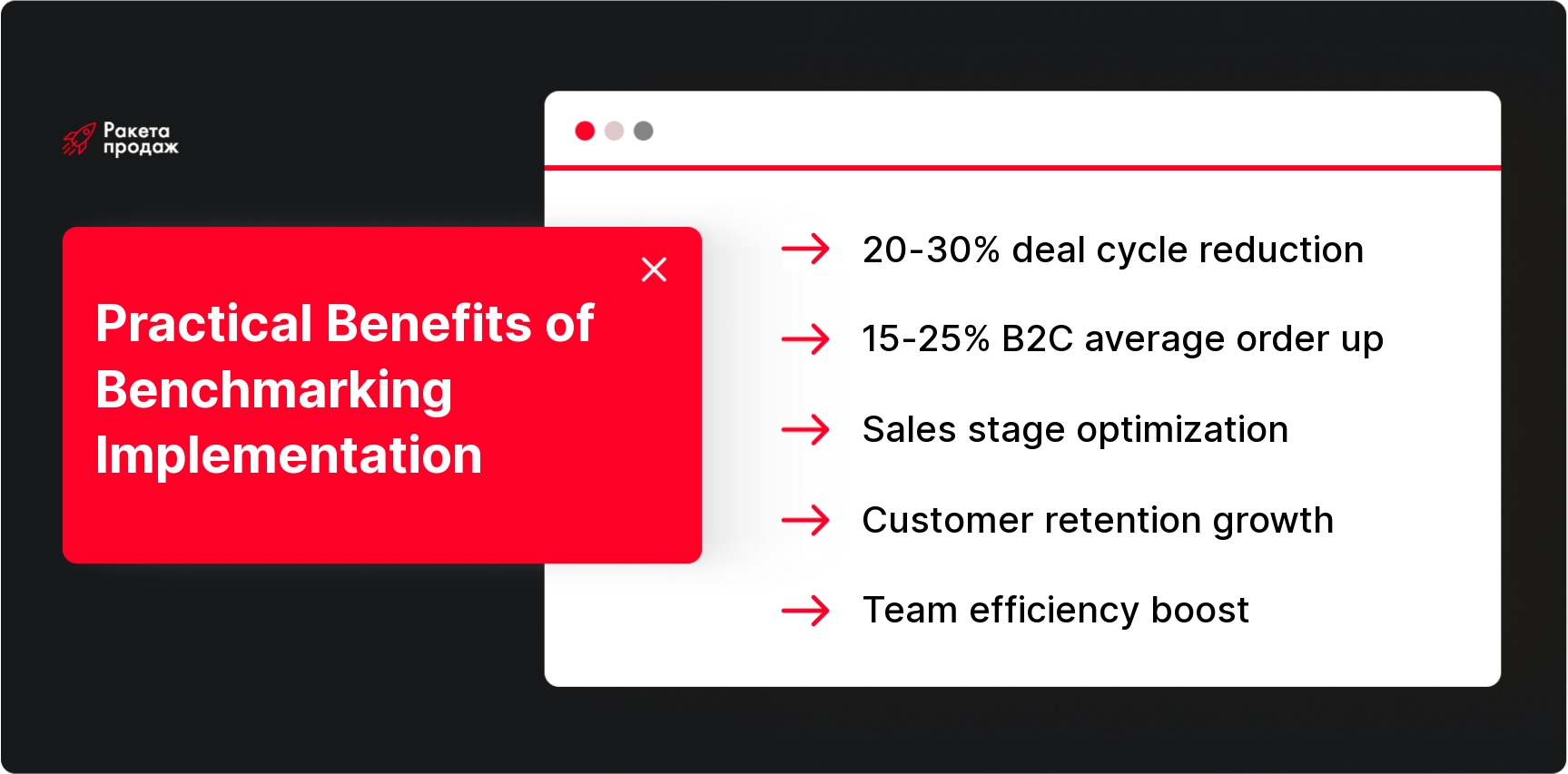
Companies that overcome these challenges gain significant advantages. For example, B2B firms that have implemented systematic sales process benchmarking report a 20-30% reduction in deal cycle and improved conversion at later funnel stages. B2C companies with a developed culture of testing and comparative analysis often achieve a 15-25% increase in average check through user experience optimization.

Practical Recommendations for Conducting Benchmarking for B2B and B2C

image

Effective benchmarking doesn’t happen by chance – it’s the result of a systematic approach adapted to the specifics of the business model. Let’s consider practical steps for implementing benchmarking in B2B and B2C companies.

For B2B companies, the process should start with a clear definition of strategic goals and related KPIs. For more details on which sales department KPIs truly illuminate business dynamics, check out the specialized article. Focus on indicators that truly impact business results: conversion by funnel stages, average sales cycle duration, LTV to CAC ratio, percentage of business expansion with existing clients. It’s important not just to collect data, but to segment it: by client size, industry, geography.

Tools for B2B benchmarking should include both quantitative analysis (CRM systems, sales analytics) and qualitative methods (client interviews, satisfaction analysis). It’s useful to create an internal benchmarking committee including representatives from different departments to ensure a comprehensive view of processes. If you’re looking for proven solutions to improve efficiency, we recommend exploring effective B2B strategies that have established themselves with large companies.

In B2C benchmarking, the emphasis is different. Key metrics here are channel conversion, acquisition cost breakdown by source, average check, purchase frequency, customer churn. It’s important to set up analytics systems to track the entire customer journey – from the first brand touch to repeat purchases. B2C tools include web analytics, marketing campaign analysis, A/B testing, social media monitoring, and systematic satisfaction surveys.

Regardless of business type, it’s important to follow several universal principles. First, regularity: benchmarking should not be a one-time action, but a constant process. Second, effectiveness: results should transform into specific initiatives and changes. Third, comprehensiveness: it’s not enough to compare only financial indicators; processes, technologies, and human factors must also be analyzed.

A good practice is to create a benchmarking “roadmap” with a clear implementation plan for changes based on analysis results. This helps transform insights into concrete actions. It’s also useful to conduct regular experience exchange sessions between teams and departments to spread best practices within the organization.

Remember that the goal of benchmarking is not to copy competitors, but to discover opportunities for unique improvements that correspond to your business model and customer needs. Benchmarking should help not only catch up with the market but also define directions for innovation and differentiation. To understand sales benchmarks and set realistic goals, it’s necessary to regularly conduct comparative analysis with both competitors and best practices in your industry.

Benchmarking is not just comparing numbers, but a powerful tool for business transformation that requires a professional approach and deep understanding of both B2B and B2C process specifics. If you want to not just catch up with the market, but stay ahead of competitors, you need to know not only your indicators but also the industry’s best practices.

“Sales Rocket” offers a comprehensive approach to improving your sales department’s effectiveness. We start with a detailed audit that includes competitor analysis and comparing your processes with industry standards. Then we develop a personalized improvement strategy: from funnel optimization and CRM implementation to team training and creating effective sales scripts.

Our experience working with companies of different scales, from Mitsubishi and Yamaha to local businesses, allows us to understand the unique challenges of each segment. The average revenue growth of our clients is +35%, and the best result is +$1.6 million in just 4 months of cooperation.

Don’t waste time experimenting with unproven methodologies. Use a proven methodology that guarantees sales growth.

Turn benchmarking challenges into growth opportunities – order a comprehensive sales department audit today!

Turn benchmarking challenges into growth opportunities - order a comprehensive sales department audit today!

Conclusion

The differences between B2B and B2C sales benchmarking reflect not just a difference in metrics – they are manifestations of fundamentally different approaches to business, customers, and sales. In B2B, success is determined by relationship depth, collaboration duration, and the ability to solve complex client tasks, while B2C focuses on speed, scale, and emotional connection with the brand. These differences require completely different approaches to data collection and analysis, selection of comparison benchmarks, and implementing changes. Companies that recognize these differences and build a benchmarking system considering their business model specifics get a powerful tool for growth and competitiveness enhancement. They don’t just collect numbers – they understand which indicators are truly important in their context, and how to transform insights into specific improvements. Properly organized benchmarking allows businesses to constantly evolve, adapt to market changes, and find new opportunities to create value for customers.

In this article:
See more
Book a FREE sales funnel audit
CONTACT US
FAQ
What is the difference between B2B and B2C benchmarking?

The main differences are in focus and metrics. B2B benchmarking concentrates on long-term relationships, complex sales funnels, and high value of each client, using metrics such as LTV, sales cycle length, and key account management effectiveness. B2C benchmarking focuses on mass scale, speed, and emotional connection with consumers, operating with conversion, average check, and marketing campaign effectiveness.

How to conduct a B2B competitive analysis?

Start by identifying key competitors and comparison parameters (pricing policy, product line, service). Collect data from industry reports, tender documentation, client feedback, and employees who came from competitors. Analyze sales processes, marketing materials, and competitor positioning. Develop an action plan based on identified advantages and disadvantages.

How to conduct a B2C competitive analysis?

Identify key market players and comparison criteria (assortment, prices, user experience). Use web analytics tools to compare traffic and user behavior, monitor social networks and reviews. Conduct mystery shopping to analyze customer experience. Compare marketing campaigns and loyalty programs. Based on the data, develop a strategy to improve competitive positions.

What metrics should be compared for B2B benchmarking?

Key metrics include: conversion by sales funnel stages, average deal cycle, LTV, CAC and their ratio, customer retention rate, cross-sell and upsell percentage, NPS and customer satisfaction, objection handling effectiveness, percentage of won tenders/deals relative to competitors.

What metrics are important for B2C benchmarking?

Critical for B2C are: visitor-to-buyer conversion, average check, purchase frequency, customer acquisition cost by channel, engagement metrics on the website and social media, website and mobile app speed, loyalty program effectiveness, customer churn rate, NPS and reviews on platforms.

How to understand sales benchmarks for your business?

To determine sales benchmarks, start by analyzing your company’s historical data, then compare them with industry standards. Use data from industry reports, professional associations, and specialized research. Segment indicators by client size, regions, and product lines. Set realistic but ambitious goals based on best practices in your industry and considering your business specifics.

SUBSCRIBE TO MY TELEGRAM CHANNEL
The most valuable sales information right on your phone!
icon

LOTS OF USEFUL INFORMATION, FREE TEMPLATES, AND CHECKLISTS ON MY INSTAGRAM

Materials and practical advice on sales growth in our blog: