icon

Building a Sales Department: DIY or with Expert Help?

Every business owner eventually faces the same question: sales bring money, but work chaotically. Clients appear from nowhere, managers act on intuition, and you can’t forecast next month’s revenue. Time to systematize the process, but how exactly? Building a sales department from scratch yourself, hire a freelancer to build a sales team, or turn to companies that set up sales departments?

Want a high-performing sales team without the hassle?
We’ll build it for you.
Contact Us

Key Takeaways

  • Building a sales department on its own gives control, but hides a trap: without KPI systems, funnel stages and quality control, even talented salespeople work blindly.
  • Dependence on one strong salesperson crashes sales by 50-70% when they leave, saving on expertise turns into lost deals and high turnover.
  • A freelance sales representative handles specific tasks quickly and cheaper than an agency, but one person can’t cover strategy, CRM, motivation and analytics simultaneously.
  • An agency creates a manageable system in 1-3 months with a diverse team, eliminating “blind spots” risk and delivering predictable results.
  • Your choice depends on honest assessment: simple product and time for experiments – build yourself, need speed and systems for growth – choose an agency.

In the article below you’ll see specific contractor selection criteria, comparison of all three formats by speed, risks and implementation depth, plus signals when it’s time to transition from point solutions to systematic work. Read the full article 👇

Good news: all three options work. Bad news – each has its pitfalls. The sales department on its own provides full control but requires time and expertise. A private sales consultant will cost less than an agency but may not cover all tasks. A professional agency works quickly and systematically but costs more.

If these thoughts sound familiar – you definitely have every reason to be concerned. In our experience, 80% of business owners lose months and tens of thousands of dollars trying to build a sales department on their own or with freelancers without a systematic approach. At “Raketa Prodazh” over 8+ years of work, we’ve created a comprehensive methodology for Building a sales team on your own or with an expert that eliminates experiments and delivers predictable results. Our team of experts conducts deep audits of your current processes, builds a personalized sales system for your niche and product, then implements ready methodology with full team training cycle. During our work, we’ve successfully built 208 sales departments across 14+ industries for companies like Mitsubishi, Yamaha and NaftoGaz. The result of our work – sales departments that operate like clockwork and generate predictable revenue.

Create a systematic sales department that will bring +35% revenue growth in the first months of operation!

Building a Sales Department Yourself: When It Makes Sense

The DIY path is justified if you have time, understanding of sales, and a relatively simple product. Imagine: you manage a local service business with a short deal cycle. Clients make decisions quickly, the product doesn’t require complex presentations, and you once worked in sales yourself. In such cases, building a sales department from scratch yourself can be a smart choice.

The main advantages are obvious: full control over every stage, budget savings at startup, and deep customer understanding. Your employees will live the product, know every technical detail and sincerely believe in what they sell. No one will tell about your service better than someone who sees it from inside every day.

But there’s an important condition: you must have time to dive into sales methodology. This isn’t just hiring people and buying CRM. You need to build a funnel, write scripts, create motivation systems, organize training and quality control. If you’re ready to spend several months studying these processes – the path is real.

One key aspect is also choosing sales strategy: defining target audience, attraction channels and suitable tools. A properly built strategy will help avoid many typical startup mistakes and provide a solid foundation for further scaling.

What Risks Arise When Building a Sales Department Yourself

The most insidious trap of the DIY approach is underestimating complexity. Seems simple: hired salespeople, showed the product, gave a phone. In practice, without a system you get chaos. People work by different scenarios, CRM is used formally, and leads get lost between calls and meetings.

Typical picture: you hired an “experienced manager” with good recommendations, but after a month realize they simply don’t record data in the system. Or your team communicates excellently with clients, but no one can say how many leads are needed for the revenue plan. Without clear KPIs, funnel stages and quality control, even talented people work blindly.

The second risk is dependence on key figures. If the entire department relies on one strong salesperson, their departure can crash sales by 50-70%. Saving on expertise often turns into lost deals, high turnover and extended launch timelines. Eventually the “free cheese” becomes more expensive than working with professionals.

Freelancer or Private Sales Consultant: How This Format Works

The golden middle between DIY and a full agency – a sales team development specialist on freelance. This could be a former sales manager who now consults businesses, a CRM implementation specialist, or a sales trainer. A freelancer to build a sales team suits specific tasks: auditing current processes, setting up funnels, developing scripts or team training.

The logic is simple: you get expertise without maintaining a whole team of specialists. A private consultant can quickly analyze your “pain points,” propose ready solutions and help implement them in a few weeks. This works especially effectively if you already have a basic team but need to “tighten up” individual system elements.

This format suits medium companies needing help in specific directions. For example, you have three managers working but no unified standards for handling objections. Or CRM is installed but only used for storing contacts. A freelancer can solve these tasks faster and cheaper than an agency while transferring knowledge to your team.

Pros and Limitations of Working with a Freelancer

The main advantage of an independent specialist is flexibility and affordability. You can engage someone for a specific task, pay only for results and quickly scale up or down cooperation when needed. The entry threshold budget-wise is significantly lower than agencies, and decisions are made faster thanks to direct communication with the executor.

But there are significant limitations. A freelancer is one person with a certain set of competencies. They may be strong in CRM but weak in personnel motivation. Or excellent at scripts but don’t understand sales analytics. They don’t have a full team, so part of the tasks still remains on the business side.

Another nuance: private consultants usually work based on their past experience. They repeat solutions that worked in their previous companies but don’t always adapt them to your specifics. An agency has hundreds of projects in different niches behind them, a freelancer has experience from 2-3 companies. This isn’t bad, but you need to understand the difference.

Professional Agency for Building Sales Department: The Essence of the Approach

An agency isn’t one specialist, but a team of professionals that handles projects comprehensively. Usually the team includes a sales strategist, CRM specialist, trainer, analyst and project manager. They conduct audits, develop strategies, help with hiring, implement systems and support the process until full department autonomy.

The essence of the approach is creating a ready and manageable sales system. Not just hiring people or setting up CRM, but building the entire cycle: from lead generation to closing deals and handling objections. At the same time, the agency doesn’t just do but teaches your team to work by new standards. As a result, you get a department that functions by clear regulations and gives predictable results.

Sales department organization by a professional team is especially valuable in situations where companies face rapid growth or need to standardize processes. You can learn more about modern approaches and stages of building departments in the article about sales department organization.

This format is especially useful for companies wanting to quickly scale or enter new markets. Imagine: you’re planning to open branches in other cities. Building a sales department from scratch in each region will take years, while an agency can launch a sales system in 2-3 months and train local managers to work by unified standards.

Why Working with an Agency Is Often More Effective for Business

image

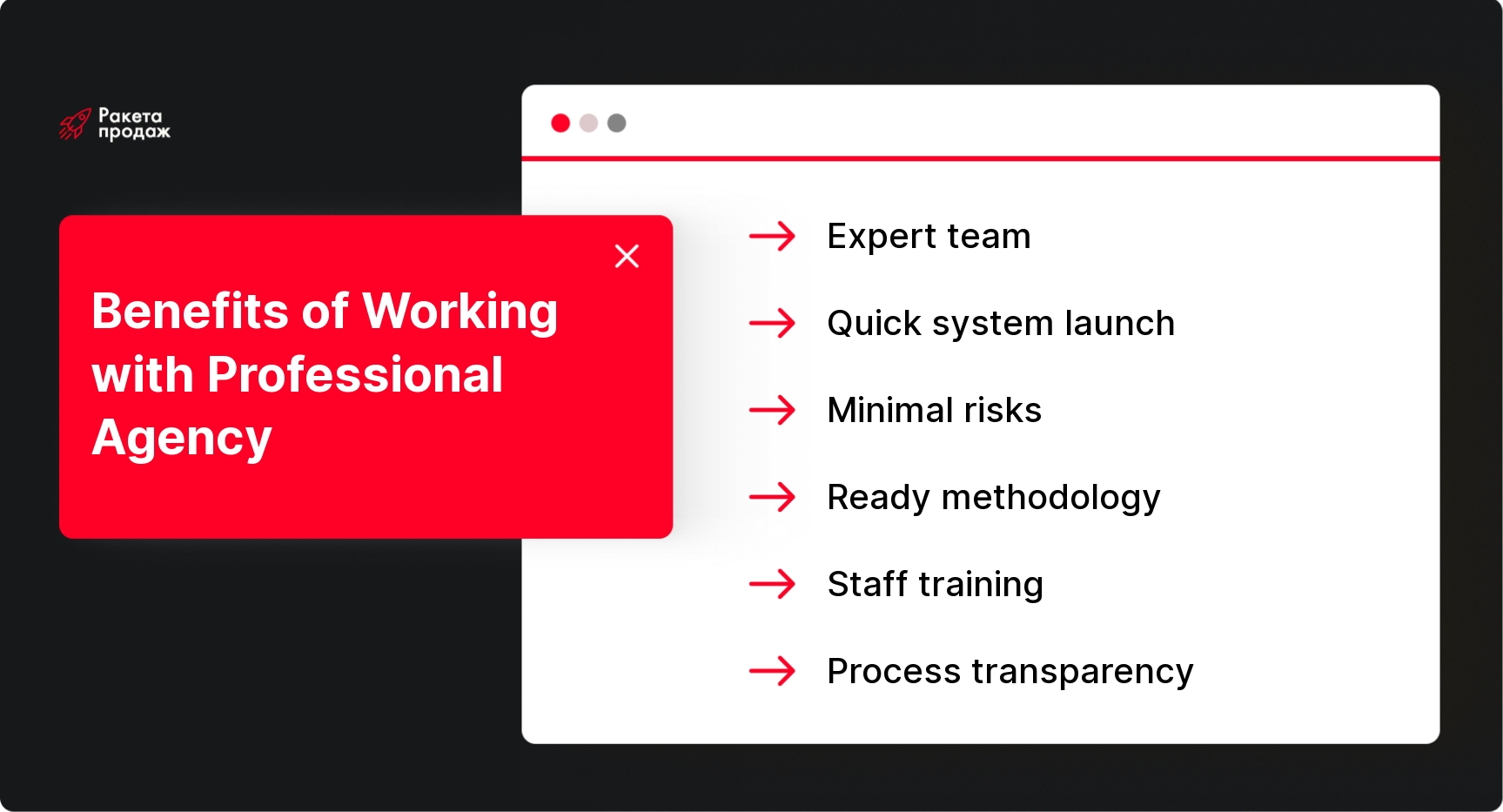
An agency provides not just recommendations, but proven methodology. Behind the team’s shoulders – experience from dozens of projects in different industries, a library of ready solutions and understanding of typical mistakes. This significantly reduces the risk of “reinventing the wheel” and spending months on experiments with unclear results.

Team expertise is another weighty argument. One person can’t equally deeply understand strategy, CRM, personnel motivation and analytics. An agency combines specialists of different profiles, allowing systematic problem solving and avoiding “blind spots.” If your internal sales director has gaps in some direction, the team compensates for this.

The third factor is speed and predictability. Agencies work by tested processes with clear stages and control points. You know that in a month the audit will be ready, in two – strategy and regulations, in three – trained team. This is especially important for businesses with seasonality or tight market entry deadlines.

Finally, an agency relieves the owner’s burden. Instead of figuring out CRM intricacies and sales methodology, you focus on strategic tasks while the professional team builds the system turnkey.

Which Companies in Ukraine Help Build Sales Departments

The Ukrainian market offers several major players in sales department building. DIA Consulting specializes in comprehensive consulting and CRM implementation for medium and large businesses. “Sales Formula” focuses on training and team education, offering ready programs for different industries.

“Sales Bureau” positions itself as a universal contractor handling tasks from audit to complete hiring outsourcing. Each of these companies has its strengths and target audience: some work better with B2B, others with retail sales.

Separately stands Raketa Prodazh – a company that builds sales departments not by templates but based on deep analytics and client data. Their approach is radically different: instead of copying “best practices” they create unique systems for specific businesses, their products, sales models and audiences. The team uses modern analytics tools, A/B testing of scripts and constant process optimization.

The market is developed enough to choose between different contractors by specialization, budget and work approach. This gives businesses the opportunity to find exactly the partner that best fits their tasks and corporate culture.

Comparing Approaches: DIY, Freelancer or Agency

To make an informed decision, it’s useful to compare all three options by key parameters. Initial cost: DIY requires large ongoing expenses (salaries, office, training), freelancer costs a fixed fee, agency is the most expensive but predictable option.

Launch speed: DIY is the slowest path (3-6 months), freelancer can solve specific tasks in 2-4 weeks, agency launches system in 1-3 months. Implementation depth: in-house gives maximum control, freelancer covers separate directions, agency creates comprehensive system.

Risk levels also differ. With DIY building you risk spending months on experiments without result guarantee. With freelancer the risk is that part of tasks may remain unsolved. Agency minimizes risks thanks to experience and teamwork but requires larger investments.

For understanding specifics, stages and necessary competencies when implementing your own or external sales system, it’s useful to study basic principles of building sales department considering your segment and product features.

Bottom line: DIY suits small companies with simple products and experienced owners. Freelancer is optimal for solving specific tasks with limited budget. Agency becomes the best option when systematic work, quick results and risk minimization are needed.

How to Choose the Right Format for Your Business

Strategy choice should be based on honest assessment of your situation. If the company is small, product simple, and you’re ready to dive into sales details – start yourself. This will be slower but give deep process understanding and full development control.

When business is already working but needs help in separate directions – turn to a freelancer. For example, you have a team but CRM is limping. Or managers sell well but can’t handle objections. A private consultant will solve these tasks quickly and without extra costs.

If you need speed, systems and guaranteed results – choose an agency. This is especially relevant for companies planning active growth, entering new markets or having complex products with long deal cycles. The decision building a sales department yourself or with an expert depends on your resources, ambitions and readiness to invest in sales development.

It’s important to remember that the right approach to choosing sales strategy significantly affects subsequent department work and investment effectiveness.

Remember: there’s no universally correct answer. The decision depends on your resources, ambitions and readiness to invest in sales department development.

What to Look for When Choosing a Sales Department Building Contractor

When choosing an agency, start by studying cases and experience in similar niches. A company that successfully worked with IT products may be weak in retail or B2B services. Look not only at project quantity but their depth: there’s a difference between “set up CRM” and “built department from scratch and brought to target metrics.”

Definitely evaluate team composition and service list. A good agency should cover the full cycle: from strategy to implementation and training. If a contractor offers only consultations or only technical setup – that’s a red flag. Systematic work requires comprehensive approach.

Important point – process transparency and reporting. Serious partners clearly describe work stages, result evaluation criteria and interaction format. They’re ready to show report examples, talk about methodology and explain how they’ll integrate with your team.

Don’t forget contractual issues: responsibility distribution, guarantees, post-launch support conditions. A good contractor doesn’t disappear immediately after project delivery but provides support during system adaptation period.

For companies focused on growth and sustainable development, a key element becomes the ability to not only close sales but properly understand how to hire a manager for the built department to maintain planned dynamics and sales culture.

Which Option Gives the Best Results

To be honest, you can build a sales department on your own, but it’s a long and risky path. Most owners underestimate task complexity and spend months on experiments that don’t always lead to needed results. A freelance sales representative is useful for solving individual problems but rarely capable of creating a full sales system from scratch.

A professional agency in most cases proves to be the most effective solution for businesses seriously focused on growth. Yes, it requires larger upfront investments, but saves months of time and reduces risks of costly mistakes. An expert team creates a system that works predictably and scales with the business.

This is especially relevant for companies with ambitious growth plans or complex products. When big money and reputation are at stake, it’s better to trust professionals than risk experimenting independently.

Building a sales department isn’t a choice between cheap and expensive solutions, but an investment in future profitability and scalability of your business. Independent experiments and working with inexperienced freelancers often cost more than professional approach, considering lost time, missed deals and need to redo processes. “Raketa Prodazh” provides turnkey ready solutions: from deep audit and personal strategy development to complete system implementation, team training and control tools setup. Our methodology is based on best international practices (BANT, MEDDIC, SPIN, Challenger Sale) and adapted for Ukrainian market specifics. Over 8+ years of work we’ve built 208 sales departments, our clients on average get +35% revenue growth, and the best result is +$10,907,403 in 4 months. Among our partners are Mitsubishi, Yamaha, NaftoGaz and dozens of other successful companies that trusted us to create their sales systems.

Turn chaotic sales into a system that guaranteed generates +35% revenue growth!

Conclusion

The choice between building a sales department yourself or with an expert, working with a freelancer or turning to an agency depends on multiple factors: business size, product complexity, available resources and strategic goals. Each approach has its advantages and limitations, so it’s important to honestly assess your situation and capabilities. DIY suits small companies with simple products and experienced owners, freelancer is effective for solving specific tasks, and professional agency becomes optimal choice for businesses needing systematic work and quick, predictable results. Regardless of chosen format, it’s recommended to start with auditing current situation – this will help understand real needs and make informed decisions about next steps.

In this article:
See more
Book a FREE sales funnel audit
CONTACT US
FAQ
Can you build a sales department yourself?

Yes, it’s realistic if you have sales experience, time to study processes and relatively simple product. It will take 3-6 months for hiring, team training and system setup.

What's included in turnkey sales department building service?

Full cycle includes audit, strategy development, CRM setup, script and regulation creation, hiring help, team training and implementation support.

How to understand when business needs an agency?

When sales work chaotically, there’s no transparent funnel, revenue is hard to forecast, and growth plans require quick department scaling.

How to choose a sales department creation company?

Study cases in your niche, evaluate team composition, clarify work methodology and reporting format. Definitely discuss guarantees and support conditions.

SUBSCRIBE TO MY TELEGRAM CHANNEL
The most valuable sales information right on your phone!
icon

LOTS OF USEFUL INFORMATION, FREE TEMPLATES, AND CHECKLISTS ON MY INSTAGRAM

Materials and practical advice on sales growth in our blog: