icon

Benchmarking Competitors' Sales Funnel

Most companies know their competitors and regularly analyze their marketing activities. We study their websites, advertising, prices, and even roughly understand their traffic. But surprisingly, few businesses truly analyze competitors’ sales funnels – the very path a customer takes from first encountering the brand to making a purchase. Yet this is precisely where the most valuable insights are hidden!

Want a high-performing sales team without the hassle?
We’ll build it for you.
Contact Us

Key Takeaways

  • Most companies look at competitors’ prices and advertising but miss the main thing – exactly how they convert visitors into buyers.
  • Quality benchmarking of the sales funnel shows not only where you’re losing to competitors but also where they’re losing customers – this is your opportunity to outperform the market.
  • Walk through the customer journey with competitors: subscribe to their newsletters, request demos, add products to cart – this way you’ll see the real triggers and weak points in their funnel.
  • Compare not only conversions between stages but also qualitative details: offers, lead capture forms, email frequency, psychological hooks in messages.
  • Don’t copy everything – test hypotheses through A/B tests, starting with those funnel stages where your metrics lag furthest behind the market.

In the full article below, you’ll find a step-by-step algorithm for analyzing competitors’ funnels, a list of tools for data collection, and specific metrics for comparison 👇

Understanding where your competitors lose leads, which stages work more effectively for them, what tools they use to convert potential customers into buyers – all this gives you powerful levers to improve your own sales funnel. Proper benchmarking allows you not just to copy others’ solutions, but to find growth points that specifically fit your business.

What is sales funnel benchmarking

Sales funnel benchmarking is a systematic process of comparing and analyzing each stage of the customer journey with you and your competitors. Unlike general competitive analysis, which can include many parameters from positioning to assortment, funnel benchmarking focuses exclusively on how potential customers transform into buyers and what their journey looks like.

When conducting an analysis of competitors’ sales funnel, you’ve likely noticed how difficult it is to independently collect all the data and interpret it correctly. Most companies stop at a superficial analysis of websites and advertising but miss a deep understanding of the processes. At “Rocket Sales,” we’ve developed a comprehensive benchmarking methodology that includes detailed mapping of the customer journey: from first contact to closing the deal. Our experts not only identify “bottlenecks” and losses in your sales funnel but also compare processes with industry best practices to find growth points. We analyze manager communications with clients, digitize all stages, and create regulations, scripts, and checklists that significantly improve efficiency. The results speak for themselves: the average revenue increase of our clients is +35%, and the maximum result is +$1.6 million in monthly turnover after 4 months of work.

Transform the black box of sales into a transparent profit growth system - order a free sales funnel audit!

Sales funnel benchmarking is a systematic process of comparing and analyzing each stage of the customer journey with you and your competitors. Unlike general competitive analysis, which can include many parameters from positioning to assortment, funnel benchmarking focuses exclusively on how potential customers transform into buyers and what their journey looks like.

It’s important to understand the difference between a superficial competitor audit and deep sales funnel benchmarking. With a regular audit, you might notice that a competitor has an attractive website or appealing prices. With funnel benchmarking, you analyze each customer step in detail: where traffic comes from, what lead magnets are used to collect contacts, how the email sequence is structured, what triggers are applied to convert a lead into a customer, and how work with existing customers is organized.

The main goal of such analysis is not simply to copy others’ solutions, but to understand why certain approaches work for competitors and how you can adapt these ideas for your business. This reveals where you have opportunities for improvement and where you already outperform the market. You compare not only quantitative metrics (conversions, time to complete stages) but also qualitative aspects (form usability, message relevance, psychological triggers).

Why conduct competitors' sales funnel analysis

Analyzing competitors’ sales funnels is not just curiosity or espionage. It’s a strategic tool that allows your business to grow faster and more efficiently. Imagine being able to precisely determine at which stage competitors lose clients or, conversely, where they experience a sharp increase in conversion. Such data gives you specific points where effort should be applied.

Among the key benefits of sales funnel benchmarking is finding growth points. You may discover that at some stage your funnel performs much worse than market averages. For example, you might have high conversion from visitors to leads but low conversion from leads to customers. Meanwhile, competitors might have the opposite situation. This immediately gives you an understanding of where to focus your efforts.

Equally important is identifying weaknesses in competitors’ funnels. If you see that at a certain stage they lose a large number of potential customers, this is your opportunity to make this stage your competitive advantage. Additionally, analysis helps define market standards – understanding which indicators are considered normal and which are outstanding.

Quality benchmarking also allows you to optimize marketing investments. Instead of trying to improve all funnel stages simultaneously, you can focus on those that provide the greatest return and where your metrics significantly lag behind competitors. This saves your resources and accelerates sales growth.

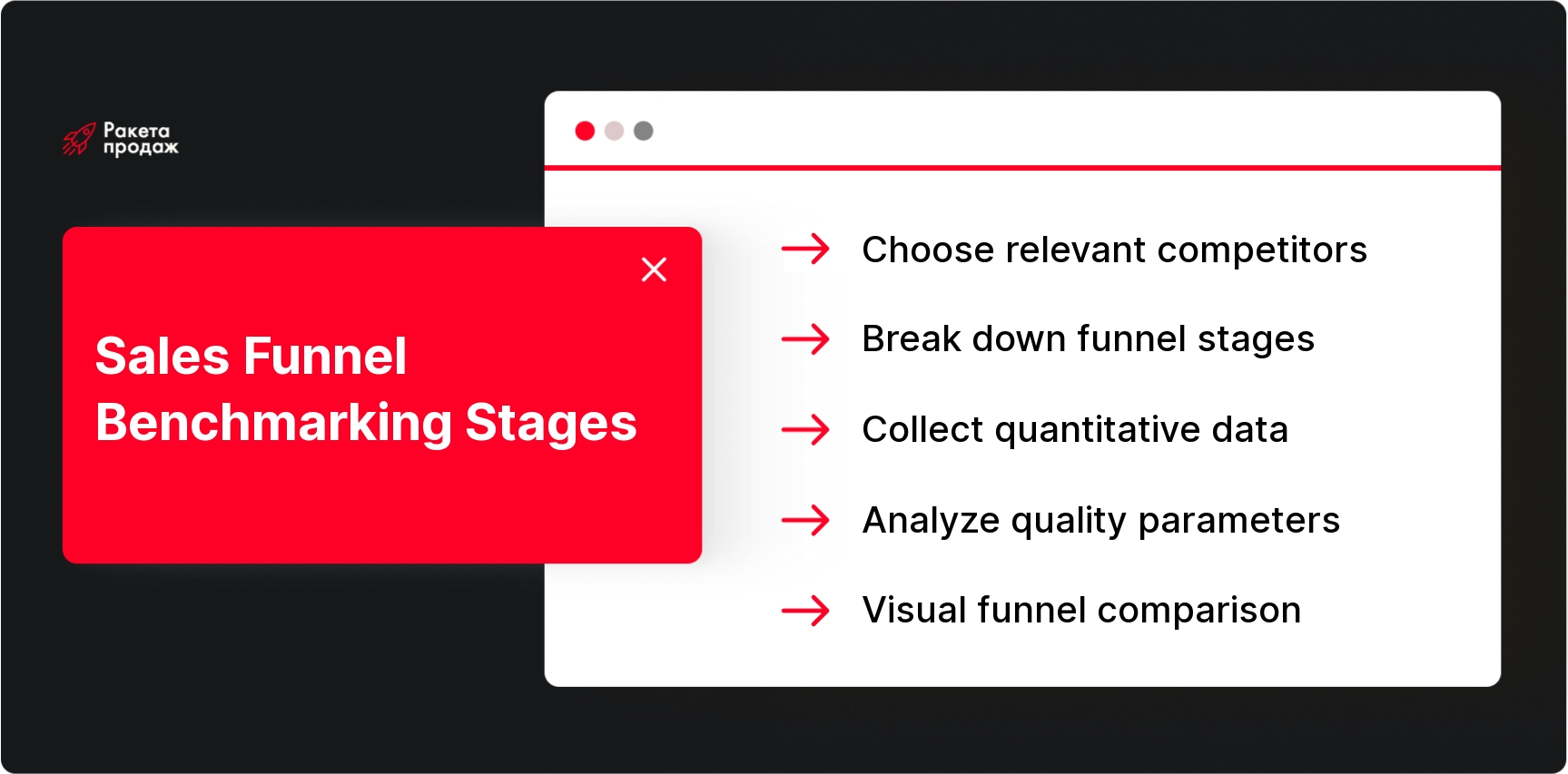
Main stages of competitive sales funnel analysis

image

Selecting companies for analysis

Quality benchmarking of competitors’ sales funnel is not a one-time action but a structured process involving several sequential stages. Let’s look at how to properly organize this analysis to get the most useful insights for your business.

  • The first and very important step is to determine exactly whom you will analyze. Not all competitors are equally useful for benchmarking. Choose companies that:
  • Operate in a market segment similar to yours
  • Have a comparable target audience
  • Demonstrate good growth or sales results
  • Use customer acquisition channels relevant to you

It’s recommended to include 3-5 direct competitors and 1-2 companies from adjacent areas that might offer interesting approaches to funnel building. Make a list and rank them by priority for your analysis.

Sales funnel decomposition

At this stage, you need to break down the sales funnel into clear stages that you will analyze. A typical structure includes:

  • Traffic acquisition stage: how potential customers learn about the company, which channels are used, which advertising messages are applied.
  • Lead capture stage: how the company collects potential customer contacts, what lead magnets it uses, how capture forms are organized.
  • Nurturing stage: how interaction with a potential customer occurs, what email chains, retargeting, or content are used.
  • Sales stage: how the purchase process is organized, what triggers are used to close deals, how hesitant customers are followed up.

For each stage, define specific elements and metrics that you will compare. For example, for the lead capture stage, these might be types of lead magnets, number of fields in forms, presence of social proof, etc.

Collecting quantitative data

Next, you need to collect numerical indicators for each stage of competitors’ funnels. These include:

  • Traffic volumes through various channels
  • Conversions between funnel stages
  • Average order value and purchase frequency
  • Average deal cycle length
  • Customer acquisition cost
  • Return on investment indicators

To collect this data, you can use special competitor analysis tools, industry reports, and calculations based on public information (for example, the approximate number of customers can be estimated from reviews or analytics service data).

For more information on which metrics to consider and how to apply them, check out the material on key sales metrics, which breaks down the main indicators affecting the entire customer journey.

Recording qualitative parameters

In addition to numerical indicators, it’s important to analyze the qualitative aspects of the sales funnel:

  • User experience at each stage
  • Content and style of marketing messages
  • Unique selling propositions and offers
  • Trust elements and social proof
  • Visual design and branding

For this, you’ll need to go through the entire customer journey with competitors: visit their websites, subscribe to newsletters, fill out forms, study the order process, etc. Record all details that might influence the purchase decision.

Tools and methods for collecting data about competitors' funnels

There are many tools and methods for conducting quality benchmarking of competitors’ sales funnels. The right combination of professional services and manual analysis will allow you to create a complete picture of how your competitors’ funnels work.

Among professional tools for competitor analysis, services like Semrush, SimilarWeb, and AdBeat are particularly useful. They allow you to assess competitors’ traffic volumes and sources, keywords they promote, active advertising campaigns, and even approximate advertising budgets. This data helps understand how competitors attract audiences at the upper funnel stages.

For collecting and processing this kind of information, check out the best analysis tools, which significantly speed up and simplify the process of studying others’ funnels.

For deeper analysis, it’s worth using “manual” research methods. One of the most effective approaches is going through a competitor’s funnel as a potential customer. Subscribe to their newsletters, request demos or consultations, add products to your cart. Track what steps they ask you to take, what messages you receive, how quickly they contact you, what arguments they use to close the deal.

“Screenshot-ing” competitors’ ads provides great value. Create an archive of their advertisements, banners, social media posts. Analyze what offers they use, what pain points they press, what benefits they emphasize. This will help you understand their strategy for attracting and converting customers.

Studying competitors’ email sequences gives insight into how they nurture their audience. Subscribe to their newsletters from several addresses (you can emulate different types of clients) and analyze email frequency, content, calls to action, technical characteristics (sending time, personalization).

Heat maps and recordings of user behavior on your site can be used for comparison with assumptions about how users behave on competitors’ sites. Although you cannot install such tools on others’ resources, comparing your behavioral analytics with visual analysis of competitors’ sites can reveal interesting patterns.

It’s also useful to study competitors’ retargeting mechanisms. Visit their site, browse several pages, and track what ads you start receiving. This shows how they work with those who showed interest but didn’t complete the target action.

If you’re interested in a broader view of competitive benchmarking to assess your position in the market, this approach is recommended for expanded sales funnel analysis.

How to use funnel benchmarking results for sales growth

Collecting data about competitors’ sales funnels is only half the job. The key question is: how to turn this information into specific actions that will lead to growth in your sales? The right approach to using benchmarking results can significantly accelerate your business development.

One of the most useful methods at this stage is comparison of the sales funnel with competitors. When you visually compare your funnel with competitors’ funnels, it becomes easier to see at which stages the greatest loss of customers occurs, what tools other companies use, and which elements of their funnel help increase conversion.

The first step is building a funnel map. Visualize your current sales funnel, marking conversions between stages, main customer touchpoints, and tools used. Create similar maps for competitors’ funnels next to it. Such visual comparison will help quickly identify structural differences and potential areas for improvement.

Then you need to determine benchmark indicators for your market. Based on collected data, establish what conversions between funnel stages are considered good in your industry. For example, if most competitors have a lead-to-deal conversion of 15%, and you have less than 5%, this is a clear sign of a problem at this stage.

After determining benchmarks, find growth points – those funnel stages where your indicators significantly lag behind competitors. For an evaluation of competitors’ funnel, analyze what exactly they do better at these stages: do they use more attractive offers? have a simpler ordering process? apply effective triggers for decision-making? Formulate specific hypotheses about what can be improved.

The next step is testing hypotheses. Don’t try to rebuild the entire funnel at once. Start with the most problematic places and gradually implement changes inspired by competitors’ best practices. Conduct A/B testing for each change to ensure its effectiveness specifically for your audience.

If you’re aiming for gradual improvement and adaptation of processes, check out recommendations on sales funnel optimization – this will allow you to implement useful changes step by step without disrupting the integrity of the entire scheme.

Finally, implement successful changes in your workflow and continue monitoring. Benchmarking is not a one-time event but an ongoing process. Regularly update data about competitors’ funnels and adjust your strategy according to market changes.

An important element of successful sales growth is also funnel comparison with competitors on a regular basis. This process allows not only to identify new trends but also to quickly adapt your strategy to changing market conditions.

Competent benchmarking of the sales funnel is not just collecting data about competitors, but a strategic tool for radically improving your business efficiency. But to really get significant results, you need a comprehensive approach based on deep experience and proven methodology. “Rocket Sales” offers not just analysis, but complete systematization of your sales department: we design an optimal funnel, implement automation tools, set up KPIs and reporting systems. After our work, you get a documented and digitized sales funnel, identified “bottlenecks,” specific optimization recommendations, and transparency of all processes. We’ve worked with companies like Mitsubishi, Audi, Ford, and Naftogaz, helping them systematically increase sales. Our approach has proven its effectiveness: clients get conversion increases of 5-86% and a stable monthly influx of new customers of the highest level.

Stop guessing how your competitors work - create a sales funnel that will exceed industry standards and increase your turnover by 35%!

Conclusion

Benchmarking competitors’ sales funnel is not just a marketing tool but a strategic approach that can radically change your business efficiency. Systematic analysis of how competitors attract, convert, and retain customers opens new opportunities for growth and optimization. Instead of acting blindly or relying only on your own experience, you gain access to market-tested solutions and approaches.

Comparative analysis of the sales funnel with leading players in your niche gives an objective picture of where you stand relative to the market. The competitors’ sales funnel becomes a kind of benchmark for comparison and measuring your progress, allowing you to adopt best practices while adapting them to your needs.

Industry and competitor data become a valuable resource that allows you to regularly improve each stage of your sales funnel, stay ahead of the market, and increase profits even in conditions of fierce competition.

In this article:
See more
Book a FREE sales funnel audit
CONTACT US
FAQ
How to conduct an analysis of competitors' sales funnels?

To analyze competitors’ sales funnels, select 3-5 relevant companies, break down their funnels into stages (attraction, lead capture, nurturing, sales), collect data using specialized tools and manual methods, walk through the customer journey, recording all touchpoints and triggers, and then compare the results with your own funnel. The stages are described in more detail in the sales funnel analysis section.

What data can you get when analyzing competitors' sales funnels?

When analyzing competitors’ funnels, you can obtain information about traffic attraction channels, types of lead magnets used, lead qualification process, average conversions between funnel stages, deal closing triggers, average deal cycle time, customer retention methods, and repeat sales.

What metrics are used to compare sales funnels?

The main metrics for comparing sales funnels include conversions between stages (from visitor to lead, from lead to customer), cost of acquiring a lead and customer, average order value, purchase frequency, churn rate, funnel completion time, return on investment indicator, and customer lifetime value.

What tools help analyze competitors' sales funnels?

For analyzing competitors’ sales funnels, tools like Semrush and SimilarWeb are used to assess traffic, AdBeat for advertising analysis, heat map services for understanding user behavior, CRM systems for comparing conversions, as well as specialized competitive intelligence platforms. Additionally, manual methods are applied – screenshot-ing ads, subscribing to email newsletters, and mystery shopping.

How does comparing funnels with competitors help improve sales?

Comparing your funnel with competitors allows you to identify weaknesses in your sales process, determine industry conversion standards, adopt successful methods of attracting and retaining customers, and find untapped niches. This leads to more efficient distribution of your marketing budget and, as a result, improved conversion at each funnel stage.

SUBSCRIBE TO MY TELEGRAM CHANNEL
The most valuable sales information right on your phone!
icon

LOTS OF USEFUL INFORMATION, FREE TEMPLATES, AND CHECKLISTS ON MY INSTAGRAM

Materials and practical advice on sales growth in our blog: