Choosing a training format should be a strategic decision based on specific business goals and capabilities, not on fashion trends or leadership preferences. It’s important to understand that different tasks require different approaches to training.
For implementing new work standards or radically changing the sales approach, it’s better to choose the offline format. The trainer’s personal presence and the possibility of immediate feedback help overcome resistance to change and ensure everyone correctly understands the new requirements.
When large-scale training of many employees with different preparation levels is required, online sales training becomes most effective. It allows quick information delivery to all participants, ensuring uniformity of material presentation.
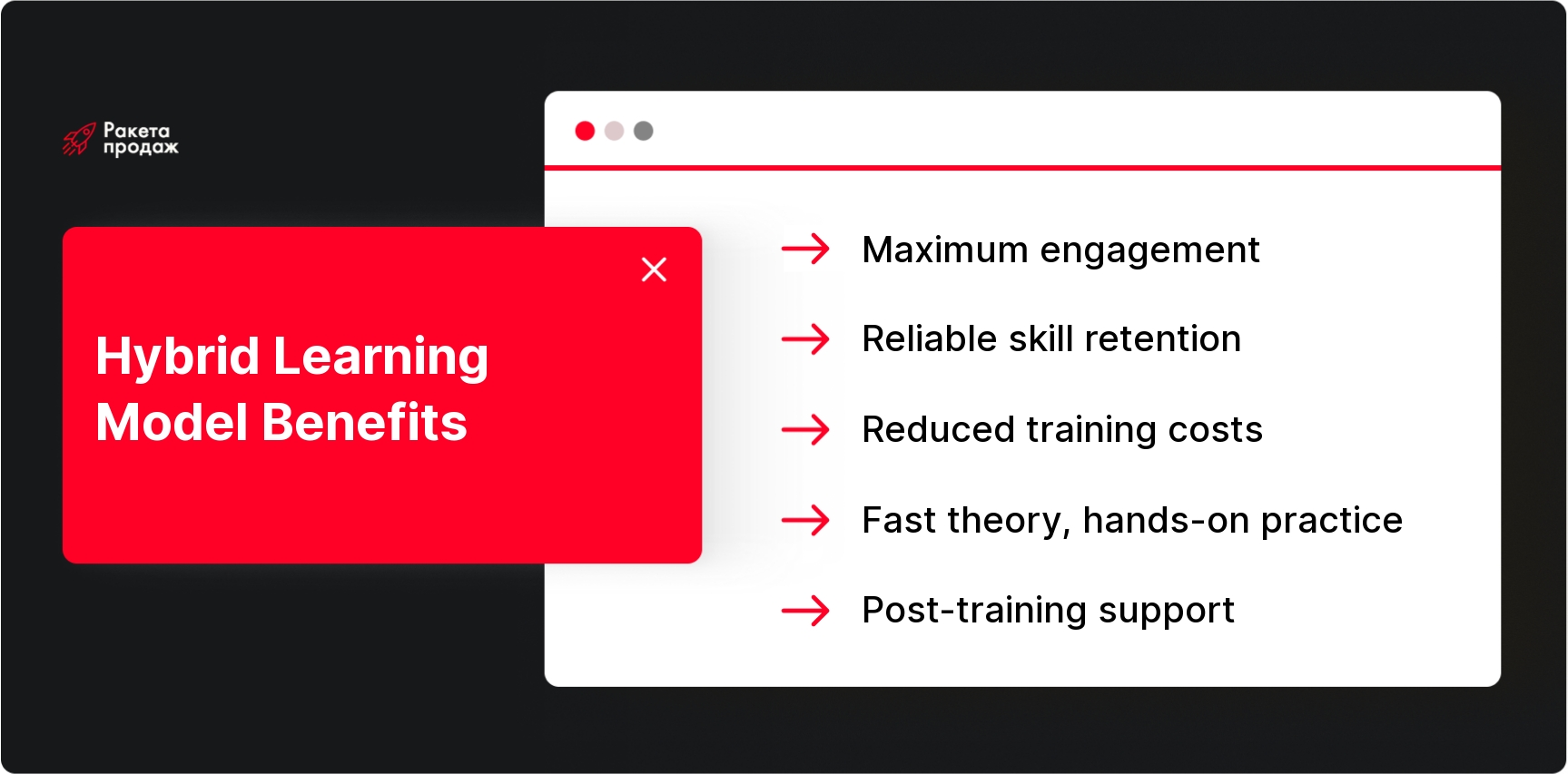
Sales trainings come in different types, and for achieving sustainable changes in seller behavior and forming new skills, the blended model is the optimal choice. It provides both theoretical foundation and practical application with subsequent reinforcement in real work.
Before choosing a suitable program, it makes sense to conduct a team competency audit to diagnose real gaps and outline development direction. For this, a detailed instruction how to conduct a sales department audit may be useful.
The course content should be directly related to the company’s business goals. If the goal is to increase average check size, the program should focus on upselling techniques and deal expansion. If the problem is in lead-to-client conversion, attention should be paid to initial negotiation skills and objection handling.
It’s important to adapt the training methodology to your market segment specifics and company features. Universal programs rarely give good results. For example, sales techniques that work in the B2C segment may be ineffective in complex B2B sales with a long cycle.
Another relevant trend is becoming sales personalization considering unique tasks, products, and audiences, companies achieve greater effect and skill reinforcement.
Tip: When choosing a training program, pay attention not only to content but also to post-training support availability. Without reinforcement and support, the training effect will quickly disappear.
Customizing the program to your business processes and products is another important aspect. Training should use real examples from your company’s practice, scripts relevant to your product, and objections your managers actually face.
Tip: When choosing a training provider, request the possibility of program customization and material adaptation to your business specifics.
The training results evaluation system should be thought out before the program starts. It’s necessary to determine which metrics will be tracked, how progress will be measured, which indicators will be considered successful. For successful training implementation and results management, sales enablement is extremely important, as well as a support system after the main program.


 Time to read: 9 min.
 12 November 2025