icon

Sales Manager Performance Evaluation During Audit: Modern Methods and Tools

In a competitive market, business success is largely determined by the effectiveness of sales managers. Proper and systematic evaluation of employee performance is necessary to increase profits, identify weak areas, and optimize sales processes. Errors in analysis lead to customer loss, decreased motivation, and deterioration of customer experience.

Key Takeaways

  • A manager with high sales volume but low client retention and average order value delivers less long-term impact than a colleague with more modest numbers but strong loyalty and upselling.
  • The number of calls and meetings ≠ effectiveness. If actions don’t move customers to the next funnel stage, that activity adds no value to the business.
  • Evaluating by sales volume alone pushes managers to sell mismatched products, make unfounded promises, and neglect service quality. The result is reputational damage and higher customer churn.
  • AI call analysis surfaces specific phrases, intonations, and conversation patterns that correlate with successful deals—often invisible even to experienced leaders.
  • Your audit must assess not only results but the process. Weak spots early in the funnel don’t appear in financial reports, yet they significantly affect overall performance.

In the article, you’ll find concrete evaluation metrics, tools to automate analysis, and a step-by-step roadmap for implementing a fair manager evaluation system 👇

Today, companies face serious challenges: rising customer acquisition costs, increased consumer expectations, and high staff turnover. All these factors force businesses to seek reliable ways to evaluate salespeople, helping to control team performance and develop its potential.

By introducing objective and technological approaches to auditing, a company can improve service levels and accelerate market growth. This article examines key criteria, modern methods, and AI tools that evaluate sales managers’ work comprehensively and effectively.

Why It's Important to Evaluate Sales Managers' Effectiveness During a Sales Audit

Sales manager performance evaluation during audit is a strategic business development tool. Why is it so important? First of all, sales is a department that directly affects company revenue. If the team works ineffectively, this immediately impacts financial results.

Imagine a situation: a company spends serious budgets on marketing and lead generation, but doesn’t control how managers process these inquiries. As a result, even the “hottest” leads go to competitors due to poor service quality or slow response. Regular audits help identify such problems before they lead to substantial losses.

Additionally, today’s market is constantly changing. Customers are becoming more informed and demanding. New communication channels appear, and competition grows. In such conditions, a company must adapt quickly, which is impossible without understanding the effectiveness of current sales processes and employee qualifications. Only objective evaluation allows making informed decisions about necessary changes.

Here are the key reasons why auditing manager effectiveness has become a necessity:

  • Growing competition and customer requirements – consumers expect a personalized approach and high service levels at all interaction stages
  • Lead generation costs and risks of losing them – customer acquisition costs are constantly rising. Companies cannot afford to lose them due to poor manager performance
  • Training in conditions of qualified personnel shortage – identifying strengths and weaknesses helps create effective training and staff development programs

Sales effectiveness evaluation allows companies to build training and development processes based on real data, not assumptions. This is especially important given the high turnover in sales, when new employees need to be prepared quickly and efficiently. Knowing typical problems helps create more precise and effective adaptation programs. Let’s examine existing methods for evaluating manager effectiveness and how to apply them correctly. If you’re interested in step-by-step recommendations, pay attention to sales department audit methods.

Why is it important today not just to measure sales results, but to comprehensively evaluate each manager’s effectiveness? Because even the “hottest” leads can go to competitors due to poor service, and customer acquisition costs are constantly rising. At “Rocket Sales,” over 7+ years we’ve developed a systematic sales department audit methodology that includes not only quantitative KPI analysis, but also qualitative evaluation of manager communications, script development, and quality control system implementation.

Our experts listen to calls, analyze correspondence, evaluate CRM usage, and identify critical “bottlenecks” in your team’s work. Based on the audit results, you receive not just a report, but a detailed action plan for immediate efficiency improvement. The average conversion growth for our clients ranges from 5% to 86%, with turnover increases reaching +35%, with the best result being +$1.6 million over 4 months of work.

Transform your sales department into a predictable profit generator - order a comprehensive sales manager audit!

Methods for Evaluating Manager Effectiveness

Evaluating sales manager effectiveness is a multifaceted process that goes beyond just analyzing sales volume. The modern approach involves a comprehensive assessment of managers’ effectiveness during an audit that examines various aspects of an employee’s work: from quantitative indicators to communication quality and customer approach.

It’s important to understand that there is no universal method suitable for all companies. The choice of evaluation techniques depends on business specifics, product type, company strategy, and the goals you want to achieve. Let’s consider the main approaches to evaluating sales managers’ performance.

KPI Analysis: Quantitative Performance Indicators

Key Performance Indicators (KPIs) are measurable metrics that help assess how successfully a manager is moving toward achieving business goals. KPIs provide an objective picture of each employee’s productivity and allow comparing results of different managers. You can learn more about how to set up key performance indicators in a separate article.

KPI analysis is based on the principle “what gets measured gets improved.” When managers clearly understand the parameters for evaluating their work, they naturally focus on improving these indicators. It’s important to remember that incorrectly selected KPIs can lead to distortion of business processes.

Effective KPI analysis includes several key indicators rather than relying on just one. The main KPIs for sales managers:

  • Number of leads and conversion – how many potential clients the manager processed and what percentage became actual buyers
  • Average check – the average purchase amount that the manager’s clients make
  • LTV (Lifetime Value) – the total amount of money that a client brings over the entire period of cooperation with the company
  • Number of repeat deals – shows how successfully the manager builds long-term relationships with clients

When calculating the overall KPI efficiency index, use a weighted formula that takes into account the importance of different indicators. For example:

KPI-index = (Sales volume plan fulfillment × 0.4) + (Conversion × 0.3) + (Average check × 0.2) + (Number of repeat sales × 0.1)

It’s important to adapt the KPI system to your business type. For example, in B2B sales with a long deal cycle, more attention should be paid to funnel progression indicators and client work quality. In the high-ticket segment, average check and client retention are more important, while in mass B2C business – conversion and volume.

A typical mistake in KPI analysis is “measuring everyone with the same yardstick.” If you don’t take into account the difference between new and experienced employees, different client segments, or seasonality, this will lead to team demotivation and incorrect management decisions. The next method will help supplement quantitative analysis with qualitative assessment.

360° Method: Comprehensive Evaluation

The 360-degree method is a multifaceted employee assessment that takes into account the opinions of everyone they interact with: managers, colleagues, clients, and even self-assessment. This approach gives a holistic view of the manager’s work and allows seeing their strengths and weaknesses from different angles.

Unlike KPI analysis, which focuses on results, the 360° method also evaluates the process and competencies. It’s especially valuable for understanding a manager’s “soft” skills, which often have a decisive influence on sales success.

Key qualities evaluated by the 360° method:

  • Communication skills – ability to establish contact, convey information, listen to the client
  • Stress resistance – ability to maintain productivity in difficult situations and when working with difficult clients
  • Customer orientation – ability to understand client needs and offer solutions, not just products
  • Strategic thinking – ability to build long-term relationships and see prospects

Conducting a 360° assessment usually includes questionnaires with a series of statements that are rated on a scale (e.g., from 1 to 5). It’s important that the questions are specific and objective, for example: “The manager always calls clients back at the promised time” or “The employee finds an individual approach to each client.”

The complexity of the 360° method lies in the need to combine “soft” and “hard” metrics. For this, use weights for different assessment categories or create an integral indicator. For example, overall effectiveness can consist of 60% quantitative indicators and 40% qualitative assessments.

The results of 360° assessment can be an excellent basis for personal coaching and manager development. They reveal problems and hidden potential of employees. At the next stage, it’s worth supplementing the overall picture with an analysis of the manager’s specific actions. We also recommend learning how sales manager certification helps in objectively testing their competencies and preparing individual development plans.

Activity Analysis (Pipeline Performance)

Activity analysis, or pipeline performance, focuses on what exactly the manager does in the process of working with clients and how effective these actions are. This method helps understand why some employees show high results while others don’t, and identifies specific points for improvement.

Modern CRM systems make it possible to track many activity parameters: number of calls, emails, meetings, tasks, and other interactions with clients. However, the simple quantity of actions doesn’t always lead to results – the quality and correctness of these actions are important.

The key principle of activity analysis is identifying “success patterns” – sequences of actions that most likely lead to closing a deal. Here, AI and BI tools come to help, capable of analyzing large volumes of data and finding hidden patterns.

For example, analysis shows that successful managers usually perform the following actions:

  • Contact the lead no later than 1 hour after their inquiry
  • Send a personalized commercial proposal within 24 hours
  • Make a follow-up call the day after sending the proposal
  • Conduct at least one personal meeting before closing the deal

It’s important to track overall activity and the effectiveness of each sales funnel stage (conversion by stage). This makes it easy to identify at which stage the manager has problems: lead generation, qualification, presentation, closing the deal – and focus training specifically on these aspects.

Activity analysis helps draw a clear line between “doing a lot” and “doing effectively.” A manager may make many calls and meetings, but if they don’t move clients to the next funnel stage, such activity doesn’t benefit the business. Proper analysis helps direct employees’ energy in a productive direction, and sales evaluation automation allows getting such data for each manager faster and more accurately.

The next method allows looking at manager effectiveness through the lens of a traditional marketing tool, but from an unusual angle.

RFM Analysis at the Manager Level

RFM analysis is traditionally used for client segmentation, but this same approach can be applied to evaluating sales manager effectiveness. This non-standard method allows identifying the strengths and weaknesses of each employee and understanding who is most productive in the long term.

In the context of manager evaluation, RFM analysis parameters are interpreted as follows:

  • Recency (recency of sales) – the date of the manager’s last closed deal. A short interval means current activity and a stable flow of operations
  • Frequency – the number of closed deals per unit of time. Shows work rhythm and result predictability
  • Monetary (volume) – the total revenue generated by the manager’s clients. Reflects the ability to work with large budgets and increase the average check

For RFM analysis of managers, each parameter is assigned a score (for example, from 1 to 5). Then the scores are summed or multiplied to obtain an overall rating. This approach allows identifying different effectiveness profiles:

  • Managers with high scores on all parameters – team “stars”
  • Managers with high frequency but low deal amounts – specialists in mass sales
  • Managers with rare but large deals – experts in working with key clients

RFM analysis results can be visualized as a matrix or heat map. In this interpretation, they are more visual and convenient for management decisions. Such analysis helps evaluate current effectiveness and identify the development potential of each employee.

RFM analysis is especially useful for companies with a diverse client base. It’s important to understand which managers better handle certain types of clients. This way you can optimally distribute leads and maximize the overall effectiveness of the department. But for a complete picture, quantitative analysis needs to be supplemented with a qualitative assessment of communications.

Qualitative Assessment: Communications and Client Approach

The quality of a manager’s communication with clients often becomes the decisive factor in sales success. Even with perfect quantitative indicators, unsuccessful communications lead to client loss. Therefore, qualitative assessment of client interaction is a necessary component of a comprehensive sales performance audit.

Traditionally, communication quality was assessed through call listening or mystery shopping. Today, these methods are complemented by technological solutions: AI and speech analytics allow automatically analyzing huge volumes of communications and identifying patterns.

When assessing communication quality, pay attention to the following aspects:

  • Adherence to scripts and key conversation stages
  • Tone and emotional coloring of speech
  • Response speed to client requests
  • Quality and regularity of follow-up communications
  • Use of active listening techniques

Communication analysis helps identify phrases and approaches that correlate with successful deals. For example, research shows that managers who ask open-ended questions, actively listen to clients, and use the “we-approach” in conversation more often close deals successfully.

In modern B2B sales, a manager’s emotional intelligence is especially important – the ability to read a client’s mood, adapt their communication style, and build trusting relationships. Although “soft” skills are difficult to measure quantitatively, they have a huge impact on sales results.

When evaluating communication quality, it’s important to consider context. For example, different communication styles are effective in different industries and for different client types. Evaluation criteria should be adapted to the business specifics and target audience.

Qualitative communication assessment complements quantitative methods and provides a more complete picture of manager effectiveness. It’s especially important for staff development as it allows giving specific feedback and recommendations for improvement.

Tools for Evaluating Manager Effectiveness

Modern technologies open up wide possibilities for evaluating sales manager effectiveness. Using specialized tools allows automating data collection, obtaining objective information, and conducting in-depth analysis. The main categories of tools that help conduct a quality sales department audit are as follows.

CRM Analytics

CRM systems have long ceased to be just a client database and have become a powerful analytics tool. They record all interactions between managers and clients, which allows conducting a detailed analysis of each employee’s and the entire department’s effectiveness.

Modern CRM systems track results (closed deals) and the work process: number of calls, sent emails, conducted meetings, response time to client inquiries. This makes it possible to identify problems before they affect financial indicators.

Main reports that should be regularly analyzed in the CRM system include:

  • “Time to deal” – shows how much time on average passes from the first contact to closing the deal. Long cycles indicate problems in the sales process
  • “Number of touches” – reflects how many interactions with the client are required to close the deal. An excessive number of contacts indicates an inefficient process
  • “Reasons for refusals” – help identify typical problems that managers face and adjust the sales approach

CRM systems such as KeepinCRM, KeyCRM, Pipedrive, HubSpot, Zoho, and Salesforce are popular on the Ukrainian market. Each has its own features and may be more or less suitable for a specific business depending on its scale and specifics.

CRM analytics is especially valuable because it allows seeing the complete picture of a manager’s work: from the first contact with a lead to after-sales service. It provides a quality opportunity to identify problems with closing deals and difficulties in the early stages of the funnel that are not reflected in financial reports but significantly affect overall effectiveness. For deeper analysis of data from CRM systems, specialized BI platforms can be used.

BI Platforms (Power BI, Tableau, Google Data Studio)

Business analytics (BI) platforms take data analysis to a new level, allowing creating custom dashboards and conducting multidimensional effectiveness analysis. They integrate with CRM and other systems, collecting data from various sources and presenting them visually.

Unlike standard CRM reports, BI platforms make it possible to build more complex data models, identify hidden patterns, and conduct predictive analysis. This is especially valuable for large companies with a large staff of managers and a diverse client base.

Key capabilities of BI platforms for evaluating manager effectiveness:

  • Comparison of indicators between different teams, regions, or periods
  • Identification of trends and seasonal fluctuations in effectiveness
  • Analysis of correlations between various metrics
  • Prediction of future results based on historical data

Additionally, graphs provided by BI platforms help see the picture in seconds. They highlight trends, comparisons, and bottlenecks that are difficult to notice in tables. This accelerates decision-making and reduces the risk of erroneous conclusions. Here are examples of useful graphs that can be created using BI platforms:
* Conversion dynamics by funnel stages for each manager
* Distribution of sales share by products, regions, or client segments
* Comparison of actual results with planned indicators
* Heat maps of manager activity by days of the week and time of day

Implementing BI analytics allows sales department managers to make more balanced, data-based decisions rather than intuition-based ones. This is especially important when scaling a business, when personal familiarity with each manager’s work becomes impossible.

Power BI from Microsoft, Tableau, and Google Data Studio are the most popular BI solutions, each with its own advantages. Power BI features deep integration with other Microsoft products, Tableau offers powerful visualization capabilities, and Google Data Studio attracts with ease of use and accessibility.

Data obtained through BI analytics can be used to evaluate current effectiveness and to plan training and development of managers.

Learning and Development Systems (LMS)

Learning Management Systems (LMS) also play an important role in conducting training and evaluating manager effectiveness. They allow connecting learning results with practical performance indicators and building personalized development programs for each employee.

Modern LMS closely integrate with CRM and other systems, allowing tracking how training impacts business results. For example, they make it easy to see if conversion rates improved after completing a sales techniques course or if the number of objections decreased after training on handling objections.

Key LMS capabilities for evaluating and developing managers include:

  • Testing knowledge of products, scripts, and sales techniques
  • Competency assessment through practical tasks and cases
  • Analysis of learning progress and its impact on sales indicators
  • Formation of individual development plans based on identified gaps

The most effective approach to training and developing managers can be described by the cycle “Learn → Apply → Measure → Improve”. LMS allows implementing this cycle in practice, connecting theoretical knowledge with real results.

There are many LMS platforms on the market, including EdApp, 360Learning, and Sintegrum. When choosing a system, it’s important to pay attention to integration possibilities with current tools and ease of use for both administrators and employees.

A properly configured LMS allows evaluating manager effectiveness and promptly addressing identified gaps in knowledge and skills. It makes the development process more targeted and effective. For even deeper analysis of manager work, AI tools can be used.

AI Communication Analysis Tools

Artificial intelligence is revolutionizing ways to evaluate the quality of manager-client communications. AI systems can analyze thousands of calls and correspondence, identifying patterns of successful sales and typical mistakes that a human might miss. In this regard, we recommend learning how to use artificial intelligence for call analysis in the sales department.

Modern AI tools go far beyond simple conversation transcription. They analyze voice tone, emotions, context, pause duration, and many other parameters that affect communication quality and the probability of successful sales.

Examples of what AI systems can analyze:

  • Scripts and key phrases – how accurately the manager follows the recommended script and whether they use phrases that increase the likelihood of a sale
  • Tone and emotionality – how friendly, confident, and convincing the manager sounds
  • Speaking time ratio – the optimal balance between how much the manager and the client talk
  • Speech speed and pauses – conversation pace and ability to make strategic pauses
  • Handling objections – how the manager responds to client doubts and refusals

Various AI solutions for communication analysis are available on the market: Gong, Refract, Avoma, Microsoft Copilot. They differ in functionality, cost, and implementation complexity, but all aim to improve the quality of client interaction.

AI tools are especially valuable as they help identify successful communication patterns that aren’t obvious even to experienced managers. For example, analysis might show that successful sales more often occur when the manager asks certain questions at the beginning of the conversation or uses specific wording when presenting price offers.

It’s important to remember that AI analysis is not a replacement for human evaluation, but an additional tool that helps make assessment more objective and scalable. AI analysis results should always be interpreted taking into account the context and business specifics.

How to Interpret Evaluation Results

Collecting data is only half the battle. It’s equally important to correctly interpret the results of manager effectiveness evaluation in order to make informed management decisions. Without proper interpretation, even the most accurate data will lead to erroneous conclusions and ineffective actions.

The first key aspect of interpretation is the ability to distinguish temporary deviations from systemic problems. Every manager can experience a period of sales decline due to seasonality, market changes, or personal circumstances. Before drawing conclusions, it’s important to analyze the dynamics of indicators over time and compare them with general team trends.

The second important component is multifactorial analysis. Evaluation based only on sales volume gives a distorted view of manager effectiveness. For example, an employee with high sales volume but low client retention and average check may in the long run bring less benefit to the company than a manager with more modest volume but excellent loyalty and up-selling indicators.

For visual presentation of evaluation results, it’s convenient to use an “effectiveness matrix.” Plot performance (sales volume, plan fulfillment) on the horizontal axis, and process quality (adherence to standards, communication quality, customer orientation) on the vertical axis. This matrix allows dividing managers into several typical profiles:

  • “Stable performer” – a manager with average indicators in both results and process. This is usually a reliable employee who lacks ambition or certain skills for a breakthrough
  • “Star with risks” – a manager with high results but low process indicators. Such an employee often achieves sales at any cost, which can lead to problems with client loyalty and company reputation
  • “Development potential” – a manager with high process quality but so far low results. These are usually new or transferred employees who need time to develop skills or adapt to the product
  • “KPI problem” – a manager with low indicators in both results and process. Requires special attention from the manager and, possibly, reconsideration of job suitability

Each profile requires its own approach to development and motivation. “Stable performers” need new challenges and incentives for growth, “Stars with risks” need training in proper processes and company values, employees with potential need support and gradual plan increases, and “problematic” ones need intensive training or transfer to another position.

When interpreting results, it’s important to consider external factors: market changes, competitor actions, seasonal demand fluctuations. This will help avoid hasty conclusions and make more balanced decisions.

Mistakes in Evaluating Manager Effectiveness

image

Even when using the most modern tools and methodologies, companies often make mistakes when evaluating sales manager effectiveness. These lead to incorrect management decisions, employee demotivation, and missed opportunities for growth.

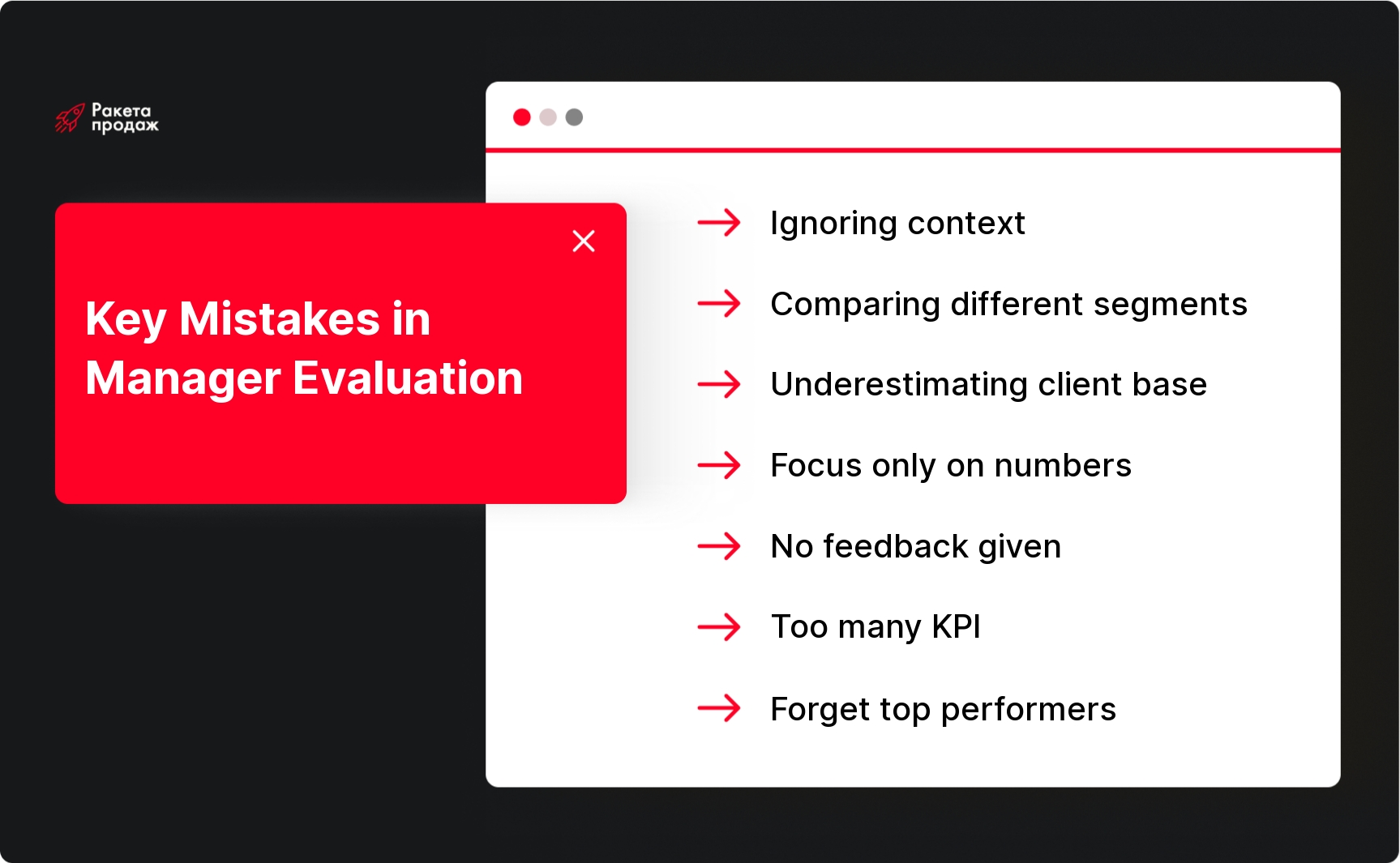
One of the most typical mistakes is using “raw” statistics without considering context. For example, comparing absolute sales figures between managers working with different products, territories, or client segments. Such comparison will inevitably be incorrect and demotivate employees working in more difficult conditions.

Ignoring differences in clients and regions is another common mistake. A manager working with corporate clients in the capital will have completely different indicators than a colleague serving small businesses in the region. For correct evaluation, it’s necessary to take these differences into account and possibly use different criteria or indicator weights.

Many companies make the mistake of underestimating intangible factors such as client engagement, satisfaction, and retention. A manager who brings in fewer new clients but works excellently with the existing base, increasing LTV and generating recommendations, will be less valuable to the company than a “hunter” for new deals.

Evaluation “by numbers” rather than “by process” often leads to short-term optimization at the expense of long-term results. When managers know they’re evaluated only by sales volume, they may neglect service quality, sell inappropriate products to clients, or give unfounded promises. As a result, the company’s reputation suffers and client churn increases.

Lack of feedback after the audit is a mistake that devalues all efforts to evaluate effectiveness. If audit results are not communicated to managers, not discussed with them, and do not become the basis for development plans, all evaluation work becomes meaningless. Managers should understand how they are evaluated, why certain results were obtained, and what they can do for improvement.

Another typical mistake is focusing only on underperforming and problematic employees. Often companies pay a lot of attention to those who don’t fulfill the plan, forgetting about developing average and even high-performing managers. As a result, the team’s potential is not fully utilized, and the best employees may feel undervalued.

An excessive number of KPIs can also become a problem. When a manager is evaluated by dozens of different indicators, they cannot focus on the main ones and disperses their efforts. It’s better to choose 3-5 key metrics that really affect business results and focus on them.

By avoiding these mistakes and applying a comprehensive approach to evaluation, businesses can create a fair and motivating system that contributes to the control and development of sales managers. To increase engagement and retain the best employees, pay attention to effective ways of motivating the sales department.

Recommendations for Implementing Comprehensive and Objective Evaluation in a Company

Implementing an effective sales manager evaluation system is a process that requires a consistent approach and attention to detail. A properly built system increases management transparency, creates the basis for continuous improvement of the team and business processes.

The key principle of a successful evaluation system is the balance between quantitative and qualitative indicators. Quantitative metrics (sales volume, conversion, average check) give an objective picture of results but don’t explain the causes of success or failure. Qualitative indicators (adherence to standards, communication quality, client experience) reveal “how” and “why,” helping identify growth points.

Transparency and clarity of evaluation criteria is another important factor. Managers should clearly understand what parameters their work is evaluated on, how indicators are calculated, and what specifically they can do to improve results. This understanding makes the system fair in the eyes of employees and directs their efforts in the right direction.

Regularity and timeliness of evaluation are critically important. Too rare analysis (once a year or half a year) does not allow promptly identifying problems and correcting the course. The optimal frequency is monthly evaluation of main KPIs with deeper analysis once a quarter. With this approach, the company will be able to see trends and make decisions while it’s still possible to correct the situation.

Automation of data collection and analysis is a necessary condition for objective and regular evaluation. Manual information collection takes a lot of time and creates the risk of human error or bias. Modern CRM and BI systems allow automating most of this process, leaving managers more time for interpreting results and working with the team.

It’s important to use practical steps for implementing a comprehensive evaluation system. They set unified rules, automate data collection, and remove subjectivity. They accelerate decisions, increase transparency and motivation, reduce losses at funnel stages. As a result, conversion and revenue grow, time to deal decreases, and training becomes targeted. Below is a brief implementation plan:

  1. Identify key business goals and derive metrics for evaluating managers from them. Indicators should be directly linked to what’s important for company success.
  2. Set up tools for automatic data collection (CRM, telephony, email tracking) and create an integrated reporting system.
  3. Develop a balanced scorecard that includes quantitative and qualitative metrics, taking into account business specifics.
  4. Involve managers in the implementation process – explain evaluation goals, gather feedback on proposed metrics, consider constructive suggestions.
  5. Create a culture of continuous improvement where evaluation results become the basis for development, not a punishment tool.

It’s important to remember that the evaluation system is not a static structure but a dynamic tool that should evolve with the business. As the company’s strategy, market conditions, or product line change, so do the criteria for evaluating effectiveness. Regular review and adjustment of the system will help maintain its relevance and effectiveness.

Working with employee motivation is an integral part of implementing an evaluation system. Managers should perceive evaluation as an opportunity for development and growth, not control and punishment. The connection between evaluation results, training, and career advancement makes the system more valuable in employees’ eyes and increases their engagement.

It’s equally important to ensure continuous improvement of the evaluation tools themselves. As data and experience accumulate, refine indicators, change their weight, and add new metrics that better reflect the connection between manager actions and business results. This way you’ll build a truly effective and adaptive evaluation system.

Conclusion

Objective and modern evaluation of sales managers’ work is a key factor in profit growth, business strengthening, and increasing client loyalty. Customer acquisition costs are rising. Competitive pressure is intensifying. Therefore, each interaction with a potential buyer should bring measurable value. Companies cannot afford to lose opportunities due to ineffective manager work or imperfect sales processes. Traditional evaluation methods based on analysis of sales volume and plan fulfillment are no longer sufficient for a complete understanding of effectiveness. They should be supplemented with comprehensive analysis of qualitative indicators, manager activity, and client experience. Automation and AI analytics open new possibilities for deep and objective auditing, allowing identification of hidden patterns and growth points. Companies implementing end-to-end analytics and regularly improving evaluation processes gain competitive advantages and more transparent sales management processes. They better understand the current situation and can predict future results, promptly adjust strategy, and develop the team in the right direction.

Evaluating manager effectiveness during an audit becomes not just a control procedure but a strategic tool for company development. Regular audit of sales performance allows identifying weaknesses and best practices suitable for scaling to the entire team. It’s important to remember that sales manager performance indicators should reflect current achievements and long-term growth potential.

As you can see, sales manager performance evaluation during audit is a multifaceted process that requires a comprehensive approach, modern tools, and a clear methodology. This is why business owners turn to professionals to quickly identify hidden problems in the sales department and maximize results.

“Rocket Sales” specializes in systematic auditing and development of sales departments with measurable results. We not only analyze your team’s current effectiveness but also implement proven solutions: from individual manager training programs to optimizing the sales funnel and automating processes. Our approach includes detailed communication analysis, development of scripts, checklists, and a quality control system that increases the effectiveness of each manager.

Over 7+ years of work, we have successfully implemented projects in 14+ industries, including collaboration with companies such as Mitsubishi, Naftogaz, and Crowne Plaza. Our clients note that after implementing recommendations, not only do sales increase (by an average of 15-30%), but expenses are optimized, staff turnover decreases, and management transparency improves.

Get an objective evaluation of your managers' effectiveness and a sales growth strategy with guaranteed results!
In this article:
See more
Book a FREE sales funnel audit
CONTACT US
FAQ
How can the effectiveness of a sales manager's work be evaluated?

Manager effectiveness is evaluated comprehensively through quantitative indicators (sales volume, conversion, average check, LTV) and qualitative metrics (adherence to standards, communication quality, client satisfaction). The modern approach includes CRM data analysis, call listening, 360° assessment, and using AI for communication analysis.

What are the 3 main qualities of a sales manager?

Key qualities of a successful manager: 1) Customer orientation – ability to understand client needs and offer optimal solutions; 2) Communication skills – ability to establish contact, ask the right questions, and effectively present offers; 3) Persistence – ability to guide the client through the entire sales cycle, overcoming objections and achieving deal closure.

What percentage should a sales manager have?

The optimal payment system usually includes 40-60% fixed part and 40-60% variable part depending on results. The specific ratio depends on the industry, sales cycle, and product cost. In B2B with a long deal cycle, the fixed part is usually higher, while in retail with quick sales, the emphasis is on bonuses.

What indicators are important for a sales manager?

Key indicators include: lead-to-client conversion, sales volume (revenue), number of closed deals, average check, client retention rate, activity (number of calls/meetings), lead processing speed, and percentage of successful follow-up contacts. It’s important to select indicators taking into account business specifics and its development stage.

How is the result of a sales manager's work measured?

The result is measured in monetary terms (sales volume, profit from deals) and in quantitative indicators (number of concluded deals, conversion percentage). Qualitative parameters are also taken into account: client satisfaction (NPS), percentage of repeat purchases and recommendations, adherence to service standards, and activity at key contact points.

SUBSCRIBE TO MY TELEGRAM CHANNEL
The most valuable sales information right on your phone!
icon

LOTS OF USEFUL INFORMATION, FREE TEMPLATES, AND CHECKLISTS ON MY INSTAGRAM

Materials and practical advice on sales growth in our blog: