Key Takeaways
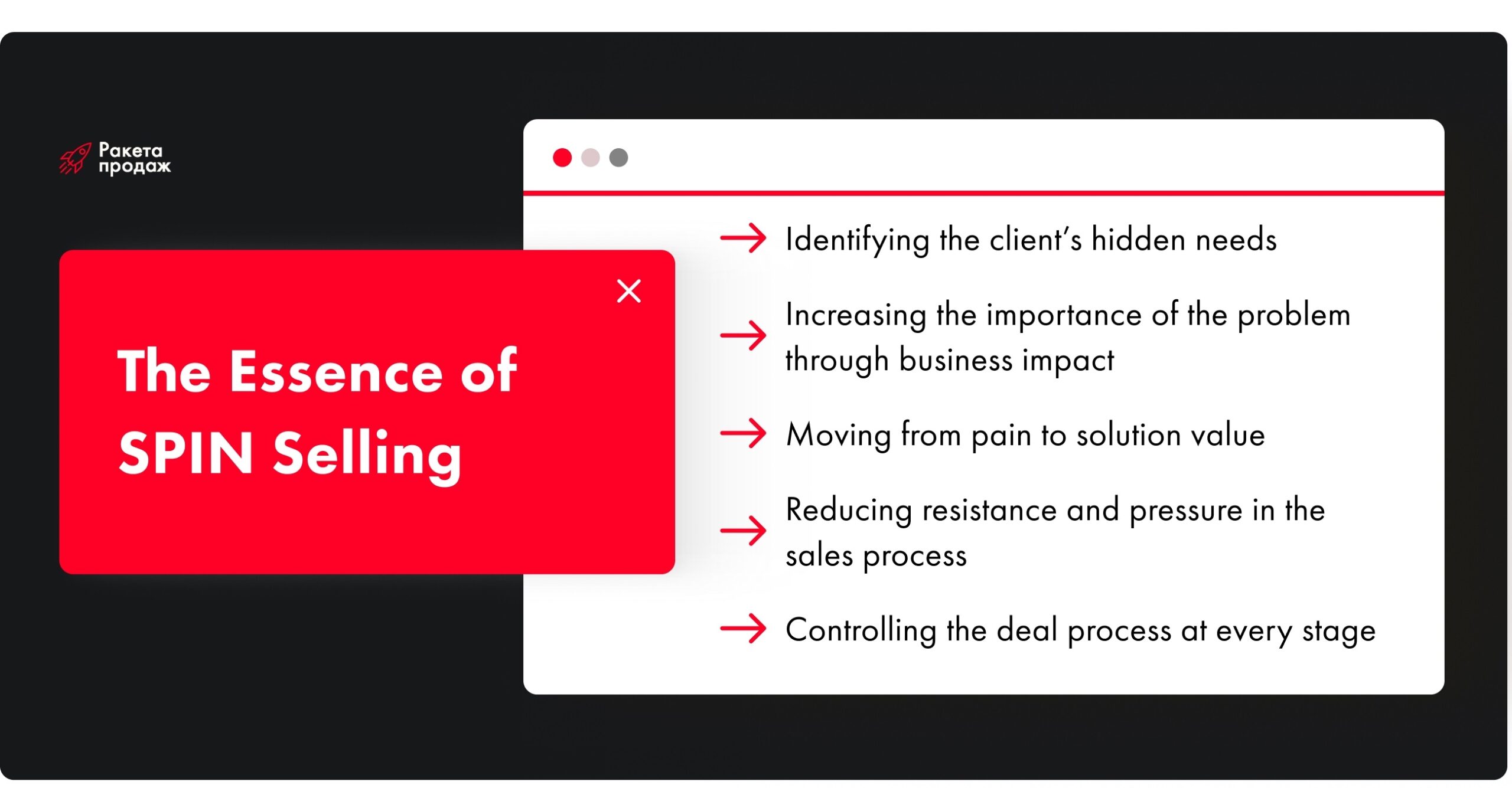
- SPIN sales are based on four types of questions: Situation, Problem, Implication, and Need payoff, helping clients independently recognize their need for your product.
- Situation questions should be limited (3 4 well formulated ones) to avoid making the client feel interrogated.
- Implication questions are the most powerful as they reveal the consequences of problems and demonstrate their impact on the client’s business metrics.
- Need payoff questions transform hidden needs into explicit ones and help the client articulate the value of your solution themselves.
- The SPIN technique works best with complex B2B products and long sales cycles where decisions are made rationally rather than emotionally.
In the full article, you’ll find detailed examples of each question type and a practical algorithm for implementing SPIN sales in your business 👇
The essence of the methodology is simple: instead of bombarding clients with your product’s benefits, you ask a series of structured questions that help them recognize their own needs. When clients come to the conclusion themselves that they need your product, resistance to purchase practically disappears. Let’s explore together what SPIN sales actually looks like in practice, along with the main stages and principles of this technique.
The spin sales technique is a methodology based on the sequential use of four types of questions aimed at uncovering a client’s hidden needs. But don’t confuse SPIN sales with the stage of identifying customer needs – these are completely different concepts. The SPIN acronym stands for:
- S – Situation questions – gathering information about the client’s current situation
- P – Problem questions – identifying existing or potential problems
- I – Implication questions – expanding understanding of problem consequences
- N – Need-payoff questions – focusing on the value of the solution
The key distinction of this methodology from classic sales techniques is that it’s client-oriented rather than product-oriented. Instead of describing your offering’s features and benefits, you help clients independently formulate their needs and recognize the importance of addressing them.
The SPIN methodology works especially well in situations involving complex products, lengthy sales cycles, and when decisions are based on rational rather than emotional factors. In other words, SPIN is a methodical approach that completely transforms the traditional sales process. What many people ask is “what is spin sales?” – simply put, it’s a questioning framework that guides prospects through a discovery process that reveals their true needs.
If you’re considering implementing SPIN sales methodology in your company, you likely already understand that successful sales aren’t just about individual manager talent, but a systematic approach to identifying customer needs. However, self-implementation of such methodologies often faces employee resistance and difficulties adapting theory to real cases. Raketa Prodazh helps companies not just learn the SPIN technique, but fully integrate it into sales department processes. As part of the spin marketing approach, our clients achieve average revenue growth of 35%, with conversion rates increasing up to 86% depending on the niche. Adopting the spin model for your sales team can transform how they engage with prospects.
Implement modern sales methodologies and increase company turnover in just 4 months – get a free consultation!
Types of Questions in SPIN Sales
Situation questions are the first stage in the SPIN methodology. Their purpose is to gather basic information about the client, their business, and current processes. They help you understand the context in which the client operates and establish initial contact.
It’s important to understand that situation questions shouldn’t be too numerous – 3-4 well-formulated questions are sufficient. An excess of such questions might make the client feel interrogated and negatively affect the conversation atmosphere.
Examples of situation questions:
- “Could you tell me a bit about your sales department structure?”
- “What tools are you currently using to manage your customer database?”
- “How long have you been working with your current supplier?”
- “How many employees are involved in this process?”
The main principle: don’t ask questions whose answers you can easily find yourself. Clients value your preparation and don’t like spending time on obvious things.
After gathering basic information, the most interesting part begins – problem questions aimed at discovering difficulties, dissatisfactions, or shortcomings in the client’s current situation.
Good problem questions should:
- Reveal hidden customer needs
- Point out inefficiencies in current solutions
- Lead to understanding the necessity for change
For example, a salesperson might ask:
- “What difficulties do you encounter when using your current CRM system?”
- “How satisfied are you with the speed of processing customer requests?”
- “What aspects of your current software don’t work for you?”
- “Which sales department processes take up the most time?”
The key point when asking problem questions is to be tactful. Don’t immediately point out problems; instead, give clients the opportunity to formulate them themselves.
Implication questions are considered the most powerful in the SPIN sales arsenal. Their purpose is to reveal and strengthen understanding of the consequences of problems identified in the previous stage. These questions help clients realize that the problem’s scale is much larger than initially thought. The main objectives of implication questions are:
- Showing interconnections between various problems
- Demonstrating problems’ impact on business metrics
- Strengthening motivation to find a solution
Examples of implication questions:
- “How does this delay in processing leads affect achieving your set goals?”
- “How much time do your employees spend manually entering data instead of working with clients?”
- “What are the financial consequences of equipment downtime for your business?”
- “How does this problem affect team motivation and staff turnover?”
Well-formulated implication questions make clients look at problems in a new way and recognize their true significance, increasing readiness to purchase your solution.
The final stage of the SPIN selling methodology is need-payoff questions. They help clients independently formulate the value of the solution and see the benefits of eliminating the problem. It’s at this stage that hidden needs transform into explicit ones, and the client becomes ready to consider your offer.
Need-payoff questions perform the following functions:
- Converting hidden needs into explicit ones
- Stimulating clients to understand the benefits of purchasing
- Preparing for solution presentation
Examples of need-payoff questions:
- “How valuable would it be for you to reduce order processing time by 40%?”
- “If you could automate this process, what opportunities would that open for your team?”
- “What impact would reducing downtime by 30% have on company profits?”
- “What would an ideal workflow look like for solving this task?”
Need-payoff questions should be open-ended and allow clients to formulate the advantages of your solution themselves. When clients talk about benefits themselves, their conviction in the necessity of closing the deal significantly increases.
Stages of Applying SPIN Sales
Applying the “SPIN funnel” methodology includes several sequential stages, each playing an important role in the sales process. Spin is a powerful framework that, when properly implemented through a spin sales technique, creates a natural progression toward closing deals.
Before meeting with a client, you need to:
- Study the client’s company, its market position, and main competitors
- Prepare a set of questions for each SPIN category
- Identify potential problem areas in the client’s business
- Consider how your product can solve these problems
At this stage, it’s important to create a trusting atmosphere, introduce yourself, and briefly explain the meeting’s purpose. Throughout the conversation, show that this isn’t a cold call – you’re oriented to what your potential client does and start asking situation questions to gather basic information.
This is the key stage of SPIN sales, including sequential use of all question types:
- Ask problem questions to identify pain points
- Use implication questions to strengthen problem understanding
- Finish with need-payoff questions to form solution value
After the client recognizes their needs:
- Present the solution, directly connecting it to identified problems
- Emphasize specific benefits the client will receive
- Use language and terms the client themselves used
With over 12 years in sales, I can confidently say that no agreement closes without objections from the client, and handling objections occurs at any stage. The SPIN sales technique also provides for effective processing of objections, based on:
- Active listening without interrupting the client
- Asking clarifying questions to understand the objection’s essence
- Clearly answering the objection, connecting the response to previously identified needs
The final stage of selling isn’t just “signing a contract” but the logical outcome of all work you’ve done in previous steps. Here it’s important not to lose momentum and properly document everything you’ve discussed with the client. After a productive meeting or presentation, propose clear next steps, agree on specific actions, and establish deadlines. This helps avoid dragging the decision out for weeks and brings the deal to a logical and quick conclusion.
Below is a visual example of how sales stages logically combine with key tasks and question types that will help you close deals faster and more confidently:
| Stage |
Key Task |
Types of Questions Used |
| Preparation |
Gathering preliminary information |
— |
| Establishing Contact |
Building trust |
Situation |
| Identifying Needs |
Understanding problems and their consequences |
Problem, Implication, Need-payoff |
| Solution Presentation |
Connecting the solution to identified needs |
— |
| Handling Objections |
Overcoming doubts |
All types as needed |
| Closing the Deal |
Reaching agreement |
Need-payoff |
When closing a deal, don’t leave the client space to “think about it.” Clearly articulate who does what next, when, and how. This way, you won’t just make a sale – you’ll lay the foundation for long-term cooperation and the client’s confidence that they made the right choice.
Advantages and Disadvantages of SPIN Sales
The spin sales technique has several significant advantages that make this methodology particularly effective in modern conditions:
- Customer orientation. The methodology puts the client and their needs at the center of attention, not the product and its characteristics. This creates a more trusting atmosphere and contributes to building long-term relationships.
- Non-intrusiveness. Spin marketing allows avoiding aggressive sales methods that often cause rejection among modern clients. Instead of pressure, the client themselves comes to the conclusion about the need to purchase.
- High efficiency. Research shows that properly applied SPIN methodology increases sales effectiveness by 17%. The effect is especially noticeable when working with complex products and services.
- Structured approach. The methodology offers a clear sequence of actions, making the sales process more predictable and manageable.
- Psychological validity. SPIN works on deep principles of decision-making psychology. When clients formulate solution benefits themselves, their internal resistance to purchase significantly decreases.
Disadvantages of SPIN Sales
Despite its effectiveness, the SPIN methodology has certain drawbacks:
- Time investment. Full application of all SPIN stages requires significant time – at least 30-40 minutes for a quality conversation.
- Need for thorough preparation. The methodology requires serious advance preparation and study of the potential client, which isn’t always possible given managers’ high workload.
- Complexity of mastery. Effective use of SPIN sales requires special training and constant practice. Many sellers experience difficulties formulating the right questions.
- Limited applicability. The methodology is most effective for complex B2B sales and may be excessive for simple transactional sales or in the B2C segment.
- Risk of artificiality. When improperly applied, the sequence of questions may be perceived by the client as a memorized script, reducing trust in the seller.
Who SPIN Selling Is Best For
SPIN Selling is not equally effective in every type of sales situation. Its true power appears in deals where decisions are made rationally, involve multiple stakeholders, and require clear justification. Below are the cases where the SPIN approach delivers the strongest results.
SPIN Selling works best in B2B environments where:
- sales cycles are long,
- multiple decision-makers are involved,
- logic, numbers, and long-term impact matter.
In these situations, clients must fully understand the consequences of their current challenges. Implication and need-payoff questions help connect problems with business outcomes, making the need for change clear and compelling.
High-Value Products and Services
The higher the price, the stronger the client’s hesitation. SPIN Selling helps to:
- reduce pressure during the sales process,
- shift the focus away from price,
- emphasize value and the cost of inaction.
Instead of defending the price, the salesperson helps the client realize why not solving the problem is more expensive than investing in the solution.
Educational and Consulting Services
Education, consulting, coaching, and system implementation are intangible offerings whose value is often hard to demonstrate upfront.
SPIN Selling allows sales teams to:
- highlight the gap between the current state and desired outcomes,
- uncover hidden risks and missed opportunities,
- let the client articulate the need for change themselves.
As a result, these services are perceived as growth drivers rather than expenses.
IT Solutions, Automation, and SaaS
SPIN Selling is particularly effective in selling CRM systems, automation tools, SaaS platforms, and enterprise software.
Clients often underestimate:
- the cost of manual processes,
- inefficiencies in workflows,
- hidden losses in time and revenue.
Through implication and need-payoff questions, SPIN helps quantify these losses and clearly demonstrate the value of automation before presenting the solution.
When SPIN Is Not the Best Choice
SPIN Selling is not a one-size-fits-all solution. For low-ticket, transactional sales or emotionally driven B2C purchases, a full SPIN approach may be excessive. In such cases, using selected elements of the methodology is often more effective.
Common Mistakes in SPIN Selling
1. Failing to Explain the Value of Questions to the Client
One of the most common mistakes in SPIN Selling is starting to ask questions without explaining why they are necessary. As a result, the client may perceive the conversation as an interrogation, rush to discuss pricing, or claim they lack time.
When a salesperson fails to clarify the purpose of the questions, the client’s resistance is directed not at the SPIN methodology itself, but at the lack of understanding of its value for them.
To avoid this mistake, it is important to set the context of the conversation in advance, for example:
“The better I understand your current situation, the more accurately I can offer a solution tailored to your specific needs.”
If the discussion involves a large number of questions, an effective strategy is to split the conversation into several shorter meetings. This reduces tension, increases client engagement, and allows the salesperson to maintain control over the sales process.
2. Difficulties Formulating Questions
Even experienced managers often encounter stumbling blocks when transitioning from one type of question to another, fear “digging deeper,” or conversely, get stuck on closed questions with “yes” or “no” answers. To avoid getting thrown off, keep a pre-prepared list of good formulations handy, practice with colleagues through role-playing, and regularly listen to your conversations – this is the best way to refine delivery and question logic.
3. Losing Control of the Conversation
Sometimes a client takes the initiative – and the conversation goes anywhere except following your SPIN model. Counter-questions about the product, discussing price too early, or flying off to “let’s discuss this too” – these are all classics. Return focus with gentle transitions, for example, “Great question, let’s come back to it a bit later. Right now it’s important to clarify…” This way you keep the rudder in your hands – and the client feels it.
4. Insufficient Attention to Client Answers
One of the most common mistakes – the seller is so busy thinking about the next question that they don’t hear the answer to the previous one. As a result, valuable details are lost, unnecessary questions are repeated, and the feeling of live dialogue is lost. Active listening helps here: take pauses, note the client’s key phrases, adapt questions to what has already been said. This is the secret of a truly “live” conversation.
5. Application in Inappropriate Situations
It’s important to remember that SPIN is not a magic wand for all scenarios. If you’re selling a simple product where the client is already ready to buy, or if the decision is made spontaneously based on emotions, multi-layered SPIN may only complicate the process. In such cases, it’s better to use only key elements: a couple of situation and problem questions – and straight to the point. Flexibility is what distinguishes a smart manager from a scripted “robot.”
Mastering the SPIN sales methodology is an important step toward increasing your managers’ effectiveness, but the real breakthrough happens when this methodology becomes part of a systematic approach to sales. Raketa Prodazh offers a comprehensive solution for businesses that want to go beyond theoretical knowledge and create a truly effective sales department. We not only train teams in effective communication techniques, including SPIN, but also completely systematize processes: from auditing the current state to developing individual development programs for each manager. Our approach is based on practice and real results – clients manage to increase turnover by $1.6 million in 4 months of work. We work with companies from 14+ different industries, creating scalable sales departments with transparent processes and guaranteed results. As spin technologies continue to evolve, staying ahead with the latest implementation strategies is crucial for sales success.
Transform spontaneous sales into a systematic business process – order a comprehensive sales department audit right now!
Key Thoughts and Conclusions
SPIN sales is not just a technique with a catchy acronym, but a true dialogue philosophy where the seller stops being a “pushy manager” and becomes a smart guide leading the client to solving their real problems. This is the strength of the approach: you don’t impose, but help clients realize where they’re losing money and how they can get it back – with you.
Remember: SPIN doesn’t work by itself – it works for those who know how to ask questions, listen between the lines, and adapt to the person they’re talking to. Yes, there’s structure, but it’s not a “dry script” but a flexible scenario that transforms conversation into a trusting partnership.
And if you want to quickly level up your team and take sales to a new level – click “Submit Request” and come to Raketa Prodazh. We know how to turn questions into deals, and deals into long-term clients. Shall we take off together?


 Time to read: 15 min.
 18 July 2025