Key Takeaways
- A three-status funnel doesn’t show where a deal is stuck when approval goes through an engineer, a procurement specialist, a financier, a lawyer, and a director all at once.
- Weak managers work with only one convenient contact, while strong ones identify the entire buying group and understand each participant’s criteria.
- Technical approval should be a separate stage in the CRM, otherwise the manager sees “proposal sent” for months and thinks the deal is almost closed.
- Participating in a tender doesn’t mean a high probability of closing, the winner is often decided in advance, and you spend weeks on a formal procedure.
- A poor handoff of the order from sales to production breaks the customer experience at the finish line and kills the chance of a repeat order.
Below you’ll find specific funnel stages for a manufacturer, signals of stuck deals, and qualification criteria that filter out unprofitable orders before approvals even begin 👇
Industrial B2B sales stretch out over months, sometimes even a year. The customer checks quality, delivery times, the reliability of the plant, and payment terms before signing anything. If your CRM only has three statuses, you won’t see where the deal is actually stuck or which participant is holding up the decision.
In this article, we’ll break down how to build a funnel for the process of selling industrial products: from target company to repeat order, factoring in tenders, technical approvals, and multiple decision-makers.
Why a Manufacturer Needs a Separate Sales Funnel
Manufactured goods aren’t a quick “here and now” purchase. The customer isn’t just choosing a product, they’re choosing a supplier they might work with for years. That’s why the decision involves quality, delivery times, technical compliance, the plant’s reputation, payment terms, service, and warranties. A simple funnel doesn’t reflect any of these factors, which means the manager and the head of sales are working blind.
A sales funnel for a manufacturing company should include technical consultations, specification approval, sample shipping, tender participation, work with the customer’s procurement department, legal review, production, and shipment. Each of these steps can take weeks, sometimes months. If the stages aren’t recorded in the CRM, the sales manager only sees a nice-looking “deal in progress” figure and doesn’t understand why it hasn’t moved for the second quarter in a row.
Take a simple example. The manager sent a proposal, and the customer is “thinking it over.” In reality, the customer’s technical department hasn’t approved the material yet, and the CFO is waiting for tender results from competitors. Without a detailed funnel, all of this looks like one vague status, even though the deal is stuck at a specific stage for a specific reason.
Next, let’s look at exactly how industrial sales differ from selling ordinary goods and services.
Does this feeling sound familiar: managers say “the client is thinking it over,” but you have no idea what exactly has kept the deal stuck for six months? When the funnel shows nice numbers, but the money isn’t coming in as planned, and you can’t see which stages are slowing down the result? For industrial B2B sales, this is critical: one missed technical detail or an overlooked approval participant can bury months of work. At “Rocket Sales” over 8+ years we’ve built a systematic approach to constructing sales funnels for manufacturing companies: from lead qualification to repeat orders, factoring in tenders, technical approvals, and long cycles. Our clients get funnels that show the real picture of their deals and give leadership full control over the sales department. Having built 208 sales departments across 14+ industries, we know exactly how to turn the chaos of industrial sales into a predictable process.
Create a sales funnel that shows the real chances of every deal - get a free sales department efficiency audit!
How Industrial B2B Sales Differ From Regular Sales
Industrial B2B sales mean a high ticket price, a complex product, and a long sales cycle. Almost nobody buys over a single phone call here: the decision goes through technical approval, procurement procedures, tenders, documentation requirements, and quality control. Add logistics and repeat deliveries, and the sales cycle can easily stretch to six months or a year.
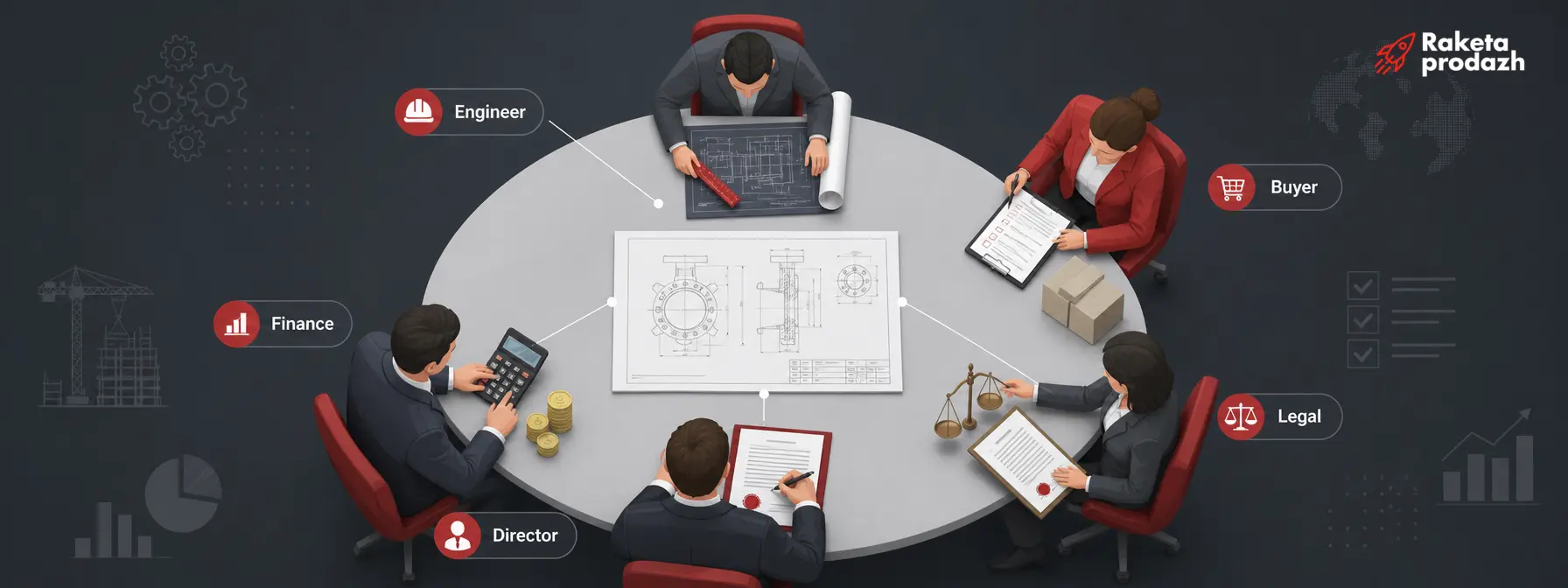
The main peculiarity is that the decision is almost never made by one person. An engineer, a process engineer, a procurement specialist, a CFO, a production manager, a lawyer, a security officer, and the business owner all take part in the process. Each has their own criteria: the engineer cares about tolerances and materials, the procurement specialist about price and timing, the financier about payment terms, the lawyer about contract risks. The sales manager doesn’t manage just one contact, but an entire buying group within the customer’s company.
Sales of manufacturing companies are structured in such a way that a deal can be lost at any of these levels. Everything is technically approved, but the lawyer won’t clear the contract. Or the opposite – the price works, but the engineer demands a different material. That’s why the funnel should show not just a “negotiation stage,” but specifically which member of the buying group the manager is currently working with and what’s preventing progress.
The next step is to bring all of this together into a concrete funnel structure.
For the sales of industrial products to be manageable and predictable, the funnel needs to account for every stage of the deal: from the first contact and gathering technical requirements to contract approval, handing the order over to production, and repeat deliveries.
What a Sales Funnel for a Manufacturer Should Look Like
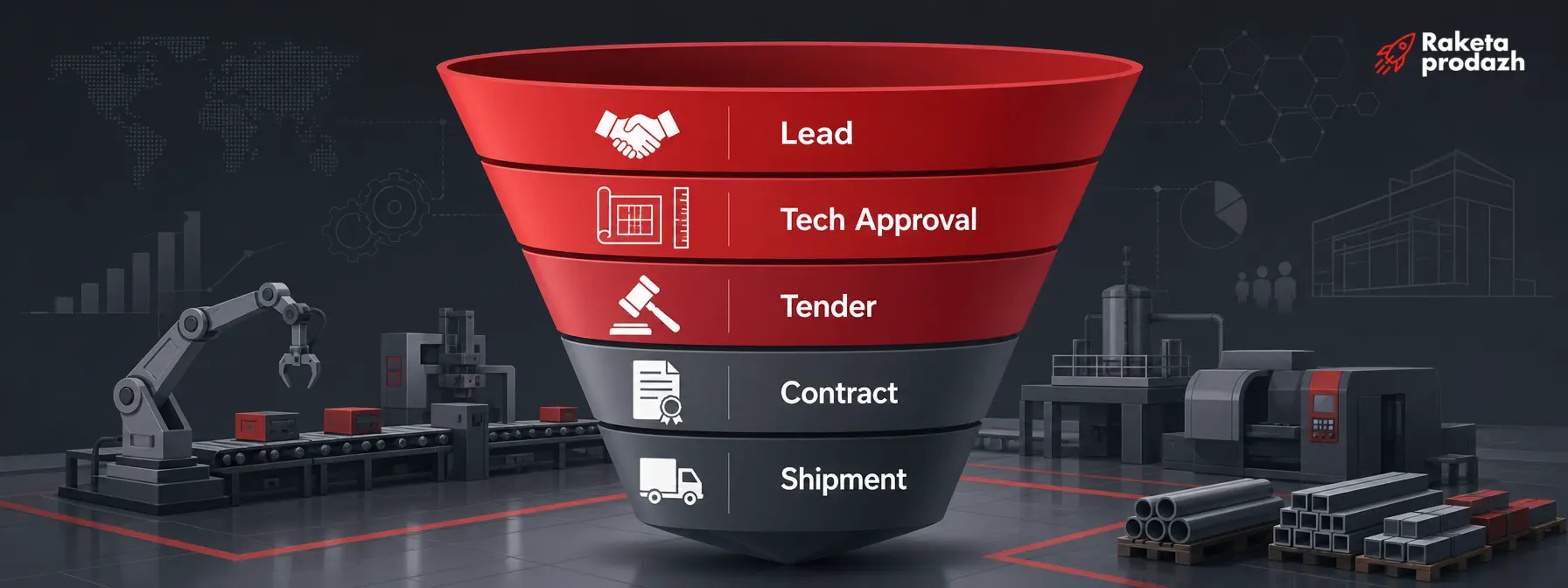
There’s no universal template here, but the basic logic of building a sales funnel for a manufacturer is roughly the same across most industries, from building materials to machine building. It should reflect the deal’s actual path, not just the manager’s actions in the CRM. Here’s what such a sequence of stages might look like:
- target company / lead
- initial contact
- needs qualification
- identifying decision-makers and approval participants
- gathering technical requirements
- preparing specifications or calculations
- commercial proposal
- technical approval
- tender or procurement procedure
- negotiating terms
- legal contract approval
- final sign-off
- order to production
- shipment
- repeat order / account development
- rejection / deferred demand
These stages can be shortened or merged depending on the specific production process. A small plant doesn’t always need a separate tender stage, while a major player in metalworking can’t do without one. What matters is that the funnel reflects the entire process of selling industrial products, not just the manager’s calls and emails. That way, leadership sees the real picture: how many deals are stuck in technical approval, and how many are waiting on a tender decision.
Next, we’ll break down each stage in detail, starting with where a deal even comes from.
Stage 1. Target Company or New Lead
A deal doesn’t have to start with an inbound inquiry. Often, the sales department picks the target company itself and reaches out through an outbound or ABM approach, especially if the market is narrow and there aren’t many customers. In this case, the first funnel stage isn’t “the lead reached out,” but “we chose this company and decided to pursue it.”
At this stage, it’s worth immediately noting the industry, company size, region, potential purchase volume, and whether there’s a real need. It’s useful to find out what alternatives the customer already uses, who the current supplier is, and how closely the company matches your ideal customer profile.
Not every lead is a fit for a manufacturer, and that’s normal. If the purchase volume is small, margins are low, or your plant’s production capacity can’t cover the customer’s needs, it’s better to figure that out at the start rather than three months into approvals.
Stage 2. Initial Contact and Needs Qualification
The first conversation with the customer determines whether it’s even worth launching a long approval process. The manager needs to understand exactly what the customer needs, in what volume, by when, and what technical requirements already exist. It’s useful to ask right away who the current supplier is and why the customer is considering a switch, the answer often reveals the real selection criteria.
Qualification in the sales of industrial products isn’t just about whether the customer is “interested.” It should assess the deal’s real potential: purchase volume, margin, timelines, budget, the customer’s solvency, and whether the product fits the plant’s production capabilities. If the volume is too small and the requirements are too complex, it’s cheaper to walk away right away than to spend weeks of engineering time on a calculation that will never turn into an order.
Good qualification saves resources across the whole company, not just the sales department. Next, it’s worth figuring out exactly who at the customer’s company will make the final decision.
Stage 3. Identifying Decision-Makers and the Approval Group
Early on, the manager needs to understand who’s actually involved in the decision. This usually includes procurement, a technical specialist, production, finance, legal, and management, and each of them carries their own weight in the final supplier choice. Missing one of the participants means risking that the deal will suddenly stall right at the finish line.
Direct questions help a lot here: who will evaluate the technical parameters, who approves the budget, how does supplier selection work at your company, will there be a tender, who needs to be brought into the technical discussion. These questions don’t come across as pushy, quite the opposite, they show the customer that you work systematically.
If the manager only communicates with one contact, they only see part of the picture. They might think the deal is nearly closed, even though the customer’s technical specialist hasn’t even seen the specification yet. How complete this list of participants is determines how accurately the technical requirements can be gathered at the next step.
Stage 4. Gathering Technical Requirements and Specifications
The technical stage is the foundation of everything that follows in the deal. For a manufacturer, it’s important to gather precise parameters: material, dimensions, standards, tolerances, packaging, batch size, timelines, operating conditions, and certification and logistics requirements. If the customer needs customization, this also needs to be recorded here rather than guessed at during the calculation stage.
Incomplete requirements are a common cause of calculation errors, delays, and re-approvals. The customer receives the proposal, finds it doesn’t match their actual operating conditions, and the whole process starts over, only now with damaged trust. It’s far cheaper to spend an extra hour clarifying details than to redo a calculation two weeks later.
At this stage, the manager often needs help from an engineer, a process engineer, or a production manager, it’s hard to sort out all the technical nuances alone. Once the requirements are gathered and confirmed, it’s time to move on to the calculation and preparing the commercial proposal.
Stage 5. Preparing the Calculation and Commercial Proposal
A commercial proposal for a manufacturing company isn’t just a number in an email. It needs to account for the specification, volume, production timelines, payment terms, delivery, warranty, minimum batch size, and how long the offer is valid. It’s good practice to include possible alternatives and constraints in the proposal right away, this saves time in the next round of questions.
In the sales of industrial products, the commercial proposal is often approved internally within the supplier company itself. Sales, production, finance, and logistics all need to confirm that the terms are realistic and margin-positive before the document goes out to the customer. A manager shouldn’t promise a price or timeline that will later need to be revised, that undermines trust faster than any delay.
Internal approval of the proposal should be built into the funnel as a separate step, even if it only takes a day. From here, the deal moves into the hands of the customer’s technical specialists, and this is where the most unpredictable stage begins.
Stage 6. Technical Approval
After receiving the proposal, the customer rarely responds with an immediate yes or no. More often, they come back with clarifications: asking to adjust parameters, or requesting certificates, drawings, or samples for testing. This is a normal part of the process of selling industrial products, but it requires separate attention within the funnel.
If technical approval isn’t singled out as a separate stage, the sales manager sees the deal stuck at “proposal sent” for weeks and mistakenly assumes it’s almost closed. In reality, the customer’s engineers haven’t approved the product yet, and the deal can hang here for months. Recording the stage along with the date of last contact and the approval status gives a real picture instead of an illusion of progress.
Once the customer’s technical specialists give the go-ahead, the next step often begins: testing the solution in practice.
Stage 7. Sample, Test Batch, or Pilot Delivery
Not every customer is ready to place a large order right away. They often ask for a sample, a trial batch, testing, or even a production audit before signing an ongoing contract. For a manufacturer, this can become a decisive intermediate funnel stage rather than a mere formality.
It’s important to set the rules of the game upfront: who pays for the sample, what criteria count as a successful test, how long the check will take, who makes the final decision after the test, and what volume can be expected afterward. Without these agreements, a pilot easily turns into an endless process with no commitments on either side.
Clear pilot terms protect the manufacturer from a situation where the test batch has shipped and then there’s just silence. If the test succeeds, the next logical step is often participation in a formal procurement procedure.
Stage 8. Tender or Procurement Procedure
For large B2B customers, procurement often goes through a tender, a request for proposals, or another formal procedure. A sales funnel for a manufacturing company needs to account for this stage separately: document preparation, proposal submission, clarifications from the organizer, comparison with competitors, negotiations, and the final choice of winner.
It’s important to understand that participating in a tender doesn’t always mean a high probability of winning the deal. Sometimes a tender is announced purely as a formality, the winner is already decided in advance, and the manufacturer just participates to satisfy the customer’s procurement policy. Before investing resources into preparing a tender proposal, it’s worth assessing the real situation.
A few questions can help gauge the odds before the team spends weeks on paperwork:
- does the customer have a real need right now, or is the tender just market research
- is the customer already familiar with your company and products
- what selection criteria are officially stated, and which ones actually apply in practice
- is the tender a mere formality, or does the customer already have a favorite
- do the tender’s terms fit your production capacity and margin
If the answers raise red flags, it’s better to spend fewer resources on preparation and pay more attention to deals with real potential. After the tender, if your proposal is chosen, the stage of direct negotiations on contract details begins.
Stage 9. Negotiating Price, Terms, and Timelines
At this stage, the customer usually raises questions about discounts, payment deferrals, delivery timelines, batch size, packaging, logistics, penalties, warranty, and service. Sometimes there’s also a conversation about a long-term contract with fixed terms for the year ahead.
The manager’s job is to protect not just revenue, but margin along with the plant’s actual production capacity. A discount, a payment deferral, or a rush order out of turn might look attractive for one deal, but it can wreck the overall economics or overload production for a given month. That’s why negotiations should be based on internal rules for approving terms, not on the manager’s desire to close the deal at any cost.
Once both sides agree on the terms, the deal moves into the territory of lawyers and financiers, and this is another place where momentum is often lost.
Stage 10. Legal and Financial Approval
In the sales of industrial products, a deal almost always goes through a contract, specifications, invoices, payment terms, penalty clauses, warranty obligations, quality documentation, and certification. Add counterparty verification by the customer’s security department, and it’s clear why this stage can take weeks, sometimes months.
If legal approval isn’t reflected in the funnel as a separate step, the manager risks counting the deal as closed too early, before the contract is even signed. The manufacturer’s finance department should also get involved here: it’s important to assess accounts receivable risk, especially if the customer asks for an extended payment deferral. It’s better to spot the risk during approval than to deal with overdue debt after shipment.
Once the contract is signed and payment is confirmed, the deal finally moves into production.
Stage 11. Order to Production, Shipment, and Follow-Up
A manufacturer’s funnel shouldn’t end with the signed contract, that’s a common mistake that ruins the customer experience at the finish line. After the sale, the order needs to be handed off to production with precise parameters, timelines, and responsible people assigned. From there, it’s important to track production status, shipment, logistics, documents, and payment, without losing sight of the customer.
A poor handoff from sales to production is a classic break that reduces the chance of a repeat order. The customer signs the contract, feels good about it, and then, silence: nobody tells them the production status, deadlines shift without warning, documents arrive late. That’s exactly why the funnel needs to treat the handoff between sales, production, warehouse, and logistics as a formal, trackable step.
A well-organized order handoff is an investment in the next sale to this same customer.
Stage 12. Repeat Orders and Account Development
For a manufacturer, repeat orders are often more important than the first deal, they’re what stable revenue and predictable plant workload are built on. After the first delivery, it’s worth tracking customer satisfaction, product quality, on-time delivery, consumption volume, purchase frequency, and any new needs that emerge.
A repeat order should be a distinct stage in the sales system, not a random inbound email once every six months. The manager should plan future touchpoints with the customer in advance and forecast future demand based on the consumption cycle of the specific product. If the plant produces consumables or components with a predictable purchase frequency, this forecast can be quite accurate.
Growing an existing customer is usually cheaper than finding a new one, especially given how many resources go into the entire journey from target company to first shipment. Next, let’s look at how to avoid losing deals that move slowly and depend on several people at once.
How to Manage Long Approvals Within the Funnel
Long approvals aren’t a reason to give up and simply wait for the customer’s response. The CRM should record the date of the next step, the responsible contact on the customer’s side, the approval status, a list of process participants, the reason for the current delay, the expected decision date, and the deal’s probability as a percentage. Without these fields, the sales manager only sees “deal in progress” and can’t tell a healthy pause from a stalled deal. It’s useful to regularly run a sales funnel analysis to catch bottlenecks in time.
The manager needs to actively help the customer move forward rather than passively waiting for an email. That means clarifying selection criteria, bringing in the right specialists on your side, sending requested documents on time, doing regular follow-ups, and flagging risks when something goes wrong. If a deal hasn’t moved in more than two or three weeks without a clear reason, it’s worth directly asking the customer what’s holding up the decision, that’s usually better than guessing. It’s also worth setting up marketing and sales synchronization so deal status information doesn’t get lost between departments.
This approach turns the funnel from a formal list of statuses into a real management tool. All that’s left is to figure out which metrics show that this whole system is actually working.
Key Performance Indicators and Benchmarks for a Manufacturing Funnel
Standard metrics like “number of leads” say very little about the health of a manufacturing company’s funnel. It’s far more useful to look at conversion between specific stages, average deal cycle length, and how fast deals move through the funnel, known as pipeline velocity. These metrics help you see not just how much was sold, but exactly where deals are getting lost and how long each step takes.
Benchmarks in industrial B2B sales differ noticeably from typical figures for simple goods or services. A deal cycle of 3-9 months for complex equipment is normal practice, not a sign of trouble in the sales department. Win rate, meaning the percentage of won deals out of all closed deals, averages around 20-21% across B2B, though in complex manufacturing niches with long cycles, even a more modest figure can be a good result if the average deal size is growing at the same time. It’s also useful to run sales funnel benchmarking against competitors to understand how your numbers stack up against the market.
Pipeline velocity is calculated with a simple formula: multiply the number of open deals by the average deal size and by the close conversion rate, then divide by the average cycle length in days. If this metric drops, the cause is usually one of three things: deals have genuinely become bigger and more complex, conversion has dropped at some stage, or deals are stalling for longer without moving. The first thing to check is conversion between specific funnel stages, that’s usually where the problem lies.
| Metric |
What It Shows |
Benchmark for a Manufacturer |
| Conversion between stages |
Exactly where deals are being lost |
Calculated for each transition separately, not as a funnel-wide average |
| Deal cycle length |
How long the journey takes from lead to shipment |
3 to 9 months for complex products, longer for capital equipment |
| Win Rate |
Share of won deals out of all closed deals |
Around 20-21% on average in B2B, higher with good qualification |
| Pipeline velocity |
Speed of deals moving through the funnel, in monetary terms |
A decline signals a problem at a specific stage |
Next, let’s look at specific mistakes that most often prevent these metrics from improving.
Common Mistakes in a Manufacturing Company's Sales Funnel
Even with a CRM in place, manufacturing companies often make the same mistakes over and over. The problem usually isn’t the lack of a system, but the fact that the funnel doesn’t reflect the actual process of selling industrial products and misses key details that end up distorting the entire forecast.
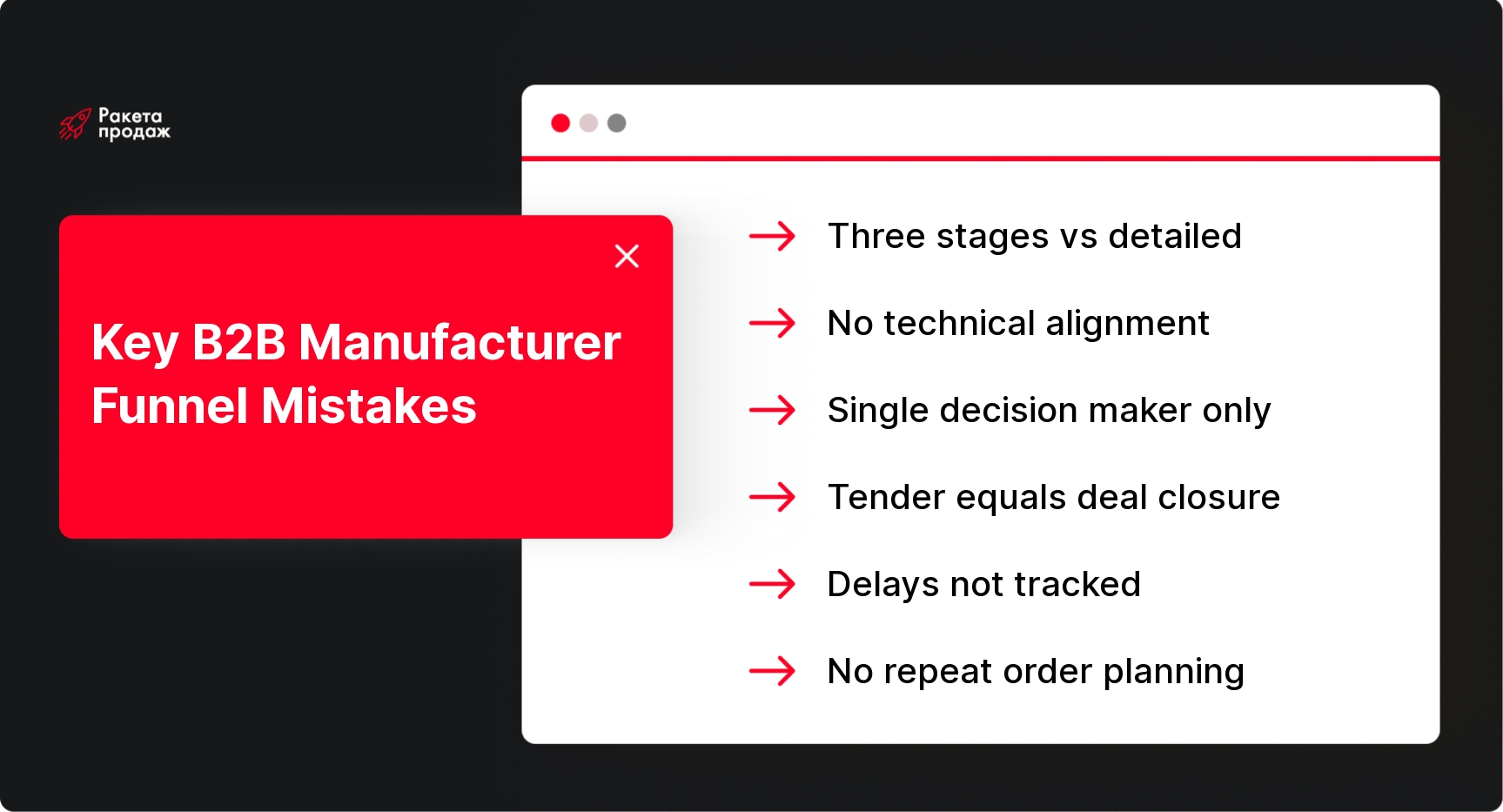
Here are the most common mistakes found in manufacturing companies’ funnels:
- using an overly simple three-to-four-stage funnel that doesn’t reflect the deal’s technical complexity
- not tracking technical approval status separately, so the deal looks “almost closed” for weeks
- failing to see all decision-makers and influencers, working with only one convenient contact at the customer’s company
- treating tender participation as an almost guaranteed deal, even though the tender may be purely formal
- not tracking the reasons for delays, so they can’t tell whether to keep waiting or the deal is dead
- not coordinating timelines with production and promising the customer dates the plant physically can’t meet
- not calculating margin at the proposal stage, and only catching the issue after the contract is signed
- not recording the final terms and specifications, which leads to disputes at the shipment stage
- not monitoring legal approval as a separate stage and losing momentum on the home stretch
- not handing off the order to production systematically, losing details during the transfer between departments
- not planning for repeat orders, even though they’re what creates stable plant workload
- evaluating the sales department’s performance only by revenue, without accounting for margin and deal quality
Each of these mistakes seems minor on its own, but together they distort the sales forecast and prevent leadership from seeing the real risks in every deal currently in progress.
A proper sales funnel for a manufacturer isn’t just statuses in a CRM, it’s a system for managing complex industrial deals with multiple approval participants. But building such a funnel on your own is hard: you need to account for the specifics of your production, customer cycles, tender quirks, and order handoffs between departments. “Rocket Sales” specializes in systematically building sales departments for B2B companies: we create turnkey funnels, implement CRM with proper analytics, train teams to work with long deals, and provide control at every stage from lead to repeat order. Our clients get full transparency into their sales process, shorter deal cycles, and an average revenue increase of +35%. Our partners include Mitsubishi, Yamaha, and Naftogaz. Don’t spend months experimenting with uncertain results when you can get a ready-made solution from industrial sales experts.
Turn the chaos of long approvals into a systematic sales funnel that boosts conversion by 5-86%!
Industrial B2B sales are rarely fast or linear. Technical specialists, procurement, finance, legal, and the customer’s management are all involved in the process, and each one has their own criteria and pace of decision-making. A simple “inquiry, call, proposal, deal” funnel simply doesn’t see most of this process. A manufacturer needs a funnel that helps managers navigate complex approvals at every stage and lets leadership see the real chances of a deal, the reasons for delays, and future production workload. This isn’t about extra bureaucracy in the CRM, it’s about being able to spot a problem in time and act on it while the deal is still alive.


 Time to read: 9 min.
 07 August 2026