Despite the obvious benefits, A/B testing of sales scripts comes with a number of limitations and common mistakes that can lead to incorrect conclusions and ineffective decisions. Understanding these pitfalls will help you conduct higher quality experiments and get reliable results.
One of the most common problems is insufficient sample size. Companies, especially small ones, often rush to conclusions after testing on several dozen calls. This approach can lead to false conclusions when random fluctuations are taken for significant results. For most tests, the minimum required volume is 100-200 calls for each script variant, depending on the expected effect size and current conversion.
For example, if your current conversion is 5%, and you want to reliably determine if a new script gives an improvement to 7%, you’ll need at least 400-500 calls in total for both variants. For smaller companies, this means the need to conduct testing over a longer period to accumulate sufficient statistics.
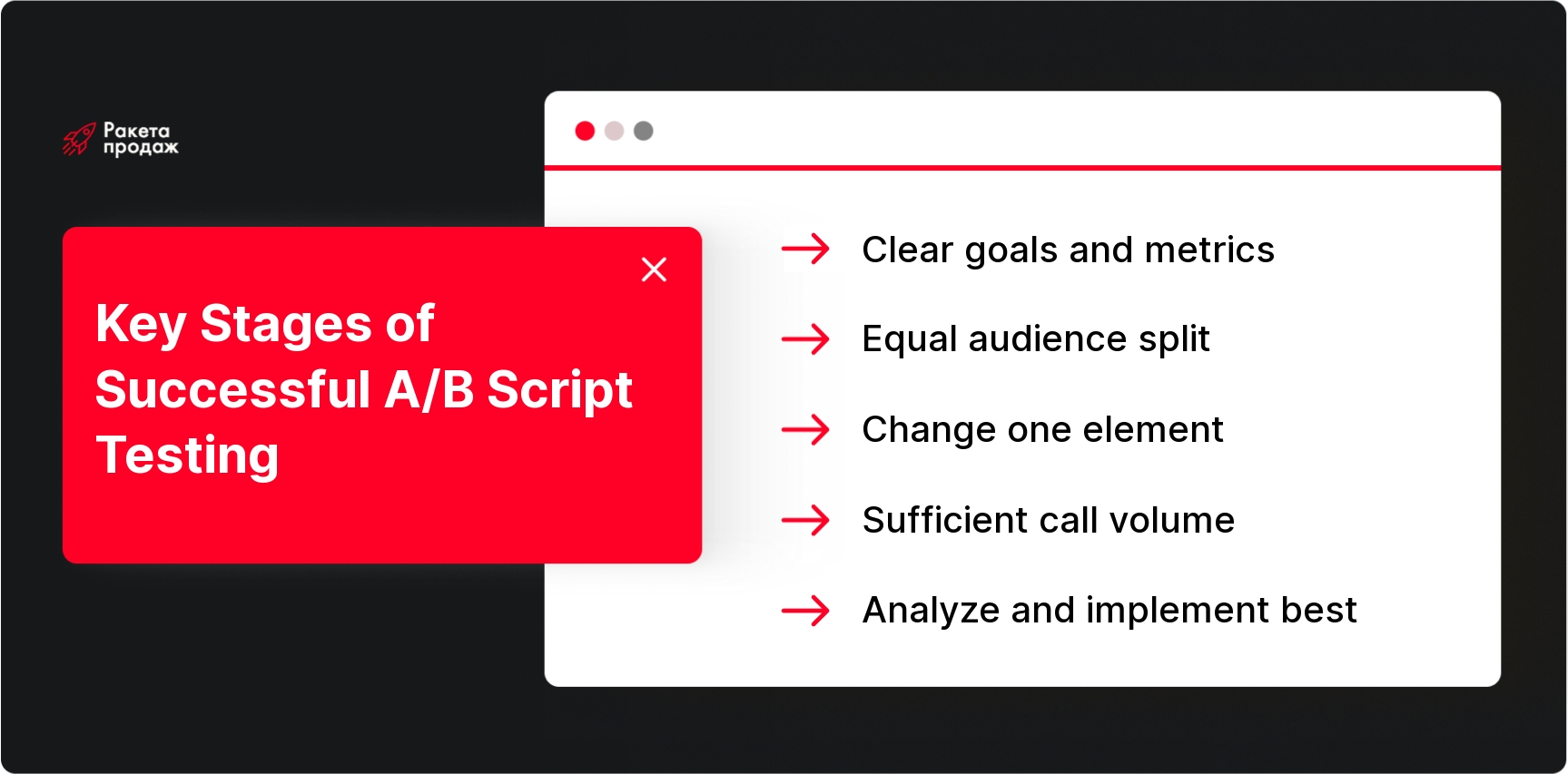
Another common problem is significant differences between the test groups. If variant A is used by a more experienced group of managers, and variant B by newcomers, the results will be distorted regardless of the quality of the scripts themselves. Similarly, if the quality of leads changes during the testing period (for example, a new advertising campaign is launched), the comparison becomes incorrect.
The solution is careful planning of the experiment with even distribution of managers, time of day, days of the week, and lead sources between variants. If complete equalization is impossible, these variables should at least be recorded for subsequent analysis.
Another limitation is “noise” variables that are difficult to control. The client’s mood, external news, random technical problems can affect the result of an individual call. In ideal laboratory experiment conditions, such factors can be minimized, but in real sales, they’re inevitable. The only solution is increasing the sample size so that random fluctuations mutually neutralize each other.
Incorrect choice of metrics can also lead to wrong decisions. For example, by focusing exclusively on short-term conversion, a company might choose a script that “pushes” clients but worsens long-term relationships. A comprehensive system of metrics, including both immediate indicators (conversion) and delayed ones (lead quality, satisfaction, repeat sales), gives a more complete picture.
Companies often ignore feedback from managers, relying exclusively on numbers. However, employees directly using the script may notice nuances not reflected in statistics – for example, that clients often ask to clarify a certain phrase or that the script sounds unnatural in a specific situation. Combining quantitative analysis with qualitative feedback gives the most complete understanding of how scripts work.
Remember that even perfectly organized A/B testing has limitations. It shows which of two variants is better but doesn’t guarantee there isn’t a third, even more effective approach. Therefore, it’s important not to rest on your laurels but to continue the cycle of experiments, gradually covering all aspects of communication with clients.


 Time to read: 10 min.
 27 April 2026