icon

How to Effectively Implement a Motivation System in the Sales Department: Checklist

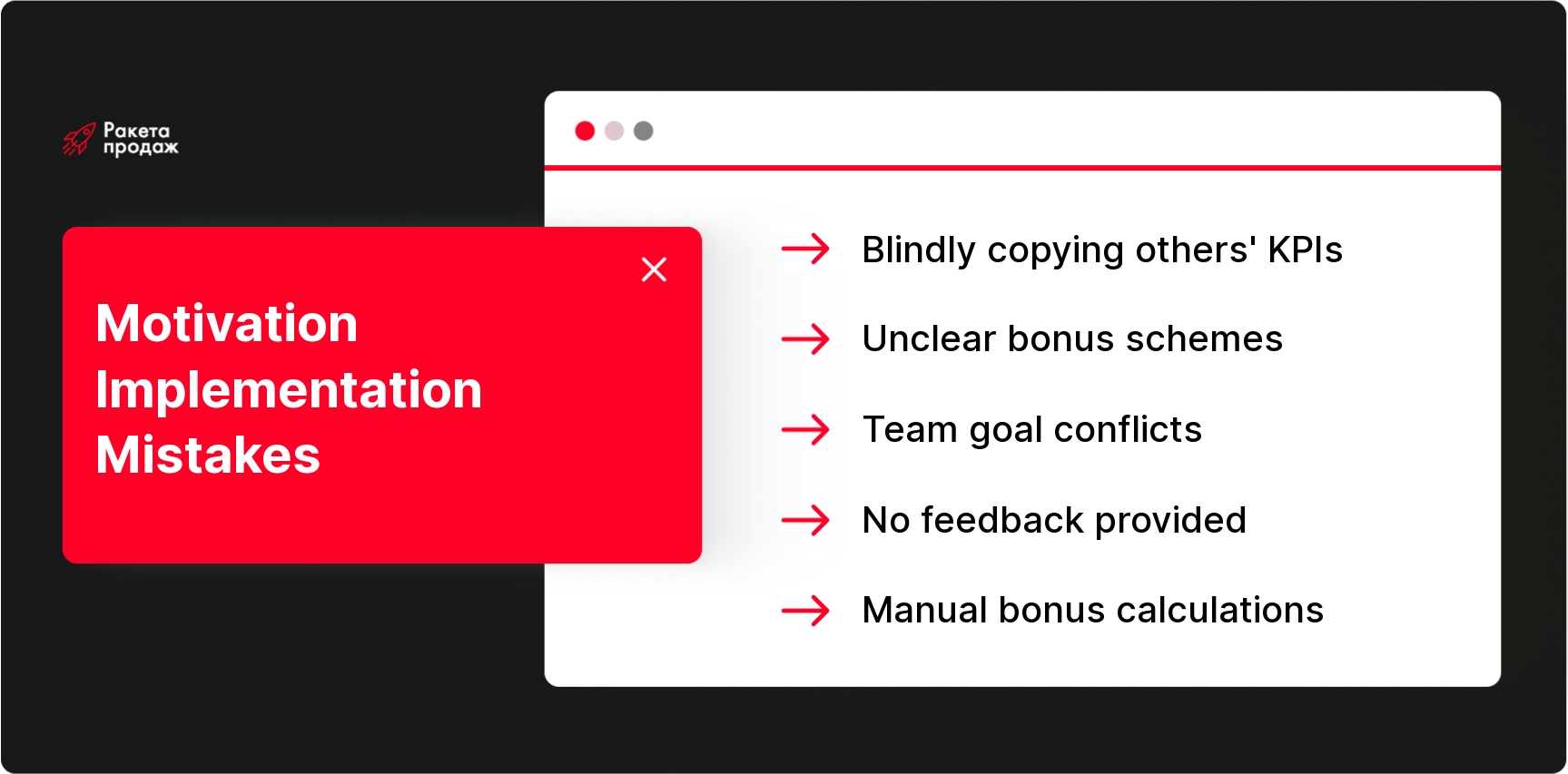
Familiar situation? Management sets ambitious sales targets, implements a new motivation system, but the results leave much to be desired. Employees are dissatisfied, goals aren’t achieved, and bonuses feel like a lottery. The reason usually lies in copying someone else’s KPIs without adapting them to the company’s specifics, creating non-transparent bonus schemes, or creating conflict between salespeople’s and business goals. When a manager strives to “close” a deal at any cost to get a bonus, while the company needs long-term customer relationships – conflict is inevitable.

Key Takeaways

  • A motivation system fails when managers copy others’ KPIs without diagnosing their team’s real needs – start with surveys, HR metrics, and identifying demotivators.
  • Non-transparent bonus formulas create distrust and conflicts. If managers don’t see the connection between actions and rewards, motivation disappears.
  • A proper system balances individual and team goals, short-term and long-term metrics to prevent internal competition and customer exploitation.
  • A pilot with one team allows you to catch unexpected effects (hidden competition, priority imbalances) before a full-scale launch.
  • Automating bonus calculations through CRM and dashboards eliminates errors and shows managers their results in real-time, enhancing the system’s effectiveness.

In the full article, you’ll find a step-by-step checklist for implementing a motivation system: what to check before starting, how to adapt KPIs to your specific needs, and which tools to use for monitoring. Read below 👇

The implementation of a motivation system in the sales department is more than just calculating premiums. It’s a comprehensive management process that begins with analyzing the current situation, includes setting measurable goals, selecting motivation tools, and mandatory testing before large-scale implementation. A properly built system not only increases sales but also reduces staff turnover, strengthens team spirit, and aligns employee interests with company goals. Let’s explore how to implement such a system step by step.

Essentially, implementing a new motivation program should follow a clear algorithm. Using a checklist for implementing a motivation system, a manager can sequentially verify all key stages: diagnosing the current situation, setting KPIs, choosing incentive tools, pilot testing, and automating control. Such a checklist for implementing a motivation system helps avoid typical mistakes and makes the change process more manageable and transparent for the team.

image

Analyzing the Current Situation and Diagnosing Staff Needs

Before changing an existing or creating a sales motivation system from scratch, it’s necessary to understand what’s happening in the sales department right now. The key question: what really motivates your employees? Often managers mistakenly believe they know the answer. “Money, of course!” is the most common misconception. Research shows that material motivation is effective only up to a certain threshold, after which non-material factors begin to play a role: recognition, development, team atmosphere.

Thorough diagnostics is especially important if the company plans to build a sales motivation system from scratch. In this case, it’s necessary not only to study current sales indicators and employee behavior but also to determine which specific sales actions should lead to business growth. A well-designed sales motivation system from scratch should consider product specifics, deal cycle, team structure, and strategic company goals.

For quality diagnostics, use a comprehensive approach. Start with anonymous surveys to determine satisfaction with the current system, major demotivators, and what employees value. Supplement this with personal interviews with key salespeople and group leaders. Analyze HR metrics: staff turnover in the department (especially among high-performing employees), vacancy closure speed, and productivity dynamics. Separately examine the reasons for resignations – this often highlights deeper motivation problems.

If you want to look at the situation more objectively and get recommendations for improvement, it’s useful to conduct an external sales department audit, which reveals not only motivational “bottlenecks” but also organizational problems.

It’s also important to analyze whether the current system corresponds to market realities. Perhaps your competitors offer more attractive conditions, and you regularly lose talented salespeople. Or conversely – your system is too generous but not tied to results, which reduces the overall effectiveness of the department.

The analysis should result in a clear picture of your team’s motivational profile and a specific list of problems to solve. This stage lays the foundation for all subsequent steps, so don’t rush and don’t skimp on diagnostics. Now, with data in hand, you can proceed to goal setting.

Have you ever wondered why even the most ambitious sales plans often remain unfulfilled despite implementing new motivation systems? The reason lies not in the idea of motivation itself, but in its improper implementation – when others’ KPIs are copied without adaptation, non-transparent schemes are created, or conflicts of interest arise between salespeople and the business. Rocket Sales specializes in creating personalized motivation systems that actually work. Our approach is based on comprehensive diagnostics – we not only analyze current sales processes but also identify the real motivational drivers of each employee. Over 7+ years, we’ve developed and implemented effective motivational models that have led to an average 35% increase in our clients’ turnover. The entire system is supported by transparent control and analytics tools, allowing fair assessment of each employee’s contribution. As a result, our clients not only increase sales but also significantly reduce turnover in the sales department.

Create a motivation system that will lead to consistently achieving 150% of the plan – order a free sales department audit!

Setting Goals and Transparent Performance Criteria

Developing a motivation system without clear goals is like building a house without a foundation. Start by defining specific changes you want to achieve: increasing sales volume by 20%, raising the average check by 15%, reducing the sales cycle, entering new market segments, or reducing staff turnover by 30%. Goals should be specific, measurable, and tied to a certain period – the classic SMART principle.

The next step is transforming these goals into KPIs that are understandable to each employee. The key requirement is transparency and achievability. If a manager doesn’t understand how their bonus is calculated or considers the indicators unrealistic, the motivational effect is lost. A typical mistake is setting overly ambitious KPIs that demotivate the team from the start.

When developing KPIs, consider the balance between individual and team indicators. A purely individual system can provoke internal competition and conflicts, while an exclusively team-based one can lead to a situation where strong salespeople “carry” the weak ones. The optimal ratio depends on the specifics of the business and corporate culture.

It’s also important to harmonize short-term and long-term indicators. A system focused only on monthly results can lead to “squeezing” customers and a lack of strategic vision. Include customer retention, return, and long-term loyalty indicators in your KPIs if they’re important for your business.

When the KPI system is formed, discuss it with key team members. Their feedback will help identify weaknesses and increase acceptance of new rules. Remember that good KPIs are not only a control tool but also a compass helping employees independently assess their progress. Your analysis will be much more effective if you implement motivation system effectiveness verification to ensure its real workability in practice. Your task after this is to choose the right tools to stimulate the achievement of these goals.

Selecting Motivation System Elements: Material and Non-Material Tools

An effective motivation system is always a combination of monetary and non-monetary incentives. The material component forms basic satisfaction and fairness, while the non-material one enhances engagement and long-term loyalty. Let’s start with financial tools: this includes not only salary and sales percentages but also bonuses for exceeding targets, premiums for cross-sales, special projects or launching new products, as well as team bonuses for achieving group goals.

Modern companies use flexible reward models: for example, a progressive commission scale (the more you sell, the higher the percentage) or cascade bonuses for achieving sequential levels of plan fulfillment. Such systems more strongly motivate high-performing employees and create healthy competition. However, it’s important that calculation formulas remain understandable and don’t turn into a “black box.”

Non-material tools are often underestimated, although they create long-term motivation. Among the key ones: professional development programs (training, mentoring, conference participation), career growth (clear ladder from junior manager to department head), recognition of achievements (public appreciation, honor boards, “best employee of the month” titles), as well as the ability to influence company processes and strategy.

Special attention should be paid to the work environment: flexible schedule, remote work possibilities, modern equipment and software, comfortable office – all these are also elements of the motivational system. Today, it’s important for salespeople not only how much they earn but also how their work process is organized.

When choosing motivation elements, focus on the diagnostic results. If your employees value stability – increase the fixed part; if competition spirit is important – strengthen the bonus component and public recognition. For young teams, development and a dynamic environment are often priorities, for experienced ones – status and influence. The best motivation systems adapt to the needs of different employee groups, offering them what is truly valuable. Now all this needs to be formalized and communicated to the team.

Development and Formalization of the Motivation Program

After selecting the motivation elements, it’s necessary to structure them into a unified system and document them. This is a critically important stage – this is where vague ideas turn into a working mechanism. Start by developing a concept: a brief document describing the goals, principles, and main components of the motivation system. This document will become the basis for discussion with management and obtaining approval for implementation.

After the concept is agreed upon, a detailed regulation is developed – an official document fixing all aspects of the system. It should clearly spell out: reward structure (fixed and variable parts), bonus calculation formulas, KPIs and their target values, payment frequency, rules for changing conditions, and those responsible for control and administration.

Pay special attention to wording – they should exclude ambiguous interpretation. A typical problem in many companies is vague formulations like “bonus is paid at the manager’s discretion” or “subject to high results.” Such uncertainty breeds distrust and reduces motivation. Rules should be specific: “A bonus of 5% of the marginal profit is paid when achieving a sales plan of 95% and above.”

An important component of the document is examples of compensation calculation for typical situations. They help salespeople understand how the system works in practice and see their opportunities. Visualizing the motivation scheme through infographics or diagrams significantly simplifies the perception of complex formulas and relationships between indicators.

Don’t forget to include in the regulations the procedure for resolving disputes and the feedback mechanism. Employees should understand who to contact when they disagree with calculations or to make suggestions for improving the system. This increases transparency and trust in the system.

The completed regulations need to be coordinated with the legal department to ensure compliance with labor legislation. Only after this can you proceed with implementation, starting with pilot testing on a separate group or department.

Pilot Implementation and Team Communication

Even the most well-thought-out motivation system on paper can face unexpected problems during actual implementation. Therefore, it’s recommended to start with a pilot project – limited implementation in one unit or team. This will allow identifying shortcomings and adjusting the system before a large-scale launch. For the pilot, choose a representative group – a team that reflects the main characteristics of the entire sales department but is also sufficiently open to changes.

Before launching the pilot, conduct an information session for participants. Explain the goals of the new motivation system, its principles, how it relates to the company’s business objectives, and what advantages it gives to employees. It’s important to emphasize that the pilot period is an opportunity for the team to influence the final version of the system. This approach reduces resistance to change and increases engagement.

During the pilot, regularly gather feedback: conduct short weekly meetings to discuss first impressions, organize anonymous surveys, monitor the dynamics of key indicators. Pay special attention to unexpected effects: has the new system led to unhealthy competition, have managers started focusing only on indicators included in KPIs, ignoring other important aspects of work.

If you notice that employees don’t understand their role in the sales system or lack skills for effective work, it’s recommended to conduct targeted sales manager training to increase their professional level and loyalty.

After completing the pilot period (usually 1-3 months), conduct a thorough analysis of the results. Compare indicators before and after implementation, evaluate changes in employee behavior, collect their final reviews. Based on this analysis, make necessary adjustments to the motivation system before full-scale launch.

Communication with the team at the global implementation stage should be even more intensive. Prepare a presentation explaining the new system in detail, conduct a series of meetings with different groups of employees, create informational materials (brochures, videos, FAQ). The key task is to achieve understanding and acceptance of the system by each team member. The clearer the connection between salespeople’s actions and rewards, the more effectively the motivation system will work. The next step is to technologically support the new system.

Automation and Modern Control Tools

An effective motivation system requires reliable technological support. Manual calculation of indicators and bonuses not only takes a lot of time but also creates a risk of errors that can undermine trust in the system. Automation is not just a convenience but a necessity for transparent and objective motivation management in the sales department.

The basic tool is CRM implementation, which tracks manager activities, deal stages, and conversions through the sales funnel. Modern CRMs allow setting up personal accounts for employees where they can track their indicators in real-time and forecast their bonus amount. Such transparency significantly enhances the motivational effect – managers see a direct connection between efforts and rewards.

For a more comprehensive approach, specialized Performance Management Systems are used, which integrate data from various sources: CRM, accounting, customer satisfaction surveys, training systems. They allow setting up complex KPI calculation formulas that consider multiple parameters and automatically generate reports for managers at different levels.

Special attention should be paid to gamification tools – the introduction of game mechanics into the work process. These can be ratings, achievement badges, accumulative points that can be exchanged for prizes or privileges. Such elements are especially effective for young teams and when working with routine tasks, adding an element of competition and fun to everyday work.

Effective analytics implementation is possible through sales department analysis and dashboards, which visualize key indicators and quickly identify growth points, as well as allow for quick response to sales dynamics and motivation system effectiveness.

An important role is also played by dashboards for managers – visual panels reflecting key department metrics in real-time. They allow quickly identifying problem areas, tracking trends, and making operational decisions to adjust goals or support individual managers.

When choosing and setting up automation tools, it’s important to maintain a balance between analytics depth and ease of use. Too complex systems with an excessive number of reports and indicators can distract from the main work and create information overload. The ideal system should be intuitive and provide exactly the information needed for decision-making at each level. Meanwhile, don’t forget about CRM control and hygiene – regular quality checks of database filling and procedure compliance are critical for calculation reliability and overall system effectiveness. Now let’s talk about how to maintain and improve the implemented system.

Monitoring, Analysis, and Improvement of the Motivation System

Implementing a motivation system in the sales department is not an end point but the beginning of a continuous improvement process. Even the most well-thought-out system requires regular monitoring and adaptation to changing business conditions, market, and team needs. Create a schedule for regular evaluation of system effectiveness – usually this is quarterly analysis of key indicators and an annual in-depth review.

During regular reviews, analyze how well the system helps achieve business goals. Key questions: have sales indicators improved after implementation; has staff turnover decreased; are there signs of unhealthy behavior (focus only on short-term results, ignoring quality for quantity); does the level of motivation costs correspond to the results obtained.

Pay special attention to feedback from employees. Conduct anonymous surveys about the perception of system fairness, KPI clarity, accessibility of information about results. Organize focus groups to discuss the system’s operation and collect ideas for its improvement. Involving the team in the improvement process not only provides valuable insights but also increases acceptance of the system.

Equally important is the analysis of the external environment: track changes in the labor market, motivational practices of competitors, new trends in sales management. The motivation system should maintain the company’s competitiveness as an employer and correspond to current business goals.

Based on the collected information, regularly make adjustments: update KPIs, review target indicators, add or remove motivation elements. It’s important to maintain a balance between stability (employees should understand the rules of the game) and flexibility (the system should respond to new challenges). Any changes should be carefully communicated to the team with an explanation of the reasons and expected results.

Remember that an effective motivation system is a living organism that should evolve with the company. Regular improvements based on data and feedback will maintain a high level of motivation and effectiveness in the sales department in the long term.

Building an effective motivation system is a complex project requiring an expert approach. If you want to avoid typical mistakes and guarantee results, it’s worth turning to professionals. Rocket Sales offers a full cycle of motivation system implementation: from diagnosing personnel needs to automating results control. We don’t just create motivational schemes – we form a holistic system for managing sales department effectiveness. Our specialists will help build transparent KPIs, implement necessary control and analytics tools, configure the CRM system for automatic bonus calculation. Over 7+ years, we have helped 187 companies in 14+ industries build sales departments with highly effective employees. Among our clients are companies such as Mitsubishi, Yamaha, and Naftogaz. The maximum result of our clients is an increase in turnover by $1.6 million in just 4 months of work. Don’t waste time and money experimenting with motivation – entrust this process to professionals.

Turn your sales managers into highly motivated professionals - order a turnkey motivation system development!

Conclusion

Implementing a motivation system in the sales department is a comprehensive project requiring a thorough approach at every stage: from analyzing the current situation and personnel needs to monitoring and continuous improvement. Following the proposed checklist for implementing a motivation system, you’ll avoid typical mistakes and create a system that not only increases sales but also strengthens team loyalty. The key to success is a balance of material and non-material incentives, transparency of criteria, automation of calculations, and flexibility in adapting to changes.

Remember that even a perfectly designed system won’t yield results without quality communication and employee involvement at all stages. Perceive the implementation of a sales motivation system as an opportunity for open dialogue with the team about company goals, expectations from employees, and their needs. This approach will not only increase the effectiveness of the system but also strengthen corporate culture based on mutual respect and common goals.

In this article:
See more
Book a FREE sales funnel audit
CONTACT US
FAQ
Where should I start when creating a sales motivation system from scratch?

Start with diagnostics: conduct surveys and interviews with employees, analyze current sales indicators and HR metrics. Then formulate business goals you want to achieve through the motivation system. Based on these, develop clear KPIs and choose a combination of material and non-material incentives that meet the needs of your team. The implementation of a motivation system in the sales department requires careful planning from the very beginning to ensure its success.

How do I check the sales department's readiness before implementing a motivation system?

Evaluate several key factors: employee qualification level (are they capable of achieving new KPIs), quality of sales processes (are they refined enough to measure results), CRM system maturity (is it possible to track the necessary indicators), and the team’s general attitude toward changes. If gaps are found, first invest in sales manager training, process optimization, and improving IT infrastructure.

How do I adapt the motivation system for my company?

Avoid copying others’ solutions without adaptation. Consider the specifics of your product (complexity, sales cycle), target market, corporate culture, and company development stage. Conduct pilot implementations to test the system in real conditions and be ready to adjust it based on feedback and changing business goals. The motivation system should reflect the uniqueness of your business and team.

SUBSCRIBE TO MY TELEGRAM CHANNEL
The most valuable sales information right on your phone!
icon

LOTS OF USEFUL INFORMATION, FREE TEMPLATES, AND CHECKLISTS ON MY INSTAGRAM

Materials and practical advice on sales growth in our blog: