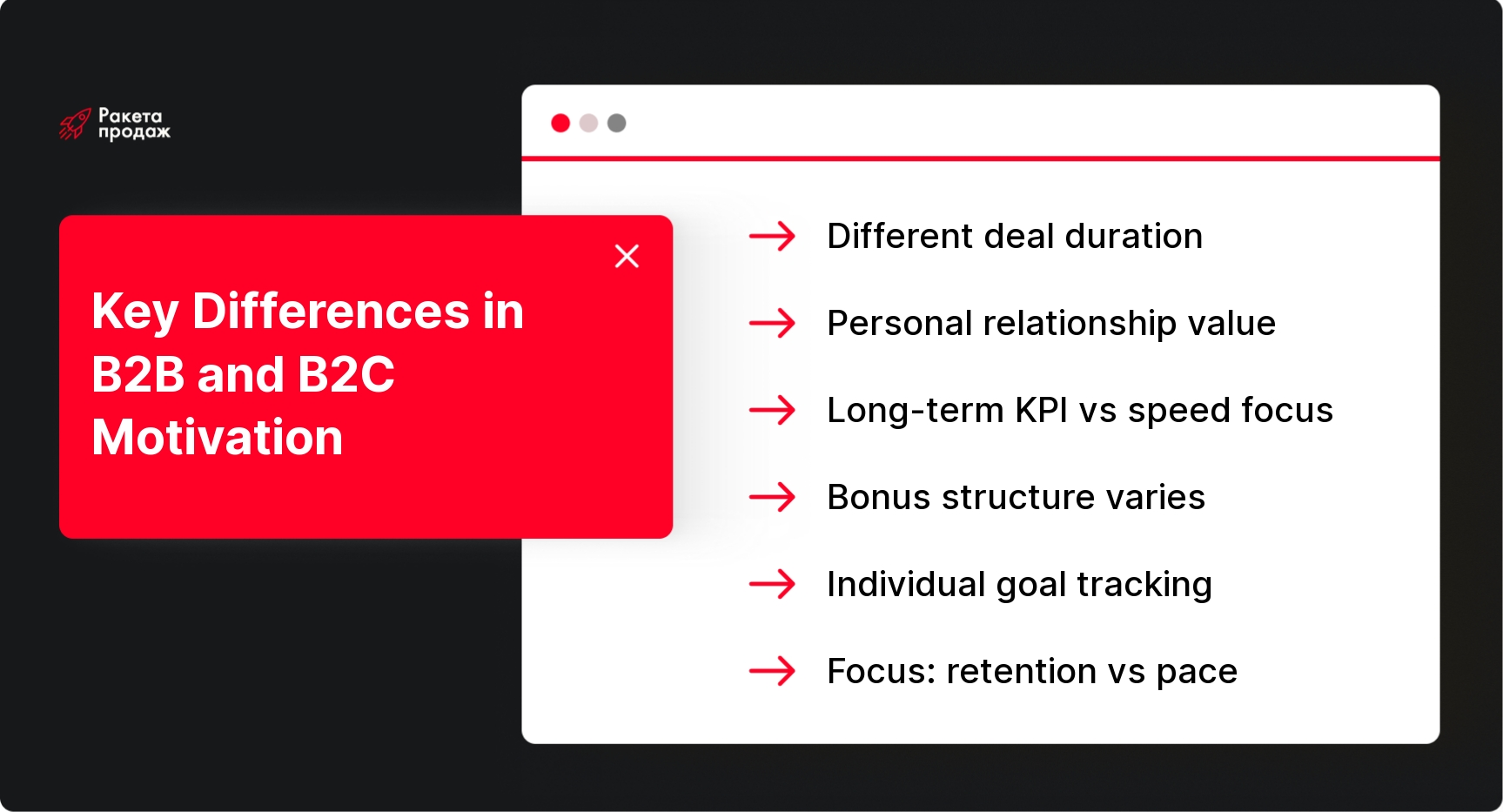
Motivation in B2C sales must consider the quick deal cycle and high customer flow. Unlike the corporate segment, the salesperson here works with a large number of inquiries and must quickly identify the customer’s needs, form an offer, and close the deal. Therefore, the motivation system in B2C sales is usually focused on short-term performance indicators.
B2C sales have their unique specifics, which are radically different from the corporate segment. Here we deal with fast deal cycles, high customer flow, and more standardized processes. All this requires a special approach to salesperson motivation by sales type.
Fast deal cycle is one of the main characteristics of B2C sales. The purchase decision is often made during one visit or even a few minutes of online communication. This means the salesperson must quickly establish contact, identify needs, and close the deal. In such conditions, motivation should be tied to short-term results and stimulate high activity.
At the same time, B2C manager motivation should stimulate not only service speed but also the quality of customer interaction. Strong salespeople know how to balance service pace, conversion, and average check, so the motivation system should consider both quantitative and qualitative performance indicators.
Working with a large number of clients requires energy, stress resistance, and the ability to quickly switch between different people from B2C salespeople. The motivation system should encourage processing the maximum number of inquiries without losing quality. It’s important to find a balance between quantitative indicators (number of served clients) and qualitative ones (conversion percentage).
Service speed plays a huge role in B2C. Modern buyers are not ready to wait for long, and extended service time can lead to customer loss. Therefore, KPIs for B2C often include indicators related to promptness: response time to inquiries, order processing speed, and time to serve one customer.
The impact of service on purchasing decisions in B2C cannot be overestimated. Since products and services are often standardized, it is the quality of service that can become the decisive factor in choice. The motivational system should take into account not only the fact of sale but also how satisfied the client was with the service (through NPS, reviews, ratings).
High competition in the B2C sector means that a client can easily go to a competitor if something doesn’t suit them. Salespeople should be motivated not just to sell, but to sell in a way that makes the client come back again.
The features of B2C motivation lie in stimulating quick results and quality service. Financial motivation for retail should be transparent, understandable, and often include short-term bonuses that maintain salespeople’s interest and enthusiasm.
Effective salespeople motivation in B2C should stimulate:
Conversion – the percentage of visitors who make a purchase. This is a key performance indicator for a B2C salesperson. The higher the conversion with the same customer flow, the better the salesperson performs.
Average check – the amount an average customer spends. Increasing the average check is one of the most effective ways to grow revenue without attracting additional customer flow.
Additional sales (cross-selling and up-selling) – offering additional goods or more expensive versions of the main product. This skill is critically important in B2C and should be separately encouraged in the motivation system.
Service speed – it’s important to find a balance between time devoted to one client and sales efficiency. Too fast service may reduce quality, while too slow can reduce the total number of clients served.
A properly built motivation system in B2C usually includes a base salary and a significant variable part, depending on the fulfillment of the sales plan, average check, and additional KPIs. Short-term competitions and bonuses for selling certain goods or achieving specific indicators for a day or week are also effective. This approach maintains the constant interest of salespeople and stimulates their activity.


 Time to read: 9 min.
 16 March 2026