icon

Follow-up Automation: How AI Agents Don't Lose Clients


The sad truth of business: 80% of deals require at least 5 touchpoints in B2C and 13-18 in B2B, but half of salespeople give up after the second contact. This leads to enormous losses – clients simply “evaporate” from the funnel not because they said “no,” but because they were forgotten. The human factor is merciless: managers are overloaded, priorities constantly shift, and some clients seem “not very promising” and get crossed off the focus list.


Want a high-performing sales team without the hassle?
We’ll build it for you.
Contact Us

Key Takeaways

  • Up to 85% of deals are lost not because the client refused, but due to forgotten follow-ups, with half of managers giving up after just the second touchpoint.
  • AI systems respond instantly 24/7 and methodically conduct 5+ touchpoints, while humans switch to urgent tasks and cross out “difficult” clients.
  • Your automated emails should adapt to client behavior (which page they viewed, when they’re active), not just execute a predetermined sequence.
  • Weak automation sounds robotic and bombards everyone with the same templates, while strong automation adapts tone, timing, and content for each segment.
  • Conversion between funnel stages increases by 15-30% if you measure response speed, AI content relevance, and triggers for human handover.

In the full article, you’ll find a step-by-step implementation algorithm, comparison of tools (Zams, Fireflies, Avoma), and specific metrics to monitor the effectiveness of AI follow-up 👇

The result? According to research, up to 85% of potential sales are lost due to communication failures. Imagine: a client viewed a product demonstration, asked a couple of questions, and then immersed themselves in their own affairs. The manager sent one email, didn’t get a response, and switched to “urgent” inquiries. The deal quietly died, although the client was ready to buy, just not at that moment.

AI follow-up automation solves this problem by not allowing potential clients to “get lost” in the funnel and ensuring constant attention to each contact – without overloading the sales team.

What is AI follow-up automation?

AI follow-up automation is a comprehensive system that maintains communication with clients after initial contact. Unlike standard template mailings, modern AI solutions go far beyond simple “reminders.” They analyze the context of interaction, consider communication history, client activity time, and even the style of previous responses.

Artificial intelligence constantly monitors all touchpoints: viewing specific pages on the website, opening emails, clicking links, time spent in the application – all of these become triggers for further actions. Based on this data, AI determines the optimal time for contact, selects the communication channel (email, messenger, call), creates a personalized message, and automatically launches the next step in the funnel.

An important distinction between AI follow-up and standard automation is that such systems don’t simply execute a programmed sequence but make decisions based on client behavior. For example, if a potential client repeatedly views a page with a specific product after receiving a general offer, AI can automatically send additional information about that particular product rather than continuing the general email sequence. This flexibility significantly increases the effectiveness of communication and brings it closer to natural human interaction.

Main benefits of follow-up automation with AI

Automating repeated touchpoints brings a number of significant benefits that go far beyond simple time savings. Companies that have systematically approached follow-up automation note comprehensive improvement in their entire sales funnel and customer experience.

First and foremost, AI systems provide stability and consistency in communication. Research shows that 35-50% of deals are won by the salesperson who responds first, and automation guarantees an instant reaction 24/7. Moreover, artificial intelligence systems don’t forget about leads, don’t lose interest in “difficult” clients, and methodically conduct the necessary number of touchpoints, significantly increasing the probability of closing the deal.

An important aspect is scalability. A manager is physically capable of processing a limited number of leads, and expanding the team requires time for hiring and training. AI solutions for follow-up allow processing a growing flow of requests without losing quality, providing an equally high level of attention to each client, whether there are ten or ten thousand.

Key benefits also include:

  • Saving salespeople’s time on routine tasks, allowing them to focus on complex negotiations and closing deals
  • Complete elimination of the “human factor” – forgotten meetings, missed deadlines, lost contacts
  • Compliance with corporate communication standards at any request volume and any team workload
  • Intelligent routing of requests to the most appropriate specialists based on context and interaction history

Practice shows that properly configured AI follow-up automation provides conversion growth in the range of 15-30% and significantly reduces time spent on administrative work. This not only increases sales efficiency but also directly affects customer satisfaction and loyalty, who see a systematic and professional approach to their requests.

Tired of losing clients due to forgotten follow-ups? Statistics are merciless: 80% of deals require at least 5 touchpoints, but half of salespeople give up after the second. At “Rocket Sales,” we solve this problem through comprehensive sales process automation. Our experts audit your current CRM system, configure integrations with necessary digital tools, and develop automatic business processes – from lead generation to deal completion. We create individual scenarios of automated touchpoint chains, taking into account the specifics of your niche and clients.

Based on our experience working with companies such as Yamaha, Mitsubishi, and Naftogaz, properly configured follow-up automation increases conversion by 5-86% and provides an average revenue growth of 35%. Our clients receive a transparent sales system where no lead gets lost due to human factors.

Transform chaotic follow-ups into a systematic process that increases your turnover by 35% - order a free consultation now!

How to implement AI follow-up automation: a step-by-step guide

Transitioning from manual management of repeated contacts to automated requires a systematic approach. Successful implementation of AI for follow-up is not a one-time event, but a sequential process consisting of several critical stages.

Analyzing weak links in existing processes

Before implementing AI solutions, it’s important to understand exactly where your company is losing opportunities. Start with an audit of the current sales funnel: at what stage do most leads “disappear”? Which follow-ups are performed irregularly? How many touchpoints does a client receive on average before closing a deal?

It’s useful to analyze CRM data for the past 3-6 months to identify patterns: perhaps your managers consistently forget about follow-up after demonstrations or stop contacting clients who requested a commercial proposal but didn’t respond within a week. Conduct anonymous surveys among employees – often the team knows perfectly well about problem areas but doesn’t have the resources to systematically address them.

The result of this stage should be a map of “pain points” with specific metrics and prioritization. For example: “75% of leads who didn’t respond to the first offer never receive a second contact” or “the average follow-up delay after a meeting is 4 days, which is 8 times higher than the industry benchmark.” For more details on how to build and conduct such an audit using modern technologies, read the article AI sales audit.

Selecting and testing AI tools

There are many solutions on the market for follow-up automation with different functionality and focus. The optimal choice depends on your industry, business size, and specific tasks.

Zams is an excellent solution for sales teams working with long B2B sales cycles. The system includes AI tools for automatic analysis of call and meeting records, creating summaries, and automatic scheduling of follow-ups linked to specific discussions and promises.

Fireflies.ai specializes in intelligent capture and analysis of information during meetings. The solution automatically records and transcribes calls, highlights key moments and actions, and then automatically creates follow-up tasks and integrates them into the CRM.

Avoma combines recording and meeting analysis functions with tools for proactive preparation. The AI system analyzes past interactions, prepares prompts for the salesperson, and automatically forms subsequent steps, taking into account the communication history.

When choosing a solution, pay attention to several key aspects:

  • Integration with your current tools (CRM, email, calendars)
  • Support for needed communication channels (email, messengers, calls)
  • Flexibility in configuring scenarios and automation rules
  • Personalization capabilities for messages
  • Analytical capabilities and reporting

Testing selected solutions on a small group of users or a limited segment of clients will help avoid large-scale errors during full implementation.

Integration with IT infrastructure

The success of AI follow-up automation largely depends on quality integration with existing systems. At this stage, it is critically important to ensure seamless data exchange between:

  • CRM system (source of data on clients, deals, and interaction history)
  • Email platforms (for sending and analyzing responses to emails)
  • Corporate messengers and video conferencing systems
  • Sales team calendars for automatic meeting scheduling
  • Internal knowledge bases and tools for content preparation

For companies using popular CRMs like HubSpot or Salesforce, most AI solutions for follow-up offer ready-made connectors. If you work with less common or custom systems, development of API integrations may be required. Interestingly, integration of CRM and phone systems also allows significantly expanding the possibilities for automation and analysis of all client communications.

At the integration stage, it’s critical to set up bidirectional data exchange: the AI system should not only receive information from the CRM but also return action results to it – who opened the email, who clicked the link, who agreed to a meeting, etc. This will ensure data integrity and allow for accurate evaluation of automation effectiveness.

Employee training and implementation control

Even the most perfect technology will be useless if the team doesn’t adopt it. Training personnel to work with new tools is a necessary investment in the project’s success.

Training should include not only the technical part (how to set up a sequence, how to check status, how to make adjustments) but also an explanation of value: how AI automation will simplify work, reduce routine, and improve results. It’s important to emphasize that AI doesn’t replace salespeople but enhances them by taking over mechanical tasks and allowing them to focus on creating value.

At the implementation stage, it’s useful to appoint “ambassadors” – employees who will master new tools earlier than others, become internal experts, and help colleagues. It’s also critical to provide operational technical support to resolve emerging issues.

Implementation control should include regular checks of system usage: are all managers creating automated sequences, are the rules set up correctly, is data properly integrated. Low usage is the main risk at this stage.

Monitoring and feedback collection for optimization

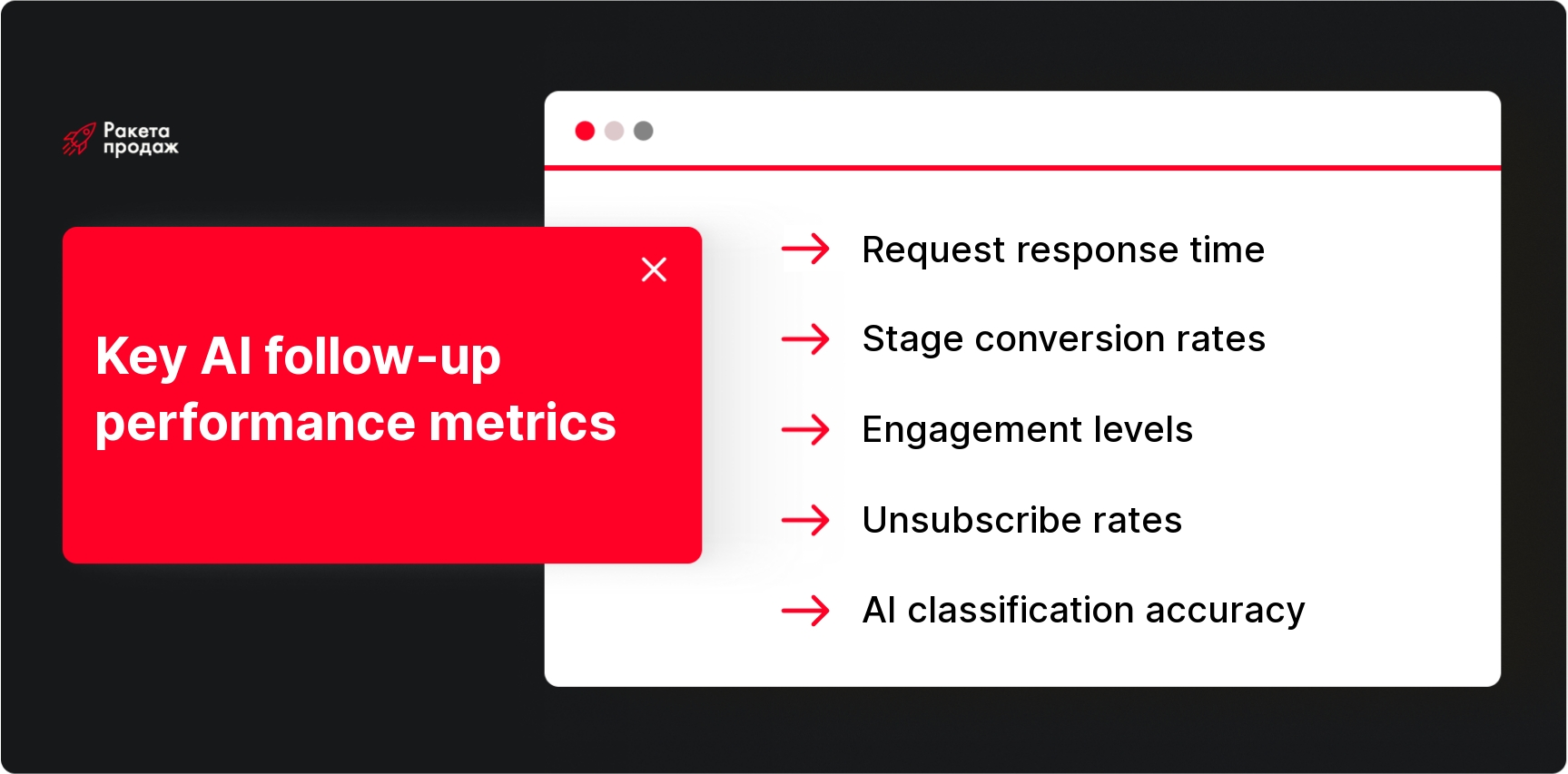
After launching AI follow-up automation, it’s important to establish regular monitoring of key indicators:

  • Coverage (proportion of leads receiving automatic follow-ups)
  • Response speed (time from event to automatic action)
  • Conversion at different funnel stages
  • Engagement metrics (opens, clicks, responses)
  • Customer satisfaction

Feedback collection should go in two directions: from the sales team (what works well, what needs improvement) and from clients (how appropriate and useful are the automatic communications). Based on this data, the system settings should be regularly adjusted, scenarios optimized, and message content improved.

In some cases, conducting A/B tests may be necessary to determine the most effective approaches: comparing different texts, sending times, touchpoint frequencies, etc. Modern AI systems make it easy to organize such experiments and automatically scale the winning variants.

It’s important to remember that implementing AI follow-up automation is not a one-time project, but a continuous improvement process requiring attention and adjustments based on data and feedback.

How AI ensures follow-up personalization

One of the key advantages of AI solutions for follow-up is the ability to provide a high level of personalization with large-scale automation. Modern artificial intelligence systems go far beyond simply inserting a client’s name into a template email.

AI algorithms analyze multiple data points about each client: history of previous interactions, website behavior, interest in specific products, activity time, preferred communication channels, and even communication style. Based on this analysis, the system creates a personalized message that considers the unique context of interaction with a specific person.

For example, if a client viewed certain sections of the website after receiving a previous email, AI can automatically include additional information specifically about these products in the next message. If a client often opens emails in the evening on weekends, the system can schedule important messages for this time to increase the likelihood of reading.

Key personalization mechanisms in AI follow-up systems:

  • Dynamic content formation based on client interests and actions
  • Adaptation of tone and message style to recipient preferences
  • Intelligent selection of optimal time for contact
  • Automatic selection of the most relevant cases and examples from the company database
  • Generation of individual offers based on behavioral patterns

For B2B sales, AI can analyze not only the behavior of a specific contact but the entire client company, taking into account interactions with different representatives of the organization and adapting communication to the role of each participant in the decision-making process.

In e-commerce, AI systems analyze browsing and purchase history to form relevant recommendations and reminders about products that might interest the client. Such systems can also automatically adapt discounts and special offers to the behavior of a specific buyer.

Service businesses use AI to personalize appointment reminders, follow-up after service provision, and proactive offers based on client needs analysis. For example, a beauty salon can automatically send a reminder about a repeat procedure exactly when the effect from the previous one begins to decrease, taking into account the client’s individual characteristics.

Learn more about how sales personalization based on AI tools affects company perception and client loyalty in our specialized article.

It’s important to understand that AI follow-up personalization is not just a “feature” but a necessary condition for effectiveness in modern realities, where clients expect relevant and timely communications, and standard template mailings are increasingly ignored or perceived negatively.

Common mistakes and risks in follow-up automation

Implementing AI for automating repeated contacts is a powerful growth tool, but it comes with certain risks. Understanding typical mistakes will help avoid disappointments and create a truly effective system.

One of the most common problems is excessive mechanization of communications. Companies often get carried away with technical possibilities, forgetting about the brand’s “human face.” If all messages sound robotic, and responses to client questions come in the form of obviously generated templates, this can be off-putting and reduce trust. It’s important to find a balance: use AI for scaling and timeliness of communications, but maintain an individual approach and warmth in tone.

Another common mistake is incorrect audience segmentation. When all clients receive the same sequence of messages without considering their needs, interests, and funnel stage, effectiveness sharply decreases. Modern AI systems allow creating dozens and hundreds of segments based on behavioral and demographic data, adapting communication to each group.

Excessive contact frequency can also be harmful. Some companies, after implementing follow-up automation, begin to bombard clients with messages, not giving them time to think. This leads to irritation and unsubscribes. The right approach is to test optimal intervals for your audience and set up automatic rules taking into account client reactions.

Ignoring feedback is another serious mistake. Companies set up automation and think “job done,” without analyzing results and adapting approaches. Even the most advanced AI system requires regular tuning based on effectiveness data and changing client needs.

To avoid these problems, it’s recommended to:

  • Regularly audit the content of automatic messages for relevance, tone, and value to the client
  • Implement a trigger system for timely connection of live specialists to the dialogue in complex situations
  • Set up detailed segmentation taking into account not only demographics but also behavior, interests, interaction history
  • Establish reasonable limitations on contact frequency and rules to prevent intrusiveness
  • Create a process for regular analysis of effectiveness metrics and updating follow-up strategies based on data

For examples and practical recommendations on preventing mistakes in automation, you can check our guide on typical sales mistakes.

Remember: the goal of follow-up automation is not to replace human communication, but to make it more timely, consistent, and scalable, while maintaining an individual approach to each client.

How to measure success: key metrics for AI follow-up automation

image

Effectively evaluating the results of AI implementation for follow-up automation requires a comprehensive approach to metrics. It’s important to track not only direct sales but also intermediate indicators that help understand exactly how automation affects the entire customer journey.

For a complete effectiveness assessment, it’s necessary to establish baseline “pre-implementation” metrics and regularly compare them with indicators after launching AI automation. This will help quantitatively assess progress and identify areas for further optimization.

The first set of metrics is related to response promptness. Response time to client inquiries is critically important – research shows that the probability of lead qualification decreases 10 times if the response comes later than 5 minutes after the request. AI systems should provide almost instant reaction to incoming requests and significantly reduce the time between touchpoints compared to a manual process.

The second important set is sales funnel metrics. You should track how conversions between key stages have changed: from lead to qualified lead, from qualified lead to meeting, from meeting to deal. Proper follow-up automation usually gives a 15-30% increase at each stage, and the overall reduction in lead “leakage” can reach 40-50%. Learn more about follow-up effectiveness in sales in a separate article that examines real cases and statistics.

The third group of indicators is related to client engagement. This includes metrics such as:

  • Email open and link click rates
  • Average client response time
  • Number of responses to automatic messages
  • Unsubscribe or communication refusal rate

A sharp increase in unsubscribes may signal problems with the content or frequency of automatic communications, while increased engagement confirms the correctness of the chosen strategy.

Finally, it’s extremely important to track the effectiveness of the system’s AI component:

  • Accuracy of request classification and answer selection
  • Relevance of automatically generated content
  • System’s ability to correctly determine client intentions
  • Need for manual correction of proposed AI solutions

For visual progress representation, comparative dashboards can be used, showing key metrics before and after AI automation implementation across different segments, products, or sales channels. Additional value will come from implementing specially developed metrics for the sales department, allowing more accurate tracking of indicator dynamics and making informed decisions.

In addition to quantitative indicators, it’s important to collect qualitative feedback – both from clients and employees. Regular surveys will help identify aspects of automation that need improvement and collect ideas for further system enhancement.

Setting clear targets for each metric and regular monitoring of progress is the key to continuous improvement of AI follow-up and maximizing its contribution to business growth.

Conclusion

AI follow-up automation transforms the approach to working with clients, turning a traditionally vulnerable funnel section into a systematic process with predictable results. Abandoning chaotic manual work in favor of intelligent automation allows companies not only to reduce lead losses but also to qualitatively improve the customer experience, making each touchpoint timely, relevant, and personalized. Instead of a situation where sales success depends on a specific manager’s workload, the business gets a reliable system that doesn’t forget, doesn’t get tired, and always follows the optimal strategy.

Using AI for repeated touchpoints significantly increases the effectiveness of client work. Automatic follow-up allows maintaining contact with potential clients without additional team workload. AI agents for follow-up constantly monitor all contacts and ensure timely reaction to any client actions. The automation of repeated touchpoints through AI systems ensures that no opportunity falls through the cracks in your sales process.

And although implementing such solutions requires a thoughtful approach and constant optimization, investments in follow-up automation show one of the highest returns among all sales and marketing automation tools.

Implementing AI follow-up automation is not just a technical project, but a comprehensive transformation of sales processes. “Rocket Sales” offers complete support on this journey: from analyzing weak links in your current funnel to integrating modern AI solutions with your IT infrastructure. Our experts will help select optimal tools for your tasks, set up personalized communication scenarios, and ensure seamless integration with existing CRM systems.

The uniqueness of our approach is the individual selection of solutions for your niche and current business development level. We don’t just implement technologies, but build transparent and manageable business processes, train your team, and provide continuous optimization based on data. Our clients avoid all typical automation mistakes and get concrete, measurable results: the average revenue increase is +35%, and in some cases reaches +$1.6 million in 4 months of work.

Don't lose another client due to a forgotten follow-up - automate the process with experts who have increased sales for 200+ companies by 5-86%!
In this article:
See more
Book a FREE sales funnel audit
CONTACT US
FAQ
Which follow-up tasks are best to automate?

First of all, you should automate regular repetitive actions: sending reminders after meetings, follow-up on unanswered proposals, reminders about missed calls. Also excellent candidates for automation are reactivating “dormant” leads, collecting feedback after demonstrations or purchases, as well as series of educational emails for leads in early funnel stages. Automation is most effective for tasks where consistency and timeliness are important, but complex negotiations are not required.

How long does it take to implement AI for follow-up?

Basic implementation can take from 2-3 weeks to 2-3 months depending on the complexity of existing processes and required integrations. First results are usually visible within 30-45 days after launch. It’s important to understand that full system optimization is a continuous process that continues for 6-12 months after implementation as data accumulates and strategies are adjusted based on it.

How safe is it to use AI for client contacts?

Modern AI systems for follow-up provide a high level of security when properly configured. It’s critically important to set clear rules: what the system can do automatically and where human participation is required. It’s also necessary to regularly check automatically generated content and set up emergency “limiters” – for example, limiting the number of automatic messages without response or mandatory transfer of complex cases to live specialists.

What mistakes are common in follow-up automation?

Common mistakes include excessive mechanization of communications without a “human face,” insufficient audience segmentation (everyone receives the same messages), too high contact frequency that irritates clients, and ignoring feedback to adjust strategy. Companies also often underestimate the importance of quality integration with existing systems and team training, which leads to fragmented data and incomplete use of AI solution capabilities.

SUBSCRIBE TO MY TELEGRAM CHANNEL
The most valuable sales information right on your phone!
icon

LOTS OF USEFUL INFORMATION, FREE TEMPLATES, AND CHECKLISTS ON MY INSTAGRAM

Materials and practical advice on sales growth in our blog: