icon

Why Sales Managers Earn More Than Business Owners: Commission Calculation Mistakes

A familiar situation: the sales department works at full capacity, managers close deals one after another, the plan is fulfilled at 120%, but company profits are not growing or even falling. Meanwhile, the best sales managers can earn more than the business owner! The root of the problem often lies in an incorrectly configured system of commissions and bonuses. Many business owners build motivation based on revenue, without considering deal margins. As a result, managers actively sell, but the business remains without profit. In this article, we will analyze typical mistakes in the sales manager commission system, show how to correctly calculate bonuses using a sales commission formula, and help you build a motivation system that will work for both salespeople and the business owner.

Key Takeaways

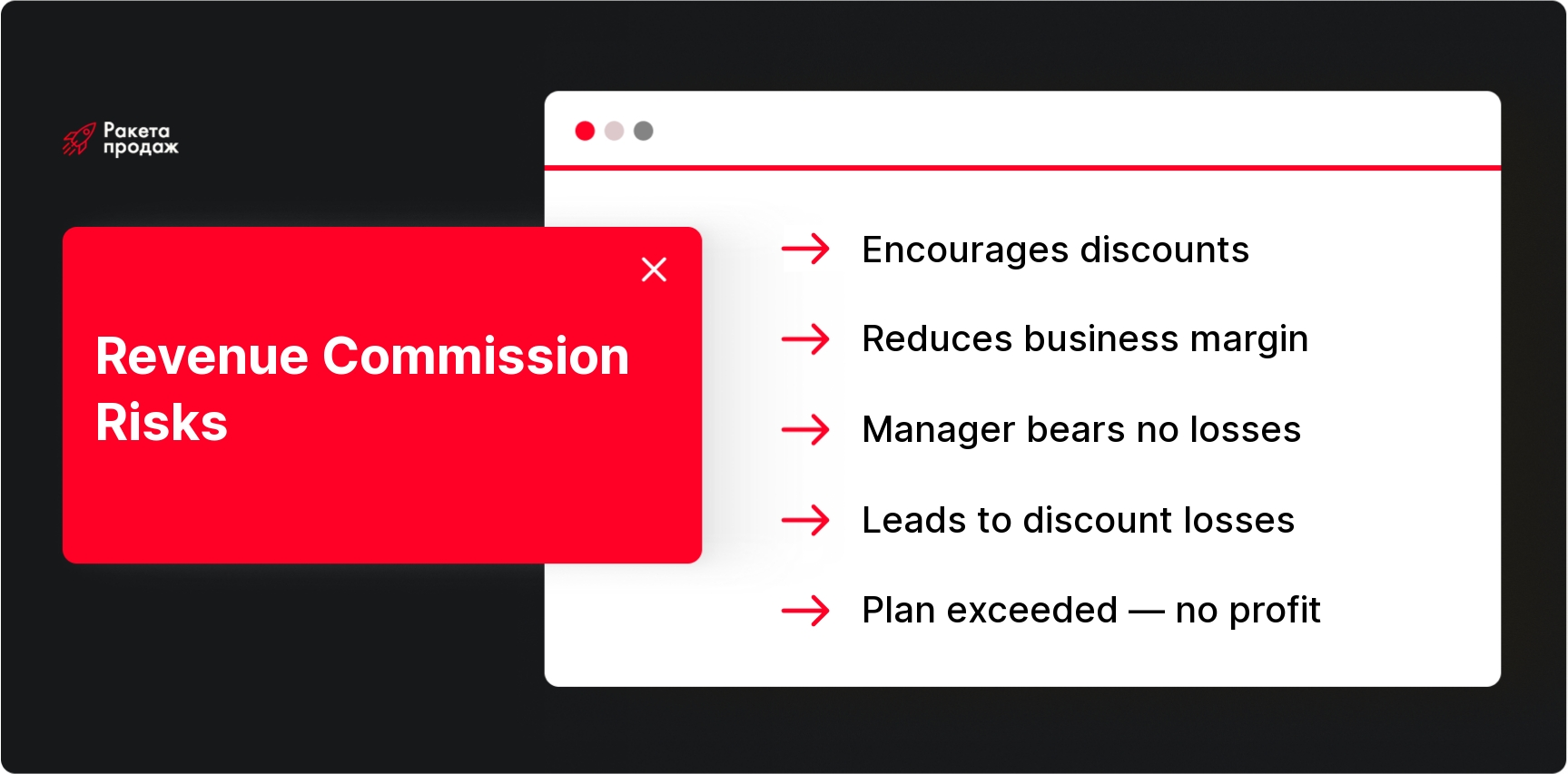
  • Commission based on revenue pushes managers to sell anything, even if it destroys margin, because a 20% discount only takes 20% of their bonus, while for the business, it’s a loss of all profit.
  • Achieving 120% of plan can result in profit decline when teams exceed targets through discounts and low-margin products.
  • Managers who can offer discounts without financial responsibility will inevitably train customers to always negotiate.
  • Tying commission to margin makes every discount percentage painful for the manager (minus 33% to bonus instead of 10%), so they start defending the price.
  • A commission calculator helps select the right percentage of margin that maintains the manager’s income but shifts focus to profitable deals.

In the full article, you’ll see specific commission calculation formulas, scenario examples, and step-by-step logic for transitioning to a managed motivation system 👇

What a Skewed Commission System in the Sales Department Looks Like

A skewed motivation system in sales forms when bonuses and commissions are tied exclusively to revenue. A typical model looks simple: the manager receives a fixed salary (for example, 15,000 UAH) and a sales manager percentage (say, 5% of the total amount of deals for the month). This scheme seems logical and fair – the more you sell, the more you earn.

Sales commission is one of the most common motivation models in sales departments. In this system, the manager receives a certain percentage of the amount of closed deals or total turnover for the period. Sales commission is easy to understand and calculate, which is why it is often used in retail, e-commerce, and B2B segments. However, when configured incorrectly, such a model can encourage managers to increase sales volume through discounts or low-margin products, which reduces company profits.

The problem is that this model encourages the manager to sell at any cost, without caring about the profitability of deals for the company. Let’s look at a common case. For example, you pay a commission of 2% on sales. Imagine a situation: you have two products with the same price of 10,000 UAH, but different cost prices. The first brings 40% margin (4,000 UAH), the second – only 10% (1,000 UAH). With a revenue-based commission system, the manager will receive the same payment of 500 UAH regardless of which product they sell. Naturally, they will sell the one that is easier to “move,” even if it is a product or service with a low margin.

It gets even worse when managers can provide discounts independently. With a revenue-based commission, it’s advantageous for the salesperson to give the maximum discount if it helps close the deal faster or in greater volume. For them, a 20% price reduction means only a 20% decrease in commission, while for the company, such a discount can completely eat away the margin or even lead to a loss. Therefore, a skewed commission system inevitably leads to the company working on high turnover with minimal profit.

Errors in the commission calculation system are not just a matter of financial mathematics. This is a fundamental problem faced by 70% of companies when managers “smash” the plan, but profits don’t grow. At “Rocket Sales,” over 7+ years working across 14+ niches, we’ve developed a mathematically verified methodology for creating motivational systems that balance the interests of the owner and manager. We don’t just consult – we implement turnkey motivation systems with individual KPIs, working through all scenarios, and a transparent mathematical commission model tied to the company’s real profit, not turnover. The average revenue growth of our clients is +35%, and conversion increases reach +86%. It’s important to understand that a competent motivation system is part of a comprehensive approach to building a sales department, which we have successfully implemented for companies such as Mitsubishi, Yamaha, and Naftogaz.

Transform your commission system from a headache into a powerful profit growth tool - get a free consultation on your current motivation system!

Sales Manager Commission Calculation Example

A sales manager commission is the variable part of an employee’s income that directly depends on their work results. In most companies, the sales manager commission is calculated as a percentage of turnover, margin, or sales plan fulfillment. Such a payment system allows linking the manager’s income to the company’s financial result and encourages employees to actively work with clients, increase deal volume, and improve sales profitability.

Let’s look at a specific example to understand the difference between different commission calculation systems. Imagine that a company sells equipment, and the manager has concluded a deal for 200,000 UAH. The cost of the equipment is 140,000 UAH, accordingly, the margin profit is 60,000 UAH (30% of the sale price).

With a basic revenue-based commission system, the manager’s commission formula looks like this:

Commission = Deal amount × Commission percentage

If the commission percentage is 2%, the manager will receive:

Commission = 200,000 UAH × 5% = 10,000 UAH

With a margin-based commission system, the formula is different:

Commission = Margin profit × Commission percentage

If the margin commission percentage is 15%, the manager will receive:

Commission = 60,000 UAH × 15% = 9,000 UAH

Now imagine that the client asks for a 10% discount. Let’s consider how this will affect the commission in different models.

With a revenue-based commission:

  • New price: 180,000 UAH
  • Commission: 180,000 UAH × 5% = 9,000 UAH
  • The manager loses 1,000 UAH (10% of the commission)

With a margin-based commission:

  • New price: 180,000 UAH
  • New margin: 180,000 UAH – 140,000 UAH = 40,000 UAH
  • Commission: 40,000 UAH × 15% = 6,000 UAH
  • The manager loses 3,000 UAH (33% of the commission)

See the difference? With a margin-based commission system, the manager is much more motivated not to give discounts because each percentage of discount reduces their earnings disproportionately more. Such a sales commission calculator helps to visually see how different models affect earnings.

Detailed examples and nuances are provided in the material on commission calculation formulas, where you will find even more real scenarios and mathematical models.

Situation: 100% Plan, 120% Fact - No Profit

This situation is more common in business than you might imagine. The team of managers meets and exceeds the sales plan, everyone celebrates success, but the financial director or business owner is surprised to find that profits are not growing or even decreasing.

Imagine a company that set a monthly sales plan of 1 million hryvnias for its managers with a commission of 3% on turnover and a bonus of 10,000 hryvnias for meeting the plan. In fact, the team sold goods worth 1.2 million hryvnias (120% of the plan), and the business owner paid commissions and bonuses, expecting to see a significant increase in profit.

However, when analyzing the deals, it turns out that the over-fulfillment of the plan was achieved through the massive use of discounts and a focus on low-margin products. As a result, the average margin on all deals fell from the usual 25% to 15%. If the plan had been fulfilled at 100% with a 25% margin, the company would have received 250,000 UAH in marginal profit. And with a fact of 120% with a margin of 15%, the marginal profit was only 180,000 UAH.

Meanwhile, expenses on commissions and bonuses increased! Instead of 40,000 UAH (30,000 UAH commission for 1 million turnover + 10,000 UAH bonus), the company paid 46,000 UAH (36,000 UAH commission for 1.2 million turnover + 10,000 UAH bonus). As a result, managers earned more, and company profits fell – a classic situation of imbalance in the motivation system.

To learn about how to competently implement sales department motivation to avoid such situations, read the special material.

Typical Mistakes in the Sales Manager Bonus System

When building a sales department motivation system, companies often make the same mistakes, leading to an imbalance between manager income and business profit.

The sales manager bonus system should be directly related to the company’s financial results. If bonuses are calculated only from turnover, managers begin to focus on deal volume, not on their profitability. A properly built sales manager bonus system takes into account margin, plan fulfillment, discount level, and strategic business priorities. This approach allows synchronizing the interests of managers and the owner, when employee income growth occurs simultaneously with company profit growth.

The first and most obvious mistake is calculating commissions exclusively from turnover without considering the margin. As we have already discussed above, this creates a situation where managers are not interested in the profitability of deals. They only care about sales volume, not how much the company will earn from it.

The second common mistake is the lack of control over discounts. If managers can freely give discounts without bearing financial responsibility for them, they will definitely use them to close deals. As a result, the average margin across the company gradually decreases, and customers get used to the idea that they can always get a discount just by asking for it.

The third serious mistake is an incorrect KPI and priority system. Companies often set contradictory KPIs, for example, requiring the manager to simultaneously increase the average check and the number of deals, setting a plan for turnover and requiring a focus on high-margin products, or giving such high plans that managers are forced to dump prices to fulfill them.

The fourth mistake is the lack of connection between bonuses and the company’s financial result. The motivation system should be set up so that payments to managers grow only when the company’s profit grows. If this connection does not exist, a situation may arise where the business is suffering losses while the sales team receives record premiums.

The fifth mistake is using the same motivation system for all products and customer segments. Different products have different margins, different sales cycles, and different strategic value for the company. If you use a unified commission system for everything, managers will inevitably focus on the easiest and most profitable deals for them, but not necessarily for the company.

By the way, if you want to learn about evaluating manager effectiveness, we recommend familiarizing yourself with specialized metrics for monitoring sales department employees.

How to Make the Commission System Manageable

To make the sales manager commission system balanced and manageable, you need to reconsider your approach to motivation. Here are several key principles that will help you build an effective system.

Sales manager motivation directly affects the company’s financial result and the efficiency of the sales department. If the motivation system is built only on deal volume, managers start chasing turnover without considering the profitability of sales. Therefore, sales manager motivation should take into account several factors: deal margin, plan fulfillment, average check, and long-term work with clients. This approach allows stimulating not just sales growth, but sustainable business profit increase.

Start by tying commissions to margin, not turnover. This is the most important change that immediately aligns the interests of sellers and the company. If margins across different products vary greatly, you can establish different commission percentages for different product lines or customer categories. For example, 20% of the margin for high-margin products and 25-30% for low-margin ones to balance motivation.

Introduce strict control of discounts and their impact on commission. One approach is to establish a “safe zone” for discounts (for example, up to 5%), within which the manager’s commission does not decrease. Anything higher severely impacts commission or requires special approval from the manager. This motivates managers to first try to sell at full price and use value arguments rather than immediately offering discounts.

Implement plan fulfillment grades with accelerators. Instead of a simple “met/didn’t meet the plan” scheme, use a progressive scale. For example, when fulfilling the plan at 80-99%, the manager receives a basic percentage of the margin, at 100-110% – an increased coefficient, at 110-120% – an even higher one, and so on. It is important that these accelerators are tied specifically to the margin plan, not just to turnover.

Add qualitative KPIs to the motivation system that affect long-term profitability: customer retention, regular sales, average check, reduction of accounts receivable. This will help managers focus not only on immediate results but also on building a sustainable business.

It is also recommended to pay attention to building sales department structures, as team work organization directly affects the transparency and manageability of the motivation process.

Regularly analyze and adjust the commission system. The market changes, new products, customer segments, and competitive conditions appear. The motivation system must adapt to these changes. Conduct analysis at least once every six months and don’t be afraid to change the rules of the game if the current model doesn’t bring the expected results.

Thanks to automation of calculations in sales, you can significantly reduce errors in commission calculations and speed up financial planning.

Sales Manager Commission Calculator

To simplify the calculation of manager commissions and check the effectiveness of your motivation system, we have developed a special sales commission calculator. It helps to quickly assess how much a manager will earn under different sales scenarios and what profit the company will receive.

The calculator takes into account key parameters: deal amount, product cost, possible discounts, commission percentage, plan fulfillment, and additional bonuses. You can model different situations and see how the motivation system works under various conditions.

Sales Manager Bonus Calculator

Calculate bonuses and total salary for your sales manager

Target Achievement: 0% Target not met
Base Salary: 0
Bonus: 0
Total Salary: 0

Want a motivation system designed for your team?

Can't find the perfect bonus model or don't know where to start? We'll do it for you.

  • Motivation system audit
  • Custom bonus model design
  • Complete implementation documentation
  • Benchmarking against industry standards
Get a Free Consultation

The sales rep commission calculator is especially useful when transitioning from turnover-based to margin-based commission. Many business owners fear that such a change will lead to a decrease in managers’ income and their demotivation. The calculator allows you to select such a percentage of margin commission that will provide comparable income while maintaining average margins but will motivate managers to focus on more profitable deals.

Using the commission on sales calculator is simple: enter data about your typical deals, current commission system, and target indicators, and you will get a clear picture of how different motivation models affect managers’ earnings and company profits. This will help you make a balanced decision about which commission system is right for your business. How to calculate manager commission correctly is one of the key questions that such a calculator will help solve.

For companies with complex sales structures, a tiered sales commission calculator is often necessary to manage different product lines and sales team levels. Additionally, many businesses benefit from using a sales commission calculator template that can be customized for their specific needs and sales commission structure.

By the way, modern solutions for implementing CRM systems allow integrating commission calculation and motivation control into a single digital flow, eliminating manual errors and calculation duplication.

A properly configured commission system is not just a way to fairly pay for managers’ work, but a strategic tool for increasing profits. But building it independently, without a mathematical model and implementation experience, is a task with many pitfalls. “Rocket Sales” specializes in creating comprehensive sales systems, where motivation is one of the key elements of the overall mechanism. We don’t just develop commission schemes, but conduct a full audit of existing processes, analyze the margins of product lines, create individual KPIs for each employee, and implement a control system. Our approach works regardless of niche: more than 158 companies have received sales departments that generate predictable profits. The maximum recorded result is an increase in monthly turnover by $1.6 million in just 4 months of work. At the same time, we take on the full support of implementing a new motivation system, including training leaders and managers, setting up reporting, and regular adjustments.

Create a sales department where managers earn only when your business earns - order the development of an effective motivation system now!

Conclusions

A properly built sales commission structure is not just a way to motivate employees to sell more, but a strategic tool for managing business profitability. When commissions are tied exclusively to turnover, you risk falling into a trap where sales grow but profits fall. Transitioning to margin-based commissions, implementing discount control, and balancing KPIs will help align the interests of managers and business owners. Develop a manager commission formula that takes into account both sales volume and their profitability. Use a commission calculator to model different scenarios and choose the optimal motivation system that will work toward a common goal – a profitable and sustainable business.

image
In this article:
See more
Book a FREE sales funnel audit
CONTACT US
FAQ
What percentage of sales does a manager receive in Ukraine?

In Ukraine, how many percent a sales manager receives typically ranges from 3% to 15% of turnover or from 10% to 30% of margin, depending on the industry, product complexity, and sales cycle. In retail and e-commerce, it is usually 3-7% of turnover, in B2B sales – 5-10%, in services and consulting – 10-15% of turnover or 20-30% of margin. Additionally, managers may receive a fixed salary, bonuses for fulfilling the plan, and other motivational payments.

How are sales percentages calculated?

Sales percentages can be calculated in several ways. The simplest is multiplying the deal amount by a fixed commission percentage (for example, 5% of turnover). A more balanced approach is calculating sales department bonuses from margin, where first the margin profit is determined (revenue minus cost), and then a percentage is applied to it. There are also progressive schemes where the commission percentage increases when certain sales levels are achieved or the plan is fulfilled. It is important that the calculation system is transparent and understandable for managers. When developing a commission system, consider all aspects of your business and the peculiarities of the market in which your company operates, including product specifics and features of working with clients, as well as market rates for sales specialists in your industry.

SUBSCRIBE TO MY TELEGRAM CHANNEL
The most valuable sales information right on your phone!
icon

LOTS OF USEFUL INFORMATION, FREE TEMPLATES, AND CHECKLISTS ON MY INSTAGRAM

Materials and practical advice on sales growth in our blog: