icon

Which Sales Department KPIs Should Be Compared with Competitors

Have you ever caught yourself thinking: “Our sales department metrics are not bad… probably”? This “probably” often becomes a problem for many companies. Without understanding the market context, your KPIs are just a set of numbers that don’t give a complete picture of the real situation. When lead-to-deal conversion is 15%, is this a good result or are you losing customers that competitors are taking? If your average check grew by 10% over the year – are you ahead of the market or lagging behind the overall dynamics?

Key Takeaways

  • Your lead conversion of 15% might seem normal, but if competitors have 20%, you’re losing customers without even knowing it.
  • Benchmarking reveals hidden advantages. High repeat sales conversion can become your weapon if you notice and strengthen it.
  • Market share is growing, but if it’s falling relative to competitors, it means they’re moving faster while you’re falling behind.
  • Compare companies with similar business models and size. B2B and B2C, premium and mass market live in different realities.
  • Low CAC looks like a win, but if customers leave after a month, you’re paying for emptiness, not profit.

In the article below, you’ll find a step-by-step algorithm for which indicators to check, where to get competitor data, and how to turn benchmarking into specific actions 👇

Comparing key indicators with competitors allows you to see real growth opportunities, determine where you’re truly leading and where you need serious improvement. Regular sales department KPI benchmarking helps make informed management decisions: from redistributing the marketing budget to revising the sales team’s motivation system. Let’s figure out which indicators should be analyzed first and how to properly organize this process.

What is sales department KPI benchmarking and why is it needed

Sales department KPI benchmarking is a systematic process of comparing your sales team’s key performance indicators with competitor results or industry standards. Essentially, it’s looking at your business through the market lens: you’re not just recording that your conversion rate is 12%, but understanding that industry leaders achieve 20%. This approach transforms raw numbers into valuable management information, allowing you to identify growth points and specific areas requiring improvement.

Imagine this situation: your sales department fulfills 90-95% of its plan month after month, and you’re quite satisfied with the results. But when comparing with competitors, it turns out that your customer acquisition cost is twice the market average, and your customer retention rate is 30% lower than your nearest rivals. This information dramatically changes the picture and requires an immediate strategy revision.

In fact, benchmarking is a systematic analysis of sales KPIs in the industry, which helps understand what indicators are considered normal for companies with similar business models. Such analysis of industry sales KPIs helps avoid subjective performance evaluations and set more realistic goals for sales department development.

When analyzing your sales department’s performance indicators, you’ve probably wondered: “How do our competitors work?” But exact benchmarks often remain inaccessible, and you’re forced to make decisions based only on internal statistics. Over 7+ years, the “Sales Rocket” team has created a unique methodology for systematizing sales departments, including comprehensive benchmarking of key KPIs. As part of our comprehensive audit, we analyze the effectiveness of your department across 12+ key indicators – from CAC and conversion to operational efficiency – followed by comparison with market leaders. Our expertise in 14+ industries allows us to quickly identify growth points and develop an action plan that will lead to tangible results. After implementing our recommendations, clients record an average turnover increase of 35%, and in some cases – up to +$1.6 million in 4 months of work.

Find out how your sales department looks compared to competitors – order a free diagnostic right now!

Regular benchmarking allows you to see not only gaps but also competitive advantages. For example, you might discover that your team demonstrates an exceptionally high repeat sales conversion rate, significantly exceeding the market average. This advantage can be used in your marketing strategy and further developed as a strength.

Benchmarking becomes especially useful when entering new markets. Having data on the typical sales funnel in a new industry for you, you can plan necessary resources much more accurately, understand what indicators are realistic in the first year of operation, and set adequate KPIs for the team.

Comparative analysis of sales KPIs also helps optimize the budget. Instead of intuitive decisions about distributing funds between customer acquisition channels, you get a clear understanding of where you have the biggest gap from competitors, requiring additional investment. And quarterly monitoring of market benchmarks allows you to quickly notice trends and adapt your sales strategy without waiting for revenue to fall.

Top 12 KPIs for sales department benchmarking

Which key indicators are really worth comparing with competitors? Let’s consider 12 most important KPIs that will help you get a complete picture of your sales department’s effectiveness in the market context.

Market Share

Market share is the percentage of total sales in your industry or segment that belongs to your company. It’s calculated as the ratio of your revenue to the total market volume, multiplied by 100%. This indicator gives a general idea of your position among competitors and allows you to evaluate your business development dynamics in the context of the entire industry.

If your revenue is growing but market share is declining, this is a signal that competitors are developing faster. They may have implemented more effective sales methods or launched successful marketing campaigns that are worth studying. Regular comparison of market share helps to notice structural changes in the industry in a timely manner and adjust your strategy.

Customer Acquisition Cost (CAC)

CAC shows how much you spend on average to attract one new customer. It’s calculated as the sum of all marketing and sales costs, divided by the number of new customers for the period. This indicator helps evaluate the effectiveness of your sales funnel and track whether you’re overpaying for acquisition compared to competitors.

If your CAC is significantly higher than competitors’, you may be using inefficient acquisition channels or your marketing messages aren’t targeted enough. However, it’s important to analyze this indicator in combination with others – for example, if you attract customers with a higher average check or better retention rate, a higher CAC may be justified.

Customer Retention Rate

The customer retention rate shows what percentage of customers continues to use your services or products over a certain period. It’s calculated as the ratio of the number of customers at the end of the period (excluding new ones acquired during this period) to the number of customers at the beginning of the period, multiplied by 100%.

Comparing this indicator with competitors is particularly important for subscription businesses and B2B companies, where long-term customer relationships are critical for success. If your retention rate is significantly lower than the market, this may indicate problems with product quality, service, or pricing policy.

Average Revenue Per User (ARPU)

ARPU shows how much you earn on average from one customer over a certain period. It’s calculated as total revenue divided by the number of active customers. This KPI is important for evaluating the effectiveness of upselling and cross-selling.

If your ARPU is lower than the market average, you may not be effectively implementing check increase strategies or your product offering is less attractive to customers than competitors’. On the other hand, if you’re focused on the mass segment, a lower ARPU may be part of your strategy.

Sales Growth Rate

The sales growth rate measures how quickly your revenue is growing compared to previous periods. It’s calculated as the percentage change in revenue between current and previous periods. Comparing this indicator with competitors helps understand whether you’re increasing market share or lagging behind the overall industry development pace.

This indicator is especially important for startups and companies in growing markets, where dynamics are often more important than absolute values. If your growth rate is significantly lower than the market average, you should review your development strategy and marketing approach.

Profit Margin

Margin shows what percentage of revenue remains as profit after deducting all costs. There are gross margin, operating margin, and net margin depending on the expenses considered. Comparing margin with competitors helps evaluate the effectiveness of pricing and cost control.

If your margin is significantly lower than the market average, you may not be managing costs efficiently enough or are forced to compete mainly on price. In this situation, it’s worth considering opportunities for differentiating your offering or optimizing operational processes.

Return on Investment (ROI)

ROI shows how effective your investments in marketing and sales are. It’s calculated as the ratio of profit to costs, multiplied by 100%. Comparing ROI with competitors helps understand how efficiently you use your resources to generate profit.

For example, if your competitors get a 300% ROI from digital marketing investments, and you only 150%, this is a signal to review your marketing strategy or lead qualification processes. Perhaps competitors better target their audience or more effectively convert inquiries into sales.

Economic Value Added (EVA)

EVA is an indicator that assesses whether your business creates value above the cost of invested capital. It’s calculated as the difference between net operating profit after taxes and capital costs. Comparing EVA with competitors helps understand how efficiently you use your capital to create value.

This indicator is especially important for companies with high capital expenditures or significant investments in development. Low EVA compared to competitors may indicate the need to review investment strategy or optimize asset management.

Brand Equity

Brand equity is the added value that your brand brings to products and services. While this is not always easy to measure directly, there are methods for assessment through premium price, brand recognition, and customer loyalty. Comparing brand equity with competitors helps understand your position in consumers’ minds.

A strong brand allows setting higher prices and reduces customer acquisition costs. If your brand is significantly weaker than competitors’, you may want to invest in marketing campaigns aimed at increasing awareness and strengthening positioning.

Brand Awareness Ratio

Brand awareness measures what percentage of your target audience knows about your brand. It’s usually evaluated through surveys and market research. Comparing awareness with competitors helps understand how effective your marketing efforts are in creating market presence.

Low awareness compared to competitors is often the cause of higher CAC and lower conversion at the early stages of the sales funnel. Improving this indicator usually requires comprehensive marketing campaigns and clear brand positioning.

Customer Satisfaction Index (CSI)

CSI measures how satisfied customers are with your products or services. It’s usually evaluated through surveys using a scale from 1 to 5 or 1 to 10. Comparing CSI with competitors helps understand how well you meet customer needs relative to other market players.

High CSI often correlates with high customer retention rates and more recommendations. If your CSI is significantly lower than the market average, this is a signal of the need to improve product quality or customer service.

Operational Efficiency Ratio

This ratio shows how efficiently your sales department uses resources to generate revenue. It’s calculated as the ratio of operating costs to revenue generated. Comparison with competitors helps identify opportunities for process optimization and cost reduction.

If your ratio is significantly higher than competitors’, your sales processes may be too complex or insufficiently automated. In this situation, it’s worth considering opportunities for simplifying procedures, implementing CRM systems, or training personnel.

How to collect and compare KPIs: sources and methods

Collecting reliable data for benchmarking is not an easy task, especially when it comes to competitors. However, there are many sources that can provide valuable information for comparative analysis of sales KPIs. Let’s consider the main ones and methods of working with them.

Industry reports and market research are one of the most accessible and reliable sources of benchmarking data. Analytical agencies regularly publish reviews with average indicators for various industries: from customer acquisition cost to average conversion rates by funnel stages. Such reports are especially useful for companies just starting with benchmarking and wanting to get a general idea of their market position.

Specialized databases, such as KPI Depot or SalesForce Benchmark, offer access to aggregated data on KPIs across various industries. They allow comparing your indicators with companies of similar size and business model, as well as tracking changes over time. However, it’s worth noting that such databases may be biased towards larger or more technologically advanced companies.

Public financial reporting of competitors is another important source for benchmarking. Annual reports of public companies contain information about revenue, growth rates, margins, and other financial indicators. Even if your direct competitors are not public companies, you can find useful benchmarks in reports of industry leaders or companies with similar business models.

For deeper analysis of competitors’ sales performance, you can use paid marketing research, which often includes detailed information about market share, brand awareness, and consumer behavior. Such research is usually conducted by professional agencies and can be quite expensive, but it provides the most current and relevant data for a specific market or segment.

It’s important to correctly choose companies for comparison. The main criteria should be similarity of business model, target audience, and scale of operations. For example, if you work in the B2B segment with a long sales cycle, comparison with B2C e-commerce may give a distorted picture. Similarly, comparison with companies that significantly exceed you in size or operate in other geographic regions may not be entirely correct.

For accurate comparison, it’s necessary to standardize definitions and calculation methodologies for KPIs. For example, the same term “new customer” can be interpreted differently: as a company that has never bought your products before, or as a new contact from an existing client company. Without a common understanding of such basic definitions, competitive analysis of sales KPIs may lead to erroneous conclusions.

Regularity and consistency in data collection is a key factor for successful benchmarking. It’s desirable to establish a clear schedule (for example, quarterly or semi-annually) and adhere to the same methodology from period to period. This will allow not only comparing your indicators with competitors but also tracking the dynamics of these differences over time.

Industry sales KPI benchmarks, which provide average values for your specific sector, can be especially valuable. Such information helps understand which indicators are considered normal in your industry and set realistic goals for improvement.

How to conduct competitive analysis of the sales department and identify growth points

Analyzing competitors’ sales effectiveness allows you to see real benchmarks for your sales department’s development and determine which processes work better at other companies. Such analysis of competitors’ sales performance helps identify not only gaps in individual KPIs but also understand which strategies allow market leaders to achieve higher conversion, customer retention, and revenue growth.

After data collection comes the analysis stage – turning a set of numbers into management decisions. For this, it’s necessary to follow a systematic approach that will allow not only identifying gaps in indicators but also understanding their causes.

Start by building a comparative table where your key KPIs will be matched with benchmarks. Visualizing this data in the form of a radar chart allows you to quickly determine areas where you are ahead of or behind the market. It’s important to consider not only absolute values but also relative differences: a 5% gap in a mature industry with low growth rates may be much more critical than a 15% difference in a fast-growing new segment.

Proper interpretation of differences requires understanding the context and relationships between indicators. For example, a higher CAC may be justified if it’s accompanied by a higher LTV or customer retention rate. Low conversion at the early stages of the funnel with high conversion at later stages may indicate excessively strict lead qualification. By analyzing such relationships, you can identify not just symptoms but also the root causes of gaps.

For a deeper understanding of the reasons for differences in industry sales KPI analysis, it’s useful to segment results by various dimensions: product lines, sales channels, customer sizes, or geographic regions. Such segmentation often reveals that the overall picture hides significant differences in individual segments. For example, your overall market share may be at the level of competitors, but a detailed examination reveals that you significantly lag in the premium segment or in a certain region.

A comprehensive approach to analysis involves comparing several KPIs simultaneously to identify patterns. A classic example is comparing CAC, ARPU, and customer retention rate. If CAC is growing while ARPU and retention remain unchanged, this may indicate a decrease in marketing channels’ effectiveness or tightening competition for customers. If all three indicators are declining, this may signal deeper problems with the product or positioning.

The temporal dynamics of differences is as important as the values themselves. A gap that is narrowing from quarter to quarter may be less critical than a small gap that is constantly widening. Build charts of changes in key KPIs compared to competitors or market average values to see trends and predict further development of the situation.

When identifying significant gaps, it’s important to formulate hypotheses about causes and possible solutions. For example, if your customer retention rate is significantly lower than the market average, possible hypotheses may include problems with product quality, insufficient level of after-sales service, or incorrect customer segmentation at the attraction stage. To test these hypotheses, you can use customer surveys, analysis of rejection reasons, and expert interviews with customer relationship managers.

The results of such comparative analysis of sales KPIs should transform into specific action plans with clear KPIs and deadlines. For example, if it’s found that your conversion from lead to qualified lead is 20%, while market leaders achieve 35%, the plan may include revising initial contact scripts, additional training for qualification managers, or implementing automated lead scoring tools.

Tools and best practices for regular KPI benchmarking for the sales department

Effective benchmarking requires not only data and methodologies but also suitable tools that will help automate the collection, processing, and visualization of information. Let’s consider key technologies and practices that will make the process of sales department KPI benchmarking more systematic and productive.

CRM systems (such as Salesforce, HubSpot, Bitrix24) are the foundation for collecting internal sales data. Modern CRMs allow tracking the entire customer journey from first contact to deal closing and subsequent support, recording key metrics at each stage. It’s important to configure your CRM to collect exactly those indicators that you plan to use for benchmarking, and ensure high quality of data entry.

CRM implementation for sales can significantly increase transparency and efficiency of KPI control at each stage of the department’s work.

BI systems (Power BI, Tableau, Qlik) turn raw data from CRM and other sources into informative dashboards and reports. They allow visualizing the comparison of your KPIs with benchmarks, tracking changes over time, and conducting multidimensional analysis. Most modern BI platforms support integration with external data sources, which simplifies importing benchmarks from industry research or specialized databases.

Specialized benchmarking platforms (Klipfolio, Geckoboard, Databox) are focused specifically on comparative analysis and offer ready-made templates for various industries. They usually include access to libraries of industry KPIs and can automatically compare your indicators with market average values.

For companies just starting with benchmarking, Excel templates can be a good starting point. There are many ready-made templates for tracking sales KPIs and comparing them with benchmarks. Although this approach is less automated than using specialized platforms, it’s more flexible and doesn’t require significant investment.

Data visualization is a key aspect of effective benchmarking. Radar charts are well-suited for comparing multiple KPIs simultaneously, bar charts clearly demonstrate gaps in individual indicators, and line graphs reflect changes over time. Good visualization makes benchmarking results accessible not only to analysts but also to the entire sales team.

For sustainable benchmarking, it’s important to build regular processes. Establish a clear schedule for data collection and updating (monthly, quarterly, or semi-annually), determine those responsible for each stage of the process, and create report templates that will be used from period to period. Automate routine operations, such as collecting data from various sources and updating dashboards.

Involving the sales team in working with benchmarks is an important success factor. Managers should not only see the results of comparative analysis but also understand how their daily work affects key indicators. Regular meetings to discuss benchmarks, team challenges to improve specific KPIs, and a transparent motivation system linked to reducing the gap from competitors will help transform benchmarking from an analytical exercise into a tool for real change.

Market sales KPI benchmarks are an important reference point for tracking your team’s effectiveness. They allow setting realistic goals based not on internal assumptions but on the actual achievements of other companies in your industry.

At the same time, it’s important to avoid blindly copying competitors’ practices. Benchmarking should lead to meaningful innovations, not to loss of uniqueness. Use comparative analysis as a source of inspiration and reference points, but adapt the identified practices to your business model, corporate culture, and strategic goals.

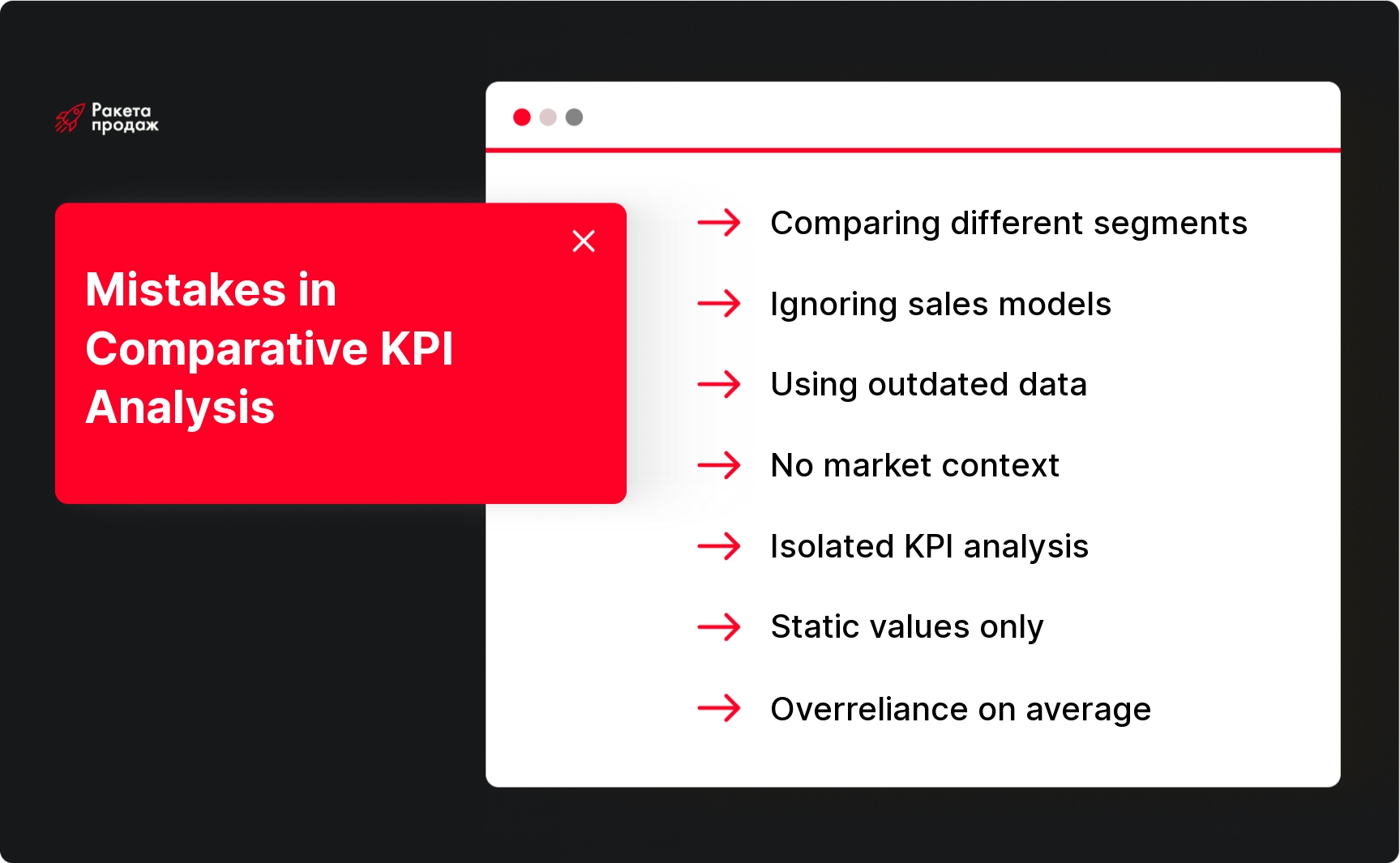
Common mistakes in competitive analysis of sales KPIs

image

KPI benchmarking is a powerful tool, but its incorrect application can lead to erroneous conclusions and ineffective decisions. Let’s consider the most common mistakes that companies make when conducting comparative analysis of sales indicators.

One of the most frequent mistakes is comparing companies from different market segments. For example, comparing KPIs of a B2B company with a long sales cycle and a B2C business with a short cycle will inevitably lead to distorted conclusions. Even within the same industry, companies can differ significantly in positioning, target audience, and price category. A premium brand with high margins and low sales volume will have a completely different KPI structure than a mass brand focused on turnover.

Ignoring differences in sales models is another common mistake. Companies with different channels (direct sales, distributors, online) and approaches to process organization (inside sales, field sales, self-service) will have completely different performance indicators. For example, a business working through a distribution network typically has lower margins but also lower costs for direct sales, making direct comparison with a company using only its own sales team incorrect.

Using incomplete or outdated data can seriously distort benchmarking results. Industry reports and market research are usually published with a certain delay, and in rapidly changing industries, year-old data may no longer reflect current reality. Additionally, many studies are based on a limited sample of companies, which may not include the most relevant competitors for you.

Comparing indicators without considering market context is another source of errors. During a period of general market growth, even lagging companies may show positive sales dynamics, while in crisis times, even leaders may show a decrease in absolute indicators. Therefore, it’s important to compare your results not only with competitors but also with general market trends, considering the economic cycle, seasonality, and other external factors.

Misinterpretation of benchmarks is often associated with isolated analysis of individual KPIs without considering their interrelationships. For example, low CAC may seem like a positive indicator, but if it’s accompanied by low quality of attracted customers and high churn, this indicates problems in the attraction strategy. Similarly, high conversion may be the result not of effective sales but of too soft qualification at early funnel stages.

Analysis of only static values without considering dynamics can lead to incorrect conclusions. Even if your current indicators lag behind benchmarks but show steady improvement from quarter to quarter, this may indicate the right direction of changes. And conversely, even being currently above market average values, with negative dynamics, you risk losing your advantage in the near future.

Often companies get carried away with collecting a large number of benchmarks but don’t transform them into specific actions. Without a clear plan to eliminate identified gaps and regular monitoring of progress, benchmarking remains a purely academic exercise, not bringing real business benefits.

Another common mistake is excessive trust in average indicators. Industry averages may hide significant variations between individual players and segments. Comparison with quartiles or deciles may be more informative, allowing you to understand where you are relative to the best and worst industry representatives.

How to improve sales department performance through KPI benchmarking

Benchmarking shouldn’t remain just an analytical exercise – its main purpose is specific improvements in sales department performance. Let’s consider how to use comparative analysis results for real changes in key areas.

Sales funnel optimization is one of the most obvious applications of benchmarking. Having identified stages where your conversion is significantly lower than the market, you can purposefully work on improving them. For example, if your conversion from qualified lead to demonstration is 25%, while competitors achieve 40%, it’s worth revising appointment scripts, training managers in more effective objection handling, or implementing automated tools for reminders and follow-up contacts.

For more information on how to conduct sales funnel analysis to identify and eliminate problematic stages, read our article.

Benchmarking may reveal the need for structural changes in the sales team. If analysis shows that competitors with similar business models have one and a half times more closed deals per manager, this may indicate excessive bureaucratization of processes, suboptimal distribution of responsibilities, or insufficient automation of routine tasks. The solution may be separating functions (for example, allocating separate roles for lead qualification, demonstrations, and deal closing) or implementing systems for document flow automation.

Adjustment of the salespeople motivation system is another area where benchmarking can provide valuable ideas. Comparison with competitors may reveal that your commission system doesn’t sufficiently stimulate certain behaviors important for the business. For example, if you have a weak customer retention rate compared to the market, it may be worth introducing deferred bonuses dependent on the duration of client relationships or KPIs for the share of regular customers in a manager’s portfolio. Tips and examples on how to influence sales department motivation can be found in a separate material.

Sales process automation often becomes an obvious necessity when comparing operational efficiency with competitors. If your costs for processing one deal are significantly higher than market averages, it’s worth considering implementing CRM with advanced automation, tools for electronic document flow, chatbots for initial qualification, or predictive lead scoring systems. Such investments pay off through increased team productivity and reduced operational costs.

Sales strategy revision may be necessary if benchmarking reveals substantial gaps in key KPIs. For example, if your market share is declining despite significant marketing investments, you may need to revise target segments, attraction channels, or value proposition. Similarly, if your customer retention rate is significantly lower than the market, this may indicate the need to shift focus from attracting new customers to developing relationships with existing ones.

Benchmarking can also help optimize product strategy. Comparing indicators across various product lines with competitors can reveal in which segments you have a competitive advantage and where you lag. This allows more informed allocation of resources between different directions, focusing on those where you can achieve leadership or where the gap creates the greatest business risks.

It’s important to remember that implementing changes based on benchmarking results should be gradual and controlled. Instead of trying to improve all indicators simultaneously, choose 2-3 most critical gaps and focus on them. Set clear goals to reduce the gap (for example, “increase conversion from lead to qualified lead from 15% to 25% over 6 months”), develop a detailed action plan, and regularly track progress.

After successfully implementing changes in one area, move to the next, using benchmarking as a continuous improvement cycle. Such an iterative approach allows not only catching up with competitors on individual indicators but also over time surpassing them, creating a sustainable competitive advantage.

Comparing KPIs with competitors is not just an analytical exercise but a powerful tool for transforming your sales department. But to get the maximum benefit from benchmarking, you need expert methodology and proper data interpretation. “Sales Rocket” offers a comprehensive solution to this task through the “Sales Department Systematization” service, where benchmarking becomes the starting point for systemic improvements. We don’t just compare numbers – we restructure processes, implement effective CRM systems with visualization of key KPIs, develop dashboards for operational control, and train your team in modern sales techniques. Our approach has proven its effectiveness in working with companies such as Mitsubishi, Audi, and Naftogaz. During our work, we have built more than 158 successful sales departments that consistently achieve planned indicators and outperform competitors in key performance metrics. Don’t spend months on experiments with uncertain results.

Turn comparative analysis into a specific action plan that will ensure sales growth of up to 86% – contact us today!

Conclusion

Sales department KPI benchmarking is not just a fashionable management tool but a strategically important practice that transforms figures from CRM systems into specific actions to strengthen competitive positions. Regular comparison of key indicators with competitors and market leaders allows seeing hidden growth opportunities, objectively evaluating the effectiveness of current processes, and making informed decisions about necessary changes.

The most informative for comparative analysis are comprehensive sets of KPIs covering various aspects of sales: from financial results (market share, margin, ROI) to funnel efficiency (conversion, CAC, cycle length) and customer indicators (retention, ARPU, satisfaction index). It’s important not just to compare individual figures but to analyze their relationships and dynamics, considering the specifics of your business model and market context.

A detailed breakdown of exactly which key sales department KPIs should be tracked is only possible considering the industry, team structure, and strategy of your company.

Successful implementation of KPI benchmarking for the sales department requires a systematic approach: from careful selection of relevant data sources and companies for comparison to regular monitoring of progress and transformation of analytical conclusions into specific changes in processes, team structure, and motivation system. Only in this way does benchmarking transform from a reporting tool into a driver of real improvements and a foundation for strategic sales management.

In this article:
See more
Book a FREE sales funnel audit
CONTACT US
FAQ
What is sales department KPI benchmarking?

Sales department KPI benchmarking is a systematic process of comparing your team’s key performance indicators with competitor results or industry standards. It allows objectively assessing the strengths and weaknesses of your sales department, identifying opportunities for improvement, and determining realistic goals based on market data.

Which sales department KPIs are most often compared with competitors?

Most often compared are indicators such as market share, customer acquisition cost (CAC), customer retention rate, average revenue per user (ARPU), sales growth rate, funnel stage conversion, margin, and deal cycle length. The choice of specific KPIs depends on your business specifics and data availability. If you want to delve deeper into this, we recommend familiarizing yourself with the material about competitive sales benchmarking.

Where can I get data for competitive analysis of sales KPIs?

Data sources can include industry reports and market research, specialized databases (for example, KPI Depot), public financial reporting of competitors, paid marketing research, industry associations and conferences, as well as aggregated data from CRM vendors and consulting companies.

How does competitive analysis of sales KPIs differ from internal analytics?

Internal analytics focuses on tracking your own dynamics of indicators over time and comparing different teams or channels within the company. Competitive analysis of the sales department complements this picture with market context, allowing you to understand how your results correspond to industry standards and indicators of market leaders, providing a more objective view of real effectiveness.

How often should sales KPI benchmarking be conducted?

The optimal frequency depends on the speed of changes in your industry and data availability. In dynamic sectors (for example, e-commerce or SaaS), it’s recommended to conduct benchmarking quarterly; in more stable industries – once every six months or a year. Basic financial KPIs (market share, growth rates) can be tracked more frequently, for example, monthly.

Can sales department KPIs of companies of different sizes be compared?

Yes, but with certain caveats and adjustments. For correct comparison, it’s better to use relative rather than absolute indicators (for example, conversion in percentages, not the number of deals), and also group companies by similar size categories. Some KPIs, such as margin or average check, may differ significantly depending on the scale effect.

How do I know if sales department KPIs are below market level?

For this, it’s necessary to systematically compare your indicators with benchmarks from reliable sources, considering the specifics of your segment and business model. If your KPIs are consistently below market average values or in the lower quartile of industry distribution, this indicates possible problems and the need for corrective actions. It’s especially important to pay attention to the negative dynamics of the gap with competitors.


If you feel that you need deeper expertise or to conduct a sales department audit, turn to professionals – a timely outside perspective will help avoid several unnecessarily expensive mistakes and accelerate the path to new horizons of efficiency.

We also recommend familiarizing yourself with modern best tools for sales funnel analysis to automate data collection for benchmarking and comparison with competitors.

SUBSCRIBE TO MY TELEGRAM CHANNEL
The most valuable sales information right on your phone!
icon

LOTS OF USEFUL INFORMATION, FREE TEMPLATES, AND CHECKLISTS ON MY INSTAGRAM

Materials and practical advice on sales growth in our blog: