icon

When a Company Needs Sales Benchmarking

Sales benchmarking is a systematic process of comparing your sales department’s performance indicators with market leaders or successful competitors. This tool helps companies find objective growth benchmarks, identify weaknesses in their processes, and implement proven practices. In today’s business environment, with growing competition and increasingly demanding customers, benchmarking has transformed from a trendy term into a necessary element of strategic sales management.

Key Takeaways

  • Sales stagnation over several quarters signals the need to compare not only results but also processes: competitors may have automated their funnel or switched to more effective acquisition channels.
  • Declining repeat purchases and NPS indicate a gap between your service cycle and industry best practices, with acquiring a new customer costing 5-7 times more than retention.
  • Benchmarking before entering a new market helps set realistic goals and avoid typical mistakes, such as understanding that the average corporate segment sales cycle is 2-3 times longer than in small business.
  • Regular comparison with competitors reveals missed distribution channels. If competitors get 30% of revenue from online while you only sell offline, you’re losing market share.
  • Effective benchmarking requires clear goals, selecting relevant benchmarking objects, and continuous monitoring; it’s not a one-time event but a system of continuous improvement.

In the full article, you’ll find specific signals for initiating benchmarking, a step-by-step algorithm for conducting it, and real cases of companies that reduced their sales cycle by 40% and increased conversion by 25% by comparing themselves with market leaders. Read below 👇

Many executives turn to this tool when they notice that sales indicators have stopped growing, when new players enter the market, or when the existing sales model doesn’t deliver expected results. In this article, we’ll examine the key signals indicating when sales benchmarking is needed and discuss how this tool can help your business.

When Sales Benchmarking is Needed: Key Signals for Business

Most companies start thinking about benchmarking when they face certain difficulties or uncertainties in their sales department. These difficulties often manifest as specific symptoms that signal the need to search for external benchmarks and comparative analysis.

It’s important to understand that benchmarking is not just about comparing numbers. It’s a comprehensive approach to analyzing the entire sales system, including strategies, processes, technologies, and personnel. When a company notices it’s falling behind competitors in any aspect of sales, benchmarking helps find specific areas for improvement and understand what solutions are already working for others.

Get an objective assessment of your sales department and increase turnover by an average of 35% – order a free consultation now!

Get an objective assessment of your sales department and increase turnover by an average of 35% - order a free consultation now!

Prolonged Sales Stagnation

When a company’s sales stop growing for several consecutive quarters, it’s a clear signal that it’s time to look for external performance benchmarks. Stagnation can be caused by two main factors: a general market downturn or internal problems in sales processes.

Benchmarking helps separate these causes and understand whether your stagnation is a general trend or you’re falling behind competitors. For example, if the entire market is declining by 5% and your sales have decreased by 15%, then the problem is not just external factors. Comparing with competitors’ indicators allows you to see at which stages of the sales funnel you’re losing efficiency – in lead generation, their conversion to customers, or in repeat sales.

In such situations, it’s useful not only to compare your indicators with competitors but also to delve deeper into the company’s internal processes. That’s why many executives first analyze when a sales audit is needed to understand which funnel stages, scripts, or management decisions are affecting the declining results.

It’s important to compare not just results but also processes. Perhaps your competitors are using different customer acquisition channels or have automated certain stages of lead work, making their sales more efficient. Such insights are difficult to obtain by looking only at your company’s internal indicators.

To get the most complete analysis, you can also use the practice of sales auditing – a tool that complements benchmarking and allows you to delve into the details of internal processes.

Increased Competition and New Market Players

When new companies enter the market or existing competitors become more active, it’s important to conduct a comparative analysis of commercial offers and sales tactics. As competition intensifies, customers become more selective and compare not only prices but also the value proposition, response speed, and service quality.

Benchmarking reveals how competitors attract customers. Perhaps they offer more flexible payment terms, additional services, or better after-sales support. Analyzing competitive offers helps adapt your sales strategy to new market realities.

For example, if a new market player offers a free trial period for your product, while you require full payment upfront, this can significantly impact the customer’s decision-making speed. Understanding such details helps adjust your offer and sales processes to meet changed market expectations.

For a more effective understanding of market positions, it’s recommended to use sales department benchmarking – a special tool that allows you to compare key aspects of your department with industry leaders.

Decline or Slowdown in Customer Loyalty and Repeat Purchases

If you notice that customers are making fewer repeat purchases and the loyalty index (NPS) is declining, this is a direct signal for benchmarking your service cycle. Often companies focus on attracting new customers, forgetting the importance of retaining existing ones, although acquisition costs 5-7 times more than retention.

Comparing your service cycle with industry best practices reveals the gap between customer expectations and the actual quality of deal support. Perhaps your competitors have implemented more effective loyalty programs, improved customer support, or created more attractive conditions for regular customers.

Benchmarking in this area includes analyzing indicators such as response speed to customer requests, quality of problem solving, frequency of post-sale contacts, and percentage of customers making repeat purchases. Comparing these indicators with market leaders helps understand exactly where you’re losing customer loyalty and what changes need to be made to your processes.

In this context, it’s useful to pay attention to key sales department metrics that can truly impact customer retention and return rates.

Low Sales Department Efficiency and Problems with Achieving Goals

When you notice that your sales department isn’t achieving set goals and key performance indicators are declining, benchmarking becomes a necessary tool for identifying causes. Low sales department efficiency can manifest in various aspects: from individual salespeople not meeting their plans to systemic problems with conversion at different funnel stages.

Sales benchmarking to improve efficiency allows comparing not only quantitative indicators but also qualitative aspects of your team’s work. Comparing training processes, motivation, and control with market best practices helps identify areas for improvement and implement systemic enhancements.

For example, analysis might show that your competitors have a significantly shorter training cycle for new salespeople, higher average productivity per employee, or a more effective compensation structure. These insights can become the basis for revising personnel policies, training systems, and motivation in your company.

For a more systematic approach to identifying bottlenecks, use recommendations from materials on how to conduct a sales department audit to additionally diagnose problem areas and development paths.

Planning to Enter New Segments or Regions

When a company decides to expand its presence in new markets or enter new segments, benchmarking becomes an indispensable tool for setting realistic goals and plans. Entering a new niche is always associated with uncertainty, and without understanding typical performance indicators in this market, the company risks either setting goals too low or creating unrealistic expectations.

Analyzing the KPIs of leaders in new niches helps establish objective benchmarks for your sales team. For example, if you’re planning to enter the corporate client market, it’s important to understand that the average deal cycle there may be 2-3 times longer than in the small business segment. And while the average check is higher, the cost of customer acquisition increases significantly.

Benchmarking also helps avoid typical mistakes when scaling a sales model. By studying the experience of companies already working in the target segment, you can prepare in advance for typical customer objections, adapt your marketing materials and sales scripts, and properly structure the onboarding process for new clients.

In this case, structured approaches to building a strategy for entering new markets are very useful, as they rely on benchmarking results and reduce risks associated with scaling.

Desire to Increase Profitability and Implement Innovations in Sales Department

Many companies turn to benchmarking when they want to increase sales profitability without reducing volumes. In such cases, it’s especially useful to study best practices in automation and process optimization that allow reducing costs per deal.

By studying how market leaders use CRM systems, analytics tools, marketing automation, and artificial intelligence, you can identify opportunities to implement technologies that have already proven their effectiveness. For example, you might discover that competitors use chatbots for initial lead qualification, allowing their managers to focus on more promising clients.

Benchmarking also helps evaluate the effectiveness of various tools before implementing them. Instead of experimenting with different solutions, you can study the experience of other companies and choose tools that are most likely to bring results in your specific situation. This is especially important with a limited innovation budget.

If your goal is not only to improve process quality but also to increase profit from individual deals, be sure to study best practices on how to increase the average check in B2B, which provide clear recommendations for integration into your sales strategy.

Need for Regular Evaluation of Sales Department Efficiency and Distribution Channels

Even if your company doesn’t have obvious sales problems, regular benchmarking helps maintain competitiveness and timely identify new growth opportunities. In modern business, technologies and consumer preferences change so quickly that a company not conducting regular efficiency evaluations risks missing important market shifts.

Benchmarking allows you to assess how effectively different distribution channels work compared to competitors. For example, if your main sales come through traditional channels, while competitors are actively developing online sales and getting 30% of revenue there, this may indicate missed opportunities.

To avoid missing new sales niches, it’s important to know the types of sales channels and their comparative effectiveness relative to your industry.

Regular comparison of your indicators with industry standards also helps maintain sales team motivation. When employees see that their results are compared not only with internal plans but also with real achievements of other companies, this creates an additional incentive for development and improvement.

Main Stages of Conducting Sales Benchmarking

image

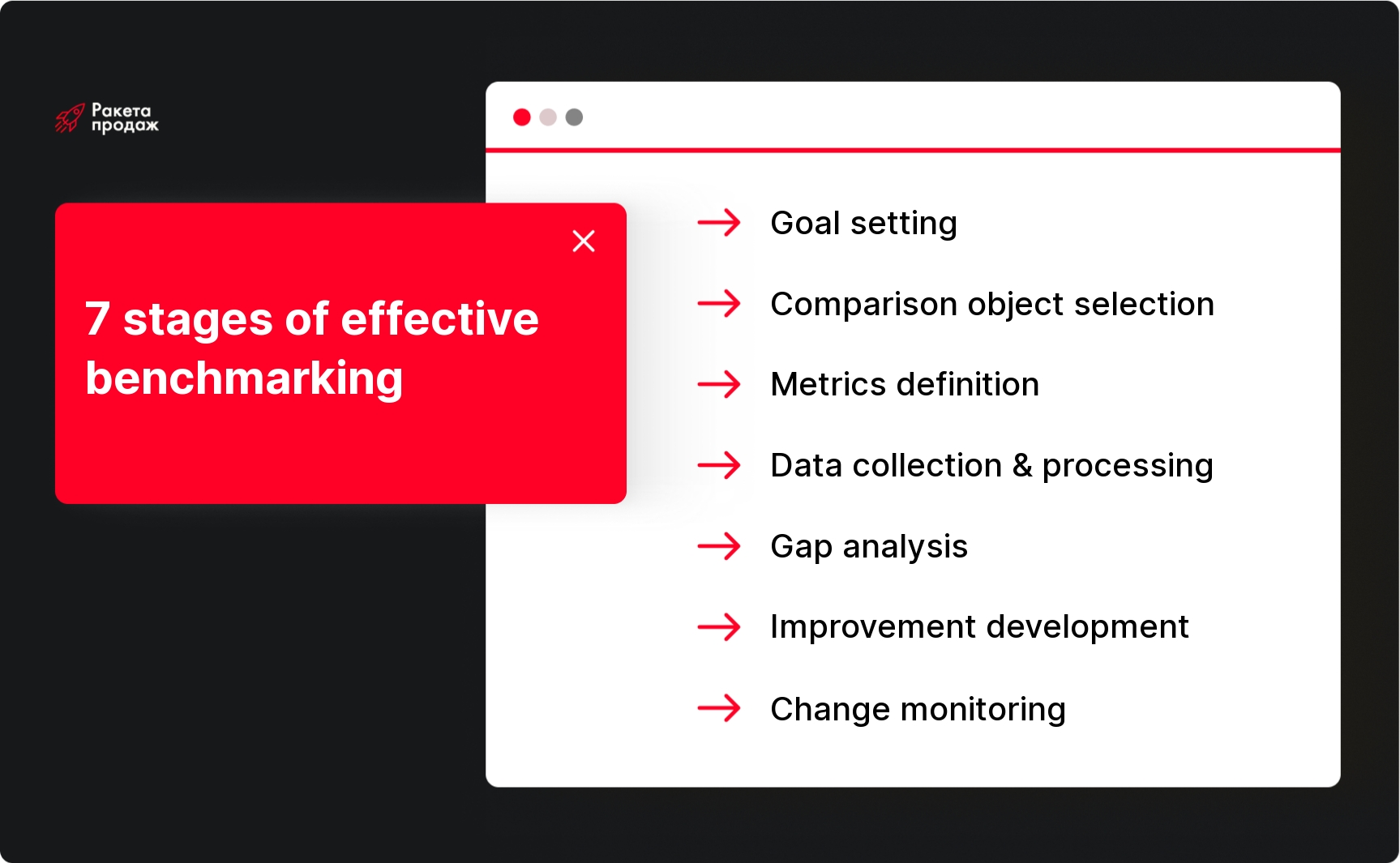
Effective sales benchmarking is not a one-time event but a structured process requiring a systematic approach. To get maximum benefit from this tool, it’s important to properly organize each stage, starting with setting goals and ending with implementing improvements.

When setting goals, many executives face the question: how to set a sales plan that is both ambitious and realistic. This is where benchmarking becomes especially useful. By comparing your company’s indicators with industry standards and competitor results, you can determine objective benchmarks for planning and form a sales plan that will reflect the real market potential.

Benchmarking should be viewed as an investment in developing your sales system. Although the process requires time and resources, when properly conducted, it can significantly increase the efficiency of the sales department and bring tangible financial results. Let’s look at the key stages of conducting sales benchmarking.

The first stage is setting goals. Before starting benchmarking, it’s important to clearly define what questions you want to solve with it. This could be revenue growth, increasing conversion at certain funnel stages, reducing the deal cycle, or lowering the cost of customer acquisition. The more specifically the goals are formulated, the easier it will be to choose relevant metrics and objects for comparison.

At this stage, it’s also important to determine the project scope: will you analyze the entire sales system or focus on specific aspects, such as onboarding new clients or the effectiveness of a particular sales channel. Goals should be measurable and align with the company’s overall development strategy.

The second stage is selecting benchmarking objects. Here it’s important to decide who you’ll compare your indicators with. These could be direct competitors, industry leaders, or even companies from other fields known for their strong sales practices. The choice of objects depends on your goals and data availability.

For internal benchmarking, you can compare different departments, branches, or teams within the company. For external benchmarking, it’s important to choose companies with comparable business models, size, and target audience to make the comparison as relevant as possible.

The third stage is selecting and collecting relevant metrics. At this stage, specific indicators to be analyzed are determined. For the sales department, these might be sales volume by channel, average check, conversion at different funnel stages, deal closing speed, customer retention indicators, and other KPIs.

The choice of metrics should reflect your goals and consider industry specifics. For example, for SaaS companies, customer churn and lifetime value are critically important, while for retail, average check and visitor-to-buyer conversion are key.

The fourth stage is data collection. At this stage, you gather information about both your own indicators and those of selected comparison objects. Data sources may include:

  • Internal systems (CRM, website analytics, financial reporting)
  • Open company reports and financial documents
  • Industry research and analytical reports
  • Customer and employee surveys
  • Interviews with industry experts
  • Specialized competitive intelligence platforms

The fifth stage is analysis and gap identification. After collecting data, it’s time to systematize and analyze it. The goal of this stage is to identify areas where your company lags behind benchmark indicators and understand the reasons for these gaps.

The analysis should be comprehensive and consider the interrelationship of various indicators. For example, low conversion might be related to lead quality, seller competencies, or value proposition. It’s important to dig down to the root causes of lagging, not just state the gap in numbers.

The sixth stage is developing specific process improvement measures. Based on identified gaps and study of best practices, you develop an action plan to optimize sales. This plan should include specific initiatives, responsible persons, implementation deadlines, and expected results.

It’s important to prioritize initiatives, focusing on those that can bring the greatest results with minimal costs. Don’t try to implement all changes at once – this can overload the team and lead to resistance to change.

The seventh stage is monitoring and correction. After implementing changes, it’s necessary to regularly track their effectiveness and adjust the approach if needed. Benchmarking is not a one-time event but a continuous improvement process, so it’s important to establish a system for regular monitoring of key metrics and comparing them with target benchmarks.

Regular progress evaluation allows timely identification of new areas for improvement and adaptation of sales strategy to changing market conditions. Ideally, benchmarking becomes part of a culture of continuous improvement in the company.

Practical Cases: How Sales Benchmarking Increased Company Efficiency

Theoretical understanding of benchmarking is important, but even more valuable is knowing how this tool works in practice. Let’s look at several real examples from different business areas where benchmarking helped companies significantly improve their sales indicators.

A B2B software company faced the problem of a long sales cycle and low lead-to-customer conversion. After benchmarking with industry leaders, they discovered that their competitors actively used product demos and free trial periods to reduce customer decision-making time.

The company implemented an automated demo system and launched a 30-day free testing program. As a result, the sales cycle shortened by 40%, and lead-to-customer conversion increased by 25%. Additionally, benchmarking showed that market leaders use specialized content strategies for different sales funnel stages. By implementing a similar approach, the company was able to increase incoming lead qualification and reduce customer acquisition cost by 30%.

A retail clothing chain conducted benchmarking to increase average check and repeat purchase frequency. Comparison with successful competitors showed that the latter actively develop an omnichannel approach, integrating online and offline sales channels. Additionally, competitors had a more effective loyalty program based not on discounts but on personalized offers.

The retail chain implemented a unified customer database system for all channels, launched a mobile app with personal recommendations, and restructured the loyalty program, adding exclusive privileges for regular customers. As a result, the average check grew by 15%, and repeat purchase frequency increased by 40% within a year. Particularly effective was the implementation of predictive analytics technology for creating personalized offers, which was borrowed from companies in another industry – online entertainment.

A food delivery startup conducted benchmarking before entering a new regional market. Analysis of market leaders’ indicators allowed them to set realistic targets for customer acquisition cost, average check, and order frequency. They discovered that in the new market, the average check was 30% lower than in their main market, but order frequency was 1.5 times higher.

This allowed the startup to adapt its marketing strategy, emphasizing programs that stimulate order regularity rather than increasing the average check. They also found that in the new market, the key success factor was delivery speed, not assortment, as in their main market. By focusing on logistics optimization, the startup was able to achieve profitability indicators 20% faster than initially planned.

These examples show that sales benchmarking not only helps companies identify where they lag behind competitors but also provides specific ideas for improving processes. The key success factor in all cases was not just adapting others’ practices, but creatively rethinking them considering the specifics of their own business and target audience.

Transform your sales department into a systematic mechanism that will increase conversion to 86% – sign up for a free audit now!

Transform your sales department into a systematic mechanism that will increase conversion to 86% - sign up for a free audit now!

Conclusions

Sales benchmarking is a powerful tool that helps companies objectively evaluate the effectiveness of their processes, identify growth points, and adopt best practices from market leaders. As we’ve seen, there are various reasons for sales benchmarking: sales stagnation, increased competition, declining customer loyalty, expansion to new markets, or the desire to increase profitability.

Properly conducted benchmarking allows not only identifying gaps with industry best indicators but also understanding the reasons for these gaps, and then developing specific steps to eliminate them. Companies that regularly use this tool adapt faster to market changes, more effectively implement innovations, and maintain a healthy culture of continuous improvement.

In this article:
See more
Book a FREE sales funnel audit
CONTACT US
FAQ
When should a company conduct sales benchmarking?

A company should conduct sales benchmarking in cases of sales stagnation or decline, increased competition, decreased customer loyalty, before entering new markets, with low sales department efficiency, and also regularly (for example, once a year) to maintain competitiveness and timely identify new opportunities. When to conduct sales benchmarking also depends on your business seasonality and the speed of changes in your industry.

What indicators are compared during sales benchmarking?

During sales benchmarking, various groups of indicators are compared: financial (revenue, margin, customer acquisition cost), sales funnel indicators (conversions at different stages, average check, deal cycle), team productivity (revenue per salesperson, number of deals, plan fulfillment), customer metrics (NPS, retention, repeat purchases), and operational indicators (channel effectiveness, response speed, service level).

Can benchmarking be used for setting a sales plan?

Yes, benchmarking is an excellent tool for setting realistic and motivating sales plans. How to calculate a sales plan is a crucial question for managers, and benchmarking allows finding a well-founded answer. Comparison with market leaders’ indicators or industry standards helps establish objective benchmarks that consider market potential and best practices. The question of how to set a sales plan is solved more effectively when planning is based on benchmarking rather than simply increasing last year’s results by a certain percentage.

Why is sales benchmarking needed in modern business?

Sales benchmarking is necessary for modern companies to objectively assess their competitiveness, identify hidden problems and growth opportunities. It’s a tool that allows adopting market best practices without reinventing the wheel. In a rapidly changing market with growing competition, benchmarking helps companies stay flexible and adaptive, timely adjusting their sales strategies in response to environmental changes. The reasons for sales benchmarking include the need to overcome falling behind competitors and addressing low sales department efficiency through systematic comparison and improvement.

SUBSCRIBE TO MY TELEGRAM CHANNEL
The most valuable sales information right on your phone!
icon

LOTS OF USEFUL INFORMATION, FREE TEMPLATES, AND CHECKLISTS ON MY INSTAGRAM

Materials and practical advice on sales growth in our blog: