icon

What Tasks Must a Sales Manager Solve Every Day

A Head of Sales (HOS) is the person whose daily management tasks in sales directly affect the company’s financial results. They’re not just a boss for managers. They control levers that can both accelerate revenue growth and trigger a negative spiral of declining sales.

Key Takeaways

  • Most sales managers spend less than 20% of their time on strategic management, dedicating the remaining 80% to routine tasks and putting out fires.
  • A Head of Sales who engages in micromanagement instead of building a system makes the team dependent on them and loses time for strategy.
  • Morning analysis of the sales funnel and problematic deals helps identify risks before they turn into plan failures.
  • Weak managers control processes, strong ones develop people. Coaching employees yields more returns than checking every email.
  • Clear prioritization using the Eisenhower Matrix separates important tasks from urgent ones, while delegation and automation free up time for department growth.

In the article below, you’ll find a specific timeline for an effective Head of Sales day, prioritization tools, and typical mistakes that cost companies millions. Read the full article 👇

Interestingly, most sales leaders spend time on tasks that don’t really drive results. Surprisingly, according to research, sales managers on average devote less than 20% of their time to strategic process management, giving the remaining 80% to routine and “firefighting.” Mistakes in the daily priorities of a Head of Sales cost the company millions.

When a manager focuses on the right tasks, it creates a multiplicative effect: team motivation grows, deal conversion improves, customers receive better service, and the business achieves sustainable revenue growth. Conversely, if the HOS engages in micromanagement or ignores systemic problems in the department, the company loses not only money but also its best employees.

Not only current sales figures depend on the manager’s daily actions. They shape the culture of customer relationships, set quality standards, and build processes that either strengthen the business or become its hindrance. This is an enormous responsibility that requires a clear understanding of daily duties.

It’s also important to understand what functions a Head of Sales performs in daily practice. These include monitoring sales plan execution, setting and adjusting tasks for the team, analyzing performance indicators, training and developing managers, implementing and optimizing processes, and regular communication with other company departments.

What should a sales department manager’s daily schedule look like? Which tasks cannot be delegated? How should a sales manager properly prioritize? Which mistakes cost the most? In this article, we’ll examine what a HOS should do every day to lead their team to consistent results and help the business grow.

Role and Key Functions of a Head of Sales

Before discussing daily tasks, it’s important to understand who a Head of Sales is and how their role differs from other positions in the company’s commercial structure. The HOS occupies a middle position between top management and the field – they are simultaneously a strategist and tactician.

Unlike a sales manager who focuses on working with specific clients and deals, the department head is responsible for the sales system as a whole. If a manager plays chess with one piece, the HOS manages the entire board. At the same time, unlike a commercial director, the department head is more immersed in operations and closely interacts with the sales team.

The key difference between a HOS and a sales director lies in the scale of tasks and level of responsibility. The director forms a long-term strategy, builds interaction between all commercial departments, and integrates sales into the overall business strategy. The HOS focuses on tactical management of one department, albeit with an understanding of strategic goals.

The basic functions of a Head of Sales can be grouped into five key areas:

Planning and forecasting. The HOS is responsible for breaking down the overall sales plan for the team and individual employees, determining tactics for achieving goals, and forecasting results based on funnel analysis.

Team management. This includes recruiting, training, motivating, coaching, and developing managers. The HOS creates an atmosphere where employees can realize their potential and achieve high results. Special attention is paid to support tools, such as sales department motivation programs, which significantly affect overall mood and staff performance.

Development of sales processes. The manager improves customer relationship methods, implements new tools, optimizes the funnel, and eliminates bottlenecks in the sales process.

KPI monitoring. The HOS tracks not only final indicators (revenue, number of deals) but also intermediate metrics that affect the result: manager activity, quality of database development, conversions at different stages of the funnel. A well-built KPI system in sales helps effectively measure progress and motivate employees.

Analytics and data work. A modern sales manager uses data for decision-making – analyzing the effectiveness of acquisition channels, segmenting the customer base, identifying trends, and adjusting tactics based on figures. For this, sales funnel analytics becomes an indispensable tool: timely analysis helps identify bottlenecks and improve results.

It’s also important to understand what is included in the work of a sales manager overall. In addition to strategic planning and KPI control, their responsibilities include setting specific tasks for the team, regular coaching and employee development, organizing customer interaction processes, analyzing sales channel effectiveness, and making adjustments to the department’s work.

It’s important to understand what tasks a manager performs in their daily work. An effective HOS doesn’t centralize all processes. Their task is to create a system where the sales department works like a well-tuned mechanism, even when the manager is absent. A good HOS is not one who does everything themselves, but one who knows how to organize the team’s work so that each employee understands their tasks and is motivated to perform them.

Now that we’ve defined the key functions, let’s look at how they transform into daily HOS tasks and what a typical sales manager’s workday should look like.

Perhaps you recognized your manager or yourself in this description: a Head of Sales who spends 80% of their time “firefighting” and handling operations instead of strategic tasks? This is a typical problem faced by most sales leaders – when the day turns into an endless stream of urgent tasks, and systematic work on department development is postponed.

At “Sales Rocket,” we help transform the Head of Sales’ work from chaotic to systematic. With over 7 years of experience, we’ve created a proven methodology that allows sales leaders to effectively build processes, train teams, and achieve predictable results. Our experts conduct comprehensive process audits, implement a clear KPI and control system, optimize the sales funnel, and provide transparent analytics – everything needed to free the manager from routine.

Turn chaos in your sales department into a clear system that works for you – order a free audit right now!

Daily Tasks of a Sales Manager: Workday Structure

The effectiveness of a HOS depends not only on what they do but also when they do it. A structured approach to planning the day allows the manager to focus on priority tasks and avoid a reactive work mode where all attention goes to “firefighting.”

How does a sales manager day go with an effective schedule? An effective manager’s day includes morning data analysis, conducting meetings, team coaching, joint sales with managers, time for strategic planning and process improvement, and summarizing the day’s results. Balance between operational and strategic tasks is important, as well as between working with people and with numbers.

A properly organized sales department manager’s day can be divided into three key blocks: morning (analysis and planning), day (team coordination and support), and evening (summarizing and adjusting plans). This structure ensures a balance between strategic and tactical tasks.

That’s why it’s so important to understand what the daily work of a Head of Sales looks like in practice. It combines constant monitoring of sales indicators, coaching and team support, participation in key negotiations, working with documentation and reports, as well as time for strategic planning and process development. This approach allows the manager to maintain control over results, timely adjust the department’s course, and ensure stable sales growth without overload and chaos.

Morning: Funnel Analysis and Priority Setting

Morning for a sales manager is a time for analysis and planning. The first 1-2 hours of the workday are best devoted to working with data and determining key priorities.

The day should start with sales funnel analysis. The HOS checks the movement of key deals, analyzes which leads are stuck and require attention, and evaluates the overall dynamics compared to the plan. This allows understanding the current state of affairs and identifying potential problems before they affect results.

An important element of morning analysis is checking manager activity from the previous day. The HOS looks at how many calls each employee made, what meetings they conducted, what commercial offers they sent. This provides insight into work discipline in the team and allows quick response to decreased activity.

Special attention is paid to problematic clients and deals at risk. The manager identifies deals that may fail or drag on and determines how to help the sales manager close them. Sometimes the HOS’s personal participation in negotiations is required, sometimes it’s enough to give advice or suggest an alternative approach.

The morning block concludes with setting priorities for the day. The HOS identifies 3-5 key tasks that must be solved today and plans time for their implementation. These might be important meetings with clients, coaching sessions with managers, or work on systemic problems in the department.

Day: Team Coordination and Sales Support

The main part of the manager’s workday is devoted to working with the team and supporting sales. This is a time of active communication, operational problem-solving, and coaching.

The morning meeting is a mandatory element of the day block. This is a short (15-30 minutes) meeting of the entire team where the previous day’s results, key tasks for today, and current issues are discussed. An effective meeting focuses not on reports of work done but on specific actions needed to achieve goals.

An important part of the day block is monitoring calls and meetings. The HOS may listen to call recordings, attend meetings with clients, or conduct joint calls with managers. This helps evaluate the quality of employee work, identify areas for improvement, and provide constructive feedback.

Supporting key deals is another critical task. The manager helps sales staff in complex negotiations, participates in meetings with major clients, and approves non-standard conditions. Their participation often becomes the decisive factor in closing important deals.

Individual coaching of managers is an integral part of the HOS’s work. These are regular one-on-one meetings where the employee’s results, current deals, problems, and growth opportunities are discussed. A good manager doesn’t just point out mistakes but helps the sales manager find their own solutions through guiding questions. Modern methods of sales manager training are especially useful for this, allowing development of employees’ strengths and enhancing their competencies.

Evening: Summarizing and Management Decisions

The final part of the day is devoted to analyzing results, planning, and strategic tasks. This is a time for reflecting on the past day and preparing for the next one.

Analysis of key indicators is the first step of the evening block. The HOS evaluates how much the team has progressed toward fulfilling the plan, which metrics have improved or worsened, where action adjustments are required. This allows keeping a pulse on the business and responding promptly to negative trends.

Preparing reports for management is an important, though not the most beloved task for many sales leaders. However, a well-prepared report is not just a set of numbers but a communication tool that helps convey key information about the state of sales and necessary resources to senior management.

Adjusting sales strategy and tactics is an element of strategic management. Based on data analysis, the manager makes decisions about redistributing resources, changing approaches to working with clients, focusing on certain products or segments.

The day ends with setting tasks for tomorrow. The HOS determines which issues require immediate attention, plans meetings and calls, and prepares materials for the morning meeting. This ensures a smooth transition between workdays and allows starting the next day with a clear understanding of priorities.

Systematizing the daily work of a sales manager is the key to sustainable results. When the HOS acts not chaotically but according to a well-thought-out day structure, this allows balancing operational and strategic tasks, paying attention to both immediate problems and long-term goals for department development.

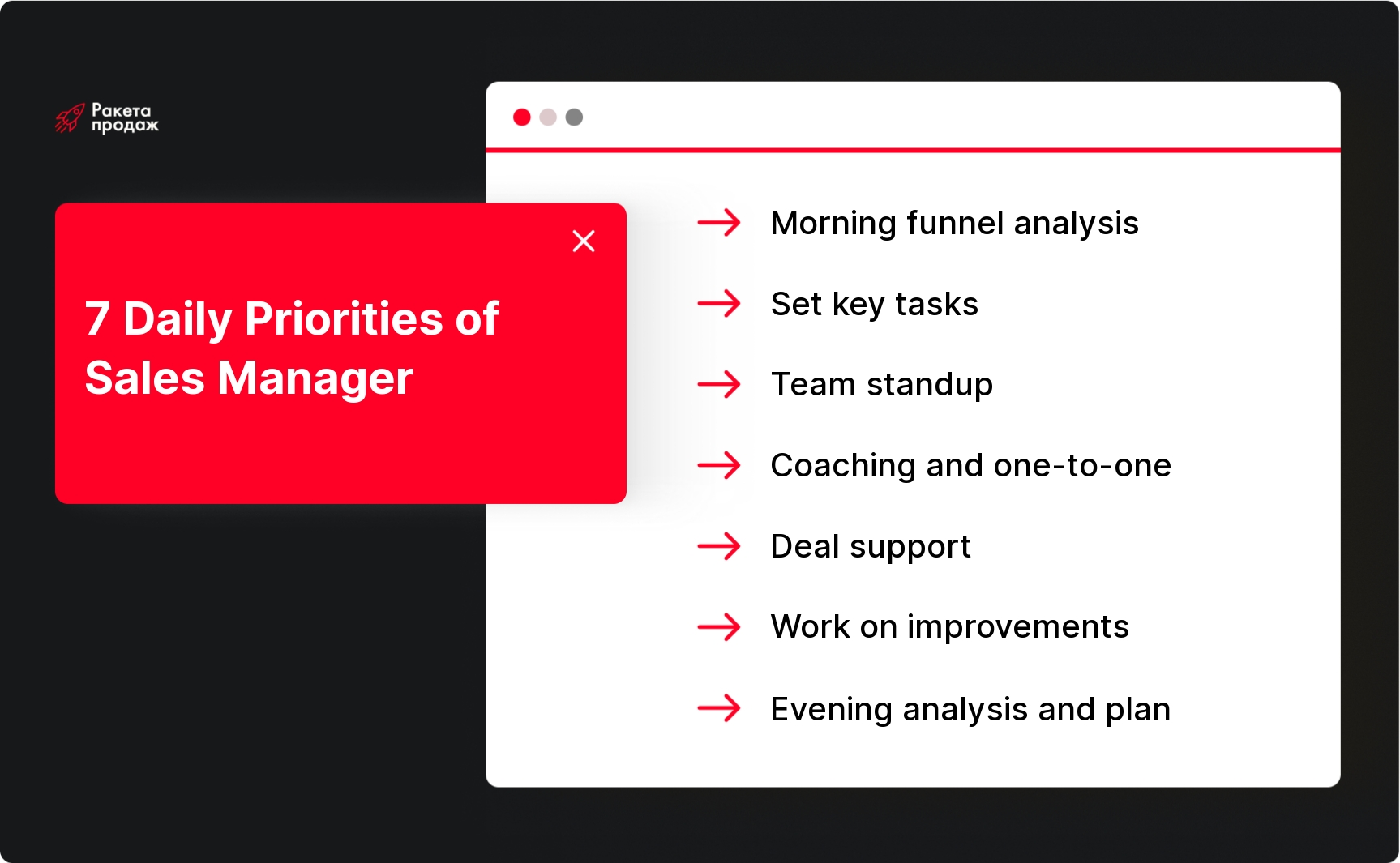
Daily Priorities of a Head of Sales: How Not to Drown in Routine

image

A Head of Sales daily faces a huge number of tasks – from urgent client calls to strategic planning. Without a clear prioritization system, there’s a risk of getting bogged down in routine and missing truly important things. How can a manager build a priority system that will help focus on tasks with maximum return?

The key problem for many managers is mixing the concepts of “urgent” and “important.” Urgent tasks are usually related to immediate responses to external requests and crisis situations. They create a feeling of busyness but often don’t bring you closer to strategic goals. Important tasks and daily priorities of a Head of Sales directly affect results in the medium and long term but rarely require immediate action, making them easy victims of procrastination.

The Eisenhower Matrix is an excellent tool for categorizing tasks by urgency and importance. For a HOS, it looks something like this:

  • Important and urgent: crisis situations with key clients, team problems requiring immediate intervention.
  • Important but not urgent: funnel effectiveness analysis, employee coaching, improving sales processes.
  • Urgent but not important: many administrative issues, some meetings, certain requests from other departments.
  • Not urgent and not important: routine reports that nobody reads, aimless internet surfing.

An effective HOS strives to devote maximum time to the “important but not urgent” quadrant, as these tasks ensure long-term success. This doesn’t mean urgent issues can be neglected, but the main thing is not to allow them to consume your entire day.

The “Golden Rule of Three Tasks” is another useful approach for a HOS. At the beginning of the day, identify the three most important things that will truly move the department toward its goal. This could be analyzing a key problem in the sales funnel, coaching a promising employee, or developing a new motivational scheme. Focus on completing these tasks before diving into the flow of incoming requests and daily routine.

Delegation is a crucial skill without which a HOS will inevitably get bogged down in operations. Many managers suffer from the “I’ll do it better” syndrome, not trusting important functions to the team. But to grow as a manager, you need to learn to transfer tasks to subordinates, even if initially they won’t perform them as well as you would.

What can and should be delegated:

  • Routine analytics and report preparation
  • Work with certain categories of clients
  • Some administrative functions
  • Training new employees in basic skills

However, you cannot delegate strategic decisions, evaluation of employee performance, key negotiations with the most important clients, and forming the department culture.

Automation is another way to free up time for priority tasks. Modern CRM systems allow setting up automatic generation of key indicator reports, which relieves the HOS from having to collect this data manually. BI systems visualize sales dynamics and help quickly identify trends and anomalies. You can learn more about automation possibilities in the article automation and CRM in sales, which reveals the key advantages of automated solutions for department control.

Task trackers provide transparency in team work – the manager can see at any moment who is doing what and at what stage important projects are. This reduces the need for constant checks and reminders, freeing time for strategic tasks.

Managing your own energy is an aspect often overlooked. Even the most perfect prioritization system won’t help if you’re physically and emotionally exhausted. Plan the most difficult and important tasks for periods of your peak energy, and leave routine matters for downtime. Don’t forget about short breaks for recovery – they increase productivity in the long term.

Determining daily priorities of a Head of Sales is not a one-time exercise but a continuous process. Conduct a weekly task review and evaluate what your time is spent on. This will help identify recurring problems that can be solved systemically rather than reacting to them each time anew.

By mastering the art of prioritization, the HOS becomes a strategist rather than a firefighter, allowing them to take the department to a new level of effectiveness. Careful planning, delegation, and automation create a solid foundation for focusing on what really drives sales forward.

What an Effective Sales Manager's Daily Schedule Looks Like

Prioritization theory is good, but how is it implemented in practice? Let’s look at a specific timeline for an effective Head of Sales workday, including tools and metrics that help structure the work.

8:30-9:00 – Preparation for the Day

The day begins with a brief calendar review and identifying key goals. The HOS reviews scheduled meetings, allocates time blocks for important tasks, and tunes in for productive work. This is time for oneself, without calls and meetings.

9:00-10:00 – Analysis of Indicators and Sales Funnel

At the beginning of the day, the manager studies key metrics in CRM and BI systems:

  • Dynamics of sales plan execution (general and by employee)
  • Conversion at each funnel stage
  • Deals in high readiness stage (close to closing)
  • Manager activity from the previous day
  • New leads and their distribution

Customized dashboards in the CRM system or BI tools that aggregate data from different sources are used for this. A good HOS knows how to quickly identify anomalies – a sharp drop in conversion at a certain stage, decreased activity of a specific manager, stuck deals.

10:00-10:30 – Morning Meeting with the Team

A short, dynamic meeting discussing:

  • Previous day’s results
  • Key tasks for today
  • Problem situations requiring attention
  • Employee successes and achievements (an important motivational element)

An effective meeting takes place in a stand-up format – each manager briefly answers the questions: what they did yesterday, what they plan today, what obstacles exist. The HOS focuses attention on concrete actions, not abstract reports.

10:30-12:30 – Coaching Sessions and Work with Key Managers

During this time block, the manager conducts planned one-on-one meetings with employees. This might be:

  • Analysis of complex deals
  • Listening to and analyzing call recordings
  • Discussing problems and achievements
  • Setting individual development goals

A structured approach is used for effective coaching: analyzing the current situation, defining goals, discussing possible actions, agreeing on specific steps. The HOS asks the right questions that help the manager find a solution themselves, rather than just giving ready answers.

12:30-13:30 – Lunch and Informal Communication

Time for energy recovery and informal communications. Experienced managers sometimes use lunch for a deeper understanding of employee motivation and mood in an informal setting.

13:30-15:00 – Work with Key Clients

The manager participates in important meetings and negotiations:

  • Joint visits with managers to strategic clients
  • Calls to resolve complex situations
  • Participation in approving non-standard deal conditions

This is a time for directly influencing sales, when the HOS acts not only as a manager but also as a highly qualified seller, demonstrating effective approaches in action to the team.

15:00-16:30 – Work on Systemic Issues and Improvements

During this block, the HOS deals with strategic tasks:

  • Analyzes the effectiveness of current sales processes
  • Develops new scripts and materials
  • Plans changes to the motivation system
  • Works on improving interaction with other departments

Analytical tools, development plan documents, and training materials are used for this work. It’s important to protect this time from urgent but unimportant issues that can distract from strategic tasks.

16:30-17:30 – Administrative Issues and Communication with Management

Time for solving organizational tasks:

  • Preparing reports for management
  • Coordinating resources and budgets
  • Interacting with other departments
  • Working with documents and administrative issues

Report templates, document management systems, Telegram bots for receiving operational information from different systems help here.

17:30-18:30 – Summarizing the Day and Planning

The final block of the day is devoted to analyzing results and preparing for tomorrow:

  • Checking completion of key tasks
  • Analyzing progress toward goals
  • Adjusting plans
  • Determining priorities for tomorrow

The HOS uses task trackers, calendar, CRM notes to record important observations and priorities for the next day.

18:30-19:00 – Ending the Day and Reflection

A short time for contemplating the past day:

  • What went well?
  • What could have been done better?
  • What lessons were learned?
  • What skills need development?

This helps the manager constantly grow and improve.

It’s important to understand that this timeline is not a rigid schedule but rather a model that each HOS adapts to their work style and business specifics. This is how a sales department manager’s day goes in its effective version. The key in this schedule is balance between operational and strategic tasks, between working with people and working with processes. This approach ensures not only fulfillment of current sales plans but also creates a foundation for long-term department growth.

Typical Mistakes of Sales Leaders in Daily Work

Even experienced sales managers make mistakes that reduce their work effectiveness and negatively impact department results. Understanding these typical traps is the first step to overcoming them.

Micromanagement and Distrust of the Team

Many sales leaders, especially those who rose from being the best salespeople, cannot give up the habit of controlling every aspect of subordinates’ work. They review every commercial offer, intervene in ordinary negotiations, don’t trust managers to make independent decisions.

This leads to double negative consequences. First, the manager spends time on operational tasks of a sales manager at the expense of strategic ones. Second, managers lose initiative and motivation, becoming dependent on instructions from above.

How to avoid it: Define clear boundaries of employee authority – what they can decide themselves and where your participation is needed. Focus on teaching, not correcting. Create a control system for key points, not total supervision.

Focus on Control Instead of Development

Many managers see their main task as controlling plan execution and process compliance. They track indicators, identify deviations, criticize for not meeting standards. Meanwhile, minimal time is devoted to employee development and process improvement.

As a result, the department works in “survival” mode rather than growth. Managers focus on fulfilling formal KPIs rather than building long-term relationships with clients. This gives short-term results but undermines the foundation for future growth.

How to avoid it: Balance control and development. Devote time not only to checking indicators but also to team training, skill improvement, and process refinement. View mistakes not as a reason for criticism but as an opportunity for growth.

Lack of Prioritization System

A HOS without a clear priority system reacts to the loudest requests and obvious problems, not paying attention to strategically important but not urgent tasks. Their day consists of a continuous series of reactions to external stimuli – calls, letters, unplanned meetings.

This creates an illusion of busyness but contributes little to achieving key goals. Important systemic improvements are constantly postponed in favor of tactical tasks.

How to avoid it: Implement a prioritization system, such as the Eisenhower Matrix. Plan your day in advance, allocating time for strategic tasks. Block calendar time for important but not urgent matters. Create a request filtering system so that not all problems go directly to you.

Ignoring Feedback from Team and Clients

Some managers perceive their position as the right to be the sole source of truth. They don’t listen to subordinates’ ideas, ignore signals from clients about problems in the product or sales process.

This leads to detachment from reality and making decisions that don’t correspond to the situation in the market or team. Managers stop sharing ideas and concerns, creating an information vacuum around the leader.

How to avoid it: Regularly collect feedback from the team through one-on-one meetings, anonymous surveys, group discussions. Carefully analyze the reasons for lost deals and client reviews. Create an atmosphere of psychological safety where people aren’t afraid to express disagreement.

Non-transparent or Inconsistent Motivation System

A HOS often underestimates the impact of transparency and consistency in team motivation. Managers don’t understand how their bonuses are formed, why some receive more than others, what specific actions lead to success. Rules change without explanation, exceptions are made without clear criteria.

This undermines trust in the manager and reduces team motivation. Employees begin to perceive the system as unfair and arbitrary.

How to avoid it: Create a transparent KPI and motivation system with clear rules. Explain the logic behind decisions. If rules change, clearly communicate the reasons and give time for adaptation. Be consistent – apply the same standards to all team members.

Insufficient Attention to Analytics and Data

Many sales managers make decisions based on intuition and experience, ignoring data and analytics. They don’t use CRM capabilities for deep funnel analysis, don’t regularly track key metrics, don’t identify patterns in successful and problematic deals.

This leads to repeating the same mistakes, inefficient resource allocation, and missed opportunities for process optimization.

How to avoid it: Define a set of key metrics that you will track daily, weekly, and monthly. Set up automated reports in CRM. Regularly conduct in-depth data analysis to identify hidden problems and opportunities. Base strategic decisions on data, not just intuition.

Reactive Management Instead of Proactive

Weak sales leaders are constantly in response mode, instead of anticipating and preventing problems. They deal with symptoms, not causes – “fighting fires” instead of setting up a “fire prevention system.”

This creates constant tension and stress, leaves no time for development and strategy, leads to repetition of the same problems.

How to avoid it: Regularly analyze recurring problems and create systemic solutions to prevent them. Allocate time for forecasting potential risks and developing action plans. Focus not only on “what happened” but also on “why it happened” and “how to prevent it in the future.”

Awareness of these typical mistakes and work on overcoming them is an important step in developing a Head of Sales. The best sales leaders constantly analyze their approach to work and adjust it, striving to find the optimal balance between control and trust, between tactical and strategic tasks, between result orientation and people development.

Daily Management System as the Foundation for Sales Department Growth

Success in sales is rarely accidental. Behind stable results, there’s always a system – consistent, repeatable processes that a manager builds and maintains day after day. It is in this daily systematicity that the key to sustainable sales growth lies.

The daily sales department management system is not just a set of rules or regulations. It’s a living organism that includes several interconnected components: regular data analysis, structured communications, standardized processes, and continuous development.

Data analysis is the foundation on which all management decisions of a HOS are built. Daily monitoring of key indicators allows identifying problems at early stages and quickly adjusting course. A manager who analyzes the sales funnel, manager activity, and deal closing dynamics every morning has a much better chance of achieving the plan than one who looks at figures only at the end of the month when it’s too late to change anything.

Structured communications create the department’s work rhythm and ensure coordinated actions. Morning meetings, weekly funnel reviews, monthly planning sessions – all these regular meetings form a unified information space where each employee understands their role and the team’s direction.

A manager who conducts these meetings not formally but with clear goals and structure lays the foundation for effective teamwork. It’s especially important that these meetings not only discuss problems but also note successes, analyze successful cases, and exchange experience between team members.

Standardized sales processes reduce result variability and increase business predictability. When each manager works by their own rules, results strongly depend on individual abilities and employee moods. Standards ensure a minimum quality level even when working with newcomers or in stressful situations.

A HOS who daily supports standard compliance – checks CRM completion, call quality, script adherence – creates a scalable sales system that can grow without losing efficiency. At the same time, standardization should not kill the creative approach – the best practices of individual managers can and should become part of general standards.

Continuous development of the team and processes is a mandatory element of a manager’s daily work. The market doesn’t stand still; client needs change, new competitors and technologies emerge. A HOS who doesn’t devote time to development condemns their department to gradual lag.

Employee coaching, experience exchange, testing new approaches, improving materials – all this should not be one-time events but part of regular activities. The best sales managers perceive their department as a startup within the company – constantly experimenting, measuring results, implementing improvements.

Balance between stability and change is another aspect of systematic management. On one hand, the HOS must ensure fulfillment of current plans and compliance with established processes. On the other – create space for innovation and adaptation to changing conditions. This requires flexibility of thinking and the ability to combine discipline with creativity.

Managers who build and maintain such a daily management system achieve not just fulfillment of current plans but also create a foundation for long-term sustainable growth of the sales department. Their teams not only sell more but do so more efficiently, with fewer resource expenditures and less stress.

It’s important to understand that building such a system is not a one-time action but a continuous process. It’s created through daily tasks of a sales department manager and small improvements, consistent implementation of best practices, constant work on mistakes. A Head of Sales who day after day invests time in improving processes, developing people, and strengthening the culture of results lays the foundation for future achievements of their department and company as a whole.

Additionally, if you’re considering updating your management team, pay attention to recommendations on hiring a Head of Sales to select a suitable candidate for your team.

As a sales manager day by day builds these systems, they create not just immediate results but a sustainable foundation for long-term growth. A day in the life of a sales department manager might seem routine, but each daily action contributes to the overall success of the organization.

As we’ve seen, a Head of Sales’ work is not just controlling plan execution but a complex activity of building a system that ensures stable results. But implementing all the described practices requires expertise, time, and the right sequence of actions.

“Sales Rocket” specializes precisely in creating systematic sales departments “turnkey.” We don’t just consult but become your partners in building an effective sales structure. Our experts conduct a detailed audit of current processes, identify bottlenecks in the funnel, implement working scripts, set up CRM systems and analytical dashboards, train the team, and ensure result control.

With over 7 years of experience, we’ve helped more than 150 companies from 14+ niches build systematic sales departments that predictably meet and exceed plans. Our methodology is based on deep analytics and adapts to your business specifics – we don’t offer universal solutions but create a system that works specifically in your niche.

Create a sales department that guarantees 100% plan fulfillment every month – order comprehensive systematization from experts!
In this article:
See more
Book a FREE sales funnel audit
CONTACT US
FAQ
How should a sales manager prioritize during the day?

A manager is helped by the Eisenhower Matrix (dividing tasks into important/urgent), the “golden rule of three tasks” (determining 3 key things for the day), time-blocking technique (allocating calendar time for strategic tasks), delegating non-strategic issues, and automating routine processes.

How to avoid routine in daily tasks of a Head of Sales?

Avoiding routine is helped by: automating regular reports through CRM and BI systems, delegating administrative tasks, implementing regulations for typical situations, using task trackers and project management, focusing on systemic improvements instead of “firefighting,” regularly updating your own skills.

How do daily tasks of a Head of Sales differ in large and small companies?

In a large company, a HOS focuses more on processes, standardization, data analysis, and interaction with other departments. In a small company, the manager often combines several roles: not only managing the team but also handling key clients, training, solving administrative issues, and participating in product line formation.

What KPIs should a sales manager control daily?

Daily control should include: sales plan execution (general and individual), quantity and quality of manager activities (calls, meetings, commercial offers), funnel stage conversion, number of new leads and their distribution, number of closed deals, average check, dynamics of key deals, manager workload, fulfillment of individual employee tasks.

What are the daily duties of a Head of Sales?

A HOS’s daily duties include analyzing the funnel and key indicators, setting priorities, conducting meetings, coordinating and coaching the team, supporting key deals, and making operational management decisions. Their focus is not on personally making sales but on managing the system, people, and results through data and processes.

What tasks can't a HOS delegate to their team?

A HOS cannot delegate strategic and tactical department management: setting goals and KPIs, evaluating employee effectiveness, making personnel decisions, forming work culture and standards, as well as key negotiations with strategic clients and decisions on non-standard deal conditions.

What does a typical HOS workday look like?

A typical HOS day begins with morning analysis of indicators and funnel, continues with a team meeting and work with the team (coaching, deal analysis, manager support), includes participation in key negotiations and work on systemic improvements, and concludes with summarizing results and planning the next day.

SUBSCRIBE TO MY TELEGRAM CHANNEL
The most valuable sales information right on your phone!
icon

LOTS OF USEFUL INFORMATION, FREE TEMPLATES, AND CHECKLISTS ON MY INSTAGRAM

Materials and practical advice on sales growth in our blog: