icon

What is a Standup Meeting and Why Your Team Needs It

The ideal standup meeting is a short gathering that has long ceased to be exclusive to IT companies and has firmly established itself in the arsenal of effective sales managers. Daily standup meetings help the sales team synchronize, quickly exchange important information, and focus on results. This is not just a formality—it’s a working tool that allows managers to keep their finger on the team’s pulse and increase sales department manager effectiveness, while enabling sales managers to focus on key tasks and promptly solve emerging problems.

Key Takeaways

  • A standup meeting in a sales department is a short daily 10-15 minute meeting where participants stand while discussing results, plans, and obstacles.
  • A structured standup has a clear format: yesterday’s results in facts and numbers, specific plans for today, and existing obstacles.
  • Regular standups increase sales process transparency, strengthen team spirit, and allow quick reactions to market changes.
  • Typical standup mistakes include dragging out the meeting, turning it into a report to the manager, and lack of focus on specific results.
  • An effective standup creates a culture of mutual support where one person’s success becomes the team’s success, and problems are solved through collective efforts.

In the full article, you’ll find detailed instructions for implementing effective daily meetings that will transform your sales department into a well-coordinated mechanism 👇

In a world where sales are becoming increasingly competitive and customers more demanding, team synchronization transforms from a nice addition to a necessity. A daily standup meeting is precisely the format that allows for maximum efficiency without unnecessary time expenditure. Let’s explore what makes these short meetings so valuable for a sales department and how to turn them into a powerful driver of your team’s performance.

What is a Standup Meeting and Why Salespeople Need It

What is a standup meeting? It’s a short daily meeting during which participants literally stand (hence the name “stand-up”) to ensure the meeting doesn’t drag on. The concept is simple: each team member briefly shares information about completed work, plans for the current day, and possible difficulties. In a sales department, this format acquires special value, transforming from a formal report into a powerful tool for motivation and coordination.

For salespeople, a standup meeting in sales is not just another meeting but a way to tune in for a productive day. Imagine: a manager shares a successful deal experience, describing a sales technique that worked with a demanding client. Such exchange of experience is invaluable—it allows the entire team to learn from each other’s successes and mistakes without spending time searching for solutions independently. Additionally, regular sales team standup meetings create an atmosphere of healthy competition and serve as a sales department motivation tool; no one wants to repeatedly admit a lack of results when colleagues are reporting their victories.

For a sales department head, the standup becomes an indispensable tool for control and operational management. In 15 minutes, you can get a complete picture of the current state of affairs: who is close to meeting their plan, who has difficulties, where intervention is required. This allows for timely resource redistribution, strategy adjustments, and targeted assistance to those who need it. Now, let’s look at the rules that will help make your standups truly effective.

Basic Rules for an Effective Standup in the Sales Department

Let’s consider how to conduct a standup meeting so that it brings real benefits rather than turning into a meaningless formality. A properly organized standup can energize the team and set them up for productive work, while a poorly planned meeting will only take precious time and cause participant irritation.

The first and most important rule is a specific time and duration. The standup should start at the same time, preferably at the beginning of the workday, so the team can plan their actions. The optimal duration is 10-15 minutes, no more. When employees know the meeting won’t drag on, they come prepared and focused on what’s most important. Regularity is also critically important: daily standup meetings conducted at the same time form habits and discipline.

The second rule concerns the meeting format. A classic standup assumes that participants are actually standing. This isn’t just tradition—standing naturally helps maintain focus and prevents the meeting from dragging on. When people are uncomfortable standing for long periods, they strive to be brief and to the point. For remote teams, this principle can be adapted, for example, by setting a strict timer on the screen.

The third rule is a clear structure for each participant’s speech. Instead of vague reports and long stories, everyone should answer three specific questions: what was done yesterday in facts and numbers, what is planned today in relation to figures, and what obstacles and risks exist today. Such a structure helps avoid deviations from the topic and ensures the information is useful for all present. Now that we’ve covered the basic rules, let’s look in more detail at the optimal standup structure for a sales department.

Structure of a Daily Standup for Salespeople

A well-structured standup meeting is a kind of ritual that gets the team in a working mood and ensures effective information exchange. For a sales department, it’s especially important to adapt the classic structure to the specifics of working with clients and deals, focusing on concrete indicators and results. This practice also helps in building an effective department structure, where each work stage is clearly distributed and understood by team members.

The optimal standup structure for salespeople begins with a brief overview of the previous day’s results. Here it’s important to emphasize not just completed tasks, but specific achievements: closed deals, conducted meetings, advanced negotiations. For example, instead of the vague “worked with clients,” an employee might say: “Conducted a demonstration for company X, received preliminary agreement, expecting the final decision on Thursday.” This approach gives everyone a clear idea of the current state of affairs.

The second block is dedicated to plans for the current day, and here the key word is prioritization. The manager should not list all tasks in a row but focus on 2-3 key activities that will bring maximum results. These could be important meetings with potential clients, final negotiations on a major deal, or strategic calls. Clearly identifying priorities helps avoid spreading oneself too thin and concentrates on what really drives sales.

The third block—discussing difficulties and blockers—is perhaps the most valuable from a teamwork perspective. Here, sales managers identify obstacles that prevent them from moving forward: difficult client objections, competitive pressure, technical product problems. It’s important that this block doesn’t turn into complaints but is oriented toward finding solutions. Colleagues can offer their experience in overcoming similar difficulties, and the leader can provide necessary support or resources.

Regular standup meetings are only part of an effective sales system. What if your team spends precious time on meetings, but it doesn’t lead to sales growth? According to research, more than 67% of companies conduct daily meetings, but only 23% see real revenue growth. At “Rocket Sales,” we don’t just implement standups but create a comprehensive sales department management system with clear metrics, funnels, and checkpoints. Our experts conduct a deep audit of your processes, identify all “bottlenecks,” and implement proven control tools, including an effective format for daily meetings. Over 6+ years, we’ve implemented more than 187 projects in 14+ different industries, helping companies create autonomous, motivated, and proactive sales teams. Our clients receive an average +35% increase in turnover, with the best result being +$1.6 million in just 4 months of work.

Turn your standups from formal meetings into a powerful tool for increasing sales—get a free audit of your sales department's effectiveness!

The final element can be a short speech by the leader with the key accents of the day: a reminder of team goals, an announcement of important events, or a motivational message. This structure provides a balance between individual reporting and team synergy, allowing you to extract maximum benefit from a short meeting. But how do you choose the optimal format for such a meeting? Let’s look at various options.

Examples of Standup Meeting Formats

The choice of standup meeting format largely depends on the specifics of your team’s work, its size, and geographical distribution. Modern conditions offer various options for organizing such meetings, each with its advantages and application features.

The classic offline format remains the most effective in terms of team interaction. The team gathers in a specific place in the office, often at a task board or screen displaying the CRM system, and effective work in this format is closely related to CRM system implementation. Physical presence creates a special energy and promotes deeper participant involvement. This format allows reading nonverbal signals, which is especially important when discussing complex client situations. Many successful sales departments conduct standups in specially equipped areas where key indicators and goals are displayed on the walls, helping maintain focus on priorities.

The online format has become necessary for distributed teams and has gained particular popularity in recent years. Zoom, Microsoft Teams, or Google Meet allow conducting standups with participants from different locations. To increase the effectiveness of such meetings, it’s recommended to use video, not just audio, to maintain an element of personal contact. Many teams supplement online standups with virtual boards and dashboards where task progress and key indicators are displayed in real-time.

The asynchronous format is suitable for teams working in different time zones or with flexible schedules. In this case, participants send their reports to a corporate chat (Slack, Telegram) according to a certain structure. An important advantage of this approach is the ability to reread information and think through responses, which sometimes leads to higher quality communication. Some teams use specialized bots that request information from participants at a certain time on three key questions and compile the answers into a general report.

The hybrid format combines elements of previous approaches and is becoming increasingly common. Part of the team gathers in the office, while remote employees connect online. The success of this format depends on the quality of technical equipment: good sound, a wide-angle camera, and a screen for displaying key indicators. A daily standup in this format combines the advantages of personal communication and the flexibility of remote work. However, even the most well-thought-out format can be ineffective if typical mistakes are made. Let’s look at what mistakes to avoid when conducting standups.

Mistakes in Conducting Standups and How to Avoid Them

Standup meetings, despite their seeming simplicity, often suffer from typical mistakes that reduce their effectiveness and turn them into empty formalities. Recognizing these problems is the first step to overcoming them and turning standups into a truly useful tool for your sales team.

One of the most common mistakes is letting the meeting drag on. A standup that lasts 30-40 minutes ceases to be a standup and turns into a full meeting that eats up salespeople’s valuable time. The reasons can vary: lack of participant preparation, weak moderation, attempts to solve all issues here and now. To avoid this problem, introduce a strict timer and a culture of “discussion after the standup”—any detailed discussions are taken outside the main meeting and continued only with interested parties. It’s also useful to develop regulations in the sales department, clear rules for conducting standups and distributing subsequent actions.

The second common mistake is turning the standup into a report to the manager. When employees talk about their work, addressing only the boss, not the team, the value of horizontal information exchange is lost. It’s important for the leader to create an atmosphere of team discussion: ask leading questions, encourage interaction between participants, sometimes even physically step aside to avoid being the center of attention.

The third mistake is lack of focus on results and plans. Many standups turn into a list of activities without connection to specific results: “I called clients, sent offers, worked with documents.” Such information is of little use to the team. Much more valuable is specificity: “Out of 10 calls, I got 2 agreements for meetings, today I plan to conduct them and move to the commercial proposal stage.”

The fourth mistake is ignoring blockers and problems. Often employees are reluctant to talk about difficulties, fearing to appear incompetent. The leader’s task is to create an atmosphere of psychological safety where problem discussion is encouraged. You can start with yourself: “Yesterday I couldn’t reach an agreement with client X because of Y, today I’ll try a new approach.” Such an example demonstrates that acknowledging difficulties is normal and contributes to their effective resolution.

The fifth mistake is lack of follow-up actions. When problems voiced at a standup remain unaddressed, employees quickly lose faith in the usefulness of this format. It’s important to record all blockers and definitely return to them at subsequent meetings, tracking progress in their resolution. Now that we’ve considered the main mistakes, let’s move on to the advantages that regular standups give to a sales department.

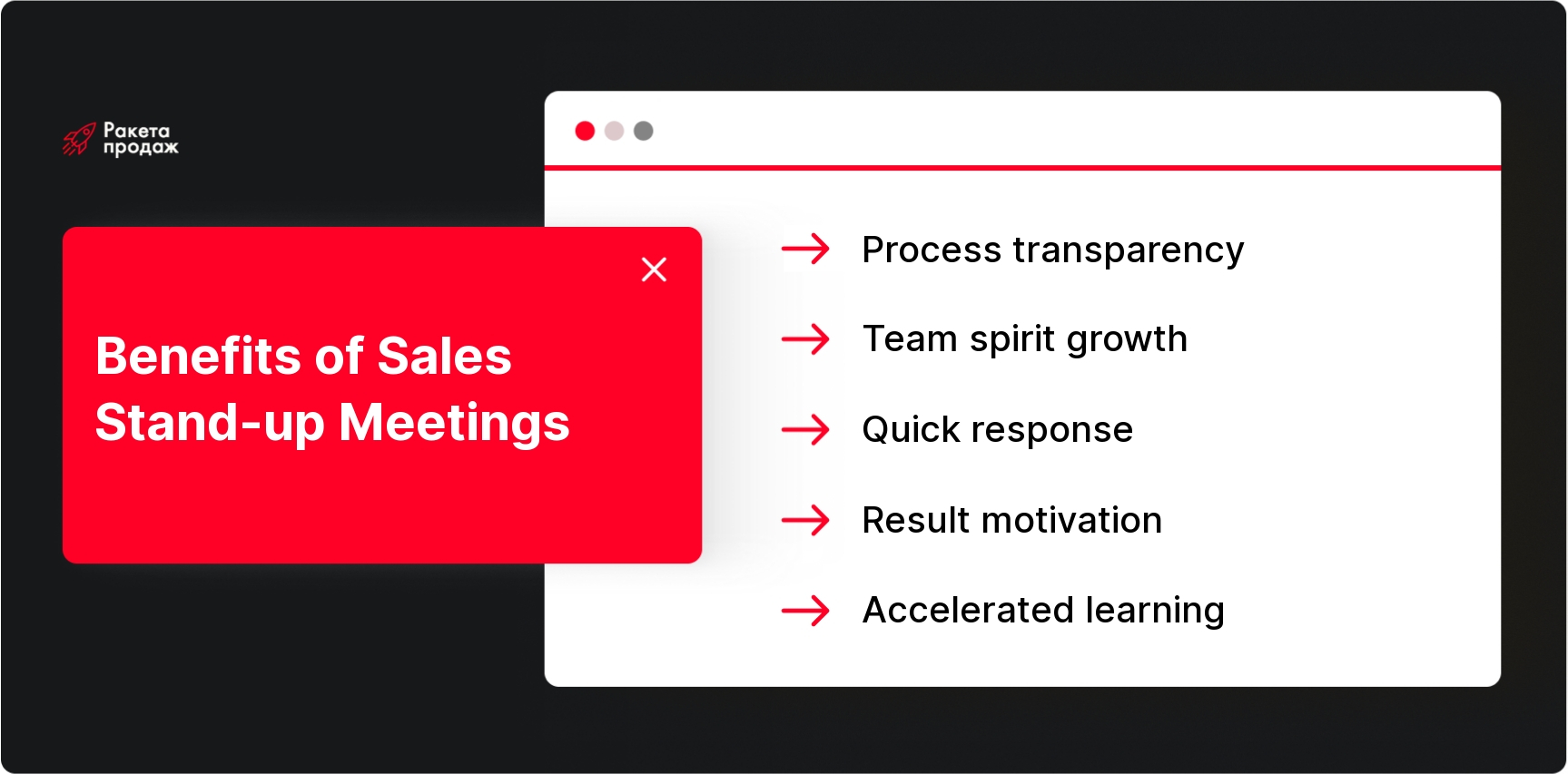
Benefits of Daily Meetings for the Sales Department

Regular standup meetings make a huge contribution to sales department effectiveness, offering a range of benefits that directly affect the performance of each employee and the team as a whole. These short meetings create a system that helps salespeople stay on track toward their goals and constantly improve.

The first and perhaps most important advantage is increased transparency of sales processes. When each team member daily shares information about their actions, victories, and problems, a complete picture of what’s happening in the department is created. The leader no longer needs to spend time finding out the status of projects or deals—all key information is already available. For salespeople, such transparency is also valuable: they see how colleagues solve similar problems, what approaches they use to work with clients, which helps them expand their professional arsenal.

The second significant advantage is strengthening team spirit and mutual support. Daily sales team standup meetings create a sense of common cause and unified goals. When a sales manager knows that their colleague is close to closing a major deal, they can offer help or share experience working with a similar client. Such interaction forms a culture where one person’s success becomes the success of the entire team, and problems are solved by collective efforts.

The third advantage is quick response to market changes and client behavior. Sales is a dynamic field where the situation can change daily. Standups allow instantly distributing important information throughout the team: new client objections, competitor activity, product changes. Such responsiveness gives a significant competitive advantage and allows flexibly adapting sales strategies.

The fourth advantage is increasing personal responsibility and self-discipline of salespeople. When an employee knows they’ll have to report on their work results before the entire team tomorrow, it creates additional motivation to fulfill planned objectives. Nobody wants to admit lack of progress day after day, so salespeople strive to plan their day more effectively and achieve set goals.

The fifth advantage is accelerating learning and professional growth, especially for new employees. By daily listening to how experienced colleagues structure their work, what methods they use, and how they overcome difficulties, newcomers more quickly adopt best practices and integrate into the team. Daily standups for salespeople become an effective informal learning tool, significantly reducing their time to full productivity and decreasing the need for formal training.

Regular standups become a kind of pulse of the sales department, setting the work rhythm and ensuring constant forward movement. And although their implementation requires certain efforts and discipline, the advantages they bring multiply pay back these investments.

Conclusion

A standup meeting is much more than just a trendy management practice. In the hands of a competent leader, it becomes a powerful tool that structures the sales department’s work, increases its effectiveness, and creates a culture of continuous improvement. 15 minutes at the beginning of each workday is a small time investment that can bring a colossal return in the form of improved communication, prompt problem solving, and strengthened team spirit. For standups to truly work, it’s important to adhere to key principles: clear structure, focus on results, regularity, psychological safety, and follow-up actions. Under these conditions, even the most skeptically inclined team will quickly feel the advantages of this format. So if you haven’t yet implemented standups in your sales department—perhaps now is the time to start this simple but effective ritual that will help your team reach new heights.

Implementing daily standup meetings is an excellent first step toward increasing your sales department’s effectiveness. However, a comprehensive approach to systematizing all processes is required to achieve breakthrough results. “Rocket Sales” helps not only properly organize daily meetings but also create a holistic system where each element works toward the overall result. We diagnose current processes, analyze scripts, documents, CRM, funnel, and identify “bottlenecks” where your clients and profits are lost. As part of our “Sales Department Systematization” service, we develop optimal processes, including effective standup formats, implement modern CRM systems, and set up a transparent result control system. Our clients—from small businesses to giants like Mitsubishi, Audi, and Naftogaz—value our individual approach and orientation toward specific results. As a result of cooperation, you’ll receive not just a standup meeting regulation but a full-fledged system that will work even without your constant control.

Turn your sales department into a well-coordinated mechanism that guarantees reaching and exceeding the plan—order comprehensive systematization right now!
In this article:
See more
Book a FREE sales funnel audit
CONTACT US
FAQ
What is a standup meeting in simple terms?

A standup meeting is a short daily team gathering (usually 10-15 minutes) during which each participant briefly talks about yesterday’s results, today’s plans, and possible problems. The name comes from “stand-up” since these meetings were originally conducted standing to maintain dynamics and brevity.

How to conduct daily standups in a sales department?

Conduct daily standups at the beginning of the workday, at the same time, with a clear structure: yesterday’s results, today’s plans, problems. Emphasize specific sales indicators rather than activities. The leader should act as a moderator, following the schedule and involving all participants.

How long should a standup meeting last?

The optimal standup duration is 10-15 minutes. This time is sufficient for team synchronization without compromising the workday. For a team of 5-7 people, this means each participant speaks for no more than 2-3 minutes.

What is discussed at daily sales team meetings?

At standups, salespeople discuss specific results (closed deals, conducted meetings), priority tasks for the day (important clients, key negotiations), arising difficulties (complex objections, competitive pressure), and ways to overcome them.

How is a standup different from a regular meeting?

A standup differs from a regular meeting in brevity (up to 15 minutes), clear structure (three questions), standing format, focus on planning rather than reporting, and mandatory daily occurrence. Regular meetings are longer, less structured, and held less frequently.

How to motivate the team at a standup?

Motivate the team by noting each participant’s successes, sharing inspiring stories about closed deals, setting clear daily goals, creating a competitive spirit through comparing results, and demonstrating the team’s progress toward common goals.

When is the best time to hold a standup—morning or evening?

Most teams prefer morning standups (usually from 9 to 10 AM) because they help set the tone for the day, plan priorities, and promptly resolve emerging problems. Evening standups are less effective as they don’t allow for promptly responding to identified difficulties.

What questions to ask at a standup meeting for salespeople?

Ask specific questions: What deals did you close yesterday? With which clients did you advance in negotiations? What are your priority tasks for today? Which clients require special attention? What obstacles prevent you from achieving your goals? Do you need team help in solving problems?

SUBSCRIBE TO MY TELEGRAM CHANNEL
The most valuable sales information right on your phone!
icon

LOTS OF USEFUL INFORMATION, FREE TEMPLATES, AND CHECKLISTS ON MY INSTAGRAM

Materials and practical advice on sales growth in our blog: