icon

Reporting in B2B vs B2C Sales

Imagine making business decisions blindly – without understanding which acquisition channels work, where money is being lost, and which customers are truly profitable. Sounds like a nightmare? For many companies, this is reality because they try to use the same reporting approaches for fundamentally different types of sales.

Key Takeaways

  • A B2B company that only tracks lead quantity risks spending budget on thousands of useless contacts instead of analyzing quality and funnel progression.
  • The B2B sales cycle can stretch for months, and if 60% of clients drop off after a demo, it signals problems with your presentation or product-expectation mismatch.
  • In B2C, conversion can drop from 3% to 2% in just two days, and you need to immediately understand why by checking payment forms and competitor promotions.
  • Weak metrics kill businesses. If CAC grows faster than LTV, you’re headed toward losses regardless of sales volume.
  • Reporting becomes a ritual when numbers are discussed in meetings, everyone nods, but no metric has an owner or action plan when deviations occur.

In the article below, you’ll find specific metrics for B2B and B2C, typical mistakes that destroy data accuracy, and ways to build a system that helps you sell more 👇

Here’s the thing: the difference in reporting between B2B and B2C isn’t just about different sets of numbers. These are two completely different business languages. A B2B company that only tracks the number of leads (as done in B2C) risks spending budget on thousands of useless contacts. And a B2C business obsessed with deep analysis of each customer (as in B2B) will simply drown in data and miss the moment for quick market response.

Proper B2B reporting isn’t bureaucracy for the sake of a checkbox. It’s your radar in the market fog. It shows where to invest your next dollar (or euro), which products to develop, and which customers to expect growth from. Your salaries, team bonuses, and the company’s ability to survive a crisis depend on it.

In this article, we’ll explore reporting features in B2B and B2C: which metrics really matter for each segment, what mistakes ruin data accuracy, and how to build a system that helps sell more rather than just generating pretty charts for presentations.

Key Differences in B2B and B2C Reporting

When you sell to businesses and when you sell to regular people, you’re playing different games with different rules. And B2B report must reflect this difference, otherwise you’ll be counting the wrong things and drawing the wrong conclusions.

In B2B sales, the deal cycle can stretch for months. You don’t just show a product and receive payment – you negotiate with several people in the client company, prepare commercial proposals, conduct demonstrations, discuss contract terms. Each of these stages is important, and B2B sales reporting should show exactly where deals get stuck. If 60% of potential clients drop off after a demo presentation, that’s a signal: either the product doesn’t meet expectations, or managers are presenting it poorly. In B2B, you work with a limited number of clients, but each can bring a contract worth tens or hundreds of thousands of euros. Therefore, B2B sales reporting focuses on lead quality, funnel velocity, and the long-term value of each client.

In B2C, everything happens faster and in larger volumes. A person sees an ad, visits the website, adds a product to cart and pays – the whole process can take minutes. Here, operational reporting in B2C must be in real-time: you track conversion, see which advertising channels bring customers, analyze user behavior on the site. If conversion drops from 3% to 2% over the past two days, you need to instantly understand why – perhaps the payment form broke or a competitor launched an aggressive promotion. The B2C e-commerce report shows thousands of transactions, and the speed of reaction to mass trends is important, not deep analysis of each individual buyer.

If you want to dive deeper into the key differences in B2B and B2C reporting, take a look at differences between B2B and B2C in sales – this topic reveals why some strategies are effective only in one format but may fail in another.

Reporting objectives differ too. In B2B, you want to understand how effectively the sales department works, what the average deal length is, how much it costs to acquire one customer, and what profit they will bring over the entire period of cooperation. You analyze each stage of the sales funnel – from first touch to contract signing – and look for bottlenecks where opportunities are lost. Reporting for the B2B sales department helps plan revenue for the next quarter based on the number and quality of leads in the funnel right now.

In B2C, reporting answers different questions: which marketing channels bring maximum return, which products sell best, at what stage shoppers most often abandon carts, how often customers return for repeat purchases. Reporting in B2C sales works with aggregated data – looking at trends across thousands of customers, not individual histories. The main thing is to quickly notice changes and respond: launch a promotion, change advertising creatives, add a new payment method.

The nature of the data also differs. In B2B, you often work with qualitative information: manager notes about negotiations, interaction history with each client, individual contract terms. B2B reports may include details on each major deal because one failed deal worth 100,000 euros will significantly impact revenue. B2C reporting metrics focus on quantitative data – clicks, views, cart additions, purchases. You’re interested in percentages and conversions for large user groups, not the details of a single transaction.

Another important point is the planning horizon. B2B companies look at quarterly and annual indicators because the results of today’s marketing efforts will show up in several months when leads go through the entire sales cycle. B2C sales reporting lives here and now: yesterday’s advertising campaign should already show results in increased traffic and sales. This makes reporting for the B2C sales department more dynamic and requires constant monitoring of key metrics.

Understanding these differences is critically important because properly built B2B reporting and B2C sales reporting give you a competitive advantage. You make decisions faster and more accurately than those who rely on intuition or use inappropriate metrics for their type of business.

Familiar situation? Your company collects a lot of sales data, but the real benefit from these numbers is minimal. Reports are generated regularly, the charts are beautiful, but business decisions are still made intuitively rather than based on analytics. According to our research, 70% of B2B and B2C companies suffer from ineffective reporting that doesn’t match their business model.

At “Rocket Sales,” we implement reporting systems that actually work – for both B2B and B2C. Our comprehensive approach includes customizing CRM to your specifics, developing individual KPIs, and creating tools for daily result monitoring. We don’t just set up data collection but build a decision-making system based on it. The effectiveness of this approach is proven in practice: our clients achieve an average turnover increase of 35%, and in some cases – up to $1.6 million in 4 months of work.

Turn the chaos of numbers into a business management tool – order a free audit of your reporting system!

Wholesale Sales Reporting as a Borderline Model

Wholesale sales reporting is an interesting hybrid that sits somewhere between pure B2B and classic B2C. And their reporting reflects this duality, borrowing elements from both models.

On one hand, a wholesaler works with business clients – stores, distributors, the HoReCa sector. These are not end consumers but companies that will resell the goods further. There are B2B elements here: negotiating terms, building long-term relationships, credit lines, personal managers for key clients. CRM implementation is particularly relevant for this format: it helps not just record data but build systematic work with each partner, which is reflected in reporting.

On the other hand, the deal cycle in wholesale is often much shorter than in classic B2B. A store can place an order today and receive goods in a few days. Purchasing decisions are made faster because products are often standardized and don’t require lengthy approvals. Here, B2C reporting elements appear: you need to track sales dynamics in real-time, seasonal demand fluctuations, popularity of individual SKUs, effectiveness of promo actions for retail partners.

Wholesale sales reporting often includes metrics characteristic of B2B: average order size, purchase frequency, return rate, margin by customer groups. You want to understand which customers bring the most profit considering not only purchase volume but also their service cost. A large customer who demands significant discounts and creates many operational hassles may be less profitable than a medium customer with smaller volumes but stable orders and minimal problems.

At the same time, wholesalers use B2C approaches to product line analysis. Which products sell fastest, which ones sit in warehouses, which categories show demand growth. This information helps optimize purchasing and inventory management – a key task for any wholesale business. Poor inventory management means either frozen money in unsold goods or lost sales due to missing popular items.

Another feature of wholesale sales reporting is geographical segmentation. Wholesalers often work with clients in different regions or even countries, and it’s important to track sales effectiveness by territory. This helps make decisions about distribution development, hiring regional representatives, and localizing assortments for each market’s specifics. This approach is more characteristic of B2B, where client geography plays a strategic role.

Ultimately, wholesale sales reporting needs to be flexible enough to reflect both long-term relationships with key clients (B2B element) and short-term demand fluctuations and product line effectiveness (B2C element). This requires combining metrics and approaches from both models, making wholesale reporting more complex but also more informative for management decisions.

Key Metrics and Indicators in B2B and B2C Reports

Now let’s talk specifically: what numbers really matter for each type of business. Metrics aren’t just numbers in a table; they’re your business health indicators. The right metrics show where you’re losing money and where there’s potential for growth.

In B2B reporting, lead quality and movement indicators come first. Lead-to-Opportunity Conversion Rate shows what percentage of leads turn into real sales opportunities. If this indicator is low, the problem could be in lead quality (marketing is attracting the wrong audience) or in the sales department’s work (managers poorly qualify leads). You want to see this indicator in dynamics and compare it across different lead sources – contextual advertising, SEO, industry conferences, cold outreach. This helps understand where to invest your marketing budget.

Sales funnel analytics is key for B2B: this is the only way to see at which stage the client “leaves” and which processes need strengthening or automation.

Sales Cycle Length is a critical metric for B2B. The longer a deal drags on, the more resources it consumes and the higher the risk that the client will change their mind. If the average deal cycle is six months, and you have leads hanging in the funnel for more than a year, that’s a red flag. Perhaps these leads are already dead, but no one has bothered to close them. Tracking this metric helps identify problematic funnel stages and reduce time to deal closure.

Average Deal Size shows how much on average you close contracts for. Growth in this indicator may mean you’ve started working with larger clients or are more effectively selling additional products and services. A decline signals that clients are cutting budgets or you’re losing large customers in favor of smaller ones.

Customer Retention Rate is the percentage of clients who continue working with you after one, two, three years. In B2B, where acquiring a new client is expensive, retaining existing ones is critical. If clients leave after the first contract, you’re losing money. A high Retention Rate means the product works, clients are satisfied and ready to extend cooperation. This metric directly affects the customer’s lifetime value and overall business profitability.

CAC or Customer Acquisition Cost shows how much it costs to acquire one customer. You take all marketing and sales expenses for a period and divide by the number of acquired customers. In B2B, this indicator is usually high – several thousand euros per customer is not uncommon. It’s important to compare CAC with customer lifetime value: if you spend 5000 euros on acquisition, and the customer will bring 15000 euros in profit over the entire cooperation period, that’s normal. But if CAC grows faster than LTV, the business is moving towards losses.

In B2C reporting, the focus shifts to mass indicators and speed. Conversion Rate is the percentage of website visitors who made a purchase. Typical conversion for an online store is 1% to 5%, depending on the niche. If your conversion is 1.5%, and your competitor’s is 3%, it means that with the same traffic, they sell twice as much. Their site is more convenient, their offer more attractive, or their prices more competitive. Tracking conversion by funnel stages (product view → cart addition → order placement → payment) helps find bottlenecks and improve each step.

Average Order Value shows how much a buyer spends on average per transaction. Increasing the average check with unchanged conversion automatically increases revenue. You can influence this indicator through cross-sell (offering related products), up-sell (offering a more expensive product version), or free shipping for orders above a certain amount.

Customer Lifetime Value (LTV) in B2C shows how much profit a customer will bring over the entire cooperation period. It’s calculated as the product of average check, purchase frequency, and average customer lifecycle duration. If your LTV is 200 euros and CAC is 50 euros, a 4:1 ratio is considered healthy. But if CAC grows due to advertising becoming more expensive, and LTV doesn’t increase, you’ll soon start losing money on each acquired customer.

Churn Rate is the percentage of customers who stopped buying over a certain period. In B2C, especially in subscription businesses (streaming services, consumer SaaS, food delivery by subscription), high Churn Rate kills the business. You can attract thousands of new customers, but if the same number leaves each month, growth stops. Reducing Churn Rate even by a few percentage points can radically improve business economics.

ROMI or Return on Marketing Investment shows how much profit you get from each euro invested in marketing. If ROMI is 3, it means that each euro of marketing expenses generates 3 euros of profit. In B2C, where marketing often consumes a significant portion of the budget, tracking ROMI for each channel helps optimize fund allocation and turn off ineffective traffic sources.

The digital tools market is developing rapidly, and if you want to implement modern methods of data verification and optimization, AI sales audit will help automate collection and verification of key metrics in B2B and B2C and suggest areas for growth acceleration.

B2B reports and B2B reporting metrics aren’t just numbers for pretty presentations. They’re your tools for making decisions: where to direct the budget, which products to develop, where to look for problems. Without them, you’re flying blind and relying on luck rather than strategy.

Common Mistakes in B2B and B2C Sales Reporting

image

Even the most ambitious plans collapse when reporting is built incorrectly. Let’s examine the most common mistakes that prevent companies from seeing the real picture and making adequate decisions.

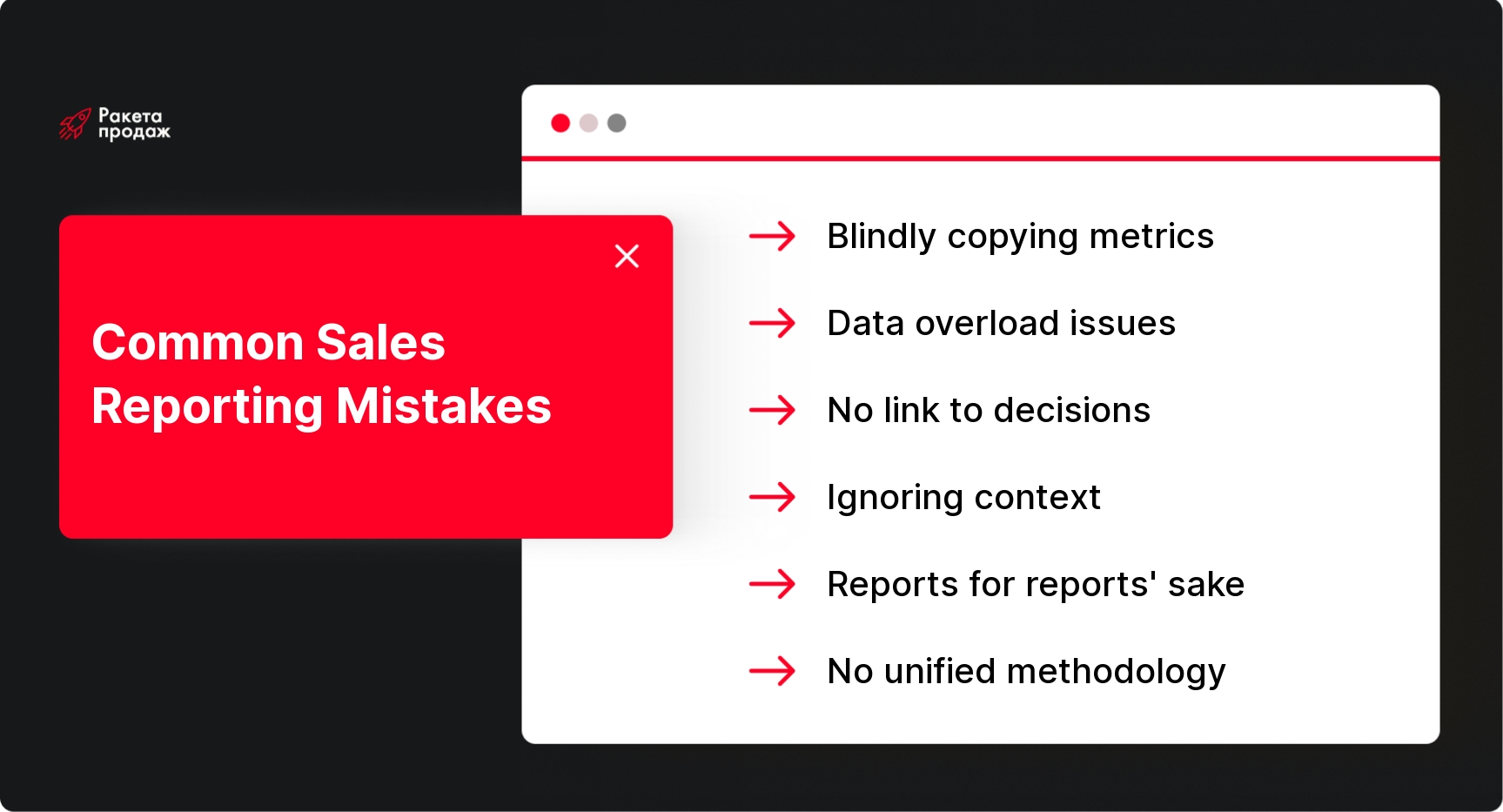
Mistake number one is blindly copying B2C metrics into B2B. You launch a B2B product and start tracking website visitors, ad clicks, and bounce rates, just like online stores do. The problem is that these indicators say little about actual sales effectiveness. You might have 10,000 visitors per month and zero sales because none of them were decision-makers in target companies. In B2B, traffic quality is more important than volume. Better to have 100 targeted visits from purchasing directors than 10,000 random visitors. Reporting should focus on qualified leads, funnel velocity, and conversion to real contracts, not on mass traffic metrics.

The opposite mistake is trying to apply B2B approaches in B2C. A company starts to analyze each buyer in detail, maintain a CRM with notes about customer preferences, track interaction history. This works when you have a hundred customers. But when there are thousands, such an approach becomes an operational nightmare. You drown in data that no one has time to analyze. In B2C, you need to work with aggregated indicators and segments, not individual profiles of each buyer.

Report overload happens when you track everything because “it might be useful.” The result is huge tables with dozens of metrics that are impossible to understand. Managers spend hours filling out reports, but no one knows what to do with them. The rule is simple: each metric should answer a specific question and influence a specific decision. If an indicator is just “interesting to know” but doesn’t change your actions, throw it out of the report. Good reporting is not maximum data, but maximum usefulness with minimum noise.

Lack of connection between reporting and decisions occurs when reports are regularly generated, presented at meetings, everyone nods, and… nothing changes. Reporting becomes a ritual rather than a management tool. Each indicator should have an owner who is responsible for improving it and a specific action plan when it deviates from the target value. If conversion drops, what do you do? If the deal cycle grows, who is responsible for it and what measures are taken? Without this, reporting is an empty formality.

Another mistake is ignoring context. Numbers themselves mean nothing without understanding the causes. Revenue fell by 20% – is this a catastrophe or a seasonal fluctuation? The number of leads doubled – is this marketing success or did you simply lower the lead qualification requirements, and now half of them are garbage? B2B reporting should not just show what happened but help understand why it happened. Add comments, compare with previous periods, consider external factors (holidays, competitor promotions, changes in legislation).

Reporting for the sake of reporting is when the process is more important than the result. A company spends resources on creating beautiful dashboards, automating data collection, implementing BI systems, but doesn’t think about why all this is needed. The result is an expensive toy that nobody uses. Investments in analytics are justified only when they lead to measurable improvement in business results – sales growth, cost reduction, improved customer retention. If this doesn’t happen, you just flushed money down the toilet.

And the last common mistake is lack of standardization and transparency in metric calculation. Each department calculates indicators in its own way, definitions are vague, and as a result, marketing reports 500 leads, and sales says they received only 200 because the rest “were not qualified.” Agree on unified definitions: what is considered a lead, how conversion is calculated, what goes into CAC. Document calculation methodologies and use a unified system for data collection to avoid discrepancies and conflicts between teams.

Avoid these mistakes, and your B2B reports and reporting will become a powerful growth tool, not a bureaucratic burden.

Properly built reporting is not just tables with numbers. It’s your navigator that shows where you’re losing money and where growth points are located. But for reporting to really help with decision-making, it must match your business model and reflect the specifics of your sales – whether B2B or B2C.

“Rocket Sales” specializes in creating transparent reporting systems that transform into a real management tool. We don’t just set up dashboards but build a complete quality control system with weekly analytical reports and clear recommendations. Our approach includes auditing current processes, developing a sales funnel, implementing CRM, and training the team to work with data.

The results speak for themselves: after implementing our reporting systems, clients note conversion growth up to 86%, increased average check, and reduced deal cycle. You get not just a set of metrics but a full-fledged tool for making strategic decisions.

Stop guessing and start managing sales based on data – order a reporting system implementation from experts!

Conclusion

Reporting is not tables for checkboxes or a way to report to management. It’s your navigator in the sales world, showing where you’re losing money, where opportunities for growth exist, and which decisions will lead to results. The difference between B2B and B2C reporting is fundamental: in B2B, you work with long deal cycles, a limited number of clients, and focus on lead quality and long-term value of each contract. In B2C, speed, volume, and mass conversion metrics determine success. Trying to apply the same approaches to both models is like trying to hammer a nail with a screwdriver: technically possible, but inefficient and fraught with injuries. Conscious choice of metrics, understanding your business specifics, and readiness to act based on data transform reporting from a formality into a competitive advantage. Invest time in building the right reporting system, and it will pay off many times over through more accurate decisions, optimized processes, and sales growth. Your competitors who continue to rely on intuition and outdated metrics will wonder how you overtook them so quickly in the market.

In this article:
See more
Book a FREE sales funnel audit
CONTACT US
FAQ
Why should companies separate reporting for B2B and B2C sales?

Because these are two fundamentally different business types with different deal cycles, customer bases, and sales mechanics. B2B requires focus on lead quality and long-term relationships, B2C – on conversion speed and mass indicators. Using the same metrics leads to wrong conclusions and money loss on ineffective strategies.

What is the key difference in reporting between B2B and B2C sales?

B2B reporting concentrates on the sales funnel, deal cycle length, lead quality, and customer lifetime value. B2C focuses on conversion, average check, purchase frequency, and marketing channel effectiveness in real-time. The planning horizon also differs: B2B looks at quarters and years, B2C responds to changes every day.

What mistakes do companies most often make when building B2B and B2C reporting?

Copying B2C metrics into B2B (focus on traffic quantity instead of lead quality), overloading reports with unnecessary data, lack of connection between metrics and real decisions, ignoring context when interpreting numbers, and reporting for the sake of reporting without impact on business results.

SUBSCRIBE TO MY TELEGRAM CHANNEL
The most valuable sales information right on your phone!
icon

LOTS OF USEFUL INFORMATION, FREE TEMPLATES, AND CHECKLISTS ON MY INSTAGRAM

Materials and practical advice on sales growth in our blog: