Key Takeaways
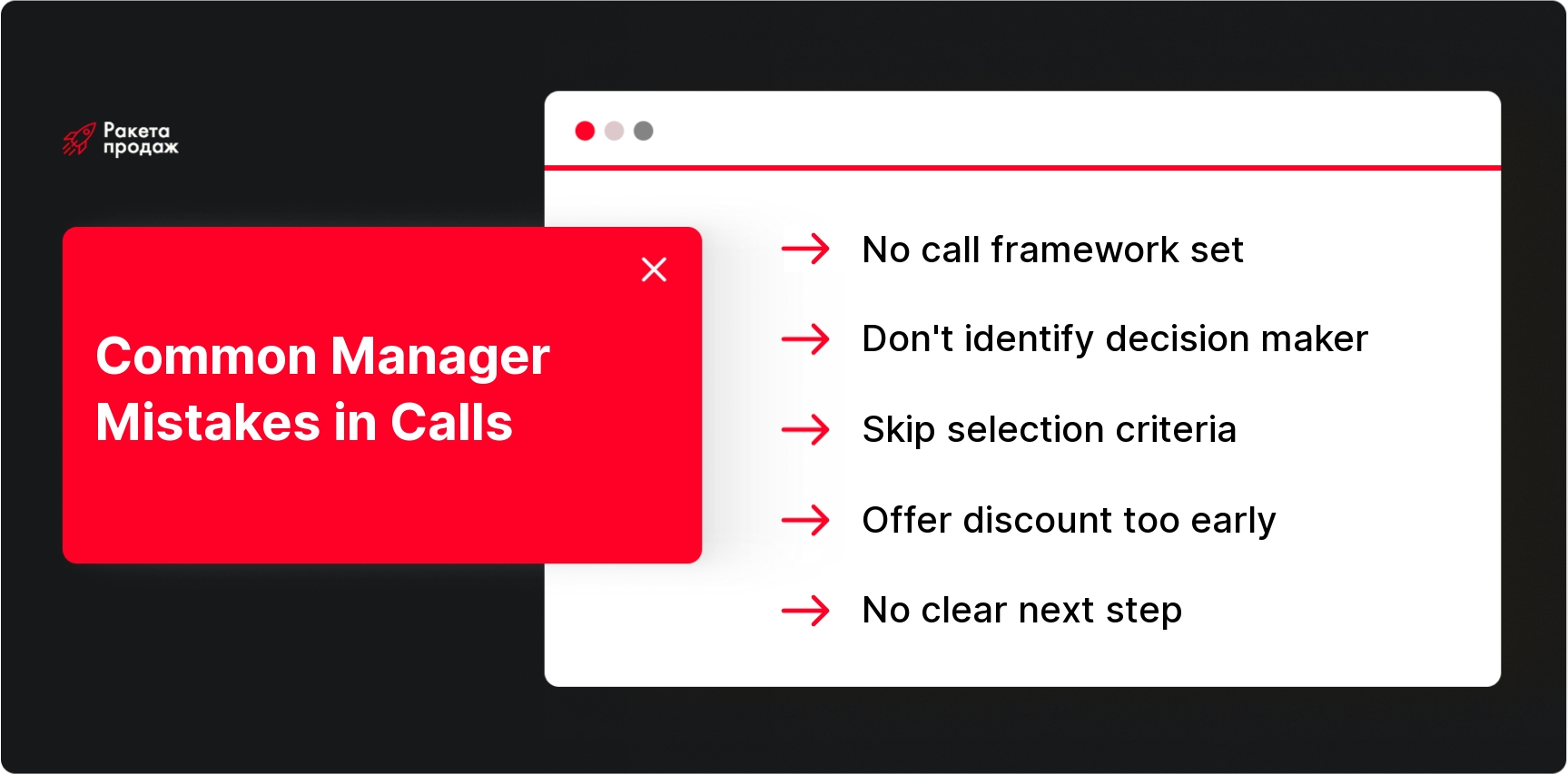
- Deals aren’t lost at the moment of rejection, but the moment the manager fails to clarify selection criteria, the decision-maker’s role, or a concrete next step after the call.
- The client’s phrase “we’ll think about it” or “we’ll discuss it with the manager” isn’t a final answer, it’s a signal to ask a clarifying question, not just wait a week.
- Weak managers immediately offer a discount when a competitor is mentioned, strong ones first find out exactly what the client is comparing and what terms are included in that price.
- Your call should start with a frame (why you’re calling, how long it will take, what outcome is needed), otherwise the conversation turns into polite small talk that doesn’t move the deal forward.
- A concrete next step sounds like this: an exact date, time, purpose of contact, and what the client does before that point, not a vague “I’ll write next week.”
In the article below, you’ll see a real conversation with a client, a step-by-step breakdown, and an improved version of the same call with the right questions asked. Read the full article 👇
In this article, we’ll take a real call from a B2B company’s manager and go through it step by step. First, we’ll give you the context of the deal, then show a fragment of the dialogue, and then do a detailed analysis of a conversation with a client, stage by stage. At the end, we’ll pull together conclusions that will be useful for improving scripts, training new employees, and quality control in sales, especially if the company already has call auditing in sales set up.
How many deals are your managers losing in exactly these kinds of conversations, where everything seems fine but the client just disappears with a polite “we’ll think about it”? Based on our experience, about 70% of lost deals aren’t related to the product or price, they’re related to a poorly structured dialogue at the lead qualification stage. At “Rocket Sales,” we run a comprehensive audit of manager calls: we analyze real conversations, identify typical mistakes, and create personalized checklists for each employee. This approach shows exactly where deals are being lost and turns ordinary calls into a tool for managing the sales funnel. Over 8+ years of work, we’ve helped 208 companies build sales departments that show an average revenue increase of +35%, specifically through proper objection handling and lead qualification.
Turn every manager's call into a controlled sales growth tool - get a free negotiation quality audit!
Call Context: Which Deal We're Breaking Down
The company “Mareshak” wholesales packaging and plastic containers: bottles, jars, lids, and bags for retail stores and small manufacturers. The lead came in through paid search ads (meaning the need is already conscious): the client found the website, entered a query about wholesale prices, and called. This is a new lead who hasn’t interacted with the company before, so it’s the very first stage of the funnel.
The manager Kshisya takes the call. The caller is the owner of a small store who sells dietary supplements and wants to buy packaging wholesale for repackaging products. Her interest is real, but the decision hasn’t been made yet. The company’s goal for the call is simple: qualify the lead, understand the volume and regularity of purchases, and secure preliminary agreement on a minimal test shipment. It’s this goal, not “chat and send a price list,” that should guide the conversation. But to understand whether the manager succeeded, we first need to look at what the outcome of such a call should actually be.
The Call's Goal: What the Manager Should Have Achieved by the End
Every call needs a clear goal, not a vague “have a chat with the client.” This could be qualifying a lead, scheduling a meeting, conducting a discovery conversation, clarifying selection criteria, agreeing on a commercial proposal, reaching the decision-maker, or setting a decision date. Without a specific goal, the conversation turns into polite small talk that doesn’t move the deal anywhere.
In our case, the goal was clear: not just “chat” and “send information,” but understand how real the deal actually is. The manager needed to find out who makes the decision about the supplier, what purchase volume is being planned, whether there are obstacles, and what needs to happen next to get to a test shipment. If the goal isn’t formulated in advance, the manager just drifts along with the conversation, and the client leaves with a formal “thanks, we’ll take a look.” To see exactly where this goal got lost, let’s look at the conversation itself.
Sample Manager Call: The Original Script
Below is a fragment of a real conversation that became the basis for this analysis. At first glance it doesn’t look like a failure, the manager is polite and tries to help, but it’s exactly in the details where the typical sales manager mistakes are hiding, the ones that make a deal get stuck.
Manager: Good afternoon, this is “Mareshak,” my name is Kshisya. You submitted a request on our website about wholesale prices, correct?
Client: Yes, hello. My name is Irina, I have a store called “Estriy,” I sell dietary supplements. I wanted to clarify the terms for containers and packaging.
Manager: Great. We have two cooperation formats: buyout with a discount starting at 25 percent, and consignment with a 20 percent discount. Minimum order amount is 3 thousand hryvnias.
Client: I see. Honestly, another supplier’s price seemed lower, we’re currently comparing options.
Manager: We could discuss an additional discount if the volumes are larger. What volume are you roughly considering?
Client: I don’t know exactly yet, I need to calculate it and discuss it with the manager.
Manager: Alright, go ahead and discuss it, and in the meantime I’ll send you the price list on Telegram so you have it handy.
Client: Okay, thanks, we’ll take a look.
Manager: Agreed, I’ll write to you next week to see how things are progressing.
Client: Okay, I’ll be waiting.
At first glance, nothing terrible happened. But it’s exactly in this softness and politeness that the main losses we’ll break down below are hidden.
Short Conclusion on the Call: Where the Deal Started Slipping Away
Formally, the manager did a follow-up: thanked the client, promised to write in a week, sent the price list. But essentially he didn’t control the conversation, he just drifted along after the client. He never figured out what criteria Irina uses to compare suppliers, who actually makes the final decision, what specifically bothers her about the price, or which competitors are being seriously considered.
The deal wasn’t lost at the moment of the polite “we’ll take a look,” it was lost earlier, when the manager failed to pin down the real obstacle and failed to agree on a concrete next step. Let’s break it down in detail, starting from the very first seconds of the call, where these gaps first appeared.
The Start of the Conversation: The Manager Didn't Set a Frame for the Call
The manager started the conversation with the formal question “you submitted a request, correct?” but didn’t state what he wanted to discuss, how long the call would take, or what outcome was needed by the end. A small detail that actually determines the whole dynamic of the conversation.
A weak opening makes the conversation reactive: the client says “we’re still thinking” or “I need to ask my manager,” and the manager starts adapting to these replies instead of steering the conversation toward the goal. It would have been better to set the frame right away: “I’d like to quickly discuss how well our terms fit your needs, what’s still unclear, and what next step would work for you.” A phrase like this immediately shows the client that the call has a purpose, it’s not just about “sending the price list.” With this frame, the manager earns the right to ask clarifying questions further on, and that’s exactly where the next problem in the conversation begins.
The Manager Didn't Clarify What "We're Thinking About It" Actually Means
The client’s phrase about needing to calculate and discuss with her manager is, in fact, a signal to ask for clarification, not a final answer. Behind a “we’ll think about it” like this could be anything: the client is genuinely comparing suppliers, coordinating a budget internally, has doubts about the price, didn’t see the value in the offer, is waiting for her manager’s decision, or simply lost interest in the project altogether.
The manager took the phrase at face value as a normal status update and simply promised to write in a week, instead of figuring out what was behind the pause. He should have asked directly: “What exactly are you discussing internally right now?”, “What comparison criteria are most important to you?”, “Is there anything specific holding you back from moving forward?” Questions like these don’t come across as pushy, they show interest in the client’s task rather than in your own sales plan. Without this clarification, “we’ll think about it” remains a black box, and it makes sense to break down exactly what was missing in understanding the client’s selection criteria.
The Selection Criteria Were Never Identified
The client said directly that another supplier’s price seemed lower, which means a comparison is already happening. But the manager never clarified what parameters she’s comparing on: just price, or also delivery times, payment terms, minimum volume, container quality, flexibility in assortment, supplier reputation.
Without these criteria, the manager can’t argue the value of the offer. He speaks in general phrases about discounts and terms, but misses the client’s actual doubts, because he doesn’t know what really matters to her. Maybe for Irina, the critical factor isn’t the per-unit price, but the fact that she has to pay for delivery herself under the consignment model, or the lack of a small trial batch. He should have asked: “What parameters are you comparing options on right now?”, “What will be the deciding factor for you when choosing a supplier?”, “What would need to be in the offer for you to make a decision this week already?” Next, it’s worth figuring out why the manager never understood who at the client’s company actually makes the purchasing decision.
The Manager Didn't Understand Who Makes the Decision
The manager let the “I need to discuss it with the manager” moment slide right by and simply agreed to wait. This is a clear signal that he’s either not talking to the final decision-maker, or doesn’t understand what role his conversation partner plays in the decision. Maybe Irina is the owner herself, and “the manager” is just a shorthand for her business partner, or maybe the decision really does depend on someone else with different priorities.
The mistake is that the manager never clarified who exactly this “manager” is, what role they play in purchasing, and what matters to them when choosing a packaging supplier. Without this information, it’s impossible to prepare arguments that will actually work for the final decision. He should have asked: “Who usually makes the final decision on purchases like this at your company?”, “What does the manager usually focus on in offers like this, price or delivery terms?”, “Would it make sense to get on a call together to close out all the questions at once?” A similar logic applies to how the manager reacted to the mention of a competitor’s lower price.
The Price Objection Was Handled Too Early, Through a Discount
As soon as the client mentioned that another supplier’s price was lower, the manager immediately offered to discuss an additional discount. A classic mistake: he reduced the value of the offer down to a number, without even figuring out what exactly the client was comparing it to. Maybe the competitor has a different batch volume, different delivery terms, or a different level of service, and the comparison isn’t even apples-to-apples.
The right approach is different: first acknowledge that the price question itself is completely normal, then clarify the details of the comparison, and only then move on to terms. He should have asked: “What offer are you comparing it to, what’s the volume and delivery like there?”, “What terms are included in that price?”, “Is there anything critical for you, like timing or minimum batch size?” This approach often shows that prices actually aren’t all that different once you compare equivalent terms. A discount should remain a negotiation tool for the final stage, not the first reaction to a mention of a competitor, and situations exactly like this are usually covered in objection-handling training. This part of the manager call analysis is especially useful, because it shows: a discount offered too quickly often masks a lack of value arguments.
The Manager Didn't Demonstrate the Value of the Offer
Not a single phrase in the conversation explained why “Mareshak’s” terms are actually better overall, not just in terms of the discount. General statements like “we have good quality” don’t work, because the client needs to understand a specific benefit: lower risk of product damage during transport, faster restocking, flexible minimum volume for testing, clear delivery timelines, or time savings on assortment selection.
Value always needs to be tied to the client’s actual task, and since the manager never figured out the selection criteria or the manager’s role, he simply has nothing to build an argument on. A good approach would be something like: “Our consignment terms are especially convenient for small stores, because you’re not freezing money in inventory, you pay after you sell. This could matter a lot for you if cash flow is what’s critical right now, rather than a couple of percentage points in discount.” A phrase like this shifts the conversation from “we’re better” to a concrete benefit for the client’s business. Next question: what happened at the end of the call, and why did the next step turn out so vague.
No Concrete Next Step Was Set
The manager ended the call with the phrase “I’ll write to you next week to see how things are progressing.” Sounds polite, but essentially it’s postponed uncertainty: no exact date, no purpose for the next contact, and no understanding of what the client should do before then.
A good next step would have sounded different: “You’ll discuss the purchase volume with your manager by Wednesday, and on Thursday at 11:00 AM I’ll call you, we’ll go through the questions and decide whether you’re ready to move forward with a test shipment.” A phrasing like this gives the client a deadline and gives the manager a concrete reason for the next call, rather than just “checking in to see how things are going.” Without a clear next step, the deal easily falls off the client’s radar, and all that’s left in the CRM is a note saying “follow up in a week,” which says nothing about the deal’s actual status. To avoid these kinds of gaps repeating themselves, it helps to think through in advance a list of questions that need to be answered in calls like this.
What Questions the Manager Should Have Asked the Client
This analysis of a conversation with a client shows that almost all the mistakes here are related not to the product or the discount, but to a lack of the right questions at the right moment. The manager sensed that the client was hesitating, but never turned that feeling into a concrete clarifying question, he just waited for a response or immediately offered a discount.
If you gather up moments like these into a working list, you get a checklist that can be used for similar calls at B2B companies selling wholesale packaging, equipment, or any products with a long decision cycle, and also for regularly evaluating sales manager effectiveness. It’s important that the questions sound like a natural part of the dialogue, not like a formal point-by-point questionnaire, otherwise the client will feel pressured and start shutting down.
- What exactly are you discussing right now after getting the pricing information?
- What criteria are you using to compare us with the other supplier?
- What specifically bothers you about the price: volume, delivery, or payment terms?
- Who at your company makes the final decision on purchases like this?
- What does that person usually focus on when choosing a supplier?
- What would need to change in the offer for you to be ready to move forward?
A set of questions like this won’t turn the call into an interrogation if you ask them gradually, reacting to the client’s answers. Next, we’ll show what these questions look like in a real conversation, if you rewrite the same call the right way.
Improved Version of the Manager's Call
Below is the same call, but with all the points we broke down taken into account. The manager sets a frame, clarifies criteria, doesn’t argue with the price, identifies the manager’s role, and agrees on a concrete next step.
Manager: Good afternoon, this is “Mareshak,” my name is Kshisya. You submitted a request about wholesale prices on containers. I’d like to quickly discuss what matters to you right now, and agree on how to move forward. It’ll take about five minutes, is that okay?
Client: Yes, of course.
Manager: Tell me, what do you need the containers for: a store, online sales, or both?
Client: I have a physical store, I sell dietary supplements, I need packaging for repackaging products under my own brand.
Manager: I see. And right now, are you comparing us to other suppliers, or are you just researching the market so far?
Client: I’m comparing, one supplier’s price seemed lower.
Manager: Good that you mentioned that. And what about the volume and delivery there, are the terms comparable to ours?
Client: Honestly, I haven’t compared it in detail, I just saw the number.
Manager: In that case, I’d suggest comparing on volume, delivery, and payment terms, so the decision is accurate. By the way, who usually makes the final decision on purchases like this at your company?
Client: I do, but I discuss larger purchases with my partner.
Manager: Got it. And what usually matters to your partner: price, or, say, supply stability?
Client: More likely stability, we had issues with delays from our previous supplier.
Manager: That’s an important detail. Here’s what I suggest: you discuss the volume for a first trial batch with your partner, and on Thursday at 11:00 AM I’ll call you, show you the numbers factoring in delivery timelines, and we’ll decide whether to move forward with a test shipment. Does that work?
Client: Yes, that works, thank you.
The difference between these two versions of the same call isn’t about the discount or the tone of voice, it’s about the questions the manager actually decided to ask.
Analysis of the manager’s call is only the first step toward systematic sales growth, but without properly implementing changes, the analysis stays just an interesting exercise. “Rocket Sales” specializes in the full cycle of sales department optimization: from negotiation audits to script creation, quality control system implementation, and training teams in modern objection-handling techniques. Our approach includes not just identifying mistakes, but also creating clear negotiation standards, checklists for managers, and a reporting system that shows the dynamics of improvement in real time. Our clients include Mitsubishi, Yamaha, and Naftogaz – companies that achieved measurable conversion growth of 5-86% and consistent sales plan fulfillment. Don’t let good leads slip away because of the wrong questions in ordinary manager calls.
Build a negotiation system that turns every call into a step toward closing the deal!
Manager call analysis, like any other analysis of the negotiations, isn’t meant to find someone to blame, it’s meant to reveal how the conversation with the client is actually being managed. In this case, the deal didn’t fall apart because of rudeness or a bad product, it got stuck because of missed questions about criteria, the manager’s role, and a concrete next step. If you regularly conduct this kind of analysis of a conversation with a customer, you can gradually improve your questions, objection handling, value presentation, and the quality of your CRM entries. Systematic changes like this usually start with implementing a sales audit and gradually grow into an understanding of how to build an effective sales department. And that means fewer deals lost, not at the final rejection, but somewhere in between ordinary conversations.


 Time to read: 9 min.
 31 August 2026