Key Takeaways
- A manager without a clear script loses control of the dialogue and misses key questions about budget, timelines, and the client’s real motivation.
- Strong scripts don’t just list property features, they connect them to the buyer’s specific needs (a family with kids, an investor, someone relocating).
- Your phone presentation should paint a picture of life in the apartment, not read off technical specs like square footage and layout.
- The “too expensive” objection hides deeper fears, clarifying the real reason works better than jumping straight into arguments.
- Speech analytics automatically checks whether the manager asked about budget and timelines, and shows where the team deviates from the script.
For detailed examples of scripts for each stage of the funnel, from cold calls to closing the deal, read the full article 👇
Real estate sales scripts for sales department should sound natural, not mechanical. Their job is to help the manager quickly identify the client’s real request, understand their budget and timeframe, determine their purchasing motivation, find a suitable property, and conduct an effective showing. A well-built script guides the client toward the next logical step, whether that’s an office meeting, an apartment viewing, or discussing deal terms. Let’s break down which blocks should be part of real estate sales scripts and how to adapt them for different situations and client types.
Professional (Sales script development)[https://s-rocket.com/en/sales-script-development] starts with analyzing the funnel, typical client requests, and the manager’s tasks at every stage of interaction. Scenarios need to account for the specifics of the properties, the audience segment, the length of the deal cycle, and the real reasons why clients postpone their purchase.
Which Stages of Real Estate Sales Require Separate Scripts
Real estate sales involve multiple touchpoints with the client, and each one requires its own approach. A single universal script simply can’t handle every task, because the client’s level of interest, trust in the company, and readiness to make decisions vary dramatically at different stages.
At the first-contact stage, the client might just be “testing the waters” of the market without a clear sense of their own needs. By the time of the apartment viewing, they’re approaching the choice more consciously, but may still have doubts about the specific property. And at the final negotiation stage, the main task is handling last-minute objections and gently guiding the client toward signing the documents. That’s why every stage requires its own set of questions, arguments, and techniques.
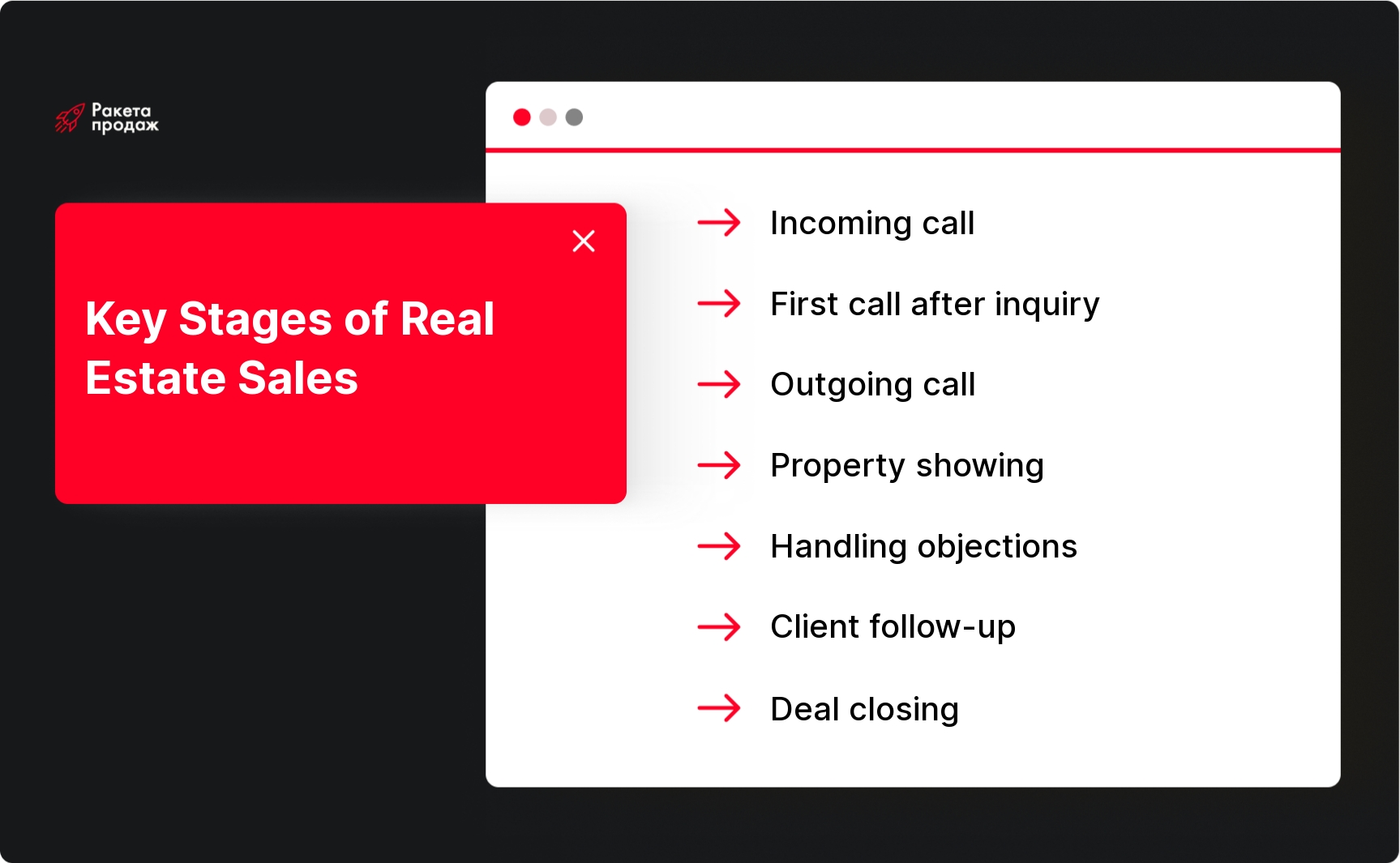
The key stages that need specialized scripts include: an inbound call from an ad or listing, the first call after a submitted inquiry, an outbound call to a contact database, cold calling potential clients, detailed qualification and needs identification, scheduling and confirming a showing, presenting the property during the viewing, a follow-up call after the showing to get feedback, handling objections and doubts, follow-up and motivating the decision, closing the deal and finalizing documents, as well as working with deferred demand and repeat touchpoints. This level of detail allows the manager to be as effective as possible at every stage of the funnel.
Sound familiar? Managers make plenty of calls, but showings don’t get scheduled, clients “think it over” forever, and deals fall through at the last stage? More often than not, the problem isn’t a lack of motivation or professionalism among staff, it’s the absence of structured scripts and clear business processes. At “Rocket Sales,” over 8+ years of work, we’ve built a ready-made methodology for creating effective real estate sales departments, including a complete set of scripts for every stage of the funnel. Our approach includes not just developing dialogue scenarios, but also implementing a CRM system, training the team, and ongoing quality control. In 4-8 weeks, we completely rebuild the sales process: from the first call to closing the deal. The result for our clients: sales departments that consistently hit 150% of plan every month, with an average revenue increase of +35%.
Turn chaotic client interactions into a system of predictable sales, get a free audit of your real estate department!
What a Sales Manager Call Script Should Include
The structure of a phone conversation in real estate needs to be clear and logical, so that within the limited time of the call you can gather maximum information about the client and motivate them to take the next step. The basic framework of any call script includes several mandatory blocks that help the manager control the dialogue and not miss important details.
It all starts with a greeting and introduction, the manager states the company name, their own name, and briefly explains the reason for the call. Next, it’s important to establish context: which property or inquiry the client is calling about, and how they heard about the company. Checking whether it’s a convenient time to talk shows respect for the client’s time and creates a more comfortable atmosphere for the conversation. Clarifying the request helps understand exactly what the client is looking for, whether it’s for themselves, their family, or as an investment.
Client qualification is the core of any Sales Manager Call Script. At this stage, key parameters are identified: budget, location preferences, property requirements, and decision timeline. Identifying motivation helps understand what’s driving the client, relocation, improving living conditions, investment, or an urgent need to sell their current home. After gathering information, the manager presents suitable options, not as a long monologue, but by connecting them to the client’s needs. Handling questions and objections requires separate preparation, and the call wraps up with a specific next step and all agreements logged in the CRM system.
The script should quickly move the conversation from surface-level questions like “just checking the price” toward understanding the client’s real request and motivation.
Examples of Scripts for Realtors: Cold Calls, Inbound Calls, Handling Rejections
Ready-made scripts help realtors and sales managers adapt to the job faster and see winning phrasing in practice. Let’s look at specific scenarios for the most common client situations.
Modern Real Estate Telemarketing Scripts account for the specifics of remote communication and help quickly qualify a client without a face-to-face meeting. An effective Script for a Real Estate Sales Manager’s Conversation is built on understanding client psychology at each stage of the funnel.
Inbound Call Script for Real Estate
An inbound call is a hot lead, because the client took the initiative themselves and reached out to the company. The manager’s main task is not to lose that interest and to handle it as effectively as possible. The logic of an inbound call is based on the fact that the client has already seen an ad, browsed the website, or looked at a specific listing, so they have certain expectations. The search query “inbound call script real estate” is usually used by managers who need a clear scenario for handling a hot inquiry: from clarifying the property and identifying needs to scheduling a showing or the next contact. The manager starts with a quick greeting and clarification: “Which property are you calling about?” or “Did you reach out through our website/portal?” This immediately ties the conversation to a specific reason for calling. It’s important not to limit yourself to just answering a surface-level question about price or availability, but to use the client’s interest for deeper qualification. For example, if they’re asking about the price of a two-bedroom apartment, it makes sense to clarify: who are you buying for, which neighborhood are you considering, and what’s your purchase timeline.
The key goal of an inbound call is to qualify the client on the main parameters (budget, location, timeline, motivation) and move them to the next action: a property showing, an office meeting, sending a detailed selection, or a phone consultation on financing. The manager needs to clearly log the agreements and always follow up in writing through whichever channel is convenient for the client. A successful inbound call ends with a specific date and time for the next contact, not vague promises to “call back” or “send information.”
Real Estate First Call Script
When a client submits an inquiry on a website or portal but hasn’t yet spoken with a manager personally, a special approach is needed. This kind of client has shown interest but isn’t ready for an active dialogue yet, so it’s important to make contact appropriately without seeming pushy.
The Real Estate First Call Script should help the manager quickly restore the context of the inquiry, establish contact, confirm the request is still relevant, and determine how ready the client is to move forward with property selection or scheduling a showing. The call starts with a reminder of context: “Good afternoon, you submitted an inquiry on our website about finding an apartment in the… area” or “You showed interest in the property at…” This immediately explains why the manager is calling and helps the client recall their request. Next, it’s essential to check whether it’s a convenient time, the client might be at work or on the road.
After establishing contact, the manager moves on to clarifying the details of the request. It’s important to ask open-ended questions: what exactly are you looking for, for what purpose (living, investment, relocation), what criteria matter most in your choice, are there any budget or timeline constraints. This helps understand the client’s real need and their readiness for active steps. If the request is serious, the manager offers a meeting or a showing; if the client is still just “browsing,” it’s fine to send a selection and agree on the next contact.
The main rule of the first call script is not to pressure or try to sell over the phone, but to build trusting contact and understand the client’s real need.
Outbound Call Script for Real Estate
Outbound calls work with a contact database: clients who have previously reached out, viewed properties, or contacts from open sources. Here, the context of the previous interaction and a relevant reason for the call are key. The phrase “outbound call script real estate” implies a scenario where the manager doesn’t just cold-call through the database, but uses a specific and timely reason to reconnect with the client. For working with “cold” clients, real estate agencies use a special Cold Call Script for a Real Estate Agency that accounts for low willingness to engage and the need to quickly capture the person’s interest. A quality Real Estate Cold Call Script includes checking whether the topic is still relevant, a brief value presentation, and a soft offer of a consultation.
If the client previously showed interest in a certain type of property, the manager can open with: “Six months ago you were considering buying a two-bedroom apartment in the… area. We have an interesting option that might fit your criteria.” This shows that the company remembers the client and keeps track of their needs. For a “cold” database, the approach is different: “My name is Anna, I’m with [agency name] real estate agency… We help clients buy and sell property in the city. Is real estate a relevant topic for you right now?”
It’s important to have a clear reason for the call: a new property, a price change, special financing terms, a developer promotion, a newly available layout, or the possibility of an urgent showing. An outbound call shouldn’t sound like a random cold call, it should demonstrate value for that specific client. If there’s interest, the manager moves on to standard qualification and offering a meeting; if not, they politely wrap up the call and flag the contact for follow-up after a certain period.
How to Present a Property Over the Phone
Presenting a property over the phone requires special skill, because the client can’t see the apartment with their own eyes and has to make a decision based purely on the manager’s words. The key principle is not to list every feature in a row, but to connect the property’s characteristics with the specific client’s needs and requests.
If the client is buying an apartment for a family with children, the focus is on the layout (separate rooms for parents and kids), the neighborhood (schools, kindergartens, parks nearby), safety (gated courtyard, doorman), and infrastructure (clinics, shopping centers, sports clubs). For an investor, different factors matter: how liquid the neighborhood is, price growth potential, rental demand, the condition of the building and utilities, and proximity to transport hubs and business centers.
Instead of dryly listing “65 square meters, two bathrooms, a balcony,” the manager says: “Based on your need for a separate kids’ room and a workspace, this option is a perfect fit: the 20-square-meter living room lets you carve out a work zone, the kids’ room is fully separated from the master bedroom, plus there’s a spacious kitchen that’s comfortable for cooking for the family.” This kind of presentation helps the client picture what life would be like in this apartment and builds an emotional connection with the property.
The apartment viewing is the culminating moment in working with a client, when the main decision gets made. The showing script needs to be structured but flexible, so it can adapt to the client’s reactions and questions during the tour.
The meeting starts by establishing contact and briefly recapping the client’s request: “As I understand it, you’re looking for a three-bedroom apartment for your family, and a good layout and developed infrastructure matter to you, is that right?” This helps set expectations and focus attention on the key aspects. The route of the showing is planned in advance: usually starting with common spaces (entryway, living room), then moving to private areas (bedrooms, bathrooms), and ending in the kitchen, which is a comfortable place to discuss details.
An effective Real Estate Listing Script accounts not just for apartments, but also for commercial real estate, houses, and land plots, each type of property requires adapting the approach to its specific use and the criteria buyers evaluate it by.
During the showing, the manager highlights the property’s strengths and ties them to the client’s needs: “See how well the rooms are arranged, the kids’ room is far from the front door, so it’ll be quiet” or “The kitchen is a corner layout, plenty of counter space, easy to cook in.” It’s important to watch the client’s reaction, ask clarifying questions (“What do you think of the layout?”, “Are the room sizes right for you?”), and address any doubts right there on the spot.
The showing wraps up with a discussion of next steps: if the client is interested, they discuss purchase terms; if there are doubts, the manager finds out the reasons and offers alternative options. The main goal of the apartment tour script is not just to showcase the property, but to help the client make a well-informed decision based on complete information.
Real Estate Client Follow-Up Script
Following up in real estate is delicate work with a client who’s interested in a property but is putting off the decision. It’s important to use professional motivation techniques, not aggressive pressure, which can destroy trust and damage the relationship.
The query “real estate client follow-up script” is often tied to searching for ready-made persuasive phrases, but an effective scenario should start with identifying the real reason the client is delaying their decision.
The follow-up script starts by reminding the client of their own criteria: “When we talked about your requirements, you emphasized how important good transport access and a quiet neighborhood were to you. This apartment matches all your requests.” Then the manager confirms the interest: “As I understand it, you liked the property, but you have some doubts?” This helps surface the real reasons for the delay and address them directly.
Next, the manager gently points out the risks of waiting: “There aren’t many quality options in this area on the market right now, similar properties are selling pretty fast” or “The developer plans to raise prices by 10% starting next month.” That said, it’s important to tell the truth and not create false scarcity. A Real Estate Client Follow-Up Script needs to be ethical and help the person make an informed decision, not pressure them into buying something that doesn’t fit.
The follow-up wraps up with a specific next step: a repeat showing with the family, a consultation with a lawyer about the paperwork, calculating mortgage terms, holding the property for a few days to think it over, or a meeting with a manager to discuss special terms.
Handling Objections: Key Techniques and Winning Phrasing
Objections are a natural part of the real estate sales process, especially given high prices and long decision cycles. The ability to respond to client doubts correctly is often the deciding factor in closing a deal. The main mistake inexperienced managers make is trying to immediately talk the client out of the objection or refute it, which triggers resistance and destroys trust.
When developing a strategy for handling objections, it’s worth implementing effective techniques suited to the different scenarios found in real estate departments.
An effective response to an objection follows three steps: agreement, clarification, and argumentation. First, the manager acknowledges the client’s position: “I understand your concerns, the price is indeed significant” or “I’ll agree, the neighborhood is still developing.” This lowers emotional tension and shows that the client’s opinion matters. Then comes clarifying the real reason behind the objection: “What specifically concerns you about the price, the overall budget, or the value for the cost?” Often, a surface-level objection hides deeper fears or constraints.
A quality Script for Handling Objections in Real Estate helps the manager systematically address the most common client doubts: high price, an unsuitable neighborhood, concerns about legal clarity, fears about financing, and uncertainty about whether they’re making the right choice.
Only after uncovering the real motives should you move to argumentation. For example, in response to the “too expensive” objection, you might say: “Compared to neighboring buildings, the price per square meter here is actually 5-8% lower, plus you get a new renovation and modern utilities. So there’s no overpaying, and you’ll save at least $800-1,000 on renovations alone.” It’s important to log new objections and successful response phrasing to build up your script library and train the team.
Adapting and Implementing Scripts: Turning Scenarios Into a Working Tool
Even the best-quality scripts won’t work if the team doesn’t understand their purpose or treats them as a mere formality. Successful implementation requires a systematic approach and ongoing support from sales department leadership.
The first stage is training sessions, where the logic behind each block of the script and the connections between questions are explained. Managers need to understand not just “what to say,” but “why it matters.” Role-playing exercises help practice tough situations in a safe environment: one team member plays the client with typical objections, another plays the manager using the script. This kind of practice reveals weak spots and helps the team feel more confident in real negotiations.
Overall, an experienced sales team onboarding process significantly reduces resistance and improves how well new tools, including any scripts, are received.
Regularly reviewing real calls in team meetings makes it possible to analyze how the scripts perform in practice and where adjustments are needed. It’s important to create an atmosphere of constructive learning rather than criticism, so employees aren’t afraid of mistakes and actively share their experience. Continuously gathering feedback from managers helps adapt phrasing to individual communication styles while preserving the overall structure and logic of the script. Only this kind of comprehensive approach turns scripts from a formal document into a living tool for boosting sales performance.
Monitoring and Automating Script Usage in the Sales Department
Monitoring compliance with scripts remains one of the biggest challenges for sales department managers. Manually reviewing every call is physically impossible, which is why modern companies are shifting to automated solutions that let them analyze the quality of communication in real time.
AI-powered speech analytics automatically recognizes speech, converts calls into text, and checks them against defined criteria. The system can track whether the manager asked key questions about budget and timelines, used the right phrasing when handling objections, and offered a specific next step. This kind of automatic audit makes it possible to catch deviations from the scripts and correct the team’s work before problems affect the results.
Implementing a sales CRM makes it possible to connect script compliance quality with conversion rates and financial performance. A manager can see how a change in the approach to client qualification affects the share of scheduled showings, and how adjusting objection-handling techniques affects the percentage of closed deals. An effective Real Estate Transaction Closing Script helps managers wrap up negotiations professionally and boosts the sales department’s overall conversion rate. Deviation analytics show which stages of the script get skipped most often and why: lack of time, manager uncertainty, client resistance, or technical issues. Integrating these tools into workflows turns quality management from occasional checks into an ongoing improvement process.
Real estate sales scripts for sales department aren’t just ready-made phrases, they’re a comprehensive system for managing the sales process that requires professional development tailored to your business’s specifics. Even the best-quality scenarios won’t deliver results without proper implementation, team training, and ongoing compliance monitoring. “Rocket Sales” offers a “Turnkey Systematic Sales Department” service, where we don’t just write scripts, we completely rebuild your client-facing processes. Our methodology includes auditing your current processes, developing personalized scripts for your properties, implementing a CRM system with automation, training managers, and ongoing support until you achieve consistent results. Across 208 sales departments built in real estate and other industries, we know which scripts actually work in practice and which ones stay pretty theory. Our clients include companies at the level of Mitsubishi, Yamaha, and Naftogaz, who trusted us to build their sales departments.
Build a real estate sales department that converts calls into deals with 86% efficiency!
Real estate sales scripts for sales department aren’t just a set of ready-made phrases, they’re a structured system for managing the dialogue with the client at every stage of the sales funnel. In real estate, where the client is making an expensive and emotionally significant decision, a well-built script helps the manager pinpoint needs accurately, carefully address doubts, and professionally guide the process through to a successful close. The best Apartment Sales Scripts and property sales scripts aren’t built on aggressive pressure, but on trusting communication, precise client qualification, and providing valuable information to support an informed decision.


 Time to read: 9 min.
 03 August 2026