icon

How to Conduct Competitive Sales Department Benchmarking: Step-by-Step Guide

In the business world, knowing your place in the market is not a luxury but a necessity. This is especially true for the sales department, which directly impacts a company’s financial performance. 

Key Takeaways

  • Companies that regularly conduct competitor benchmarking adapt to market changes 2-3 times faster than those who analyze competitors chaotically.
  • Benchmarking research of competitors examines not only what competitors sell, but how their processes are organized, which scripts work and why customers choose them.
  • Mystery calls and test inquiries reveal real scripts, response speed, and objection handling methods that aren’t visible in public data.
  • Blindly copying competitors’ practices without adapting them to your business model and culture leads to implementation failure.
  • Internal benchmarking between your departments delivers quick results because data is accessible and best practices are already adapted to the company.

In the full article, you’ll find step-by-step instructions, a checklist, and specific methods for collecting competitor data that will help improve conversion and sales processes. Read below 👇

Competitive benchmarking in sales helps companies not only identify their own weaknesses but also find sources of inspiration for growth. According to research, organizations that regularly conduct competitor benchmarking adapt to market changes 2-3 times faster.

Many executives know about competitor benchmarking but face the question: how to do competitor benchmarking properly? How to collect the necessary data? What indicators should you pay attention to? Competitor analysis is often conducted chaotically, without structure, which reduces its effectiveness. In this article, we’ll examine how to systematically approach sales benchmarking, from selecting companies for analysis to implementing best practices. You’ll get a step-by-step guide to competitor benchmarking that will help improve conversion, optimize scripts, enhance your sales funnel, and adopt the best market practices.

What is competitor benchmarking?

Competitor benchmarking is a systematic process of comparative analysis between your company’s indicators and the results of competitors or industry leaders. The goal of such competitor benchmarking analysis is not simply to see who is better or worse, but to identify best market practices and adapt them to your business.

Unlike regular competitive analysis, benchmarking is not a one-time event but a continuous improvement process. It allows companies to understand where they stand relative to the market, what their strengths and weaknesses are, and what needs to be improved to increase competitiveness.

It’s important to understand that competitor benchmarking is not just research of direct competitors. It’s often useful to analyze companies from related industries that solve similar problems. For example, a bank can learn a lot from telecommunications companies in terms of call center organization and customer service.

Also, don’t forget about internal benchmarking – comparing metrics of different departments or branches of your company over different periods. This approach helps identify internal reserves and best practices that already work in your organization. Internal benchmarking is an excellent starting point since the data for it is more accessible and easier to interpret.

Have you wondered how effective your sales department is compared to competitors? Practice shows that 70% of companies don’t know their real performance relative to the market, which leads to missed opportunities and lost profits. “Sales Rocket” conducts professional sales department audits, including not only internal process analysis but also comparison with best practices in your industry. Our experts identify “bottlenecks” in your sales funnel, analyze scripts and customer communications, compare your KPIs with market standards, and form a clear action plan for optimization. Over 7+ years, we have successfully conducted more than 187 projects across 14+ industries, achieving an average client revenue increase of 35%.

Find out how your sales department looks compared to competitors and get a plan to increase conversion up to 86% - order a free audit now!

How benchmarking analysis differs from classical competitor analysis

image

Many confuse benchmarking with regular competitor analysis, but there are fundamental differences between them. Classical competitor analysis usually focuses on external factors: what competitors offer, what prices they have, what marketing they use. It’s a kind of market “intelligence” that gives a general understanding of the competitive environment.

Regular competitor analysis most often studies elements such as product range, pricing policy, promotion methods, and sales channels. It answers the question “what do competitors do?” but rarely reveals “how exactly they do it” and “why it works.”

Competitor analysis benchmarking goes deeper and focuses on the processes behind the results. It examines not just what competitors sell, but how their sales are organized, what performance indicators they track, what scripts and communications they use, and how the customer journey is structured from first contact to purchase and repeat sales.

Benchmarking doesn’t just state facts but seeks to identify cause-and-effect relationships and best practices that can be adapted for your business. It is actively oriented toward changes and improvements, while regular competitor analysis may remain passive observation without practical conclusions.

Another important difference lies in regularity. Classical competitor analysis is often conducted once or episodically, for example, before launching a new product. Benchmarking, however, involves constant tracking and comparison of indicators, which allows timely response to market changes and continuous improvement of business processes.

Types and formats of benchmarking

Internal benchmarking

Internal benchmarking compares the effectiveness of different departments or processes within the company itself. For example, you can compare the results of two sales teams working with different regions or products to identify more effective approaches and scale them.

The advantages of internal benchmarking are obvious: data is easily accessible, its reliability is not in doubt, and identified best practices are easier to implement since they are already adapted to your corporate culture and business model. Additionally, such analysis helps level indicators between departments and create healthy internal competition.

External benchmarking

External benchmarking analyzes your company relative to other market players. It is divided into several subtypes:

Competitive benchmarking focuses on direct competitors with whom you compete for the same audience. This type of analysis helps understand your place in the market and identify competitive advantages and disadvantages.

Functional benchmarking compares individual functions or processes with companies from different industries that are known for their achievements in these areas. For example, a sales department can study how the onboarding process for new clients is organized in leading IT companies, even if you work in a completely different field.

Collaborative benchmarking involves information exchange between companies on a voluntary basis. This can happen within professional associations, business clubs, or partnership agreements. Such an approach provides access to deeper data but requires mutual trust.

Generic benchmarking studies fundamental business processes that are universal for most companies, regardless of industry. For example, hiring and training processes, project management, or customer service.

External benchmarking provides a broader perspective and allows you to go beyond the company’s established stereotypes. However, it is more difficult to implement due to limited access to competitor data and the need to adapt it to your context.

Why should businesses monitor competitors?

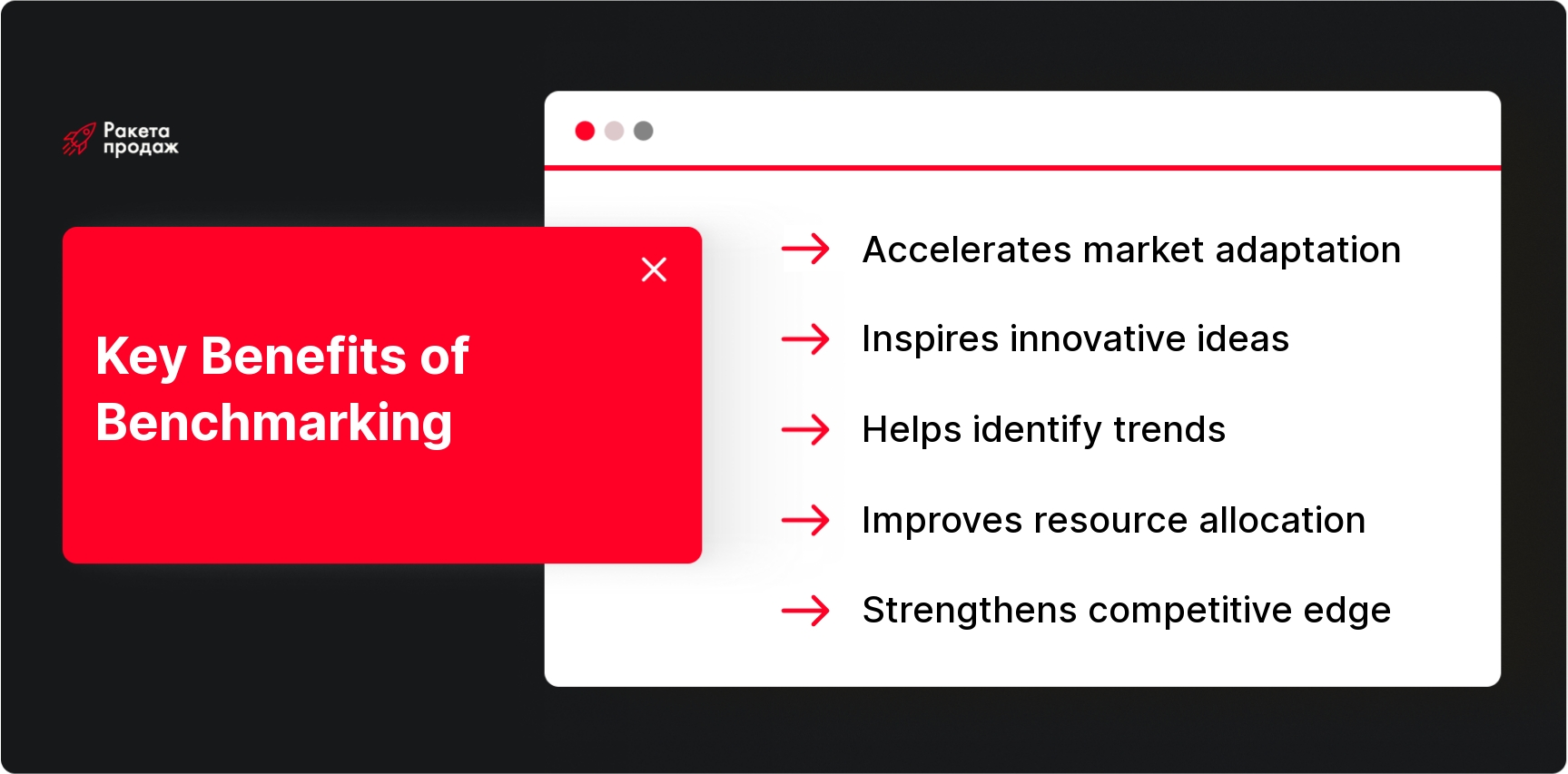
Regular competitor analysis is not just a trend or idle curiosity but a critically important element of strategic management. Companies that systematically study the market and competitors gain a number of significant advantages.

First of all, competitor benchmarking helps prevent falling behind the market. In today’s rapidly changing world, new technologies, approaches, and business models can radically change the rules of the game in a short time. Regular monitoring allows you to notice these changes in time and adapt to them without losing competitiveness.

Competitors can become a source of inspiration and new ideas. By studying their successful solutions, you can find innovative approaches that can be adapted for your business. This doesn’t mean you need to blindly copy competitors, but their experience can be an excellent starting point for your own improvements.

Benchmarking competitor research also helps to more reasonably allocate budgets and resources. By understanding where and how much your competitors invest, you can make more informed decisions about your priorities. For example, if you see that market leaders are actively investing in a certain sales channel or technology, this may be a signal that this direction is promising.

For B2B companies, competitor analysis is especially important in the sales process. Sales representatives should know well the advantages and disadvantages of competing offers to effectively handle customer objections and emphasize their strengths.

Finally, benchmarking helps identify market trends and predict changes in consumer behavior. By analyzing how your competitors evolve, what new products they launch, and what segments they develop, you can build more accurate market development forecasts.

What indicators should be compared in sales benchmarking

Choosing the right metrics for benchmarking is a key factor in its success. Depending on your company’s business goals, you should focus on different indicators, but there is a set of universal metrics that are important for most sales departments.

Key metrics for the sales department, such as lead-to-customer conversion, average check, LTV, request processing speed, and deal duration, should be your reference point when comparing with competitors. Lead-to-customer conversion is one of the fundamental indicators of sales effectiveness. It shows what percentage of potential customers ultimately make a purchase. Low conversion compared to competitors may signal problems in the sales process, ineffective scripts, or a mismatch between your offer and customer expectations.

Average check or LTV (lifetime value) reflects how much money each customer brings. This indicator is especially important for businesses with repeat sales. If your average check is significantly lower than competitors, you may not be fully utilizing the potential of upsells and cross-sells.

Request processing speed and deal duration directly affect customer satisfaction and sales department efficiency. A long decision-making process can lead to customers going to more responsive competitors.

The number of customer touchpoints before a deal shows how effective your communication is. Too many contacts may indicate an unstructured sales process, while too few may indicate insufficient work with objections and customer needs.

The effectiveness of sales scripts can be assessed by parameters such as the percentage of meetings after first contact, conversion of meetings to sales, and the number of successfully handled objections.

When choosing metrics for benchmarking, it’s important to remember that not all indicators are equally important for your business. Focus on those most relevant to your strategy and business model. Mindlessly copying all competitor metrics can lead to resource dispersion and loss of focus.

Finally, it’s important not only to collect data but also to interpret it correctly. For example, a higher conversion rate from a competitor may be related not only to a better sales process but also to a different target audience or price positioning. Context always matters when comparing indicators.

How to choose competitors for analysis

The right selection of companies for benchmarking is the foundation of successful analysis. Too narrow a focus will limit your vision, while too broad a focus will lead to diluted results and difficulties in interpreting data.

First of all, it’s worth segmenting the market and determining who exactly you’re competing with. Direct competitors are companies offering similar products or services to the same target audience. Their analysis will give you an understanding of your immediate competitive environment and market position.

Indirect competitors don’t offer identical products but compete for the same client budget or solve the same problem in different ways. By analyzing them, you can discover alternative approaches and potential threats to your business.

It’s also useful to study leaders in related markets who can serve as a source of innovation and best practices. For example, if you sell business software, it’s worth paying attention to successful B2B services from other niches.

When compiling a list of competitors, it’s important to include not only recognized market “stars” but also fast-growing companies that may become significant players in the future. Young and aggressive competitors often implement innovative approaches that can transform the industry.

For a more complete picture, it’s also useful to include several lagging players in the analysis. This helps understand typical industry mistakes and ensure you’re not repeating them.

The optimal number of companies for deep benchmarking is usually between 5 and 10. Fewer will provide insufficient data to identify trends, while more can make the analysis too labor-intensive and diluted.

After selecting competitors, it’s worth systematizing information about them in the format of profiles or matrices reflecting key comparison parameters. This approach will allow you to visually present the analysis results and identify patterns and deviations.

Step-by-step guide to sales benchmarking

Conducting competitive benchmarking is a structured process that requires a sequential approach. Let’s look at the main stages that will help you conduct an effective sales department analysis.

Below is a step-by-step guide to competitor benchmarking that will help systematically organize market analysis and identify best practices in sales. This approach is especially useful for companies that want not just to observe competitors but use the obtained data to build a sales strategy and develop their own sales department.

Planning

The first step is to clearly define benchmarking goals. What exactly do you want to achieve? Increase conversion? Shorten the sales cycle? Increase the average check? These goals will determine what data you need to collect and how to analyze it.

At this stage, it’s also important to determine key processes and evaluation criteria. Make a list of specific metrics and indicators that you will compare. For example, if your goal is to improve sales funnel analysis, you’ll need data on conversion at each stage, number of touchpoints, cycle duration, etc.

Finally, plan the resources and timeframe of the project. Benchmarking can be quite labor-intensive, so it’s important to determine in advance who will be involved in the process and how long it will take.

Selection and data collection

After defining goals and criteria, select companies for comparison, following recommendations from the previous section. Then move on to the most responsible stage – data collection.

Data can be divided into open and closed. Open data is publicly available: information from company websites, investor reports, press releases, management interviews, customer reviews, job postings. Closed data is harder to obtain: internal processes, exact performance indicators, sales scripts.

To collect closed data, you can use the “mystery shopper” method: make a test request, go through the entire customer journey, and record all interaction stages. It’s also useful to communicate with former employees of competitors (within ethical and legal norms) and analyze their customer reviews, which often contain valuable information about the sales process.

Use specialized tools for data collection and analysis: SEO platforms to evaluate competitors’ traffic and keywords, social media monitoring services, advertising analysis platforms, etc.

Analysis and interpretation

When data is collected, move on to its analysis. Compare key metrics of your company with competitor metrics, identify gaps and areas for improvement. It’s important not just to record differences but to understand their causes.

Look for best practices that can be adapted for your business. Pay attention to unique approaches or solutions that can provide a competitive advantage. Remember that not all competitor practices should be copied – some may not correspond to your business model or corporate culture.

For deeper understanding, it’s useful to conduct a SWOT analysis of each competitor, as well as your own company. This will help identify not only current differences but also potential opportunities and threats.

Developing an improvement plan

Based on the analysis, develop a concrete action plan. Determine what changes need to be implemented first, what resources will be required, and who will be responsible for each direction.

The plan should be realistic and have clear deadlines. Prioritize, focusing on changes that will bring the greatest return with minimal costs. Don’t try to change everything at once – this can lead to chaos and resistance from the team.

It’s also important to determine how you will measure the effectiveness of implemented changes. Set specific KPIs and time points to evaluate progress. This will allow you to adjust the plan in a timely manner if some changes don’t give the expected result.

How to conduct sales benchmarking yourself

Conducting sales benchmarking on your own, without involving consulting agencies, is quite realistic. It takes time and effort but gives a deeper understanding of processes and saves budget. Let’s look at practical methods of collecting and analyzing data.

Mystery calls are one of the most effective ways to study competitors’ sales processes from the inside. Prepare a scenario that imitates a potential customer and contact companies from your benchmarking list. During the conversation, pay attention to scripts, ways of identifying needs, objection handling, closing techniques. Record conversations (if legal in your region) or take detailed notes immediately after the call.

Test inquiries allow you to evaluate not only the sales process itself but also after-sales service. Leave a request on the competitor’s website, fill out a feedback form, or send an inquiry by email. Note the speed of reaction, quality of responses, subsequent steps, and communication channels used (email, phone, messengers).

Analysis of public data involves working with information that is in the public domain. Study competitors’ websites, blogs, social networks, presentations, conference speeches, management interviews. Pay attention to process descriptions, result statements, mentions of tools and technologies used. Annual reports of public companies are also useful, as they often contain information about key indicators and strategic initiatives.

Customer surveys, especially those who previously worked with competitors, can provide valuable insights. Ask why they chose you, what they liked and disliked about the previous provider, how the sales and service process was organized. Such conversations not only provide information for benchmarking but also help better understand customer expectations.

Analysis of competitor job postings is an underrated source of information. Job descriptions often reveal internal processes, tools used, required skills, and KPIs. For example, from a sales manager vacancy, you can learn about the department structure, motivation system, CRM systems used, and expected performance indicators.

If you want to structure this complex process, refer to the practice of conducting a sales department audit – this will help formalize the collection and analysis of information and not miss important details.

It’s important to remember that data collection is only half the battle. Equally important is its correct analysis. Systematize the collected information into a unified structure, highlight patterns and anomalies, compare with your processes and indicators. Look not only for differences but also for the causes of these differences.

It’s also useful to involve employees from different departments in the analysis – they may notice what escaped your attention and offer non-standard ideas for improvements.

Competitive benchmarking checklist

Preparation and planning

  • Specific analysis goals defined (what exactly you want to improve)
  • Key metrics and KPIs for comparison selected
  • List of 5-10 competitors for analysis compiled
  • Roles and responsibilities distributed in the team
  • Timelines for analysis and implementation of changes established

Data collection

  • Mystery calls and test inquiries to competitors conducted
  • Public data analyzed (websites, social media, reports)
  • Reviews collected from customers who previously worked with competitors
  • Competitor job vacancies and employee requirements studied
  • Marketing materials and value propositions analyzed

Sales process analysis

  • Sales stages for each competitor recorded and described
  • Scripts and communication styles analyzed
  • Speed of request processing and response to inquiries evaluated
  • Methods of handling objections and closing deals studied
  • After-sales service and support analyzed

Comparative analysis

  • KPIs collected for all selected metrics
  • Comparison of your indicators with competitor indicators conducted
  • Strengths and weaknesses of your sales process identified
  • Best market practices for each funnel stage determined
  • Unique approaches and innovative solutions identified

Development of improvement plan

  • Priority areas for improvement identified
  • Specific changes in processes and tools formulated
  • Measurable goals for each improvement established
  • Implementation schedule with checkpoints compiled
  • Responsibility for implementation of each change distributed

Implementation and control

  • Team trained on new processes and approaches
  • Necessary tools and technologies implemented
  • Key indicator monitoring system set up
  • Interim results control points defined
  • Next benchmarking cycle planned (in 6-12 months)

This sales benchmarking guide checklist can be adapted to the specifics of your business, adding or removing items depending on your goals and industry characteristics. The main thing is to use it as a structural foundation that helps not to miss important elements of the process.

Systematic competitor benchmarking is a powerful tool for sales growth, but its implementation requires time, expertise, and access to closed data. Instead of spending months on independent analysis, entrust this task to professionals. “Sales Rocket” offers a comprehensive audit of your sales department with in-depth competitive benchmarking, which includes analysis of the sales funnel, scripts, processes, and KPIs in comparison with market best practices. We not only identify gaps between your indicators and industry standards but also provide ready solutions for their elimination: from script optimization to implementing an effective motivation and control system. Our clients – including Mitsubishi, Yamaha, Naftogaz – receive not just recommendations, but concrete tools for increasing turnover. The maximum result of our clients – an increase of $1.6 million in 4 months of work.

Turn competitor analysis into a real competitive advantage - get expert benchmarking of your sales department!

Conclusion

Competitor benchmarking in sales is not just a way to find out what other companies are doing, but a powerful tool for developing and increasing your business competitiveness. Systematic analysis of competitors’ processes, indicators, and strategies allows you to identify best market practices, find weaknesses in your own work, and make informed decisions about necessary changes.

The key to successful benchmarking is regularity and systematicity. A one-time analysis will give only a temporary representation of the market situation, while constant monitoring allows you to track trends, respond promptly to changes, and always stay one step ahead of competitors. It’s recommended to conduct a full benchmarking every 6-12 months, and track the main indicators on a regular basis.

Remember that the goal of benchmarking is not blind copying of others’ solutions, but inspiration and adaptation of best practices, taking into account the uniqueness of your business, target audience, and corporate culture. Only in this way can you create a truly effective and competitive sales system.

In this article:
See more
Book a FREE sales funnel audit
CONTACT US
FAQ
What is competitive benchmarking?

Competitive benchmarking is the process of systematically comparing your company’s indicators, processes, and strategies with direct competitors to identify strengths and weaknesses, as well as borrowing best practices. The main goal is to increase work efficiency and strengthen competitive advantages.

How is benchmarking different from competitor analysis?

Competitor analysis benchmarking typically focuses on external aspects (what they sell, at what prices, what marketing they use), while benchmarking goes deeper and examines internal processes, performance indicators, and cause-and-effect relationships. Benchmarking is also more action-oriented and focused on improvements, not just information gathering.

How many competitors should you analyze for benchmarking?

The optimal number is 5 to 10 companies. Fewer won’t provide enough data to identify trends and best practices, while more will make the analysis too labor-intensive and diluted. It’s important to include different types of competitors: direct, indirect, market leaders, and fast-growing newcomers.

How often should you conduct competitor benchmarking?

Full benchmarking is recommended once every 6-12 months, depending on your market’s dynamics. More frequent studies may not show significant changes, while less frequent ones risk missing important trends. Key indicators should be tracked on a regular basis, for example, monthly or quarterly.

What mistakes are most commonly made in benchmarking?

Common mistakes include: blindly copying competitor practices without adapting them to your business; focusing only on quantitative indicators without understanding processes; analyzing too many competitors or metrics; lack of a concrete action plan based on analysis results; conducting benchmarking once, without regular data updates.

SUBSCRIBE TO MY TELEGRAM CHANNEL
The most valuable sales information right on your phone!
icon

LOTS OF USEFUL INFORMATION, FREE TEMPLATES, AND CHECKLISTS ON MY INSTAGRAM

Materials and practical advice on sales growth in our blog: