Key Takeaways
- Most CRMs record call occurrences but hide their quality. Ringostat shows which managers are truly working and which lose clients at greeting, objection handling, or call closing.
- A manager who doesn’t close the call with a next step (meeting, proposal, follow-up) wastes the lead. Listening to recordings identifies such employees and helps establish error patterns.
- Call duration without linking to results is deceptive. If a manager talks for a long time but has low conversion to deals, they’re wasting time rather than making sales.
- Target calls Ringostat are filtered by duration, keywords, and source. This removes spam and provides an accurate picture of advertising effectiveness and manager performance.
- Ringostat’s CRM integration links calls with leads and deals. You can see what percentage of each manager’s calls convert to revenue, not just conversations.
In the full article, you’ll find a step-by-step algorithm for implementing call quality control, criteria for evaluating managers, and specific error signals that kill conversion 👇
What is Ringostat and Its Role in Business Communications
Ringostat is a comprehensive platform for managing and analyzing customer communications. Unlike regular telephony that simply connects callers with a company, Ringostat creates an entire ecosystem for handling incoming and outgoing calls. The system includes a virtual PBX, call tracking to monitor call sources, modules for working with messengers, and tools for call analytics in Ringostat.
The main difference between Ringostat call tracking and standard telephone solutions lies in its ability to connect marketing, sales, and customer service. If regular telephony simply provides communication, Ringostat answers the questions: where did the customer come from, how well were they served, and what result did this contact bring?
Ringostat call tracking analysis functions help solve critically important tasks for two departments. For marketing – tracking advertising channel effectiveness, determining the most successful campaigns, and precisely measuring the cost of attracting a customer through a call. For the sales department – controlling service quality, analyzing manager effectiveness, and identifying weak points in the lead processing workflow.
Calls often remain the most “blind” sales channel: you know they’re coming in, but don’t understand their effectiveness. Statistics show that 70% of sales plan fulfillment depends on properly configured sales models and management control. The “Rocket Sales” team has created a comprehensive methodology for analyzing customer communications over 8+ years – from listening to calls to evaluating manager performance in CRM. We conduct in-depth sales department audits: analyzing scripts, identifying critical errors, and creating call quality control systems that increase conversion. Our experts not only point out problems but also implement weekly and monthly reporting tools to track progress. The result? Our clients receive a transparent sales system with predictable results and an average turnover increase of +35%.
Transform your calls "black box" into a transparent and manageable sales system - order a free sales department audit!
Ringostat integrates with CRM systems, web analytics, and advertising platforms, allowing you to build comprehensive end-to-end analytics from the first click to closing the deal. This level of integration and automation is impossible when using traditional telephone systems where calls exist separately from other business information. If you need a comprehensive approach for business at the intersection of IT and management, consider implementing CRM and telephony to get the most out of new technologies.
How Call Analytics Works: Data Collection and Analysis
Call analytics in Ringostat begins the moment a client visits your website. The system tracks where the visitor came from and links this information to their subsequent actions, including calls. When a user dials a number, Ringostat call tracking automatically determines the source of the inquiry – whether it was a search engine visit, an ad click, social media, or even an offline advertisement.
One of the key technologies is dynamic call tracking, which substitutes the phone number on the website individually for each visitor. Thanks to this, Ringostat precisely links the call to a specific user and their path on the site, even if the call happens later, several hours or days after the visit. To learn more about call tracking capabilities for marketing and sales, read a separate article about what is call tracking.
The Ringostat analytics interface provides multi-level information about calls. Basic reports show the overall picture: how many calls were received, from which sources, at what time, and their duration. More in-depth reports reveal details: which keywords led to the call, which website pages generate the most calls, and which devices customers use.
An important aspect of analytics is separating calls into target and non-target. The system allows you to set criteria by which a call is considered targeted, such as duration longer than 30 seconds or transferring to a specific department. This helps filter out spam, erroneous calls, and inquiries from non-target audiences to evaluate advertising effectiveness based on quality inquiries rather than just their total number.
Additionally, Ringostat tracks unique visitors, which allows you to accurately determine website-to-call conversion. You see not just the number of calls, but how many were initial contacts and how many were repeat contacts from existing customers, which is critically important for proper evaluation of the marketing funnel. This approach is particularly useful for analyzing sales channel effectiveness and optimizing customer acquisition strategies.
How to Listen to Manager Calls in Ringostat
Many leaders wonder how to listen to a call in Ringostat and quickly access real dialogues between managers and clients without complex settings and additional tools.
Listening to manager calls is one of Ringostat for call listening basic functions that helps control customer service quality. To start listening to calls, simply go to the “Calls” section in your personal account and select the call you’re interested in. The system provides convenient filters to search by date, manager, traffic source, or conversation duration.
For each call, a recording is available that you can listen to online or download for further analysis. Ringostat call recording stores recordings in a convenient format, making it easy to organize their further use for training. In addition to the recording itself, the system shows additional information: which manager took the call, how long the customer waited for an answer, how long the conversation lasted, and what the outcome was.
How to Analyze a Manager's Conversation When Listening
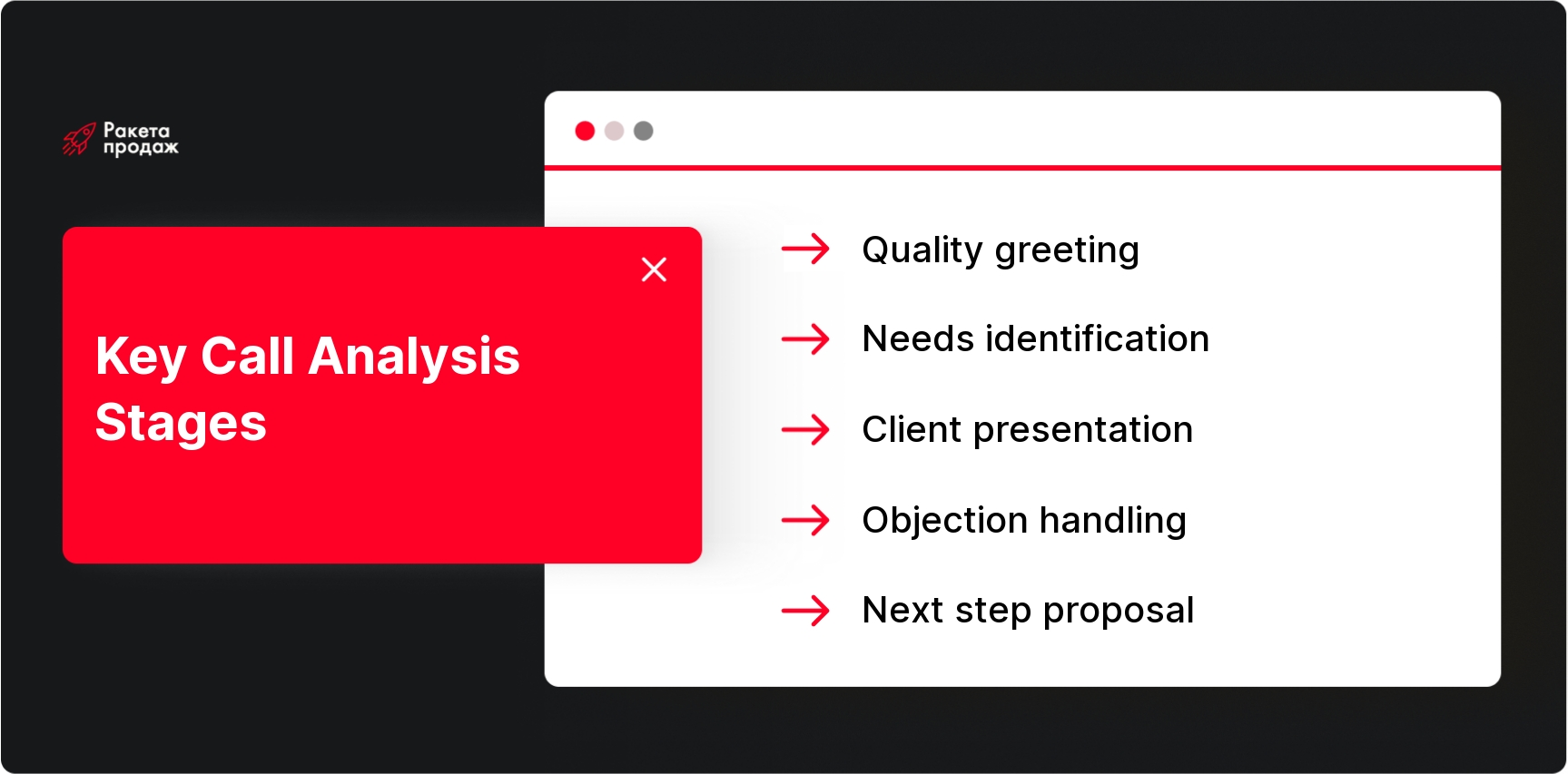
When analyzing manager calls, pay attention to several key stages of the conversation. First, evaluate the greeting – did the manager introduce themselves, mention the company name, and were they friendly? The first 10-15 seconds of conversation shape the customer’s impression and set the tone for the entire discussion.
The next important element is identifying the customer’s needs. Did the manager ask clarifying questions? Did they interrupt the client or let them speak? Proper needs identification is the foundation of successful sales, and insufficient attention to this stage often leads to losing potential customers.
Also, assess the quality of product or service presentation. Did the manager talk about benefits that interest this specific customer, or did they simply list general characteristics? Did they use understandable language without excessive technical terms? A good manager adapts their presentation to each customer’s needs.
Pay special attention to objection handling. How many objections were raised during the conversation? How did the manager respond to them? Did they manage to convince the client, or did the conversation end in rejection? Note which objections cause the greatest difficulties for your managers – this will help improve scripts and conduct targeted training.
Finally, analyze the conversation closing. Did the manager propose a next step – a meeting, sending a commercial proposal, a follow-up call? Did they get the client’s agreement for this step? Ending without a specific agreement about the next stage often means losing the client.
If you want to learn more about service quality assessment techniques and telephone conversation analysis, check out recommendations for call analysis, which will help build a transparent communication audit system.
How to Identify Target and Non-Target Calls in Ringostat
Properly separating calls into target and non-target is the foundation of accurate analytics and objective manager evaluation. Target calls are those from potential customers interested in your product or service. Non-target calls include spam, erroneous calls, or inquiries unrelated to your main business.
Ringostat offers several ways to identify target calls. The simplest is filtering by duration. Calls lasting less than 15-20 seconds are usually considered non-target, as it’s impossible to conduct a meaningful dialogue in such a short time. A more complex method is filtering by keywords spoken during the conversation. For example, if a customer mentions a competitor or a product you don’t sell, the call may be marked as non-target.
You can also set up filtering by traffic sources. If you notice that a certain advertising campaign brings mostly non-target inquiries, you can automatically mark all calls from this source as potentially non-target for further analysis.
It’s important to understand that the rules for determining target calls Ringostat should be adapted to your business specifics. For example, for an online store, a target call might be longer than one minute, while for legal consultation, a target call might last 5-10 minutes.
After setting up filters, you’ll be able to generate reports only for target calls, giving a more accurate picture of advertising effectiveness and manager performance. Additionally, separating calls into target and non-target allows you to correctly calculate the cost of attracting potential customers and optimize advertising campaigns. For a broader understanding of the multi-channel approach to inquiry analysis, check out omnichannel analytics and messengers.
How to Analyze Manager Effectiveness Through Calls Using Ringostat
Comparing Managers by Accepted Calls
The first and most obvious way to analyze manager effectiveness is comparing the number of accepted calls. Ringostat allows you to generate a report showing how many calls were directed to each manager and how many were answered. This helps identify employees who systematically miss calls and lose potential customers.
However, the simple number of accepted calls doesn’t always give a complete picture. It’s important to consider that some managers may accept more calls, but mostly non-target ones, while others handle fewer calls, but almost all from potential customers. Therefore, Ringostat allows you to filter reports by target calls, providing a more objective assessment.
Also pay attention to missed calls statistics during working hours. If a manager regularly doesn’t answer calls when they should be at their workplace, this is a clear signal of a problem. Call details in Ringostat shows detailed information about each missed call, including time and source, allowing you to understand the reasons and take action. In this context, regular auditing and sales department management becomes an important part of management, allowing systematic tracking of employee KPIs.
Call duration is an important indicator of manager work quality. Excessively short conversations may indicate that the manager can’t hold the customer’s attention, doesn’t identify needs, or doesn’t offer solutions. On the other hand, extremely long calls aren’t always effective – the manager may get lost in details without moving to specific offers.
Ringostat allows you to analyze the average duration of conversations for each manager and compare this indicator with the department average. You can establish an optimal duration range for your business and track which managers regularly exceed its limits.
It’s especially useful to compare call duration with its result. If a manager conducts lengthy conversations, but they rarely end with a next step (meeting, deal, sending a proposal), they may be using time inefficiently. Conversely, a manager who achieves specific agreements in optimal time works productively.
Analyzing Call-to-Lead Conversion
The deepest level of manager effectiveness analysis is evaluating call conversion to real opportunities and deals. This requires integrating Ringostat with a CRM system, which allows tracking Ringostat call status and what happens after the call.
With such integration, you can see what percentage of calls accepted by each manager turns into leads and then into deals. Information about average check and total revenue generated by each manager also becomes available. This data provides the most objective picture of employee effectiveness.
It’s important to analyze not just overall conversion, but conversion for different types of inquiries. For example, one manager might excel with “hot” clients but struggle when communicating with those just starting to choose. Another might masterfully conduct initial consultations but fail to close deals. Ringostat helps identify such patterns and distribute incoming calls considering each manager’s strengths.
Manager Errors Revealed by Ringostat Analytics
Ringostat analytics helps identify typical manager errors that reduce sales effectiveness. The most obvious mistake is not answering the phone. Missed calls statistics in Ringostat clearly shows how many potential customers didn’t receive an answer. According to research, about 85% of customers who don’t get through on their first attempt don’t call back and go to competitors.
The second common error is quickly ending the call. Some managers try to finish the conversation as quickly as possible, especially if the customer doesn’t show immediate interest in purchasing. Phone sales analysis Ringostat and call duration analysis helps identify such managers and explain why it’s important to dedicate enough time to each inquiry.
The third mistake is the absence of clear conversation closing and invitation to the next step. Many managers end calls with phrases like “Call us if you have questions,” instead of offering a specific action – a meeting, specialist consultation, or sending a commercial proposal. Listening to recordings in Ringostat allows you to assess how successfully the manager closes the conversation to the next step.
The fourth problem is losing repeat calls. Often customers call several times before making a purchase decision. If each time they’re served by a new manager who doesn’t know the communication history, effectiveness drops sharply. Call conversation details Ringostat shows the history of each customer’s calls, helping track such cases and configure the routing system.
Finally, analyzing conversation recordings often reveals problems with the sales script itself. For example, managers may use complex technical terms that customers don’t understand, or fail to adapt presentations to specific needs. Regular call listening allows improving scripts and training managers in more effective sales techniques.
How to Implement a Manager Control System Through Ringostat
Implementing a manager work quality control system through Ringostat is a process that requires sequential actions and team involvement. Start by enabling call recording in the platform settings. Be sure to notify both employees and customers about this (usually adding a warning on the website and a voice message at the beginning of calls is sufficient).
The next step is setting up target call criteria. Define which calls are considered successful for your business and configure appropriate filters in Ringostat. This could be minimum conversation duration, transfer to a specific extension, or the presence of keywords in the conversation indicating customer interest.
Then add tags for call classification. Tags help quickly navigate through large volumes of recordings and generate analytical reports. For example, you might create tags like “Price request,” “Complaint,” “Repeat call,” “Consultation,” etc. Tags can be added manually or set up for automatic assignment based on certain criteria.
Organize regular conversation checks. Set aside time (e.g., 1-2 hours per week) to listen to a random sample of calls or focus on critical cases – particularly long or short conversations, calls that didn’t lead to deals, or inquiries after which the customer went to competitors.
Based on call analysis, create regular reports for management and the team. The report should include both quantitative indicators (percentage of accepted calls, average duration, conversion) and qualitative assessments (script adherence, objection handling, overall impression). It’s important that the report isn’t just statistics but a foundation for improving work.
Finally, use the obtained data for manager training and development. Conduct regular call review sessions where you and the team analyze both successful conversations and those that could have been conducted better. Such sessions help managers learn from real examples and see how their colleagues handle similar situations.
Call analytics is a powerful tool, but its maximum effectiveness is achieved only through a systematic approach to the sales department. At “Rocket Sales,” we don’t just analyze calls, but create comprehensive quality control systems including listening, evaluation, and manager training. Our approach includes mapping the customer journey from first contact to deal, identifying “bottlenecks” and losses, and developing optimal scripts and checklists for managers. We implement modern CRM systems with telephony integration, which automates control and increases the intensity of customer work. Over 8+ years, we’ve built 208 sales departments in various industries, including projects for Mitsubishi, Audi, and Naftogaz. Our clients don’t just get recommendations, but a ready-made system that provides stable results: increasing conversions from 5% to 86% and sustainable turnover growth.
Create a sales department that predictably increases your turnover by 35% - order a comprehensive audit and systematization of processes right now!
Call analytics in Ringostat provides a unique opportunity to transform traditional telephone communication into a powerful tool for business growth. Regular call monitoring and comprehensive evaluation of manager work not only improve conversion and increase sales but also create a solid foundation for continuous process improvement. Ringostat’s end-to-end analytics connect advertising campaigns with actual sales, allowing precise measurement of ROI for each marketing channel. Implementing such a system is an investment that pays off through optimizing advertising budgets, improving service quality, and consequently, increasing customer trust and loyalty to your brand.


 Time to read: 10 min.
 08 April 2026