icon

How Sales Manager Mindset Limits Sales Growth

A Head of Sales makes dozens of decisions daily that determine the success of the entire team. But what if the main brake on revenue growth isn’t the market or team, but the leader’s own mindset? The limiting beliefs of the Head of Sales act like invisible walls, imperceptibly narrowing the field of possibilities, causing the sales manager to repeatedly choose proven but not always effective strategies. These beliefs form over years, intensify during crisis periods, and often remain unconscious. The problem is that the leader’s thoughts inevitably transmit to the team, defining the sales culture and affecting results. In this article, we’ll explore which limiting beliefs most commonly hinder sales managers, how they appear, what consequences they lead to, and most importantly – how to identify and overcome them to achieve a new level in sales.

Key Takeaways

  • Your beliefs about the market, team and customers silently transform into self-fulfilling prophecies. If you’re convinced that “good salespeople are rare,” you stop investing in training and end up with a weak team.
  • A leader with the mindset “I must personally close key deals” becomes a super-salesperson rather than a systems leader. The department doesn’t scale, and growth hits a ceiling limited by your time.
  • Limiting beliefs form from past failures, corporate pressure, and defensive reactions. One failed automation attempt gets cemented as “CRM is a waste of money.”
  • Test your assumptions against facts. If you believe “no one will buy without discounts,” run a pilot with strengthened value argumentation and compare results.
  • Growth mindset transforms mistakes into experience and processes into experiments. You begin to see opportunities where you previously only saw limitations.

In the article below, you’ll find specific ways to identify your limiting beliefs, techniques for reframing them, and steps for mindset transformation. Read the full article 👇

What Are Limiting Beliefs in a Sales Manager

Limiting beliefs of the Head of Sales are persistent internal mindsets that unconsciously restrict their decision-making capabilities, team development, and building an effective sales system. Essentially, these are deeply rooted perceptions about the market, clients, subordinates, and their own role, which are perceived as indisputable truths, though they actually only reflect subjective experience.

For example, the belief that “growth beyond 10% annually is impossible in our market” may seem like an objective observation but is actually just a justification for why not to seek new approaches or target segments. Such mindsets become “mental frames” through which the sales manager perceives any information, ignoring facts that contradict their worldview. These very mindsets create decision-making blocks, when the leader doesn’t even consider alternative strategies and acts according to familiar scenarios.

The peculiarity of limiting beliefs is that they are rarely expressed explicitly. More often they disguise themselves as “common sense” or “years of experience.” A sales manager might be absolutely convinced that “good salespeople are rare” or “nobody will buy without discounts,” without even noticing how these beliefs influence their management decisions: minimal investments in training, refusal to test value propositions without discounts, unwillingness to systematically work with the sales funnel.

The danger of such beliefs lies precisely in their invisibility. They form a comfort zone for the leader, within which they operate automatically, following established patterns. The problem is that in today’s changing world, these scenarios quickly become outdated, and beliefs prevent seeing this and adapting. A vicious circle emerges: the sales manager acts in a certain way, gets a predictable result, and perceives this as confirmation of their correctness.

The destructive influence of limiting beliefs manifests not only in strategic decisions but also in everyday actions: how the leader communicates with the team, what they focus on in reports, which initiatives they support and which they block. For instance, the belief that “all employees work only for money” leads to ignoring non-material motivation and stimulates turnover among those who value recognition and development. And when results decline, this same sales manager will see only confirmation that “people are difficult.”

Have you ever wondered how often your beliefs about sales limit the results of your entire team? It’s not uncommon – 78% of sales leaders don’t notice how their internal mindsets become a “glass ceiling” for business. At “Rocket Sales,” we’ve developed a systematic approach to transforming leader mindset and building effective sales departments. For over 8 years, we’ve helped 208 companies transition from limiting thinking to growth strategy through deep process audits, identifying hidden assumptions, and implementing measurable KPIs. Our clients don’t just get recommendations, but a comprehensive restructuring of their sales system with a focus on results: the average revenue increase is +35%, with a maximum recorded result of +$10,907,403 in 4 months of work.

Turn limiting beliefs into growth points for your business – order a free sales department audit right now!

Turn limiting beliefs into growth points for your business - order a free sales department audit right now!

Common Examples of Limiting Beliefs Among Sales Managers

Working with sales department heads, several categories of limiting beliefs can be identified that are particularly common and have a significant impact on management effectiveness. Most of these mindsets are not just beliefs, but systemic thinking mistakes of the Head of Sales that directly influence strategy and daily management decisions.

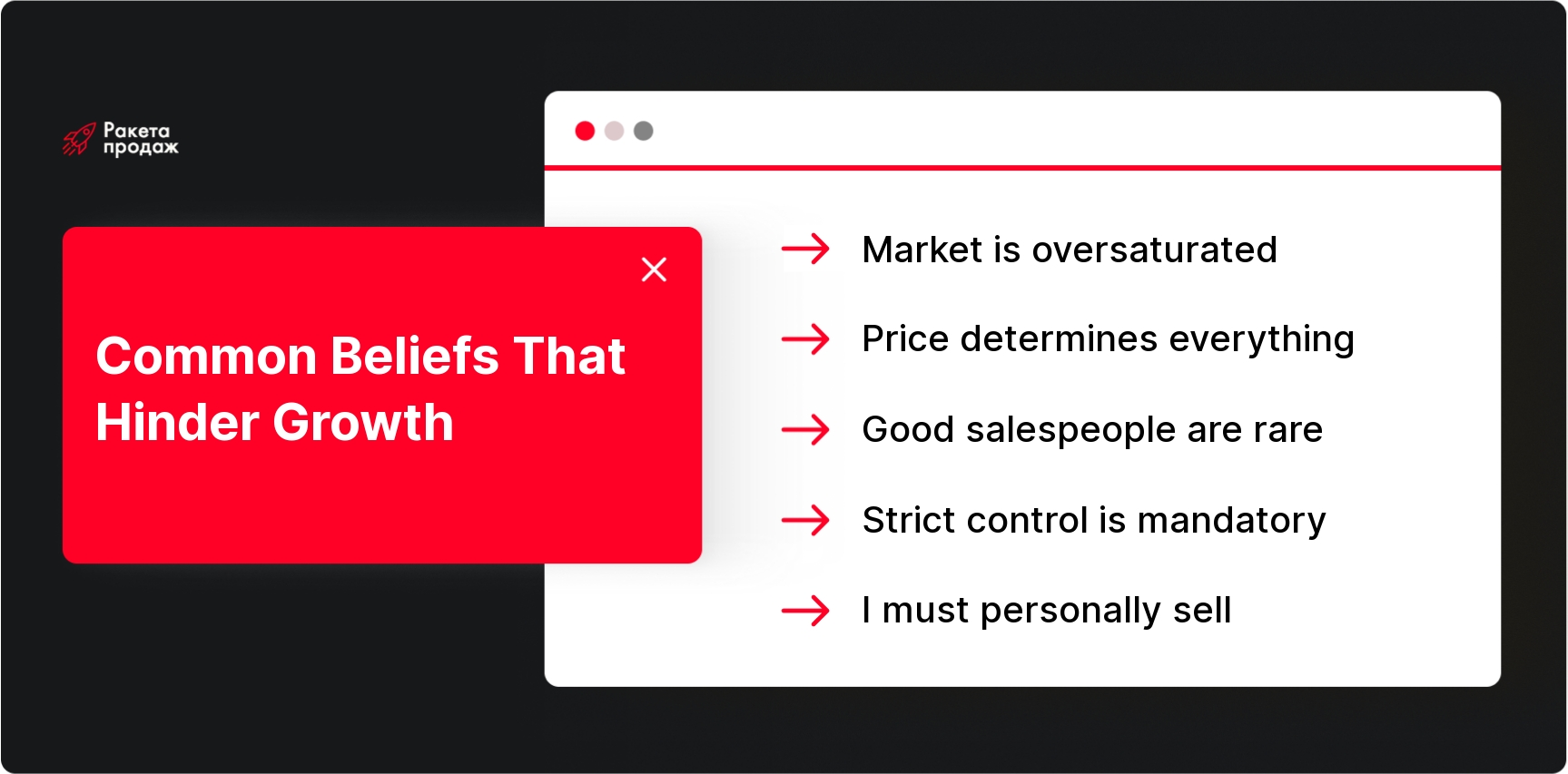
The first group involves beliefs about the market and competitive environment. A typical mindset: “Our market is saturated; it’s impossible to attract new clients.” With such a belief, the sales manager automatically focuses only on the existing client base, not allocating resources to finding new niches and attraction channels. Similarly, the belief that “in our industry, only price matters” leads to the sales department becoming a “discount department,” while work on value proposition and training managers in argumentation takes a back seat.

The second category concerns beliefs about people and team. Many sales managers are convinced that “good salespeople are extremely rare; you can’t develop them.” This belief blocks investment in personnel training and development. Instead of creating a system that makes average salespeople good and good ones excellent, such a leader spends energy on the endless search for “stars” in the job market. Another common mindset: “People need strict control, otherwise they’ll slack off.” With this approach, the sales manager immerses themselves in micromanagement, demands constant reports, but leaves no space for initiative and creativity in sales.

The third group involves beliefs about their own role. “I must personally close key deals; no one will do it better than me” – with this mindset, the sales manager becomes a “super-salesperson” instead of a systems leader. They don’t scale their expertise through the team but strive to control everything personally, which limits department growth. Or another example: “My task is to fulfill the plan at any cost, not to deal with processes.” This belief leads to the department working in constant “firefighting” mode, without strategic development and systematization.

The fourth group concerns beliefs about working methods. “CRM and analytics are just extra bureaucracy that distracts from sales.” With this mindset, the sales manager resists digitization and working with data, depriving themselves of the ability to see the complete funnel picture and make informed decisions. Or “Formalized processes kill creativity in sales” – a belief that prevents standardization of best practices and makes department results unpredictable.

During economic instability, beliefs like “Now is not the time to experiment; we need to focus on proven methods” gain special strength. This is a justification for rejecting innovation exactly when it’s most needed. A vivid example is a company where the sales manager resisted implementing online sales for years, considering them “not suitable for our product,” until competitors took a significant market share through new channels.

These and similar beliefs form a vicious circle of self-fulfilling prophecies. A sales manager with the mindset “nobody buys during a crisis” transmits this belief to the team, reduces activity, expects rejections – and naturally gets a sales decline that only “proves” they were right.

image

How Limiting Beliefs Form and Why They Persist

Limiting beliefs in sales department heads don’t appear suddenly – they’re the result of complex interactions between personal experience, corporate culture, and psychological self-defense mechanisms. Understanding these processes helps work more effectively with one’s own mindsets.

First of all, the sales manager’s professional path influences belief formation. Most leaders grew from successful salespeople, and this experience creates a certain worldview: “I achieved success thanks to my sales style, so this style is the only correct one.” Such a leader will unconsciously encourage subordinates who work in a similar manner and criticize those who use different approaches, even if they’re effective.

Past failures also have a strong influence. If a sales manager once suffered defeat, for example, when launching a new product or implementing a CRM system, this can become cemented as a belief: “Innovations don’t work in our company” or “Automation is a waste of money.” One negative experience transforms into a universal rule that blocks future initiatives.

The corporate environment also plays an important role. In companies with rigid pressure from above, where the only success criterion is fulfilling the plan at any cost, the sales manager forms corresponding beliefs about priorities and acceptable working methods. If company management constantly demands to “squeeze more from clients,” while long-term investments in team development and processes aren’t valued, it’s not surprising that the sales manager begins to consider such an approach normal.

The phenomenon known in psychology as “confirmation bias” gives special persistence to limiting beliefs. People tend to notice and remember information that confirms their existing perceptions and ignore contradicting data. For example, a sales manager with the belief “all clients are only interested in price” will note every case where a deal fell through due to cost but won’t attach significance to situations where a client chose a more expensive offer because of quality or service.

Added to this is a person’s natural tendency to remain in their comfort zone. Acknowledging the erroneousness of one’s beliefs requires restructuring the entire thinking system, and this is psychologically complex and energy-intensive. It’s easier to continue acting out of habit and explain failures by external circumstances: “the market isn’t right,” “clients are bad,” “employees are lazy.”

Finally, it’s important to understand that limiting beliefs often serve a protective function. The belief “I can’t trust key negotiations to employees” may mask fear of risk. And the mindset “in our market, it’s impossible to grow faster than competitors” protects against disappointment when ambitious goals aren’t achieved. In such situations, the Head of Sales is afraid of risk, preferring to remain in the zone of familiar decisions, even if they no longer give the needed result.

Impact of Limiting Beliefs on Sales Department Effectiveness

A sales manager’s beliefs don’t remain their personal matter – they inevitably affect the entire department and its results. In practice, it’s the Head of Sales’ mindset that slows down sales, even if the team is strong enough and the market provides growth opportunities. This influence occurs across several key areas that are critical for sales effectiveness.

First of all, the leader’s beliefs directly determine the team culture and atmosphere. If a sales manager is convinced that “all people are naturally lazy,” they will build systems of total control that demotivate initiative-taking employees. This approach leads to managers actually starting to work strictly to the minimum, confirming the initial belief. This is a classic case of a self-fulfilling prophecy: the leader’s expectations shape reality.

A vivid example is the story of a construction materials sales company where a new sales manager arrived with the belief “employees should fear their leader.” He introduced a harsh system of fines and public reprimands, which led to the departure of the most qualified managers who valued professional dignity. The remaining employees began to avoid risks and stopped offering clients complex solutions, fearing mistakes. Within a year, the share of margin-generating deals decreased by 35%.

Limiting beliefs significantly influence strategic decisions. The belief “during crisis, all expenses must be cut” leads to the sales manager reducing the training budget exactly when the team especially needs new skills to work in changed conditions. Or the mindset “marketing doesn’t bring quality leads” prevents building full cooperation with the marketing department, which limits the influx of new clients. The result is a narrow mindset of the Head of Sales, where new channels, tools, and approaches to business development are ignored.

The sales manager’s beliefs are especially noticeable in hiring and personnel development processes. If the leader believes that “salespeople are born, not made,” they will spend enormous resources searching for ideal candidates instead of creating a system that transforms ordinary specialists into high-performing salespeople. In one IT company, this approach led to the sales manager position remaining open for an average of 4 months – a critical time during which clients and market share were lost.

If you’re interested in a more systematic approach to team development and process optimization, pay attention to tools like How to Conduct a Sales Department Audit, to timely identify problem areas and limiting beliefs.

The sales manager’s beliefs also determine their approach to innovation and change. The mindset “our client isn’t ready for new formats” can block the implementation of online consultations, automated funnels, or mobile applications for years. When competitors implement these tools and capture market share, it becomes too late to catch up. This fear of innovation in the Head of Sales can dramatically slow a company’s growth in rapidly changing markets.

Equally important is the impact on financial indicators. The belief “our products can only be sold with a discount” leads to systematically underpricing and falling margins. In a manufacturing company, such an approach by the sales manager cost 15% of profits until an independent audit revealed that a significant portion of clients was willing to pay full price for guaranteed deadlines and quality.

Finally, limiting beliefs affect the personal effectiveness of the sales manager themselves. The mindset “I must control every important deal” transforms the leader into a perpetually overloaded operational worker with no time left for strategy and sales system development. Such “irreplaceability” becomes the main obstacle to business scaling.

The combination of these effects explains why a sales department can tread water for years despite high activity and employee motivation. The limiting beliefs of the Head of Sales, like an invisible ceiling, determine the maximum level to which the team can grow. And overcoming this ceiling is only possible through transforming the leader’s mindset.

Ways to Identify Your Own Limiting Beliefs

Work with limiting beliefs begins with awareness, and this is often the most difficult step. Our deep-seated mindsets become so integrated with us that they’re perceived not as subjective opinions but as indisputable facts. How can a sales manager recognize their limiting beliefs?

The first effective method is analyzing recurring problems and situations. If your department experiences the same difficulties year after year – high staff turnover, plan failure in certain periods, conflicts between departments – this signals possible limiting beliefs. It’s useful to ask yourself: “What perceptions about people, market, or processes might lead to such results?”

For example, one sales manager constantly faced new employees quickly losing effectiveness and resigning after successful probation. Analyzing the situation, he realized his belief: “Experienced employees don’t need support; they should manage on their own.” Because of this mindset, he stopped active mentorship immediately after the probation period, which led to manager burnout.

The second method is tracking automatic thoughts in stressful situations. When the team doesn’t meet targets, a client rejects a deal, or a key employee leaves – what thoughts come to mind first? It’s in these moments that limiting beliefs manifest most vividly. It’s useful to write down these thoughts without censoring them, then analyze them for generalizations, categorical judgments, and negative forecasts.

In one coaching session, a B2B services sales manager noticed that his first thought with each client rejection was: “It’s impossible to sell in this segment without connections.” Recognizing this mindset, he could see how it limited his approach to finding and developing clients.

The third approach is getting feedback from team and colleagues. People around us often better see our blind spots. You can ask trusted employees or fellow managers to note phrases you regularly repeat when discussing problems or tasks. Especially telling are statements beginning with “we always…”, “it’s impossible because…”, “I know that nobody can…”.

A useful tool is an anonymous team survey. Questions like “What management decisions or actions do you find illogical?” or “What opportunities do you think we’re missing?” can reveal areas where your beliefs differ from the team’s vision.

The fourth method is practicing regular reflection. By setting aside time to analyze your decisions and their results, you can notice patterns indicating hidden beliefs. It’s useful to keep a leadership journal, recording not just events but also your reactions, emotions, and decision rationales. After some time, recurring themes and explanations will emerge in these notes that may indicate limiting beliefs.

The fifth way is using coaching techniques and questions. Questions like “What do I consider absolutely impossible in my work?”, “What rules do I never break?”, “What would I do if I knew for certain I couldn’t fail?” help discover boundaries we’ve set for ourselves.

All these methods require the sales manager’s readiness for honest self-analysis and acceptance of possible discomfort. Confronting one’s own limiting beliefs can be unpleasant, but it’s precisely this confrontation that opens the path to a new level of managerial effectiveness.

How to Overcome Limiting Beliefs and Develop Leadership Mindset

After limiting beliefs have been identified, the most important and difficult work begins – their transformation. This isn’t just an intellectual exercise, but a deep process of changing habitual ways of thinking and perceiving reality. The mindset of the Head of Sales plays a key role here, determining whether they will seek growth opportunities or remain within limitations.

The first step is checking beliefs against reality. For each identified mindset, ask yourself three key questions: “Is there irrefutable evidence this is true?”, “Are there examples that contradict this belief?”, “How would the situation look if this belief were false?”

For example, if you’ve discovered your belief is “good salespeople don’t want to work in our industry,” analyze competitors. You’ll surely find companies that manage to attract and retain strong specialists. What do they do differently? This analysis helps shake the rigidity of the belief and see alternative perspectives.

The second step is reformulating limiting beliefs into developmental ones. The mindset “it’s impossible to find qualified managers in our region” can transform into “to attract qualified managers, we need to create more attractive conditions and reputation in the job market.” It’s important that the new formulation isn’t just a positive slogan but opens space for concrete actions.

The third step is conscious experimentation. Our beliefs are especially strong because we rarely test them in practice. An effective change method is planning and conducting small experiments that could disprove a limiting belief. If you’re sure that “nobody will buy without discounts,” try a pilot project where some managers work without discounts but with strengthened value argumentation. Analyzing the results can provide a new perspective on the situation.

The fourth step is developing a growth mindset. Psychologist Carol Dweck’s concept contrasting fixed and growth mindsets is especially useful for sales managers. Fixed mindset is based on the belief that abilities and talents are given from birth and change little. Growth mindset, in contrast, assumes that hard work, learning, and constructive feedback can significantly develop any qualities.

For a sales manager, transitioning to a growth mindset means:

  • perceiving mistakes and failures as valuable experience, not proof of incompetence;
  • focusing on gradual process improvement, not just results;
  • encouraging experiments and initiative among employees;
  • investing in learning and development, including their own.

While studying sales department motivation, many leaders find ways to interact with their team differently, relying on modern concepts of motivation and development.

The fifth step is implementing a coaching approach to management. The practice of asking open questions instead of giving ready-made instructions helps both the sales manager and their team move beyond habitual thinking patterns. Questions like “What other options haven’t we considered?”, “What could we do differently?” stimulate creativity and develop employee responsibility.

The sixth step is creating an environment of support and accountability. Changing deep-seated beliefs is a complex process that easily reverses when returning to a familiar environment. It’s useful to find like-minded people, a coach, or mentor who will support you on this path and help notice when you slip back into old patterns. Many sales managers benefit from participating in professional communities where they can exchange experiences with colleagues facing similar challenges.

The seventh step is working with the emotional side of beliefs. Behind many limiting beliefs stand deep fears: fear of failure, fear of losing control, fear of being judged, fear of innovation in the Head of Sales. Simple rational persuasion often doesn’t work if this emotional component isn’t addressed. Mindfulness techniques, written reflection, and in some cases professional psychological support can help deal with fears underlying limiting beliefs.

This work requires time and persistence, but the results – increased adaptability, effectiveness, and satisfaction – are worth the effort. A leader with flexible thinking can take a sales department to a completely new level of performance.

The Role of Corporate Environment and Support in the Change Process

The transformation of a leader’s mindset is not just a personal journey but an organizational process. The corporate environment can either facilitate overcoming limiting beliefs or reinforce them, making individual changes practically impossible.

In companies with toxic cultures, where an atmosphere of constant pressure, accusations, and blame-finding reigns, even the most motivated sales manager will be forced to return to defensive mindsets. Fear of mistakes and punishment blocks any attempts to experiment or recognize one’s own limitations. In such an environment, employees learn to “keep their heads down,” and leaders to control every step of subordinates.

In contrast, organizations with cultures of openness and psychological safety create conditions where a leader can safely explore their beliefs, admit mistakes, and test new approaches. Key elements of such a supportive environment include:

First, a culture oriented toward learning, not just results. In such companies, not only “what” is achieved is valued, but also “how” and “what we learned.” Sales managers get space for pilot projects and limited experiments, the results of which are analyzed without blame for failure.

Second, the practice of regular constructive feedback at all levels. The sales manager receives balanced feedback from upper management, focusing not only on numbers but also on processes, approaches, team development. This helps see blind spots in their own thinking and management approaches.

Third, investment in leader development. A company serious about transforming leadership thinking allocates resources for their training, coaching, participation in professional communities. This signals that leader development is a strategic priority, not just a fashionable trend.

Fourth, alignment of values and actions at all organizational levels. If a company declares the value of innovation and development but punishes any deviations from the plan, the sales manager develops a duality: officially they need to talk about development, but in reality – avoid any risks.

Success stories show that changes are most effective when supported at the organization-wide level. In one manufacturing company, the process of overcoming sales leaders’ limiting beliefs began with a series of strategic sessions for the entire management team. These sessions openly discussed past failures and mistakes, analyzed beliefs that led to them, and formulated new working principles. The CEO first shared their limiting mindsets, creating a psychologically safe space for others.

Another company implemented regular “belief reviews” alongside results reviews. Each quarter, managers not only reported on achieved KPIs but also shared what limiting beliefs they discovered in themselves, how they worked with them, and what results this brought. Such an approach integrated mindset work into the regular management cycle.

HR also plays an important role, creating tools for leadership mindset diagnostics, organizing development programs, and providing methodological support for the change process. In some companies, internal coaches or mentors specifically work with leaders, helping them recognize and overcome limiting beliefs.

Experience shows: the more systemic and consistent organizational support is, the higher the probability of sustainable changes in leadership thinking and, consequently, in their teams’ results.

Transforming a sales leader’s mindset isn’t just psychological work but a systematic process with measurable business results. But identifying and overcoming your own limiting beliefs independently is extremely difficult – you need an experienced external partner. “Rocket Sales” offers a comprehensive solution to this challenge: from a detailed audit of current processes to complete sales department systematization with transparent KPI implementation, team training, and regular management reporting. Our methodology, tested on 208 sales departments across 14+ different niches, helps not only identify limiting mindsets but also replace them with effective working models. Among our clients are companies like Mitsubishi, Yamaha, and Naftogaz, which through cooperation with us achieved conversion growth up to 86% and stable plan fulfillment at 150%. Don’t let your current thinking limit your business potential.

Create a sales department capable of systematically improving results regardless of market conditions – schedule a consultation with experts!

Create a sales department capable of systematically improving results regardless of market conditions - schedule a consultation with experts!

Conclusion

The limiting beliefs of the Head of Sales aren’t just a psychological characteristic but a real barrier that can significantly hinder the development of the sales department and the entire business. These internal mindsets about the market, clients, team, and their own role form invisible frames within which the leader makes decisions, builds processes, and interacts with the team. Awareness of one’s own limiting beliefs is the first and often most difficult step, requiring honest self-analysis, feedback, and readiness to see one’s own blind spots. Changing these beliefs isn’t a one-time act but a gradual process including rational rethinking, emotional work, and practical experimentation. The role of corporate culture here can’t be overestimated: it either supports transformation or blocks any attempts at change. Leaders who have managed to overcome limiting beliefs and develop a growth mindset not only take their teams to a new level of performance but also experience greater satisfaction from work, seeing previously invisible opportunities and solutions.

If you want to increase your effectiveness and develop sales department head efficiency, it’s important to systematically analyze your management approaches and be open to changes. And for comprehensive improvement of department results, pay attention to modern methods of sales department management, which will help implement best practices and avoid common traps of limiting beliefs.

In this article:
See more
Book a FREE sales funnel audit
CONTACT US
FAQ
What qualifies as limiting beliefs?

Limiting beliefs include persistent internal mindsets that narrow perception of possibilities and block development. In a sales manager’s work, these can be beliefs about the market (“our market is saturated”), about clients (“only price matters”), about the team (“good salespeople are born, not made”), about their role (“I must personally control all important deals”). Such beliefs often disguise themselves as “common sense” or “life experience,” but in fact limit managerial effectiveness and department growth.

What are the 3 strongest limiting beliefs in sales?

The three most common and destructive limiting beliefs in sales are: “In our industry/region/segment, it’s impossible to grow faster than the market” – this belief blocks the search for new opportunities and innovative approaches; “Clients are only interested in price” – a mindset that transforms sales into constant discounts and reduces margin; “A good salesperson should be able to sell anything without support and training” – a belief that prevents systematic team development and implementation of modern sales tools.

What 5 steps help change limiting beliefs?

Five key steps for changing limiting beliefs: 1) Awareness and identification of limiting beliefs through self-analysis, feedback, and tracking automatic thoughts; 2) Checking beliefs against reality – searching for examples and evidence contradicting the mindset; 3) Reformulating limiting beliefs into developmental ones that open space for action; 4) Practical testing of new mindsets through small experiments with measurable results; 5) Reinforcing changes through regular reflection, support from like-minded people, and integration of new principles into everyday management practice.

SUBSCRIBE TO MY TELEGRAM CHANNEL
The most valuable sales information right on your phone!
icon

LOTS OF USEFUL INFORMATION, FREE TEMPLATES, AND CHECKLISTS ON MY INSTAGRAM

Materials and practical advice on sales growth in our blog: