icon

How to Manage Sales Staff After Transitioning from a Manager Position

Being promoted from an ordinary sales manager to a department head is not just a new line on your resume. It’s a complete transformation of your professional identity and relationships with former colleagues. Yesterday, you discussed work matters over lunch together; today, you’re responsible for their KPIs and conducting meetings. Unsurprisingly, such a transition often causes stress for both parties.

Key Takeaways

  • About 60% of new managers cite managing former colleagues as their most difficult challenge, and companies rarely prepare for this transition from manager to leader.
  • You need to shift from personal sales to responsibility for the entire department, make unpopular decisions, and be a buffer between the team and senior management.
  • Weak managers either continue to do all the work themselves or completely detach from operations, while strong ones delegate routine tasks and stay in touch with reality.
  • Fairness to former friends is tested in practice: either you evaluate everyone based on results, or favoritism will destroy team trust.
  • Authority is built on consistency, professional competence and honesty, while micromanagement and secrecy kill motivation.

In the article below, you’ll find specific steps, signals, and mistakes that will help you navigate the transition from manager to leader without losing your team’s respect 👇

According to statistics, about 60% of new managers admit they don’t know how to manage former colleagues and this became their most challenging professional test. Yet companies rarely prepare employees for such changes, expecting you to somehow figure out the new role on your own.

In this article, we’ll explore how to smoothly transition from being “one of the guys” to an effective leader without losing your team’s respect. You’ll learn how to establish appropriate boundaries, gain authority, and avoid typical mistakes made by newcomers in leadership positions.

Transitioning from Manager to Sales Department Leader: Key Challenges

When you become a sales department leader, your life changes literally overnight. Just yesterday, you were part of a team where everyone was on equal footing, but today you’re responsible for the results of the entire unit. This transition from manager to leader comes with a range of psychological and professional challenges.

The first and perhaps most difficult challenge is changing relationships with former colleagues. Previously, you were “one of them,” discussing management together, sharing personal stories, and possibly even socializing outside of work. Now you find yourself on the other side of the barricades. You’ll need to evaluate the work of people with whom you were sitting at the same table yesterday. This creates psychological discomfort for both you and them.

The second serious challenge is changing your sphere of responsibility. If previously you were only responsible for your own sales, now the entire department’s plan fulfillment depends on you. You become responsible for hiring, firing, resource allocation, and strategic planning. This is a completely different level of responsibility that takes time to get used to.

An equally important challenge is the need to make unpopular decisions. When you were an ordinary manager, you could criticize management decisions without bearing responsibility for them. Now it’s you who will have to set strict deadlines, deny vacation requests during peak season, or implement unpopular changes in the department.

Many new leaders also discover that promotion means not only more authority but also more stress. You’ll receive pressure from above from senior management and from below from your team. You’ll need to act as a buffer between these two sides and find compromise solutions.

A particular challenge for sales departments lies in the fact that salespeople are often bright, ambitious individuals with strong egos. Managing such people isn’t easy even for an experienced leader, and for yesterday’s colleague, it can be twice as difficult. You’ll need to find a balance between maintaining discipline and preserving team motivation.

Awareness of these challenges is the first step to overcoming them. Remember that almost all new leaders go through similar difficulties. The main thing is to prepare for them in advance and develop an action strategy.

How to Adapt to the Role of Sales Department Leader

The transition from sales manager to leader is not just a position change, but a complete reset of your professional mindset. Successful adaptation to the role of sales department leader requires a conscious approach and the development of new competencies.

The first step in your adaptation should be clearly defining your area of responsibility. Ask your supervisor to explain in detail what results are expected from you and by what criteria your work will be evaluated. Make a list of your new duties and powers to have a clear understanding of the boundaries of your responsibility. This will help you not only better understand your role but also explain to the team what you are responsible for.

If you’re looking for ways to successfully integrate newcomers into the department, be sure to pay attention to modern approaches on how to successfully adapt employees to create a unified work standard.

Delegation becomes a crucial skill for a new leader. Many newcomers make the mistake of trying to perform not only their managerial functions but also continue doing operational work. This is a direct path to burnout. Learn to determine which tasks can and should be delegated to the team and which require your direct involvement. Remember that your main function now is organizing the department’s work, not performing routine tasks.

Strategic thinking is another key skill that needs to be developed in your new position. If previously you focused on sales tactics and your personal indicators, now you need to see the big picture. Allocate time for strategic planning, market and competitor analysis, and sales forecasting. This approach will allow you to make more informed decisions and lead the department to long-term success.

An equally important aspect of adaptation is managing your emotional state. A leadership position often brings with it high levels of stress, and it’s important to learn how to deal with it. Find suitable methods of relaxation and energy recovery for you – whether it’s sports, meditation, or a hobby. It’s also helpful to find a mentor or coach with whom you can discuss difficult situations and get advice.

Working on self-organization is also critically important. A sales department leader after promotion has a busy schedule that includes meetings with clients, conferences with management, working with the team, and solving operational issues. Without a good time management system, you risk drowning in the flow of tasks. Use a calendar to schedule meetings and important events, allocate time for strategic work, set hours when you can be interrupted, and time for deep work without distractions.

Finally, remember that adaptation is a process that takes time. Don’t expect to become comfortable in your new role in a week or a month. Be patient with yourself and ready to learn from your mistakes. Regularly analyze your experience, note your successes and areas for development.

With the right mindset and readiness for change, your transition to a new position can become not just career growth, but also an opportunity for personal development.

If you’ve just become a sales department leader, you may already feel the complexity of transitioning from “one of the guys” to a team leader. Statistics show that over 60% of managers experience stress when managing former colleagues, and companies rarely provide adequate preparation for such a transition. At “Rocket Sales,” we’ve created a comprehensive support system for new managers that includes personalized training, implementation of transparent business processes, and methodological support. Our team of experts will help you develop clear work standards, a quality control system, and a motivational model that will allow you to rely on objective indicators rather than personal relationships. With our support, you’ll gain authority faster and be able to focus on strategic tasks, while your team will consistently achieve and exceed sales targets.

Turn transition difficulties into management advantages - get a free consultation on developing leadership skills!

How to Become an Authority for Former Colleagues

Gaining authority over former colleagues who were your equals just yesterday is perhaps the most delicate task for a new leader. Your success in this matter will determine how effectively the team will work under your leadership.

Start with an open conversation with each team member. Meet with employees one-on-one and frankly discuss the changes in your role. Explain your vision for the department’s development and ask about their expectations of you as a leader. Such conversations will help clarify new relationships and show your respect for the team’s opinions.

Professional competence is one of the main sources of authority. You should not just know your business, but constantly develop your knowledge in sales, management, psychology, and business in general. When the team sees that you understand the subject better than they do, it naturally commands respect. Don’t hesitate to share useful insights and train the team – this will strengthen your expert status.

Consistency in your decisions and actions is another key factor in building authority as a new manager. If you said you’ll hold weekly meetings – conduct them without exception. If you’ve established certain rules – follow them yourself. A leader’s inconsistency quickly undermines team trust and creates an atmosphere of unpredictability.

Honesty and transparency in communication are also critically important. Don’t hide information from the team, explain the reasons for decisions, even if they’re unpopular. If you don’t know the answer to a question, honestly admit it and promise to figure it out. Lies or evasion quickly destroy trust, which is very difficult to restore.

Fairness towards all team members is a crucial leadership principle. This issue is especially acute when you were friends with some employees before your promotion. It’s important to show that you evaluate everyone based on work results, not personal sympathies. This doesn’t mean you need to artificially distance yourself from former friends, but at work, everyone should be on equal terms.

In addition, it’s important to develop emotional intelligence. The ability to understand employees’ feelings and motives, empathy, and the ability to manage your own emotions – all these qualities make you a more effective leader. The team feels when a leader truly cares about them, not just performing functions.

Regular meetings and feedback in management are of great importance for creating an atmosphere of trust, allowing you to adjust expectations and give employees a sense of involvement.

Don’t be afraid to admit your mistakes. Many new leaders believe that admitting a mistake undermines authority, but in practice, the opposite happens. The ability to say “I was wrong, let’s fix the situation” shows your maturity and humanity. This also creates a culture where people aren’t afraid to take risks and try new things.

Finally, invest time in developing each team member. Regular discussions of career plans, training, constructive feedback – all this shows your interest in employees’ growth. When people see that you help them grow professionally, they are more likely to respect you and follow you.

Remember that authority doesn’t appear in one day – it’s the result of consistent actions and right decisions. Be patient and constantly work on your leadership style.

How to Effectively Manage a Team After Promotion

Effectively managing a team after transitioning from manager to leader requires a systematic approach and clear understanding of your new role. Your task now is not just to perform individual tasks, but to create conditions in which the entire department will work as a single mechanism.

The first step towards effective management should be diagnosing the current state of the department. Analyze sales indicators, work processes, strengths and weaknesses of each employee. This will give you an objective picture and help determine areas for improvement. It’s important to base your decisions on data, not subjective impressions or old perceptions of colleagues.

The next important step is establishing clear KPIs and goals for the department and each employee. Goals should be specific, measurable, achievable, relevant, and time-bound (SMART). When the team has a clear understanding of what it’s striving for, this significantly simplifies the management process and increases motivation.

For successful long-term work, it’s important for a leader not only to set goals competently but also to conduct regular evaluation of leader effectiveness to adjust their management style and processes.

Creating effective work processes is another key aspect. Analyze how the department’s work is organized and think about what can be optimized. This could be CRM systems, customer search methods, lead transfer processes, sales scripts, reporting formats. Get rid of unnecessary bureaucratic procedures that slow down the team’s work.

Regular meetings with the team will help keep everyone informed of current tasks and problems. Establish a clear rhythm of communications: daily short briefings for operational issues, weekly meetings to discuss results and adjust plans, monthly sessions to analyze achievements and set new goals. Structured communication helps everyone stay on the same page.

Special attention should be paid to team motivation. Sales team management after promotion is an excellent opportunity to review the motivation system in the department. Remember that money is not the only motivator. For many salespeople, recognition, professional growth opportunities, competitive spirit, and interesting tasks are important. Read more about the intricacies of sales department motivation in our special material.

Retaining top salespeople becomes one of the leader’s key tasks. The best employees often have high ambitions and may see your promotion as a threat to their career plans. Regularly discuss their career prospects with them, offer new challenges and growth opportunities within the company. Remember that losing a top salesperson is not only a loss of revenue but also a risk of losing clients.

An individual approach to each team member is also important for effective management. Each employee has their own strengths, work style, and motivation. Some need constant support and feedback, while others prefer to work autonomously. Your task is to adapt your management style to the needs of each employee, helping them maximize their potential.

Finally, don’t forget about creating a positive atmosphere in the team. The sales department often works under high stress conditions, and your role as a leader is to help the team cope with this stress. Leading former colleagues requires the ability to acknowledge successes, organize informal meetings, encourage mutual assistance and exchange of experience between employees.

When faced with disagreements or tension, it’s important to timely apply techniques and tools for resolving team conflicts to keep the working climate healthy.

Remember that building an effective team is not a sprint but a marathon. Be prepared that some changes will take time, and don’t expect instant results from all your initiatives.

Mistakes to Avoid When Transitioning to a Leadership Position

image

The transition to a sales department leadership position is associated with a number of typical mistakes that can seriously impede your establishment in the new role. Understanding these mistakes in advance will help you avoid them.

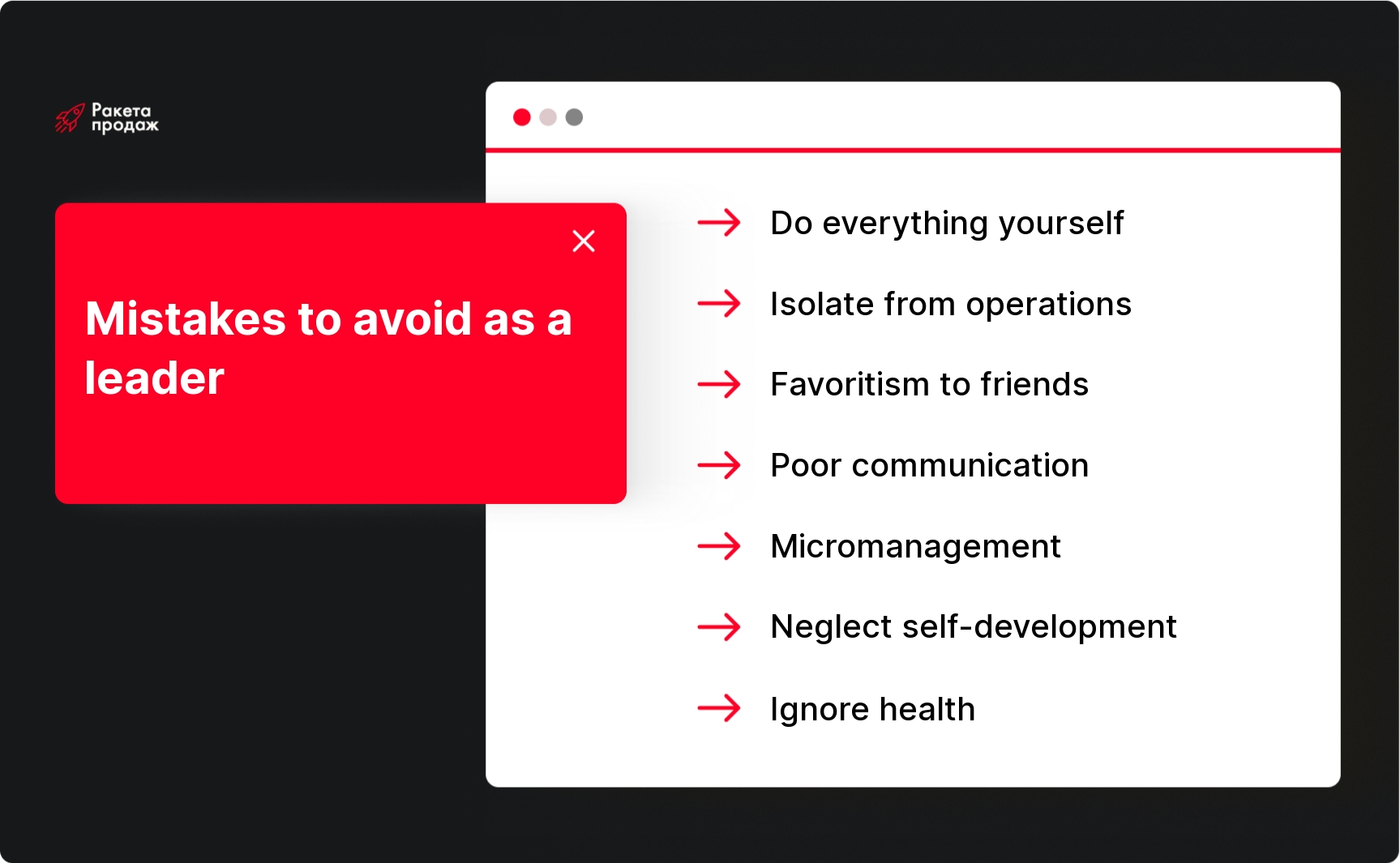
One of the most common mistakes is trying to do everything yourself. Many new leaders continue to perform sales manager duties, not delegating tasks to the team. This happens due to fear of losing control or distrust in subordinates’ abilities. As a result, the leader drowns in routine and cannot focus on strategic tasks. Remember that your effectiveness now is measured not by your personal sales, but by the results of the entire department.

The opposite extreme is equally dangerous – complete detachment from operational activities. New leaders sometimes interpret promotion as an opportunity to refuse “dirty work” and focus only on management. But a sales department leader should maintain a connection with reality: periodically participate in meetings with clients, listen to salespeople’s calls, analyze difficult cases together with the team. This helps maintain authority and better understand the problems the team faces.

A serious mistake is also unfair treatment of former colleagues. Many new leaders are either too strict with former friends (so that no one thinks about favoritism) or, conversely, give them privileges. Both approaches are destructive for team dynamics. It’s important to treat all team members equally fairly, evaluating them by real results and efforts.

Insufficient communication with the team is another common mistake. New leaders often don’t explain their decisions, don’t share information about company or department plans, don’t give enough feedback. This leads to uncertainty and anxiety in the team. Establish regular communication channels and be as transparent as possible in your decisions and expectations.

Many newcomers in the leadership role also fall into the trap of micromanagement. Uncertainty in their abilities or fear of failure leads to excessive control over every step of subordinates. This not only demotivates the team but also takes your time and energy. Trust your employees and control results, not the process.

Ignoring your own development is a mistake made even by experienced leaders. After reaching a leadership position, many believe they’ve “reached the finish line” and can stop learning. But it’s precisely in a leadership position that you’ll need new skills: conflict management, strategic planning, budgeting, coaching. Invest in your development through books, courses, mentoring.

Finally, a serious mistake is neglecting your physical and mental health. New leaders often work overtime, skip lunches, refuse vacations, are constantly available by phone. This is a direct path to burnout, which will negatively affect not only you but the entire team. Set healthy boundaries between work and personal life, find time for rest and recovery.

Remember that all these mistakes are correctable if you realize them in time. Regular reflection and openness to feedback will help you identify problems at early stages and adjust your approach to management.

Conclusion

The transition from manager to sales department leader is not just a new line in your resume, but a fundamental transformation of your professional identity. You’ll have to not only change your approach to work but also restructure relationships with former colleagues, find a balance between strictness and support, learn to think strategically and make difficult decisions. It’s a path full of challenges, but with the right approach, it opens up enormous opportunities for your professional and personal growth.

Remember that the key to success in your new role is your willingness to learn and change. Leadership is a skill that develops with practice. Don’t be afraid to make mistakes, but learn from them. Be open to feedback from the team and senior management. Invest in your development and the development of your team. And most importantly – maintain authenticity. The best leaders don’t try to copy others’ management styles; they find their unique path based on their values, strengths, and understanding of the team’s needs.

Transitioning from manager to sales department leader is not just a job change, but a complete transformation of your professional thinking and team relationships. Instead of trying to handle this challenge on your own, trust the experts at “Rocket Sales” who have helped build 187 effective sales departments across 14+ industries. Our team provides comprehensive support: from developing an individual adaptation plan for the leader to implementing a quality control system for the entire department. We’ll help you develop checklists for evaluating managers’ work, create transparent standards and motivational models, as well as provide constant methodological support. “Rocket Sales” clients note an average revenue growth of 35%, increased conversion rates up to 86%, and significant reduction in time spent on employee monitoring. Instead of months of trial and error, get a proven system that works.

Become an effective leader and increase department performance by 35% in 4 months - order the implementation of a sales management system!
In this article:
See more
Book a FREE sales funnel audit
CONTACT US
FAQ
How to become an authority for former colleagues after promotion?

To build authority, it’s important to be consistent in your decisions, treat all team members fairly, demonstrate professional competence and emotional intelligence. Have open conversations with each employee, set clear expectations, and lead by example. Don’t be afraid to admit mistakes and ask for advice from the team in matters where they are more competent than you.

How to avoid conflict with former colleagues after promotion?

Conflict prevention begins with open communication. Discuss changes in your role and what this means for relationships. Establish clear work rules and follow them consistently. Be fair and don’t give reasons for accusations of favoritism. If conflict still arises, resolve it quickly and directly, not allowing it to grow.

What are the main difficulties when transitioning from sales manager to leader?

The main difficulties include changing relationships with former colleagues, the need to make unpopular decisions, expanding the area of responsibility, transitioning from tactical to strategic thinking, and managing your time. Many new leaders also face the problem of balancing between control and delegation and experience “impostor syndrome.”

How to manage a sales team after transitioning to leadership?

Effective team management requires establishing clear KPIs and expectations, creating a transparent motivation system, regular communication, an individual approach to each employee, and creating a positive work atmosphere. It’s also important to build effective work processes and pay special attention to developing and retaining top salespeople. Don’t forget to regularly analyze results and adjust your approach.

SUBSCRIBE TO MY TELEGRAM CHANNEL
The most valuable sales information right on your phone!
icon

LOTS OF USEFUL INFORMATION, FREE TEMPLATES, AND CHECKLISTS ON MY INSTAGRAM

Materials and practical advice on sales growth in our blog: