Key Takeaways
- Reporting without connection to motivation turns KPIs into an abstraction, with managers not seeing how their actions affect numbers and bonuses.
- A weak system only records closed deals and provokes funnel neglect, while a strong one tracks conversion at each stage and shows where leads are lost.
- A manager who sees their own results in real-time stops being an object of control and starts managing their own metrics.
- Unrealistic targets kill motivation faster than lack of bonuses, while stimulating only volume results in zero-margin sales.
- Visualization of reports (dashboards, graphs, month-end forecasts) works on an emotional level and motivates better than tables and meetings.
In the article below, you’ll see how to build a transparent reporting system, which metrics stimulate the right behavior, and how to avoid mistakes that turn KPIs into fiction. Read on 👇
A transparent motivation system in sales is not a control tool. It’s the foundation of a fair game where everyone sees the rules, understands their score, and knows what they’ll get for results. This article is for sales managers, commercial directors, and business owners who want to transform chaos into a system. We’ll examine how to connect numbers in reports with real team motivation, why KPIs without reporting are fiction, and how to make managers want to fill out CRM themselves.
The Role of Reporting in Sales Managers' Motivation System
Reporting isn’t bureaucracy invented to annoy managers. It’s the foundation of how any KPI-driven motivation in sales works. Without clear numbers, you can’t objectively assess who’s working toward results and who’s just talking nicely in meetings. When every call, meeting, and closed deal is recorded in the system, you get transparency. Managers see that they’re evaluated based on facts, not sympathies. This creates a sense of fairness-the foundation of healthy motivation.
The difference between reporting for a manager and for a salesperson is fundamental. A manager needs aggregated data: overall plan, sales funnel, weekly dynamics. A salesperson cares about personal metrics, progress toward goals, understanding how much more is needed for a bonus. A good reporting system provides both levels of detail. When a manager opens a dashboard and immediately sees their results relative to the plan, they understand what depends on them. This changes behavior: instead of formally completing tasks, there’s a focus on results.
Reporting influences behavior more than you think. If only closed deals are recorded, managers will ignore funnel work. If you track call quantity but not quality, you’ll get a hundred meaningless calls per day. Properly structured reporting to improve sales team performance shows not only the final result but also the path to it: how many meetings turned into proposals, what’s the conversion at each stage, where leads are lost. This gives managers understanding of what to work on, and leaders insight into where to improve processes or conduct training. Ukrainian companies often forget this aspect: they collect figures but don’t use them to correct actions, and reporting becomes deadweight.
If you’re just planning to automate performance tracking, pay attention to the benefits of implementing a CRM system for sales – such systems help collect and analyze data, and integrate reporting into work processes with minimal resistance from the team.
How to Use Reports for Motivation, Not Pressure
Control and management through numbers are not synonymous. Control is when you demand daily reports on calls made and yell if quotas aren’t met. Management is when a manager sees their own metrics and understands what needs to change. The former creates an atmosphere of distrust, the latter a culture of responsibility. The difference is in approach: reporting should help managers control their results, not become a tool for pressure from above. The question of “how to use reports for motivation” requires a paradigm shift: from control to support.
Report visualization plays a huge role in engagement. When a manager sees not a table with numbers, but a beautiful dashboard with graphs, dynamics, and month-end forecasts-it works on an emotional level. They see progress, understand that a little more effort will reach the bonus level. This motivates stronger than any meeting. Ukrainian companies often use simple solutions: Excel with conditional formatting, free CRM systems with basic dashboards. The key is that information is available to the manager in real-time, not arriving once a month as a summary from the supervisor.
The principle “the manager sees their own result” is critically important. When a person doesn’t depend on what the boss tells them, but can access the system themselves and check their metrics-this changes the power dynamic. The manager stops being an object of control and becomes a subject managing their own results. They see that they need three more deals worth 50 thousand hryvnias to fulfill the plan, and understand they need to push current negotiations or make five more calls to potential clients. This is self-motivation in its purest form.
The regularity and format of reporting should match sales specifics. For fast transactional sales, daily reporting works-figures change quickly, and it’s important to keep a finger on the pulse. For long sales cycles, typical for the business traveler segment, weekly reports focusing on funnel movement are sufficient. It’s important not to overload managers: if reporting takes more than thirty minutes per day, it becomes a burden. Automation through CRM solves this problem-the system collects data from manager actions, and they only need to check correctness. This way, reporting becomes a natural part of the work, not an additional load.
Connection Between Reporting, Motivation System, and Sales Planning
A KPI-based motivation system only works when managers see a direct link between their actions, reporting metrics, and money in their accounts. If this chain is broken, motivation becomes a lottery. Sales planning, reporting, and motivational schemes must be tightly linked. A manager knows their monthly plan, sees current progress in reports, understands what bonus they’ll receive upon plan completion. When all three elements work synchronously, predictability emerges-the basis of calm and productivity. That’s why a motivation system based on KPIs requires not just setting target indicators, but also regular, understandable reporting that makes progress visible to each team member.
Creating a competent KPI system for salespeople is no easy task. It’s important to choose metrics and correctly “embed” them in the motivational scheme. If you’re still forming your approach, familiarize yourself with recommendations on sales department KPIs to reduce startup errors and make the system motivating, not formal.
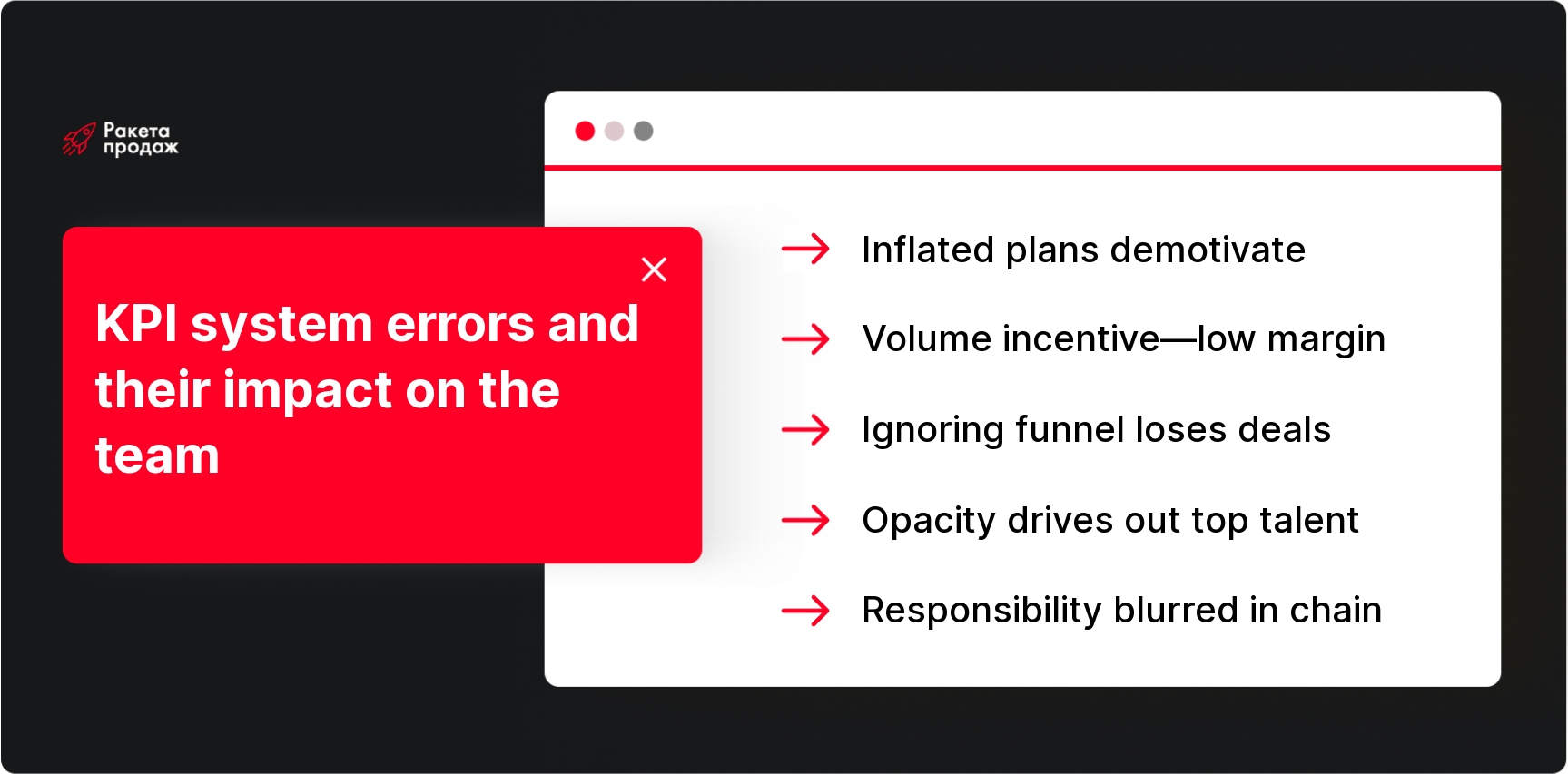
Common risks of incorrect goal setting kill motivation faster than lack of bonuses. Unrealistic plans that are physically impossible to fulfill lead to burnout and turnover. A manager understands that no matter how hard they try, the plan is unattainable, and stops trying. Low targets create a comfort zone: meet the minimum, get a basic bonus, then relax. Stimulating the wrong indicators is classic: if you pay only for volume, you’ll get zero-margin sales. If you incentivize meeting quantity, managers will run to meaningless meetings instead of working with real leads. Motivation using the KPI system should show a balanced set of metrics: volume, margin, conversion, lead quality. Then motivation stimulates the right behavior.
Responsibility dilution occurs when it’s unclear in the reporting system who is responsible for what. If a deal passes through several managers, but only the last one who closed it gets a bonus-the first links in the chain become demotivated. A KPI-driven motivation system must account for each participant’s contribution. Transparent reporting records everyone’s input: who attracted the lead, who qualified it, who conducted the presentation, who closed. Modern CRM systems allow distributing bonuses proportionally to contribution, which is fair and motivates the entire sales chain.
How many management decisions per month do you make based on inaccurate data? Can you build an effective motivation system without a clear picture of each manager’s results? Statistics show that 70% of leaders struggle with objectively evaluating their salespeople’s work due to lack of transparent reporting. At “Rocket Sales,” we’ve created a comprehensive methodology for building a KPI-based motivation system that transforms chaos into a manageable business process. Our experts conduct a deep analysis of current processes, develop a clear sales funnel, and implement a daily reporting system that automatically connects with team motivation. Over 6+ years, we’ve built more than 150 effective sales departments across 14+ different niches. The average revenue increase for our clients is +35%, with the best result being +$1.6 million in 4 months of work.
Transform reporting from bureaucracy into a sales growth tool-get a free motivation system consultation right now!
A good foundation for initial analysis of your internal system would be a sales department audit for growth, which will help identify hidden “holes” in reporting and motivation before major changes.
How Reporting Improves Sales Team Performance in the Long Term
Increased manager independence is the first thing proper reporting provides. When someone sees their figures, analyzes what works and what doesn’t, they learn to manage their results without constant supervision from above. This is especially important for remote teams or distributed sales departments. A manager in Lviv or Odessa doesn’t need hourly calls from a Kyiv supervisor-they can see in their dashboard that three deals are stuck at the proposal stage and understand they need to push them through.
The transition from plan execution to result management is a qualitative leap. Instead of mechanically fulfilling activity standards, the manager begins to think strategically: which actions yield maximum returns, where are the bottlenecks in their funnel, how to increase the average check. Reporting provides data for such analysis. The manager sees that their meeting-to-deal conversion is above team average, but meeting quantity is low. Conclusion: need to work on the upper funnel, make more calls and schedule meetings, because they know how to close.
Building a culture of accountability for numbers happens gradually. When the team sees that decisions are made based on data, not subjective opinions, respect for numbers emerges. Managers stop justifying themselves with abstract reasons like “the market is bad” or “clients aren’t ready to buy.” They see a colleague who’s getting results in the same market and understand: it’s not about the market, it’s about actions. This creates healthy competition and a desire to grow.
Scalability of the motivation system is a critical factor for growing companies. When there are five managers in a department, a leader can keep everything in mind. With twenty-it’s impossible without a reporting system. A properly built system allows scaling business without losing manageability. A new manager joins the company, gets CRM access, sees their metrics and understands the rules of the game. They don’t need to wait until month-end to learn how they’re doing-the system provides feedback in real-time. This accelerates adaptation and reduces dependency on the leader’s personal control, which is especially important for the Ukrainian market, where many companies are actively growing and opening new regions.
For leaders, it’s important not to lose focus on their own effectiveness. Read about how to measure sales manager effectiveness – proper reporting and transparent processes not only improve manager performance but also give you quality management guidelines.
Sales reporting for efficiency improvement isn’t about Excel and bureaucracy. It’s about a fair game where everyone knows the rules, sees their score, and understands what they’ll get for results. Key principles of a working system: data transparency, connection between metrics and motivation, real-time information availability, focus on actionable metrics rather than collecting data for data’s sake. When reporting becomes a growth tool rather than control, managers stop resisting the system and start using it to manage their results. The business gains sales predictability, a fair motivation system, reduced staff turnover, and growing results without increased pressure on the team. The right combination of KPIs and motivation through transparent reporting gives you a manageable sales department that grows with the company.
The connection between reporting, KPIs, and motivation is not just management theory but a practical tool for growing your business. But implementing this system requires expertise, experience, and specialized tools. “Rocket Sales” offers a comprehensive solution: from auditing current processes to fully implementing a KPI-driven motivation system that works for results. Our experts develop individualized motivational programs considering your business specifics, automate routine tasks through CRM, and create transparent reporting understandable to both leaders and managers. We don’t just consult but build sales departments together with clients-our approach is based on mathematical models and deep analytics, not template solutions. Among our clients are companies like Mitsubishi, Yamaha, and INGVART, which increased revenue up to 218% in a short period by implementing our systems. Don’t waste time and money experimenting with ineffective motivational schemes.
Create a sales department where each manager sees their path to success-order a motivation system built by experts today!
If you want to learn more about creating incentives for your team, it’s useful to study modern approaches to sales department motivation that work successfully in the Ukrainian market.


 Time to read: 9 min.
 25 February 2026