Key Takeaways
- A manager fails at technical sales not because of weak negotiation skills, but because they were never taught to diagnose the client’s problem and translate specifications into business impact.
- Product complexity isn’t defined by price, but by the need for customization, integration with existing systems, and the high cost of a wrong decision.
- Your presentation should start with the client’s problem and their selection criteria, not with your company’s history and a list of every product feature.
- In B2B, the decision is almost always made by a group of people: the engineer looks at compatibility, the finance person at payback, and the manager at business outcomes and risks.
- A pilot project only moves the deal forward when there are clear success criteria, agreed timelines, and a specific next step defined after the test is completed.
In the article below, you’ll see what knowledge a manager needs before the first meeting, how to structure diagnostics and presentations, and which mistakes destroy client trust. Read the full article 👇
Technical sales are the sale of products, services, or solutions where the client cares not only about price and benefit, but also about a bunch of other details: technical specifications, compatibility with existing infrastructure, implementation timelines, risks, and operational requirements. In simple terms, you can’t just talk beautifully about the product and close the deal on charisma alone. The client asks questions that need to be answered specifically and to the point.
This includes industrial equipment, production materials, IT solutions, business SaaS products, engineering services, automation systems, complex medical and laboratory equipment, as well as B2B services that require implementation. Almost always, such deals are built around a link between three parties: the sales manager, the technical expert on the supplier’s side, and the client’s team that will use the solution. Without this connection, sales of complex solutions turn into a game of telephone, where the manager promises one thing, the engineers do another, and the client ends up unhappy with the result. Next, let’s look at which products are considered technically complex and why this matters for preparing a manager.
Does it sound familiar when a manager gets lost facing a client’s technical questions and falls back on listing specifications that mean nothing to the customer? Or when a deal falls through at the final stage because the team didn’t account for all the people involved in the approval process? This is a typical problem for 70% of sales departments when working with technically complex products. At Sales Rocket, over more than 8 years we’ve created a systematic methodology for training managers in the sales of complex solutions – from needs diagnostics to working with multiple decision-makers in a single deal. Our trainings include an in-depth analysis of real client cases, the development of personalized scripts tailored to the specifics of the technical product, and the implementation of a communication quality control system. Using our methodology, we’ve successfully trained 208 sales departments across 14+ different industries, including industrial equipment, IT solutions, and engineering services. The result? Our clients get managers who confidently negotiate with technical experts and consistently close complex B2B sales.
Turn your managers into technical sales experts with conversion growth of up to 86% - get a free sales department audit!
Which Products and Services Are Considered Complex
The complexity of a product is determined by far more than just its price. An expensive product can be simple to explain, while an inexpensive one may require hours of consultation due to integration nuances. That’s why the question of how to sell high-priced products doesn’t always overlap with the question of how to sell a complex product: price and complexity are different dimensions of the same deal. Key signs of complexity include: technical parameters that matter for the decision, the need for customization, integration with existing systems, user training, regulatory requirements, and a high cost of error when choosing.
Such products typically include manufacturing equipment and production lines, ERP and CRM systems, business SaaS platforms, engineering projects, consulting services, automation solutions, logistics systems, and industrial materials with specific characteristics. This category also includes services with multiple implementation stages, where the client pays not for a one-time delivery but for an entire process. Sales of complex services require a completely different kind of preparation from a manager than selling a standard off-the-shelf product. That’s why it’s worth looking next at what difficulties managers face when they have to sell something more serious than a set of easy-to-understand specifications.
Why It's Hard for a Manager to Sell a Technical Product
Most often, the problem isn’t that the manager is bad at selling in general. They may be great at building rapport and negotiating, but get lost when the client asks a technical question. The manager is afraid of looking incompetent, so they either retreat into generic phrases or, on the contrary, fall back on listing specifications that mean nothing to the client. They don’t understand the client’s industry, can’t explain how the product will fit into their processes, and can’t speak the same language as the client’s technical specialists.
The question of how to sell a technical product remains unanswered for such employees simply because they were never systematically taught how. Often the root of the problem is that the manager was handed a presentation, a price list, and wished good luck. They were never taught to diagnose the client’s task, select the right solution, and argue value with numbers and facts. This is a systemic training problem, not a lack of sales skills as such. B2B technical sales require a different knowledge foundation, and without it, even an experienced negotiator will stall in meetings with engineers and technical directors. Let’s look at what knowledge base a manager needs to feel confident in such a situation.
What a Manager Needs to Know Before Selling a Complex Product
A manager doesn’t have to be an engineer or understand the product at a developer’s level. But they do need to understand it deeply enough to have a substantive conversation and not get lost when the discussion moves into details. This is the foundation without which sales of complex products turn into a lottery: sometimes it works out, sometimes the client simply goes to whoever answered their questions more confidently.
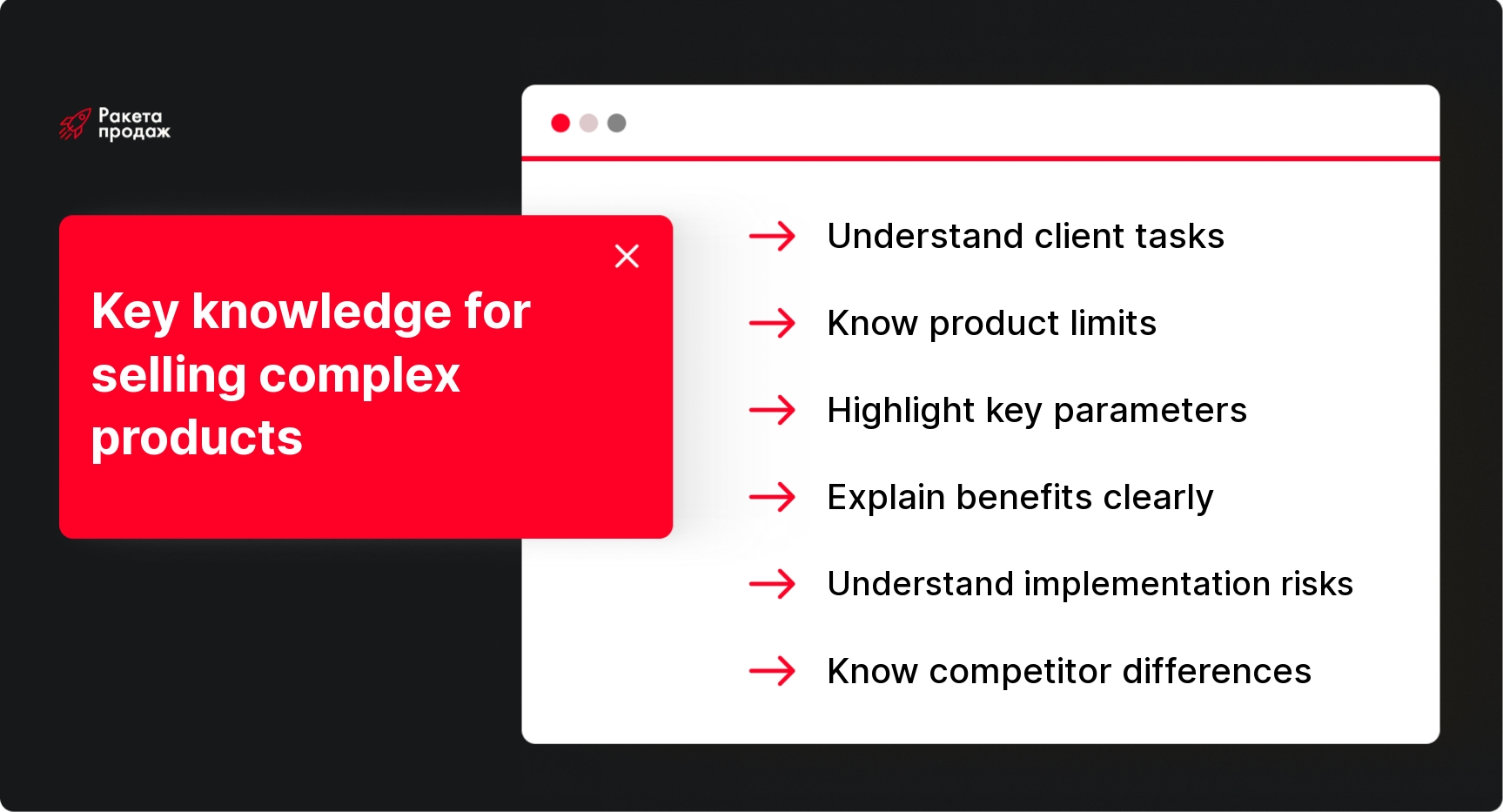
Here’s the minimum set of knowledge needed to negotiate on equal footing:
- how the product works and what client tasks it solves in practice, not just in presentation theory;
- who the solution is suitable for and who it isn’t, and what hard limitations exist for its application;
- which technical parameters actually matter to the client and which are secondary;
- how implementation or delivery works, how much time it takes, and what resources will be required from the client itself;
- what risks exist during implementation and how they’re minimized in practice;
- how the solution differs from market alternatives and how to calculate the economic effect of implementation.
It’s also worth learning the list of questions that the client’s technical specialists most often ask. This saves time in meetings and immediately builds trust: the client sees that they’re dealing not just with a salesperson with a presentation, but with someone who actually knows the subject. The next step is learning to translate all this technical knowledge into language that business understands.
How to Explain a Complex Product in Simple Terms
A good manager doesn’t overload the client with terminology, but translates specifications into business value. Equipment power, data processing speed, or integration depth don’t mean anything on their own to a company director. What matters to them is how it will affect productivity, whether it will save time, reduce the number of errors, and ultimately affect profit.
A simple formula works here: specification → what it means in practice → what client problem it solves → what effect it delivers in numbers or time. For example, “the system processes data 3 times faster” becomes “your employees spend just over an hour on reports instead of 4 hours, freeing up time for more important tasks.” This kind of translation works for any complex sales, whether it’s industrial equipment or a cloud automation service. Technical sales shouldn’t sound like an engineering lecture unless the client is a technical expert themselves. And to understand exactly which arguments a specific client needs, you first have to properly diagnose their situation.
Needs Diagnostics in Complex B2B Sales
This is arguably the central skill in technical sales of complex products. Before showing a presentation, a manager needs to properly identify the client’s needs: understand the current situation, what their problem is, what consequences it carries, what goals and limitations exist, what the budget and timeline are, who’s involved in the decision-making, and what alternatives the client is already considering.
A similar approach is described in the popular SPIN methodology, where the salesperson moves sequentially from situation questions to problem-implication questions, and only then discusses the benefits of the solution. This path helps the client formulate the value of change on their own, rather than hearing it from the salesperson. In practice, it’s useful to ask: what task the client wants to solve, how they’re solving it now, what dissatisfies them, what losses or risks they see, which requirements are mandatory for them, who will use the solution, and who needs to approve the purchase.
Without this kind of qualification, a sales manager is essentially selling blind: they offer a solution that does not match the client’s needs and then wonder why the deal falls through at the final stage. To prevent this systematically, it is important not only to teach managers how to conduct proper qualification, but also to build a clear sales process — from the first contact to closing the deal. Learn more about how to build a sales funnel in our dedicated guide.
How to Work with Multiple Decision-Makers in Technical Sales
In sales of technically complex products, the decision is almost always made by a group of people, not a single individual. The client’s team may include the product’s end user, an engineer, an IT specialist, a department head, a procurement officer, a finance person, and a lawyer, and sometimes even the business owner who has the final say. Each of them has their own interests and evaluation criteria.
A technical specialist will look at the parameters and compatibility with the existing infrastructure. Procurement cares about price and contract terms. The CFO wants to see the payback period and return on investment timeline. And the manager or owner primarily thinks about the business outcome and risks for the company as a whole. Arguments absolutely need to be adapted to the role of the person you’re talking to: the same presentation won’t work equally well for an engineer and a CFO. That’s why experienced managers prepare different versions of the same offer for different audiences within the client’s company. And this is where the supplier’s technical expert often comes to the rescue – a role worth discussing separately.
The Role of a Technical Expert in Selling a Complex Product
A manager doesn’t need to, and shouldn’t, pretend to be an expert where truly deep technical consultation is required. It’s much smarter to bring in an engineer, product manager, presales specialist, or implementation expert at the right time, someone who can answer complex questions accurately and without guesswork. The manager’s role changes at this point: they manage the deal, ask questions, record the client’s needs, and organize proper interaction between the technical teams on both sides.
The tandem of a sales manager and a technical expert works better than one person trying to cover all the roles at once. The client sees that the company is taking the deal seriously, rather than trying to push a solution without proper preparation. This is especially noticeable in projects related to digital business transformation, where the stakes of an error are high and decisions affect processes for years to come. This kind of coordinated work reduces the risk of implementation errors and noticeably increases the client’s trust in the supplier overall. But for a manager to even know when and whom to bring in, they need to be systematically trained in product expertise.
How to Train a Manager in Product Expertise
Training a manager for complex sales shouldn’t come down to a one-time webinar in the first week on the job – quality onboarding of sales department employees lays the foundation for further growth of expertise. With complex products, expertise builds gradually, through practice and regular analysis of real situations. Companies that systematically invest in this kind of training get a team capable of negotiating at the same high quality regardless of which specific manager is handling the deal.
A working training system usually includes several elements:
- product trainings and breakdowns of technical specifications in plain language, without overloading on terminology;
- a map of typical client tasks and a database of frequently asked questions from meetings;
- a comparison of the product with market alternatives and analysis of real won and lost deals;
- practice explaining the product in simple terms and meetings with the company’s technical specialists;
- shadowing more experienced colleagues on demos and consultations, plus periodic knowledge testing.
It’s also worth including a training on working with difficult clients, which teaches how to handle conflict situations and tough negotiators, as well as time management for a sales manager, so they can effectively allocate time across several long deals at once. Training materials need to be updated with every product change, otherwise the team will start working with outdated data and lose the client’s trust. Once the knowledge base is built, the next step is learning to turn that knowledge into a compelling presentation.
How to Build a Presentation for a Complex Product
A presentation of a technically complex product shouldn’t start with a story about the company and its history. This isn’t particularly interesting to the client at the start of the conversation. It’s far more effective to start with their problem and the criteria they use to choose a solution, and only then move on to the product.
A sensible structure looks like this: the client’s problem, its consequences, the requirements for a solution, the proposed product, how it works, why this particular solution fits, the expected effect in numbers, limitations and honest caveats, implementation stages, examples of similar cases, and a clear next step. It’s important not to dump all the product’s capabilities on the client at once, but to show exactly what matters for their specific situation. Sales of complex solutions are built on relevance, not on the volume of information. Even the most precise presentation won’t save the deal if the manager isn’t ready to properly handle objections, and in this kind of selling they’re practically inevitable.
How to Handle Objections in Technical Sales
Objections in complex sales aren’t a battle – they’re part of the normal process of getting a decision approved within the client’s company. The manager’s job isn’t to push their own opinion, but to understand the reason behind the objection and respond to it specifically, based on facts.
Typical objections include the following:
- it’s too expensive, or too hard to implement, or we already have a supplier we’ve worked with for years;
- we’re not sure the solution will suit our specific processes and business scale;
- there’s no budget this quarter, or we’re afraid of the risks of switching to a new system;
- we need to get approval from the technical department, and that’s a long internal process;
- we don’t see the payback, or competitors are offering a lower price.
The right approach: first clarify the real reason behind the objection, understand the role of the person voicing it, and separate technical doubts from financial or organizational ones. Next, provide an argument tailored to that specific client’s criteria, bring in a technical expert if needed, or offer a pilot, an efficiency calculation, or a demonstration. By the way, pilots and demonstrations deserve a separate discussion, because they’re a powerful tool for resolving doubts in complex sales.
How to Use a Pilot, Test, or Demo in a Sale
When selling a complex product, the client often wants to test the solution in practice before signing a contract for a serious amount in euros or dollars. This could be a test batch of material, a live equipment demonstration, a pilot project covering part of the processes, an audit of the current situation, an efficiency calculation, or a full-scale proof of concept.
For a pilot to actually move the deal forward instead of turning into an endless free trial, it needs clear success criteria. It’s worth agreeing in advance on exactly what’s being tested, who on the client’s side will evaluate the result, how long the test lasts, what data is collected in the process, and exactly what the next step will be after a successful completion. If these things aren’t agreed on upfront, the pilot easily turns into a drawn-out process with no clear ending and no deal in the end. To make it easier for a manager to negotiate such conditions and run the entire sales process, they need a set of working materials at hand.
What Materials a Manager Needs to Sell a Complex Product
Well-organized sales enablement saves the manager hours of work and makes sales predictable, rather than dependent on one person’s talent. Materials should answer clients’ real questions and help managers quickly prepare for meetings of varying complexity.
The basic set usually includes the following materials:
- product cards and technical specifications, plus an FAQ with answers to common client questions;
- a map of industry-specific tasks and a comparison of the product with market alternatives;
- real implementation case studies, an economic benefit calculator, and a commercial proposal template;
- presentations adapted to different roles within the client’s company, from engineer to CFO;
- a diagnostic checklist, ready-made consultation scripts, and a structured objection database;
- a description of implementation stages and clear instructions on when and how to bring in a technical expert.
Such materials speed up the onboarding of new managers and help the whole team sell complex solutions at roughly the same level of quality, regardless of any individual employee’s experience. Even with good materials, the team will still make mistakes, and it’s worth discussing the most common ones separately.
Common Mistakes Managers Make in Selling Complex Products
In technical sales, a manager’s mistake can cost not just a specific deal, but the company’s reputation for years to come. Clients in this segment often talk to each other and share their experience working with suppliers, especially when it comes to expensive and complex solutions.
The most common mistakes look like this:
- the manager memorized the product’s specifications but never got to grips with the client’s real task and industry;
- moving to the product presentation too early, skipping the proper diagnostic stage;
- speaking in technical terms without explaining what benefit it brings to the client’s business;
- failing to identify all the people involved in the approval process and losing the deal at a stage they didn’t even know existed;
- selling price instead of value, promising things the product objectively can’t deliver, and not bringing in a technical expert when it’s genuinely needed;
- not recording the client’s requirements in the CRM, not managing the next step, and mistaking a long approval process for a hidden refusal, when it’s often just a normal workflow on the client’s side.
These mistakes rarely happen out of malicious intent. Usually they’re the result of a manager never being taught to systematically work with a complex product from the very beginning.
Training managers in technical sales isn’t a one-time lecture on product specifications – it’s a systematic process of building expertise that requires a professional approach and deep understanding of B2B deal specifics. By applying the principles described in this article, you can significantly improve your team’s performance, but to guarantee results, it’s worth trusting the experts. Sales Rocket builds sales systems that let managers confidently work with even the most complex technical solutions. Our methodology includes personal trainings with analysis of real cases, developing diagnostic scripts tailored to your specifics, implementing sales playbooks, and communication quality control systems. We train teams to work with multiple decision-makers, present technical advantages properly in the language of business, and handle complex objections skillfully. Over 8+ years in business, our clients have achieved an average revenue growth of +35%, with the best result being +$10,907,403 in 4 months. Our partners include companies like Mitsubishi, Yamaha, and Naftogaz. Don’t waste months experimenting with uncertain outcomes while your managers keep getting stuck on clients’ technical questions.
Build a team that professionally sells any technical product with conversion growth of up to 86%!
For a manager to successfully sell technically complex products, they need to be taught not only call scripts, but also product logic, the client’s industry, proper diagnostics, argumentation in the language of business, and the economics of the solution. Technical sales of complex products are built on trust, and trust arises when a manager knows the subject and speaks honestly about limitations, not just advantages. This kind of trust later opens up opportunities for upsell and cross-sell strategies, when the client is ready to expand cooperation without lengthy repeated approvals. The more complex the product, the more important systematic team preparation and a well-coordinated link between the salesperson, the technical expert, and the sales manager become. It’s this connection, not a single talented negotiator, that ultimately brings the company large, long-term contracts.


 Time to read: 9 min.
 10 August 2026