Key Takeaways
- A real estate agency doesn’t lose clients because of weak marketing – it loses them due to slow lead processing. Every minute of delay reduces conversion, since the client is reaching out to several agencies at the same time.
- Randomly hiring “star” realtors without unified standards makes results unpredictable. Strong agencies build a real estate sales department system with a clear funnel, CRM, scripts, and viewing control, rather than relying on the personal effectiveness of individual salespeople.
- Your CRM should record not just closed deals, but also reasons for rejection, viewing results, and how up-to-date your property database is. Without this, you won’t see where you’re losing money – in qualification, matching properties, or follow-up.
- Weak agencies only look at the number of deals closed; strong ones monitor the intermediate stages of the funnel – speed of first contact, percentage of scheduled viewings, viewing-to-deal conversion, and the quality of work with property owners.
- Sales growth doesn’t start with a bigger ad budget – it starts with optimizing the system: speeding up request processing, standardizing consultations, developing exclusive listings, and regularly analyzing channel performance.
Below, you’ll find a step-by-step algorithm for building a real estate agency’s sales department: from auditing current processes to setting up the funnel, CRM, and a results management system 👇
When people search for “sales department of a real estate agency,” they often just mean a regular team of realtors. But for stable results, an agency needs a full-fledged system: role distribution, unified work standards, CRM, a transparent funnel, analytics, and regular management of the team.
Building a real estate sales department from scratch isn’t about randomly gathering agents with a promise of “you’ll earn a lot.” You need a system: a clear structure of roles, CRM implementation for process control, standards for working with clients, a transparent sales funnel, tight lead control, a staff training program, a motivation scheme, and daily results management. Building a sales team isn’t just about hiring – it’s about clearly defining responsibilities, distributing accountability, and establishing communication between everyone involved in the process.
Only this way can an agency compete with major players and steadily grow its revenue.
Where to Start When Building a Real Estate Sales Department From Scratch
You need to start with the agency’s business model, not with searching for “star” salespeople. First, determine: are you working with purchases, sales, rentals, commercial real estate, or investments? Who is your target client – young families, investors, relocators, or corporate tenants? Which properties are a priority in terms of location and price segment? How is commission structured, and what average check are you aiming for?
Next, analyze the economics: how many leads you need to hit your monthly plan, which sales channels deliver quality requests, how many viewings turn into a deal, and what stages a client goes through from the first call to signing the contract. Determine whether you have your own property database or only work with other people’s listings, how you attract property owners, and what conversion rate each lead source shows.
Only after this can you plan the team structure and roles: do you need a dedicated lead manager for initial request processing, how many managers you’ll need for handling viewings, and who will work with owners and partners. Building a real estate agency’s sales department starts with the sales model and economic calculations, not with hiring realtors on gut feeling.
Does it sound familiar – agents working like separate “entrepreneurs,” with the sales department looking more like a chaotic cluster of realtors, each running their own process differently? In real estate, this approach is especially painful – clients reach out to several agencies at once, the deal cycle stretches out over months, and one missed opportunity can cost tens of thousands of dollars in commission. At Sales Rocket, over 8+ years of work, we’ve created a systematic approach to building sales departments specifically for real estate agencies. Our methodology accounts for the specifics of working with buyers and owners, long decision-making cycles, the need for instant lead response, and viewing management. Using our processes, we’ve built 208 sales departments across various industries, including real estate. The result? Clients get sales departments that consistently generate an average revenue increase of +35%, with teams working like a well-oiled machine instead of a bunch of separate agents.
Turn chaos into a systematic real estate sales department - get a free performance audit!
Auditing Your Real Estate Agency's Current Sales Department
If your real estate agency’s sales department already exists but sales are unstable, run a comprehensive audit of all processes. Analyze your lead sources: which channels bring in more requests, which bring quality clients, and which just “eat up” the ad budget with no results. Check the speed of request processing: how much time passes from receiving a lead to the first call, how many call attempts a manager makes, and whether missed calls are logged in the CRM.
Assess the quality of the initial consultation: can agents identify the client’s real needs, qualify requests by budget and timeline, and present properties in line with the buyer’s motivation? Check how the property database is handled: are prices and statuses up to date, how quickly are matching options found, and are there any exclusive listings? Look at how the agency interacts with owners: how they find the agency, what contracts they sign, and how many properties come from repeat clients.
Take a detailed look at the CRM: do managers fill out client cards, log funnel stages, note reasons for rejection, and track the number of viewings and viewing-to-deal conversion? Check how repeat touchpoints, referrals, and analytics by agent and area are handled. A sales funnel analysis will show where the agency is losing money – in marketing, lead processing, consultation quality, a weak property database, poor follow-up, or a lack of managerial control.
Building the Team: Hiring and Organizing Sales Managers' Work
A real estate agency’s sales department should be built on a clear distribution of roles, unified client-handling standards, and clear accountability for each employee at their stage of the funnel.
When selecting managers, evaluate not just sales experience but also knowledge of the real estate market, the ability to build long-term client relationships, and stress resilience when dealing with large sums of money and buyers’ complicated life situations. A good realtor should understand the legal aspects of deals, know how to handle objections around safety and finances, and follow CRM and communication standards.
Clearly define the roles on the team: the lead manager handles initial requests and qualifies clients, sales managers run viewings and close deals, the owner-relations specialist grows the property database, and the department head oversees processes and results. Each role should have clear areas of responsibility, KPIs, and a motivation system tied to both closed deals and the quality of work at the intermediate stages of the funnel.
Building a sales team isn’t just about hiring – it’s about clearly defining duties, distributing responsibility, and establishing communication between everyone involved in the process.
The training system covers the product and market, legal nuances, sales techniques, service standards, and CRM work. Newcomers go through onboarding with a mentor, study scripts and objection-handling guides, and take part in role-playing exercises and call recording reviews. Regular assessments and certifications keep the team’s professional level up and allow you to objectively evaluate whether managers are ready to work with different types of clients.
How to Build a Real Estate Agency's Sales Funnel
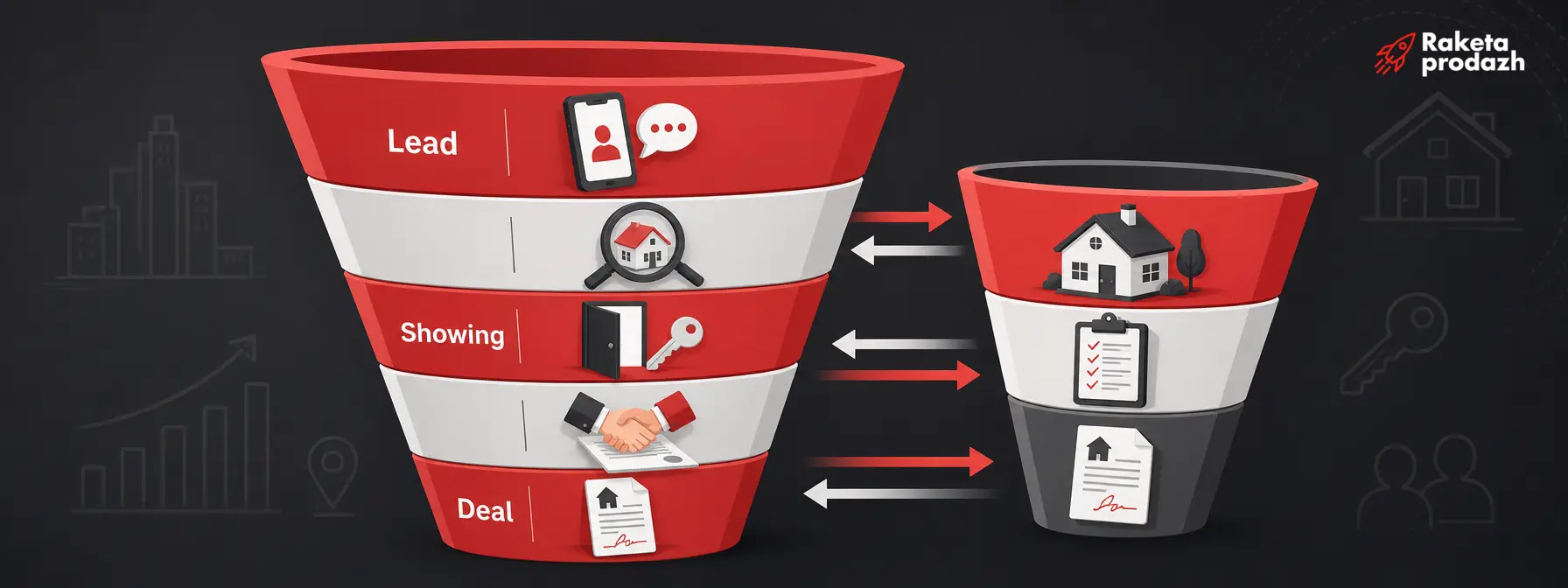
The sales funnel for buyer clients includes several key stages. A new lead comes in from advertising, the website, or referrals and requires initial contact within the first few minutes. During the qualification stage, the manager finds out the budget, location, property type, purchase timeline, and the client’s motivation. Once suitable options are selected, a viewing is scheduled – a critically important stage where the fate of the deal is decided.
After the viewing, there’s a follow-up contact to address doubts and objections, then negotiations on terms. Successful negotiations lead to a deposit, reservation, or preliminary agreement, after which document preparation and final deal processing begin. Once the deal closes, the client becomes a source of referrals and repeat sales, while some clients move into a “deferred demand” status for future follow-up.
For property owners, the funnel looks different: initial contact with the owner, property valuation and market analysis, a meeting to discuss terms, and signing an agreement for representation or exclusive cooperation. Next comes preparing the property for sale, creating marketing materials, publishing listings on platforms, arranging viewings for potential buyers, negotiations, and deal support.
A real estate agency sales system needs to account for both funnels and where they intersect: one manager can work with both buyers and sellers, using the client base for cross-selling and building partnerships with owners of exclusive properties.
How to Set Up Inbound Lead Processing at a Real Estate Agency
The speed and quality of request processing determine how competitive an agency is in the fight for clients. Leads come in from the agency’s website, real estate portals, social media, ad campaigns, messengers, calls, referrals, and partner programs. Every lead should immediately go into the CRM with the source, the client’s request, preliminary budget, desired location, property type, purchase or rental timeline, and the assigned agent.
In real estate, clients often submit requests to several agencies at the same time, so a slow response or a poor-quality consultation immediately reduces the chances of closing a deal. Processing standard: call within 5–15 minutes of receiving the request, at least three call attempts at different times, logging the result of every contact in the CRM, and sending extra information via WhatsApp or Telegram.
A quality initial consultation includes identifying real needs, qualifying by budget and timeline, offering 2-3 matching options, and scheduling a viewing or an office meeting. If the client isn’t ready to decide right away, they’re moved to a “warm” status with a plan for regular touchpoints every 1-2 weeks until their need becomes active.
Automation and Analytics Tools: CRM, Call Tracking, and End-to-End Analytics
A CRM system is the heart of a modern real estate sales department. It brings together the client database, properties, communication history, tasks, and reporting in a single interface available to the whole team. Specialized real estate solutions, such as AmoCRM with industry-specific settings, Bitrix24, or niche CRMs, let you automatically publish listings on dozens of platforms, track lead sources, set up sales funnels, and monitor how managers complete their tasks.
Call tracking through services like Ringostat helps identify which ad campaigns and channels are driving calls, while end-to-end analytics connects marketing spend to closed deals. Google Tag Manager and similar tools provide detailed tracking of on-site user behavior, conversions, and landing page performance. Integrating these systems gives you the full picture – from an ad click all the way to signing the contract.
Automation frees up managers’ time through automatic lead distribution, task reminders, alerts about “hot” clients, message templates, and reports for management. In one case with a Ukrainian developer, implementing comprehensive automation increased revenue by 40% with the same number of managers – people stopped wasting time on routine work and focused on consultations and closing deals.
KPIs for a Real Estate Agency's Sales Department
The department’s effectiveness is measured by a set of metrics covering every stage of the funnel and every aspect of the work. First-contact speed should be a maximum of 15 minutes, the number of leads processed depends on each manager’s workload, and the percentage of qualified clients shows the quality of marketing channels. The number of matched properties and scheduled viewings reflects agent activity, while the show rate (the percentage of clients who actually show up for a viewing) reflects the quality of preliminary work.
Key metrics include lead-to-viewing conversion (norm 15-25%), viewing-to-deal conversion (norm 20-40%), the number of viewings per manager, the average commission amount, and the number of deals closed per month. For agencies working with owners, important metrics include the number of contracts with property owners, the number of exclusive listings, and the repeat inquiry rate from owners.
Additional KPIs: CRM data quality (the percentage of fields filled in on client cards), the number of repeat clients and referrals, the average deal cycle, and the percentage of leads that reach the viewing stage. For the department head, the main indicators are total revenue, ad campaign ROI, staff turnover, and average manager performance.
The KPI system should motivate not just closing deals, but also quality funnel work, growing the property database, and long-term relationships with the client base – all of which drive the agency’s sustainable growth.
How to Increase Sales at a Real Estate Agency
Sales growth comes from optimizing the whole system, not just increasing the ad budget. Speed up lead processing: every minute of delay reduces conversion, especially in a competitive environment. Improve client qualification with detailed needs-assessment scripts – this helps you avoid wasting time on unsuitable viewings. Actively grow your property database, especially exclusive listings that set you apart from competitors.
Strengthen your work with owners through partner programs, referrals from satisfied clients, and direct contact with owners of properties in desirable locations. Implement or optimize your CRM for full process control and to eliminate losses at any stage of the funnel. Standardize consultations with scripts, objection-handling guides, and regular staff training in modern sales techniques.
Track every viewing: record results, reasons for rejection, and plan follow-ups and repeat touchpoints in 1-2 weeks. Train agents in negotiation and objection handling – in real estate, clients often hesitate because of large sums of money and long-term commitments. Analyze lead source performance and shift the budget toward channels with better conversion.
Develop partnerships with developers, banks, lawyers, insurance companies, and other brokers for mutual referrals and to expand your client base. Establish regular management of a real estate agency’s sales department: weekly meetings, deal reviews, funnel analysis, and strategy adjustments based on current data.
Mistakes When Building a Real Estate Agency's Sales Department
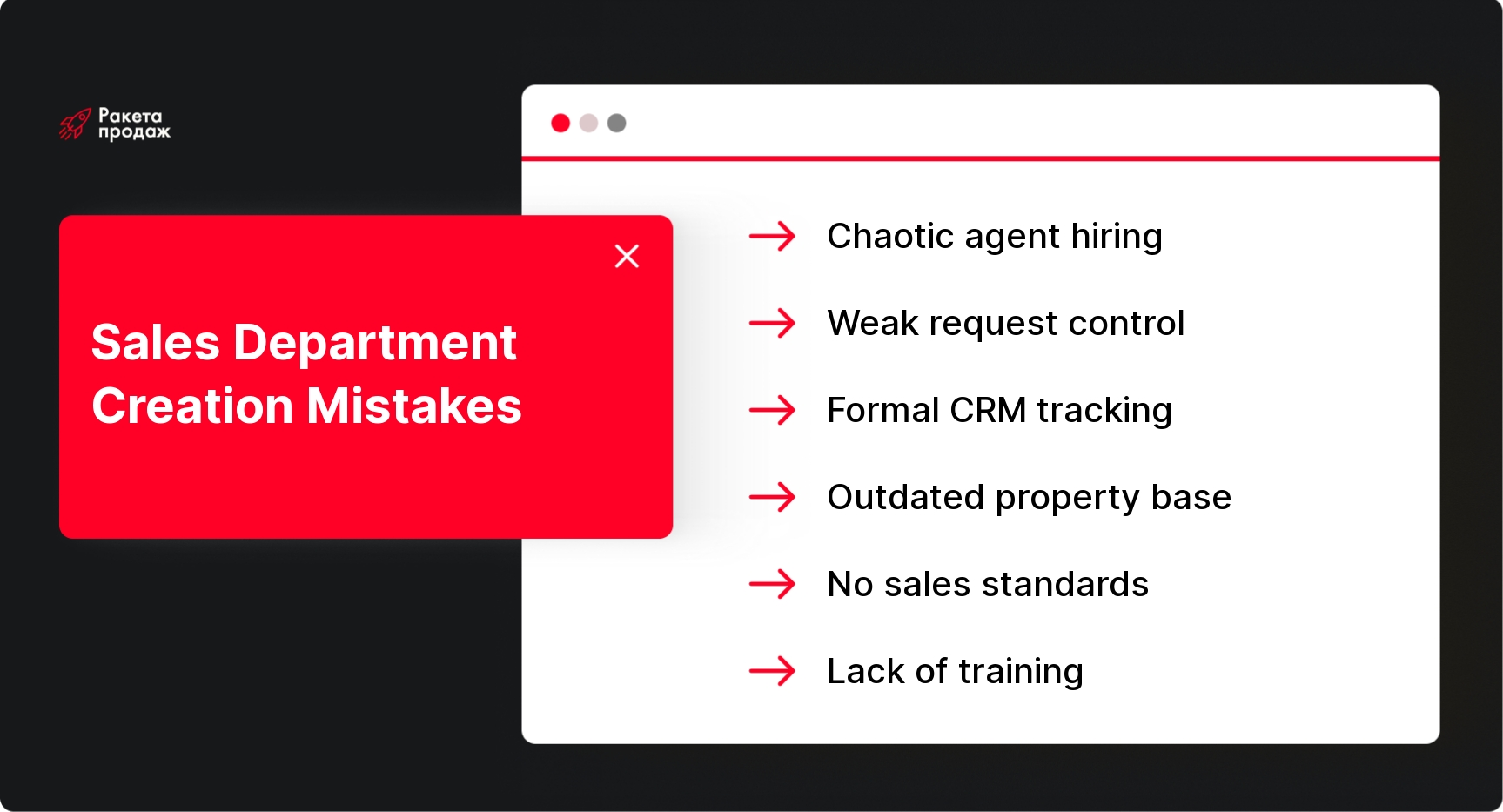
The most common mistake is hiring agents at random without a built-out sales system. Owners think it’s enough to find a few experienced realtors and give them “free rein,” but without unified standards and processes, the result is unpredictable. The CRM is either missing or maintained only on paper – managers fill in the bare minimum of fields, don’t log funnel stages or reasons for rejection, which makes analysis and optimization impossible.
Leads are distributed randomly or on a “first come, first served” basis, without accounting for managers’ specialization or current workload. There’s no control over how fast requests are processed – clients wait hours for the first call, which is critical in a competitive environment. The property database is out of date: outdated prices, apartments that have already sold, and dead contacts for owners – all of which undermines client trust in the agency.
There’s no systematic work with owners – each agent does their own thing, with no single contact database or interaction history. Viewings aren’t tracked: managers don’t record results, don’t plan follow-ups, and don’t analyze reasons for rejection. The manager only looks at the number of closed deals, ignoring the intermediate stages of the funnel where most client losses happen.
There’s no structured training or regular reviews – newcomers learn by trial and error, experienced agents work with outdated methods, and the team doesn’t develop or adapt to market changes. These mistakes get in the way of scaling and steady growth, even when you have quality leads and talented staff.
Building an effective real estate agency’s sales department isn’t just about hiring experienced realtors and buying a CRM. It’s a comprehensive system of processes, standards, training, and management that turns individual effort into predictable results. But building such a system requires a deep understanding of real estate specifics, experience across different market segments, and knowledge of modern automation tools. Sales Rocket specializes in building turnkey sales departments for real estate agencies: we audit current processes, build sales funnels tailored to working with buyers and owners, implement CRM systems that account for the specifics of real estate work, and train the team in effective consultation and negotiation techniques. Our methodology includes creating scripts for initial lead processing, standardizing how viewings are conducted, a motivation system for agents, and dashboards for management. Over 8+ years of work, our clients achieve an average revenue increase of +35%, with the best result reaching +$10,907,403 in 4 months. Our partners include major market players across various industries. Don’t spend months experimenting with an uncertain outcome.
Create a real estate sales department that runs like clockwork!
Building a real estate sales department from scratch is a complex task that requires a systematic approach – from a clear organizational structure of a real estate agency’s sales department and CRM to standardized processes, viewing management, work with owners, and constant results analytics. An agency’s success depends not only on the professionalism of individual realtors, but on how well all the elements of the real estate agency sales system work together. The sooner an agency builds sales as a well-oiled machine, the easier it is to scale the team, boost conversion, and reduce dependence on the personal effectiveness of individual “star” agents.


 Time to read: 9 min.
 31 July 2026