icon

How to Build a Sales Department for a Developer

Developers often underestimate the power of their own sales department, preferring to rely on agencies and random channels. But in reality, a well-structured sales team can become a genuine competitive advantage – especially when every lead is worth its weight in gold and clients compare dozens of projects. Imagine: while your competitor loses half their inquiries due to slow response times, your department processes them in minutes and guides the client from the first call all the way to the keys.

Want a high-performing sales team without the hassle?
We’ll build it for you.
Contact Us

Key Takeaways

  • Speed of first contact decides who gets the client: while a competitor loses leads due to slow response, your team should process inquiries within 1-2 minutes.
  • A manager who simultaneously handles cold calls, conducts showings, and closes paperwork loses effectiveness at every stage – strong departments are built on role specialization.
  • If 40% of clients are lost between the consultation and the scheduled showing, the problem isn’t the product – it’s objections the manager failed to address.
  • The funnel in the CRM should show exactly where clients are dropping off, not just record the number of leads and contracts.
  • Show rate (the share of people who attend the showing) tests whether a manager can qualify needs and build motivation before the meeting.

Below you’ll find specific funnel stages, consultation standards, automation rules, and KPIs for building a systematic sales department for a developer 👇

Building a real estate sales department for a developer isn’t just about hiring managers with impressive resumes. It’s about creating a system where every process is fine-tuned, technology works toward results, and the team knows how to turn interest into a reservation. For example, competent staff recruitment and onboarding helps quickly bring new managers up to high productivity and reduces turnover. Creating a developer’s sales department from scratch requires a comprehensive approach: from defining the structure to implementing automation. In this article, we’ll break down how to set up a sales department for a real estate developer: define the team structure, configure CRM processes, choose the right KPIs, and automate routine tasks so that sales become predictable and scalable.

Sounds familiar: managers work chaotically, leads get lost due to slow response times, and the CRM is a complete mess? Most developers face these problems when trying to create their own sales department. At “Sales Rocket,” over 8+ years of work, we’ve helped build 208 sales departments across 14+ industries, including construction and real estate. Our methodology includes a comprehensive audit of existing processes, creating specialized funnels tailored to real estate specifics, implementing CRM with lead processing automation, and a KPI system for developers. We don’t just consult – we completely rebuild processes: from organizational structure to automatic notifications about new inquiries. The result? Our clients get systems that process leads in minutes, not hours, and consistently convert interest into sales.

Turn chaos in your sales department into a well-oiled system - get a free audit of a developer's sales department today!

Organizational Structure of a Real Estate Sales Department

A developer’s sales department from scratch should be built not by searching for universal managers, but by defining functions, areas of responsibility, and stages of client interaction.

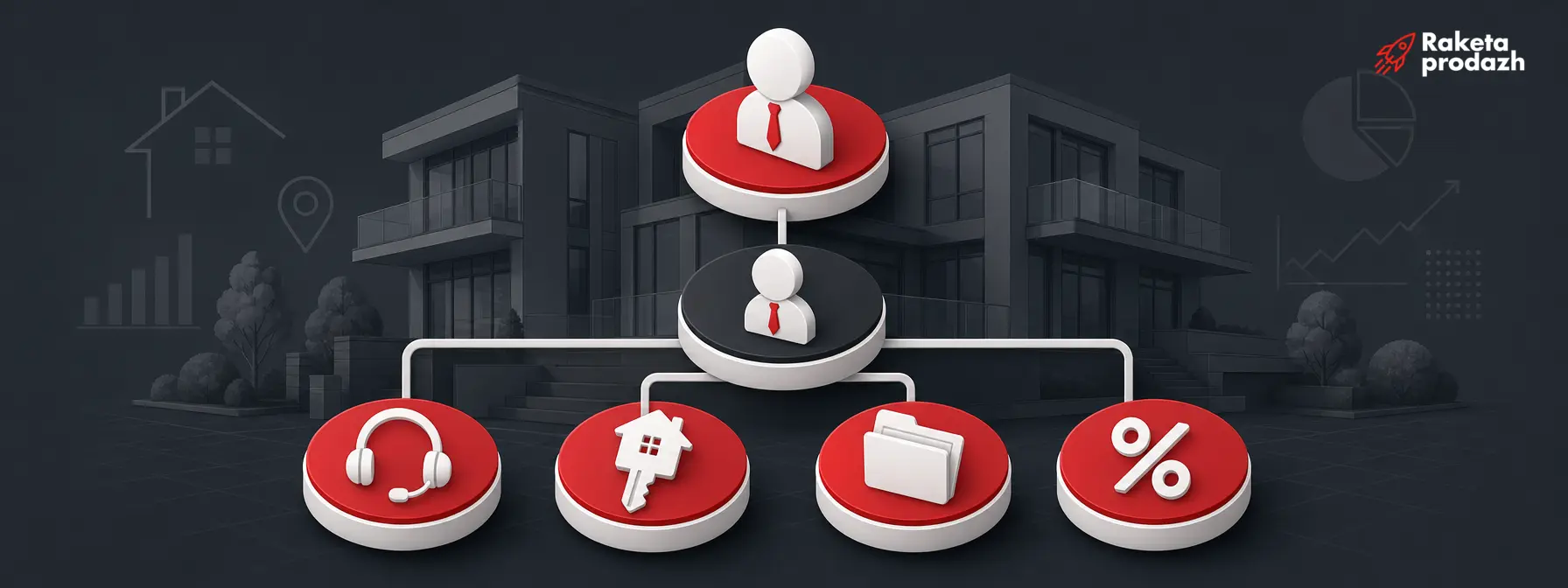
An effective structure of a developer’s sales department is built on the principle of dividing functions rather than relying on jacks-of-all-trades. In the initial setup, the team might consist of a commercial director or owner, a sales department head, and 2-3 managers. But as the company grows, it’s important to specialize roles: one person can’t equally handle cold leads, conduct showings, and manage paperwork.

Developing the structure is helped by practices of building an effective team structure, where each employee is responsible for strictly defined tasks and stages of client interaction. A mature department structure includes a sales department head, incoming lead managers, repeat-database specialists, and showing managers. Additional roles – a mortgage consultant, CRM administrator, analyst, and booking coordinator – appear once volume exceeds 200-300 apartments per year. This division allows each employee to develop expertise in their area and increases the overall funnel conversion.

The number of roles depends on the specifics of the business: if you have a single residential complex in Kyiv, a compact team is enough, but with several projects in different cities, you’ll need regional managers and specialists for working with partner agencies. The key principle is that the structure should reflect real client needs and operational volume, not copy someone else’s scheme. A properly built organization of a developer’s sales department becomes the foundation for implementing processes and technologies.

sales department organizational structure — Organizational structure of a real estate developer's sales department as a hierarchy diagram

Developer Sales Funnel: What Stages Should Be in the CRM

A real estate sales funnel should reflect the client’s actual journey from initial interest to getting the keys. The standard logic includes stages: new lead, initial contact, qualification, property selection, consultation, scheduled showing, completed showing, follow-up contact, reservation, document preparation, contract, payment. “Rejected” and “deferred demand” statuses are tracked separately with detailed reasons.

The stages should be detailed enough for the manager to see where clients are being lost, but not so complex that sales reps spend more time filling out the CRM than talking to clients. For example, if 40% of leads are lost between the “consultation” and “scheduled showing” stages, it means you need to work on objection handling or change your approach to property presentation. Using quality control in sales allows you to promptly identify problems at funnel stages and adjust your work strategy.

Reasons for rejection should be standardized: price, location, completion dates, layout, mortgage issues, chose a competitor, no decision yet, couldn’t reach them. This level of detail helps you understand which aspects of the product or service need improvement. A properly configured funnel isn’t just a control tool – it’s also the foundation for sales forecasting and marketing budget planning.

How to Set Up Incoming Lead Processing

Speed of first contact in real estate is everything. A client who left a request on your website most likely did the same thing with your competitors. Whoever reaches out first gets the chance to present. The incoming lead processing system should ensure lead distribution among managers within 1-2 minutes, automatic notifications about new inquiries, and tracking of missed calls.

For effective communication management, implementing CRM and telephony is essential – this not only speeds up lead distribution and tracking but also makes the entire department’s work transparent. Every lead should enter the CRM with full context: source (website, ads, listing portal), property of interest, contact details, and initial needs. Integrations with the website, call tracking, and messengers eliminate manual entry and human error. If a manager doesn’t answer a call, the system should automatically reassign the lead to another employee or create a callback task.

Rules for follow-up touches are also critical: couldn’t reach them the first time – call back within an hour; didn’t pick up three times in a row – send an SMS or a messenger message. Automating these processes ensures you don’t lose a single potential client and gives the manager a complete picture of channel acquisition effectiveness. A well-configured lead processing system is the foundation for high conversions in the sales funnel.

Scripts and Consultation Standards in Real Estate Sales

Managers shouldn’t work off rigid scripts – clients can sense when something feels fake. Instead, you need consultation standards that help identify real needs and provide personalized recommendations. The first block of questions concerns the purpose of the purchase: for living, investment, rental, or relocation. This shapes the entire subsequent dialogue and the focus of the presentation.

Next, it’s important to clarify the budget, purchase timeline, desired location, number of rooms, layout preferences, and payment method. Mortgage or installment plans deserve separate discussion – many clients haven’t figured out financing yet, and the right consultation can be the deciding factor. A good manager doesn’t just answer questions but also helps the client formulate their selection criteria.

The presentation should cover not just the specific apartment, but also the developer’s advantages: experience, reputation, construction quality, neighborhood infrastructure, and legal transparency of the deal. Here it’s also important to properly use effective sales channels to reach the target audience through all relevant means. Clients aren’t just buying square meters – they’re buying confidence that they’ll get the property on time and without issues. Standards help managers remember key points and build client trust at every stage of communication.

Automation of a Developer's Sales Department

Automation of a real estate developer’s sales department isn’t about replacing people with robots – it’s about making sure managers spend time on clients, not routine tasks. The CRM should automatically create leads from the website, distribute them among employees, remind about follow-ups, and track missed calls. Telephony integration allows you to record calls, track call duration, and analyze consultation quality.

Call tracking shows which ads are working, and messengers help maintain contact with clients in a format that’s convenient for them. Automatic task reminders prevent situations where a manager forgets to call back an important client. Reservation statuses should update in real time to avoid double sales and misunderstandings.

Reports on properties and source analytics give managers the data they need for decision-making: which layouts are in demand, which channels attract quality clients, how each manager is performing. Dashboards for the sales manager and owner show key metrics in real time: number of leads, stage-by-stage conversions, sales plan versus actual. Sales department motivation also plays an important role – an automated reward calculation system helps not only objectively assess managers’ contributions but also boost their engagement. Proper automation turns the sales department into a transparent and manageable system.

sales department automation — Automation of CRM processes in a developer's sales department with lead distribution

CRM for a Developer: What Data Must Be Recorded

The CRM should provide a complete picture of every client and deal. Required data: lead source (PPC ads, website, listing portal), property of interest, type of property, budget, and payment method. Additionally, we record the purchase timeline, purpose of acquisition, layout preferences, and floor. The history of all calls, meetings, and correspondence should be accessible to any employee working with the client.

The deal status should reflect the actual state of affairs: meeting scheduled, showing conducted, proposal sent, reservation signed, documents being prepared. If a client declined, it’s important to record the reason – this will help when handling similar objections in the future. The next step and responsible employee should be specified for every active deal so nothing falls through the cracks.

Without this data, it’s impossible to manage sales systematically: the manager doesn’t understand which properties are a priority, sales reps lose context when handing off a client, and marketing can’t see lead quality. A good CRM isn’t a storage unit for information – it’s a tool for decision-making and forecasting results. Management of a developer’s sales department can’t be built systematically if the CRM lacks up-to-date data on clients, deals, properties, next steps, and rejection reasons.

What KPIs Does a Developer's Sales Department Need

KPIs for a real estate sales department should cover the entire funnel, not just final revenue. Speed of first contact is a critical metric – ideally under 5 minutes for hot leads. The percentage of processed leads shows whether you’re losing potential clients due to lack of resources. The number of consultations and scheduled showings helps plan the team’s workload.

Show rate (the share of clients who actually attend the scheduled showing) is an indicator of the quality of pre-showing work: if people don’t show up, it means the manager either did a poor job qualifying needs or failed to create enough motivation. Conversions from lead to showing, from showing to reservation, and from reservation to contract show the effectiveness of each funnel stage.

Additional metrics: plan completion by property (which residential complexes sell better), the share of overdue follow-ups (work discipline), rejection reasons (what’s hindering sales), and CRM data quality (process transparency). KPIs should motivate results but not create unhealthy competition within the team. The right metrics system helps identify problems before they affect final sales.

sales department KPI — KPI dashboard for a developer's sales department showing speed and conversion metrics

Working with Showings, Reservations, and Follow-Up Touches

After the initial consultation, the most important stage begins – turning interest into concrete action. Scheduling a showing isn’t just “come take a look” – it’s a systematic preparation of the client: explaining the route, what to bring, what questions to discuss. A day before the meeting, you need to confirm the time and adjust plans if necessary. A good manager starts preparing the client for the purchase right at the invitation stage.

After the showing, a quick follow-up is critical: ideally a call on the same day or the next. You need to get feedback, answer any questions that came up, and propose the next step – a repeat showing, a meeting with a technical specialist, or preparing documents for the reservation. Many deals are lost right here: the client is impressed but hesitant, and the manager fails to maintain contact.

A reservation should be made with clear terms and deadlines. In the CRM, we record the property, amount, payment method, responsible manager, and document status. It’s important to regularly track progress on each reservation: whether documents are ready, whether the mortgage is confirmed, and whether there are any risks of the deal falling through. Systematic work with follow-up touches turns chaotic sales into a manageable pipeline.

Establishing a real estate sales department for a developer isn’t just about following the recommendations described above – it’s about creating a comprehensive system tailored to the specifics of real estate. Every element needs to work in sync: team structure, CRM processes, automation, and KPIs. “Sales Rocket” specializes in creating such turnkey systems for developers: we conduct in-depth audits, build sales funnels tailored to your properties, implement CRM with integrations, train the team, and set up a results monitoring system. Our methodology is adapted to the realities of the Ukrainian real estate market, where every lead is critical and competition is growing. Over 8+ years, we’ve helped build sales departments for 208 companies, including market leaders like Mitsubishi, Yamaha, and Naftogaz. Our clients’ average revenue growth is +35%, with a record result of +$10,907,403 in 4 months. Don’t waste months experimenting with uncertain outcomes when you can get a working system instead.

Create a sales department that turns every lead into steady profit!

Conclusion

image

Building a real estate sales department for a developer means creating a system where technology, processes, and people all work toward the same result: turning interest in real estate into concrete sales. Simply hiring managers and handing them phones isn’t enough. You need a well-thought-out structure, a properly configured CRM, clear KPIs, automated processes, and a customer service culture. Regular audits of a developer’s sales department help identify weak points and optimize the team’s work. The sooner a developer builds such a system, the easier it becomes to manage advertising budgets, scale sales, and stay ahead of competitors. In the Ukrainian market, where every lead counts, a systematic approach to sales isn’t just an advantage anymore – it’s a necessity for survival and growth.

In this article:
See more
Book a FREE sales funnel audit
CONTACT US
FAQ
What mistakes do developers most often make when building a sales department?

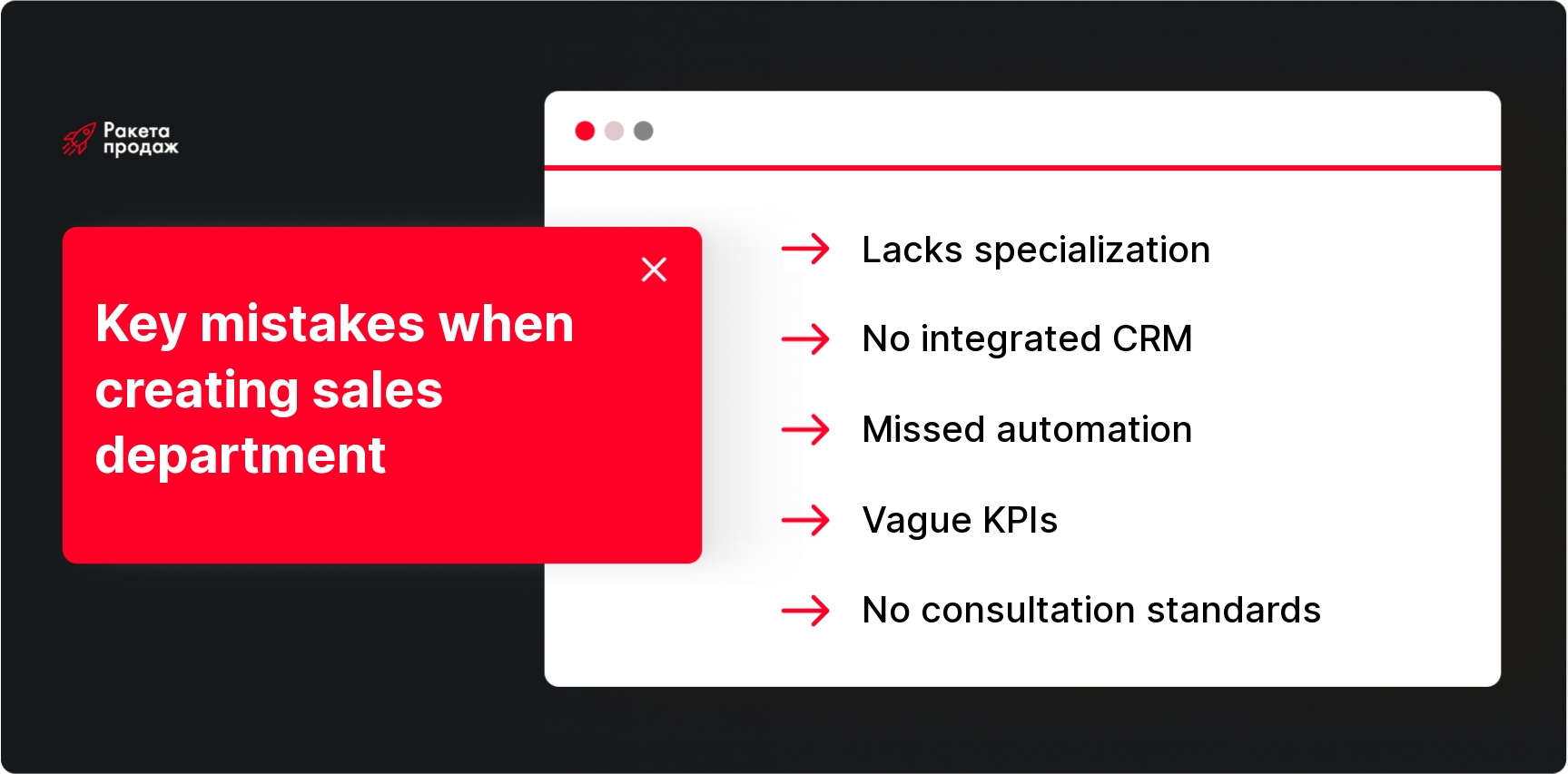
The main mistakes in building a developer’s sales department include: hiring generalist managers instead of specializing roles, having no CRM or working in Excel, ignoring lead processing automation, unclear KPIs, and lack of consultation standards.

What KPIs are important for a developer's sales department?

The critical metrics are: speed of first contact, conversion from lead to showing and from showing to reservation, show rate, plan completion by property, CRM data quality, and rejection reasons for bottleneck analysis.

How do you scale a developer's sales department?

To understand how to scale a developer’s sales department, you first need to standardize processes, implement CRM with automation, divide roles by function, organize systematic team training, and build a data-driven decision-making culture.

SUBSCRIBE TO MY TELEGRAM CHANNEL
The most valuable sales information right on your phone!
icon

LOTS OF USEFUL INFORMATION, FREE TEMPLATES, AND CHECKLISTS ON MY INSTAGRAM

Materials and practical advice on sales growth in our blog: