Key Takeaways
- An owner who spends more than 50% of their time on operational sales loses sight of strategy – an external Head of Sales frees them up within 2-3 weeks.
- A weak in-house Head of Sales costs more than a strong external one: a bad hire eats up 2-3 years’ worth of salary, plus the team’s time and motivation.
- An external specialist brings order to a chaotic CRM and pipeline faster than a new in-house employee manages to get up to speed.
- A team of 3-6 managers doesn’t justify the cost of an expensive in-house Head of Sales, but already needs systematic management instead of personal oversight.
- A hybrid model reduces risk: an external Head of Sales builds the processes, helps define requirements, and then hands management over to an in-house candidate.
In the article below, you’ll find specific criteria for choosing a management format, a cost comparison, and a decision-making checklist. Read the full article 👇
Right now, the Ukrainian market offers flexible solutions: from classic in-house hiring to temporary management through external specialists. Each format has its own advantages, limitations, and costs. Let’s break down when each option makes sense, what responsibilities fall under each type of Head of Sales, and how to properly calculate the budget. The main point is that the decision doesn’t depend on trends or advice from colleagues, but on the maturity of your sales department, your budget, and your strategic plans.
What Sales Management Options Does an Owner Have
A modern business owner has several ways to organize sales management, each with its own pros and cons. You can keep managing sales yourself – that works as long as the team is small and processes are simple. The second option is to appoint an internal senior manager as a temporary leader, which lets you test a management model without major investment.
The third path is to hire an in-house Head of Sales with full immersion in the company, daily presence, and long-term accountability for results. The fourth format is to bring in an external Head of Sales, who takes on part of the management functions on an outsourced basis. And finally, there’s the hybrid model: an external specialist helps build the system over 3-6 months, after which management is handed over to an internal leader.
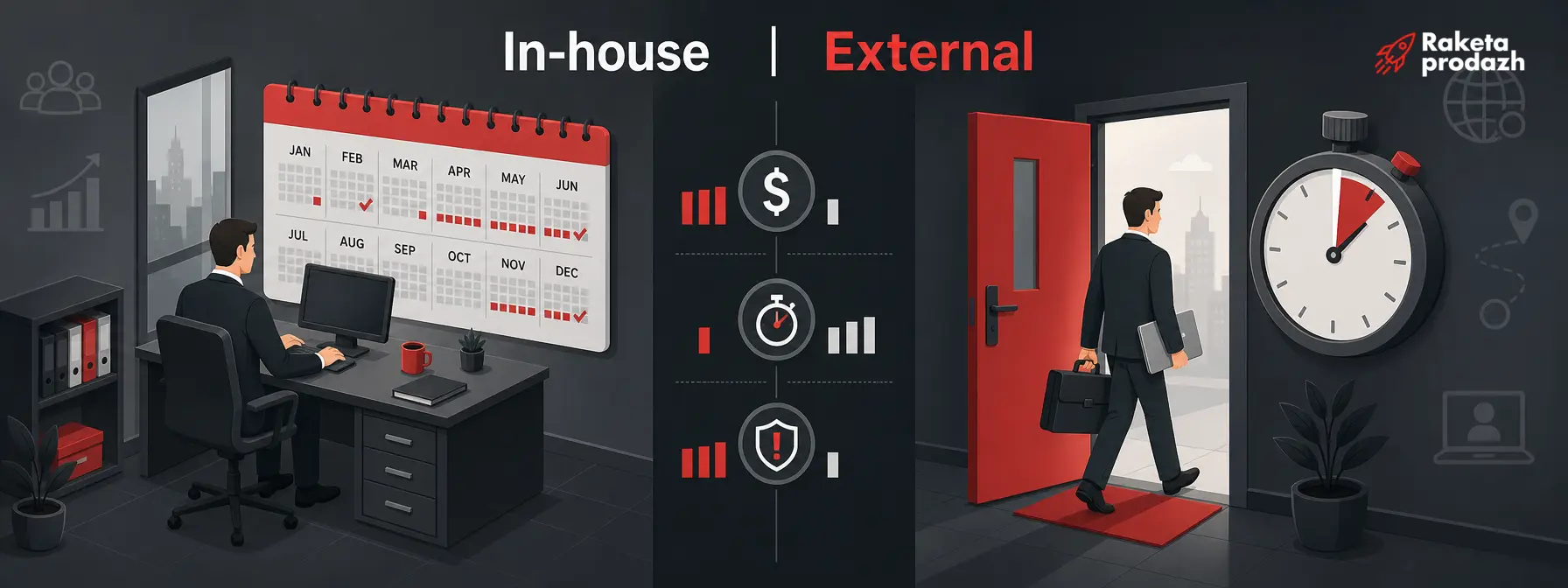
The choice between an in-house or external Head of Sales depends on several factors. The maturity of the sales department determines whether you need constant oversight or periodic check-ins are enough. Your budget determines whether you can afford a strong in-house Head of Sales or should start with an external one. The speed of the changes you need shows whether you need to bring order quickly or have time for gradual development. The presence of internal candidates suggests whether it’s worth developing your own managers or looking for ready-made specialists. The next section will show exactly what an in-house Head of Sales does and why their role goes far beyond simply overseeing managers.
Do you recognize yourself in a situation where you spend ages choosing between an in-house and external Head of Sales, while sales remain unmanaged in the meantime? This is a classic problem faced by 70% of owners trying to delegate sales department management. At “Rocket Sales,” we’ve spent over 8 years creating a unique hybrid model that lets you get all the benefits of external management with a smooth transition to an in-house Head of Sales, risk-free. Our team quickly brings order to any department: we set up CRM, implement a sales funnel, create a reporting system, and train the team to work by unified standards. Within the first 30, 50, and then ongoing days, our clients see structured processes, improved manager discipline, and transparent results. We’ve worked with 208 companies across 14+ industries, helping them build sales departments that consistently hit 150% of plan.
Get a manageable sales department within 90 days - book a free consultation right now!
What an In-House Head of Sales Does
An in-house Head of Sales isn’t just a senior sales manager – they’re the owner of the entire commercial system of the company. Their day begins with analyzing the previous day’s results: funnel conversions, quality of new leads, and each manager’s plan fulfillment. Then comes the morning stand-up with the team, where they discuss the day’s priorities, problematic deals, and new opportunities.
Next comes operational work: CRM oversight, distributing incoming leads among managers based on their workload and specialization, and untangling stuck deals by finding solutions. An in-house leader doesn’t just track the effectiveness of a Head of Sales, but also takes part in key negotiations, trains managers on new techniques, analyzes the reasons behind lost deals, and adjusts scripts. By evening, they prepare a sales forecast for tomorrow and a report for the owner on the current situation.
The advantage of an in-house Head of Sales is deep immersion in the specifics of the company. They know every client, understand the nuances of the product, sense the team, and can influence results on a daily basis. Such a specialist becomes part of the corporate culture, builds long-term processes, and accumulates expertise within the business. They can respond quickly to market changes and make operational decisions without needing approvals.
But there are limitations too: finding a strong Head of Sales is difficult and expensive, especially given the talent shortage on the Ukrainian market. A hiring mistake can cost several months of revenue and demotivate the team. On top of that, such a specialist requires ongoing development and motivation from the owner themselves. Now let’s look at how the alternative option works – an external Head of Sales.
What an External Head of Sales Does
An external Head of Sales is a specialist or team that takes on sales department management functions on an outsourced or part-time basis. Unlike consultants who just give advice, what an external Head of Sales does is actually manage the processes and take responsibility for results within the scope of their authority.
Their work begins with a comprehensive audit of the existing sales system: analyzing the funnel, assessing the team, checking the CRM, and identifying bottlenecks. Based on the diagnosis, they set up or upgrade the CRM system, implement a clear funnel with understandable stages and transition criteria, and create a reporting system for the owner.
After setting up the system, the external Head of Sales moves on to ongoing management: running weekly stand-ups with managers, working through complex deals, and monitoring lead handling and standard compliance. They implement and refine sales scripts, train the team on new techniques, and set up KPIs and a motivation system. An important part of the work is quality control: listening to calls, analyzing client correspondence, and evaluating compliance with procedures.
An external Head of Sales also prepares regular reports for the owner with analysis of trends, problems, and recommendations for improvement. In some cases, they help prepare the company for hiring an internal Head of Sales: creating a job description, participating in interviews, and ensuring the transfer of knowledge and processes. The next section will show how this looks in practice on a day-to-day basis.
How an External Head of Sales Works in Practice
The practical work of an external Head of Sales follows a clear algorithm and regular interaction rhythms with the team and the owner. To understand how an external Head of Sales works, it’s worth looking at their entire work cycle. The first stage is diagnostics, which lasts 1-2 weeks. The specialist analyzes the current sales funnel, studies the CRM or data spreadsheets, interviews managers and the owner, and identifies the main problems and growth opportunities.
After the diagnostics, the project goals, KPIs for the department and each manager, reporting formats, and areas of responsibility are fixed. The external Head of Sales sets up or refines the CRM, creates dashboards to track key metrics, and implements a regular management rhythm: weekly stand-ups, monthly reports, and quarterly result reviews.
Ongoing work includes participating in stand-ups 1-2 times a week (in person or online), working through problematic deals, and monitoring lead processing and the quality of client communication. It’s very important here to correctly define the key responsibilities of a sales manager so that the department runs as smoothly as possible. An external Head of Sales might work a few hours a week for small companies or several days a week for larger departments. The format depends on the tasks: temporary crisis management, mentoring a young internal Head of Sales, or building a system from scratch.
The main difference between an external Head of Sales and a consultant is that they don’t just give recommendations – they take on part of the management responsibility. They work through processes, procedures, and regular oversight, creating predictability and manageability in sales. Now let’s break down the situations where this format is especially effective.
When to Hire an External Head of Sales
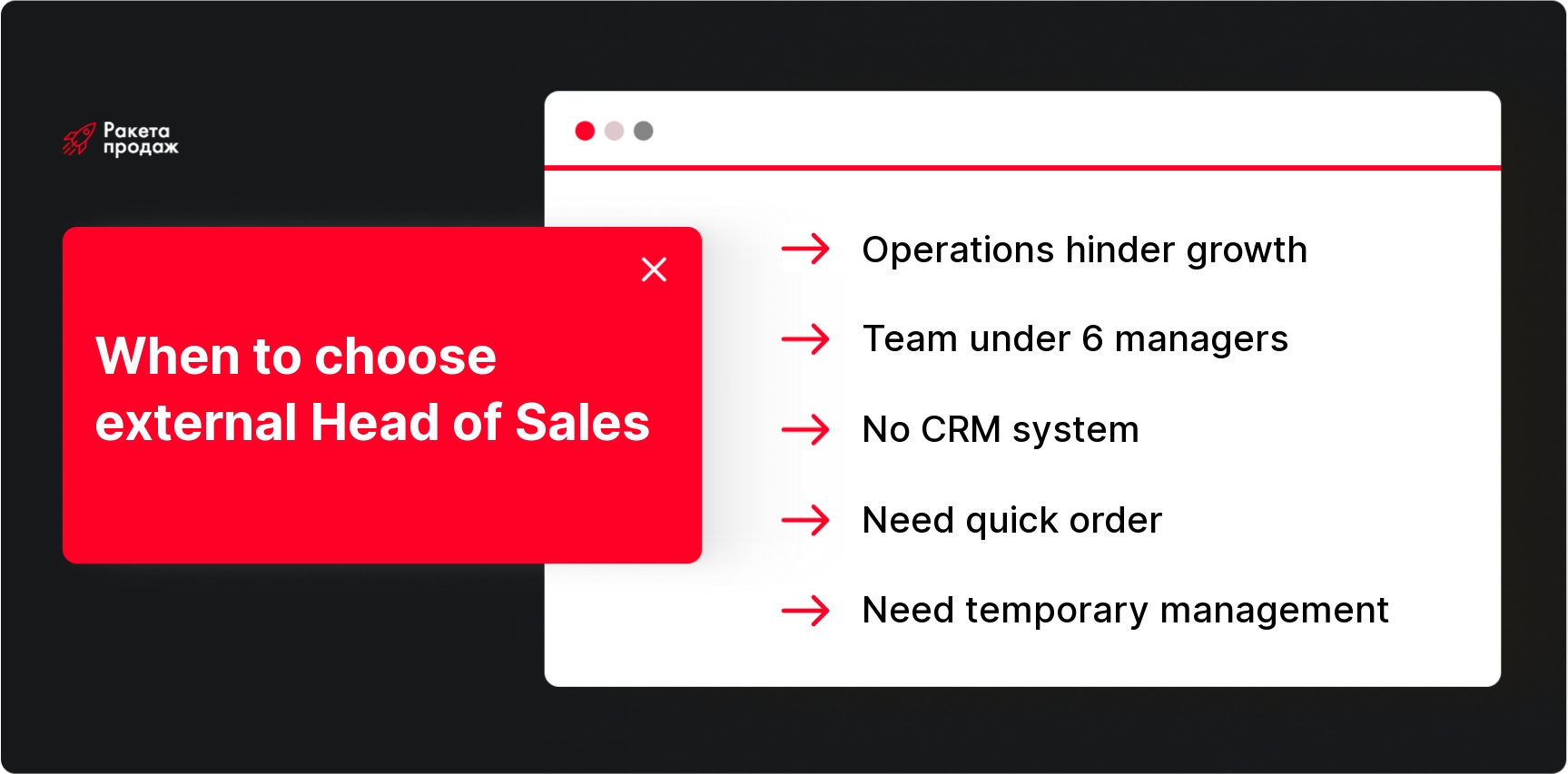
Determining when to hire an external Head of Sales is helped by analyzing several typical situations faced by Ukrainian businesses. The first is when the owner wants to step out of day-to-day sales operations, but the team isn’t yet ready for a full-fledged in-house leader. This happens with a department size of 3-5 managers, when personal oversight is no longer enough, but hiring an expensive Head of Sales isn’t economically justified.
The second situation is the need to quickly bring order to a chaotic department. If managers work without unified standards, the CRM is only partially filled in, and reporting is done “by feel,” an external Head of Sales can implement a system and discipline within 2-3 months. The third need is an independent sales audit and identification of hidden growth reserves, especially when results stagnate despite increasing marketing spend.
The fourth situation is preparing for scaling. When a company plans significant team growth or expansion into new regions, an external Head of Sales helps build the foundation: processes, procedures, and a training and motivation system. The fifth need is testing a management model without long-term commitments, which is especially relevant for startups and fast-changing niches.
An external Head of Sales is especially useful as a transitional format between owner-managed sales and building a full internal system. They can prepare the ground for hiring an in-house leader: creating clear processes, training the team, forming requirements for the future candidate, and even participating in their search and onboarding. The next section will help you understand which types of companies get the most benefit from this format.
Who Benefits from an External Head of Sales
Understanding who benefits from an external Head of Sales requires analyzing the specifics of the business and its stage of development. An external Head of Sales delivers the best results for certain types of businesses and at specific development stages. Ideal candidates are small and medium-sized B2B businesses with a team of 2 to 8 managers, where the owner is still managing sales personally but understands the need to delegate. This includes IT companies, agencies, consulting firms, distributors, and manufacturing businesses at the growth stage.
This option is especially good for businesses that are just starting to build a sales department and need a fast process launch, but aren’t yet ready for long-term investment in staff.
An external Head of Sales is especially effective for companies with unstable CRM discipline, where data is entered chaotically, reporting isn’t systematized, and effectiveness analysis happens sporadically. Such businesses get a quick return from implementing order and transparency in their processes.
Service companies and B2B service providers also find great value in an external Head of Sales, since their sales require personalization and expertise, but at the same time need to be systematic and predictable. An external specialist helps find the balance between an individual approach and process standardization.
Companies that plan to build a serious sales department but aren’t yet ready to invest in a strong in-house Head of Sales can use the external format as a “test drive” of the management model. This lets them understand their needs, form requirements, and prepare to hire a permanent leader.
An external Head of Sales is less suited to large departments with dozens of managers, where daily full-time presence of a leader within the team is needed. It may also be insufficient for highly technical products that require deep expertise and constant manager training. Now let’s look at the opposite situation – when it’s better to hire your own Head of Sales right away.
When It's Better to Hire an In-House Head of Sales
An in-house Head of Sales becomes a necessity when the sales department reaches a certain level of maturity and scale. The main indicators are a stable flow of leads, a team of 6-8 managers or more, several product lines or regions, and a regular monthly sales plan above a certain threshold. In these conditions, you need a leader who is present in the team daily and can resolve issues promptly.
An in-house Head of Sales is justified when the company is building long-term internal sales expertise, plans to constantly hire and develop new managers, and is scaling the department for ambitious growth goals. They’re critically important for deep integration of sales with other functions: marketing, product development, service, and logistics.
The need for a permanent leader increases with complex products and a long deal cycle, where every lost opportunity is costly, and the quality of client work directly affects reputation and referrals. B2B companies with contracts spanning months or years, high-tech solutions, and industrial supplies – all of this requires daily management presence.
An in-house Head of Sales is also needed by companies that compete on speed of market response: quickly changing strategies, testing new channels, and adapting the product to client requests. In such conditions, an external specialist may not be able to keep pace with the speed of change and depth of context needed.
It’s important to understand that an external Head of Sales can become an excellent bridge to hiring an in-house leader: they’ll prepare processes, train the team, form requirements for the candidate, and help onboard the new employee. The next section will give you a clear comparison of the two formats.
In-House or External Head of Sales: Comparison Table
The table shows that the choice depends on the company’s current situation and goals. An external Head of Sales wins on launch speed, flexibility, and the approach to quickly bringing order, while an in-house specialist is better for long-term development and deep team management. Many companies use a combined approach: they start with an external Head of Sales to build the system and then move to an in-house leader. Now let’s break down the financial side of the question.
How Much Does an In-House Head of Sales Cost
The real cost of an in-house Head of Sales is much higher than just the salary stated in the contract. It includes the base salary (from 40-60 thousand hryvnia for junior positions to 80-120 thousand for experienced specialists in major cities), bonuses for meeting the sales plan (usually 10-30% of the base), and the employer’s taxes and social contributions.
Additional costs include recruiting expenses: working with recruitment agencies or an HR specialist, and the owner’s time spent on interviews and decision-making. The onboarding period also costs money: for the first 2-3 months, the new Head of Sales is learning the specifics of the company, the product, the client base, and the team, while their impact on results is minimal.
You also need to account for training and development costs: attending industry conferences and training sessions, buying specialized literature, and subscribing to analytics. An important line item is the owner’s time spent managing the Head of Sales: setting tasks, holding regular meetings, analyzing results, and adjusting strategy.
The most significant hidden risk is the cost of a hiring mistake. If the Head of Sales doesn’t work out and has to be replaced, the company loses not only the money invested in them, but also time, team motivation, and possibly some clients. According to HR specialists’ estimates, the cost of a failed hire for a leadership position can amount to 2-3 years of the specialist’s salary. The next section will show how the cost of the alternative option is formed.
How Much Does an External Head of Sales Cost
The cost of an external Head of Sales depends on several variables: the work format, the scope of tasks, and the depth of project involvement. In an hourly format, rates range from 800 to 2,500 hryvnia per hour on the Ukrainian market, depending on the specialist’s experience and task complexity. When working several days a week, the cost is 25-60 thousand hryvnia per month.
The project format implies a fixed cost for auditing and implementing the system: from 30-50 thousand hryvnia for diagnostics and setting up basic processes to 100-200 thousand for a comprehensive build-out of the sales department with team training. Ongoing subscription support usually costs 20-40 thousand hryvnia per month for regular stand-ups, KPI monitoring, and consulting.
The cost is affected by the department’s size: working with 2-3 managers requires less time than managing a team of 8-10 people. The need to set up the CRM, integrate with telephony, and create reporting increases the project cost. Urgency of tasks and the need for daily presence also affect the price.
A mixed model combines a project-based cost for the initial setup with a monthly subscription fee for ongoing support. This approach often turns out to be the most effective: a fast start with deep diagnostics followed by regular management to sustain results.
It’s important to understand that in the early stage, an external Head of Sales can be cheaper than an in-house specialist, but with long-term cooperation and a large volume of tasks, the in-house option becomes more economically advantageous. However, price shouldn’t be the only selection criterion.
Why You Shouldn't Choose a Head of Sales Based on Price Alone
A cheap Head of Sales can end up costing much more than an expensive one if they don’t have the necessary competencies and don’t deliver results. A weak specialist who doesn’t know how to build systems, motivate the team, and work with analytics can cause serious damage: losing clients, demotivating managers, and creating chaos in processes.
When choosing, you need to evaluate their experience working in similar industries and team sizes, their understanding of the B2B or B2C model specifics, and their ability to work with CRM systems and set up analytics. Their management approach matters too: how the specialist builds motivation, gives feedback, resolves conflicts, and trains managers on new skills.
Key criteria are transparency of reporting and willingness to take responsibility for results. A good Head of Sales will offer clear KPIs to evaluate their own work, show case studies from previous projects, and explain their methodology and approach to solving typical problems. They should understand sales unit economics and be able to connect their actions to the company’s financial results.
You should avoid specialists who promise quick miracles without analyzing the current situation, don’t ask questions about the specifics of the business, or offer universal solutions for any company. Head of Sales is a management role where a mistake affects revenue, the team, and the company’s reputation for months to come. Skimping on the quality of such a specialist can end up costing far more than the initial price difference. Now let’s summarize the logic for choosing between the two formats.
How to Choose Between an In-House and External Head of Sales
The logic of choice is based on analyzing the company’s current situation and strategic plans. If you need a permanent leader within the team for daily management, training, and motivation – choose an in-house Head of Sales. When the main task is to quickly bring order to a chaotic department and implement processes and discipline, an external specialist will handle it more effectively.
For owners who want to step out of day-to-day operations, but whose department is still small (3-6 managers), an external Head of Sales or a hybrid model is optimal. With rapid team growth and scaling plans, it’s better to invest in an in-house leader who will grow along with the company.
If you need to conduct an independent sales audit and prepare the system for major changes, an external Head of Sales will give you an objective assessment and a fresh perspective. When there’s an internal candidate for a leadership position but they lack experience, an external specialist can act as a mentor and help with their development.
With critical dependence of sales on daily management (complex B2B deals, high competition, frequent market changes), you need an in-house leader with full immersion. If you need to test a management model or prepare to hire a permanent Head of Sales, start with the external format.
It’s important to understand that external and in-house Head of Sales don’t always compete with each other. Often, an external specialist becomes a preparation stage for going in-house: they create processes, train the team, help form requirements for a permanent leader, and take part in their search. The next section will look at this hybrid model in more detail.
Hybrid Model: External Head of Sales as a Bridge to In-House Management
The hybrid scenario is one of the most effective approaches for companies that understand the need for an in-house Head of Sales but want to minimize hiring risks. An external specialist joins the project for 3-6 months with a clear task: build a sales management system and prepare the company to hire an internal leader.
The first stage is a comprehensive audit and quick establishment of order: setting up the CRM, implementing the sales funnel, creating KPIs and a reporting system, and training the team on unified work standards. In parallel, the external Head of Sales analyzes the need for a permanent leader: which functions are critically important, what experience and skills the candidate needs, and what management style will suit the team.
The second stage is preparing for the management handover: creating detailed procedures and instructions, documenting all processes, forming requirements for the in-house Head of Sales, and even participating in candidate searches. The external specialist can conduct initial screening, take part in interviews, and help the owner make the right decision.
The third stage is transferring management and onboarding the new Head of Sales. The external specialist stays on for a few more weeks in a consulting role, helping the new leader get up to speed, master the processes that were created, and build relationships with the team.
This approach reduces the risk of a hiring mistake: the company first understands exactly what kind of manager it needs, gets a working system of processes, and only then invests in a permanent employee. This is especially valuable for a business hiring a Head of Sales for the first time and without a clear idea of the requirements for such a position.
Checklist: How to Determine If Your Company Needs a Head of Sales - In-House or External
Answer these questions to figure out the optimal sales management format for your company. Understanding how to determine if your company needs a Head of Sales, and in what format, will help you make the right decision:
Department size and maturity:
- How many managers are on the team: up to 5, or more than 6?
- Is there a unified CRM and a clear sales funnel?
- Do managers work by standards, or does everyone do their own thing? Read more about signs of turnover in a sales department separately.
Your current role:
- Do you spend more than 50% of your time on operational sales?
- Could you focus on strategy if you delegated sales?
- Do you have time for searching and onboarding an in-house Head of Sales?
Management needs:
- Do you need a full-time leader, or is periodic oversight enough?
- Do you need to quickly bring order to current processes?
- Are you planning to scale the team in the next 6 months?
Budget and resources:
- Do you have the budget for a strong in-house Head of Sales (80-120K UAH + bonuses)?
- Are you prepared for the risks of a hiring mistake and the cost of finding a replacement?
- Are you considering temporary formats as a test before permanent hiring?
Business specifics:
- How complex is the product, and how long is the deal cycle?
- Is daily leader presence within the team critical?
- Are managers willing to accept external management?
Strategic plans:
- What tasks need to be solved in the first 90 days?
- Do you need to stabilize the department first, or are you already scaling?
- Is there an internal candidate you could develop?
Understanding when to outsource the Head of Sales role comes from analyzing these factors. If most of your answers point to a small team, the need for quick changes, and a limited budget – start with an external Head of Sales. If you have a mature department, growth plans, and readiness for serious investment – hire an in-house specialist. When in doubt, choose the hybrid model: an external Head of Sales will help you understand your needs and prepare for permanent hiring.
The choice between an in-house and external Head of Sales isn’t just a financial decision – it’s a question of your business’s development strategy. But why choose when you can get the best of both formats? “Rocket Sales” offers a proven methodology for moving from chaos to structure: we start as external experts, quickly get processes in order, and then either prepare your company to hire the ideal in-house Head of Sales or continue support in a convenient format. Our approach includes a comprehensive audit of the current situation, setting up the CRM and sales funnel, training the team, creating a motivation system, and preparing all the procedures for the future leader. The result: an average revenue growth of +35% for clients, with the best case showing +$10,907,403 over 4 months of work. Our partners include companies like Mitsubishi, Yamaha, and Naftogaz. Don’t spend months experimenting with an uncertain outcome when there’s a proven solution.
Build a sales department that runs like clockwork - regardless of the management format!
An in-house and an external Head of Sales are different tools for solving the same task: making sales manageable and freeing the owner from day-to-day operations. An in-house specialist is suited to long-term development of mature departments, while an external one is suited to quickly bringing order and to transitional periods. Hybrid models let you test approaches and minimize risks. The main thing is to define specific tasks, areas of responsibility, KPIs, and expected results in advance, so that whichever format you choose brings maximum benefit to your business.
We recommend also checking out:


 Time to read: 9 min.
 27 July 2026