icon

When Should the Owner Step Back from Day-to-Day Sales Operations and Hand the Department to a Sales Director?

In most companies, it’s the owner who becomes the main driver of sales, especially in the early stages of growth. You know the product better than anyone, you understand the customer, and you’re willing to take risks to close a deal. But as the team grows and processes become more complex, a question arises: what if your personal involvement in every deal is no longer helping, but actually slowing things down?

Want a high-performing sales team without the hassle?
We’ll build it for you.
Contact Us

Key Takeaways

  • An owner stuck in daily operations in sales becomes a bottleneck: the business only grows within the limits of their working day, the team doesn’t take ownership, and strategy keeps getting pushed back.
  • When 70% of deals require your involvement and managers wait for decisions on routine questions, you’re no longer managing the department – you’re doing its job instead.
  • Dependence of key deals on the owner’s personality blocks scaling: the owner’s calendar limits the number of major contracts, and the team never learns to close complex negotiations on its own.
  • The absence of unified work standards (one manager in the CRM, another in Excel, a third giving discounts with no logic) signals that the department needs a systematic leader, not just a controller.
  • A Sales Director should free the owner from micromanagement and hand them a transparent system with metrics, regular analytics, and a predictable sales forecast.

In the full article, you’ll find a step-by-step strategy for stepping back from daily operations, common mistakes when transferring functions to a Sales Director, and concrete signs that it’s time to delegate sales management. Read below 👇

Many owners keep holding onto sales “with their own hands” out of fear of losing control, or out of the belief that “nobody can do it better than me.” However, there comes a moment when this strategy turns into a trap: the business only grows within the limits of your working day, the team doesn’t take ownership, and you yourself become the company’s main bottleneck. In this article, we’ll break down how to recognize the signals indicating when should the owner exit sales operations, how to avoid common mistakes when transferring functions, and how to build a system that works without your daily involvement.

Below, we’ll cover the main signs that a sales manager is needed – from an owner overloaded with operational tasks to the absence of unified standards, analytics, and team manageability.

Why the Owner Stays Stuck in Sales Operations - and When It's Time to Think About Stepping Back

The owner stepping back from day-to-day operations rarely happens naturally: a business owner’s psychology often works against delegating sales. You see that you personally sell better than any of your managers, clients trust you specifically, and every deal closed without your involvement feels like a potential loss of profit. Add to this the fear of spending money on a Sales Director’s salary who “might not be worth the investment,” and you get a vicious circle: the better you sell, the less motivated you are to build a system.

However, business reality shows a different picture. When the owner remains the only person who can make decisions on discounts, negotiate with major clients, and coordinate the work of managers, the company hits the ceiling of their personal productivity. Research on digital transformation confirms that companies that delegated sales management in a timely manner demonstrate more stable growth and adapt better to market changes.

Key signs of a “maturity point” include situations where your involvement is required in 70% of deals, managers regularly wait for your decisions on standard questions, and any attempt to take a vacation or focus on strategy leads to a slowdown in sales. If you recognize yourself in this description, understanding when should the owner exit sales operations becomes critically important for your business’s development.

Are you familiar with situations where attempts to delegate sales management end in falling results or a return to manual control? This happens to 70% of owners who try to delegate chaos instead of building an actual system. At “Rocket Sales,” over 8+ years, we’ve built a methodology for systematically constructing sales departments that work without the owner’s daily involvement. Our approach includes documenting all processes, setting up CRM systems, preparing regulations, and gradually transferring authority to a Sales Director. As a result, owners get transparent sales departments with clear KPIs that consistently hit their targets and keep growing even in the owner’s absence. Over the course of our work together, our clients increase revenue by an average of +35%, with the best result reaching +$10,907,403 in 4 months of work.

Build a sales department that grows without your daily oversight - get a free consultation!

Key Risks for a Business When the Owner "Sits" on Sales

Staying in the role of the main salesperson creates several serious threats for a company, which become critical as the business grows. The first risk is losing strategic focus. While you’re spending your days handling client calls, approving discounts, and resolving conflicts with managers, you have no time left to analyze new markets, develop your product line, or find strategic partners. As a result, the company may miss significant growth opportunities by focusing only on current operations.

The second critical risk is revenue dependence on one person. When key clients get used to working only with the owner, and managers can’t close major deals on their own, the owner’s illness or burnout can crash revenue within a matter of weeks. This is especially dangerous in Ukrainian realities, where external factors already create enough instability – additional internal vulnerability can become fatal.

The third threat is related to manageability of the organization as a whole. The practice of Ukrainian companies shows that owners stuck in daily operations in the sales department often lose control over other processes: production, finances, personnel. As a result, chaos grows, product quality drops, and the team gets used to the idea that “only the boss makes all the decisions.” This blocks employees’ development of managerial competencies and turns the company into one person’s personal project.

Sign 1. The Owner Has Become the Main Bottleneck in Sales

The clearest signal indicating when should the owner exit sales operations is a situation where most decisions in the sales department pass through you personally. Managers come to you with questions: what discount to give a client, how to respond to a non-standard request, who to hand off a “hot” lead to, whether it’s worth spending time on a difficult client. Each of these requests seems minor on its own, but together they create a queue of people and tasks waiting for your attention.

The consequences of this model become obvious pretty quickly. Managers stop taking responsibility for results, preferring to pass the risk of decision-making on to you. Deals slow down because clients are waiting for approvals that depend on your calendar. And you yourself end up trapped: the more you decide for the team, the less time you have for tasks that truly require your level of expertise – strategy, finance, product development.

This sign is especially critical if the sales team has grown to 4-5 people or more: it becomes physically impossible to properly oversee the work of every manager while also focusing on business development. In this situation, an urgent need arises to understand when to hire a sales manager.

owner as bottleneck in sales — Business owner as a bottleneck in sales, surrounded by a queue of managers waiting for decisions

Sign 2. The Owner Spends Time Controlling Minor Tasks

Daily operations in sales include a mass of routine but important tasks: checking who called whom, why a manager hasn’t updated a deal’s status in the CRM, whether a follow-up was done after yesterday’s meeting, why a lead has been sitting untouched for a week. In the early stages of a business, this kind of control helps establish discipline and work standards, but as the team grows, it turns the owner into a dispatcher.

The problem isn’t that these tasks are unimportant – quite the opposite, CRM discipline quality, lead processing speed, and regularity of client communications directly affect conversion. The problem is that the owner’s time is being spent on them – time that could be used for tasks at their own level: analyzing the market, meeting with potential partners, planning for scale, or developing new products.

If you find that a significant part of your day goes into checking “did the manager do what they were supposed to do,” this is a signal that you need to hire a manager who will take the daily rhythm of sales off your hands. A Sales Director should free you from micromanagement, taking on responsibility for the team’s discipline and results.

By the way, it’s precisely process setup and automation that helps relieve the burden of controlling small details. To learn how effective CRM implementation for increasing sales is achieved, read our separate article on the topic.

Sign 3. Sales Depend on the Owner's Personal Involvement

Another serious symptom is a situation where key deals only close with your involvement. Clients ask to “speak with the person in charge,” managers call you into every difficult meeting, and negotiations without your authority often end in refusals. At first glance, this looks like a sign of your high level of expertise, but it actually signals a systemic problem.

Sales dependence on the owner’s personality creates several risks. First, it limits scaling: you can only hold a certain number of meetings per day, meaning the number of major deals is capped by your calendar. Second, it weakens the team: managers don’t develop skills for handling difficult clients because they’re used to passing such tasks to you. Third, it increases risks for the business: if you get sick or otherwise can’t participate in sales, revenue can drop sharply.

The Sales Director’s role in this situation is to gradually reduce dependence on the owner by strengthening managers, standardizing the negotiation process, training the team, and creating clear rules for escalating complex deals. A properly built system should work in such a way that your involvement is only needed in exceptional cases, not in every other deal. Addressing how to delegate sales management becomes key to overcoming this dependence.

It’s precisely for such cases that well-developed objection handling in sales matters: it helps deals close without the owner’s intervention, while managers feel more confident interacting with clients.

Sign 4. The Sales Team Is Growing, but Manageability Is Dropping

As the number of managers grows from 2-3 to 5-7 people, it becomes physically difficult for the owner to keep all the information in their head: who’s working which leads, who’s hitting their targets, whose conversion is dropping, where potential clients are getting lost. If you used to be able to remember the status of every deal and regularly talk with each manager, now there’s simply too much information for manual control.

Attempts to solve this problem by increasing the number of meetings or adding more detailed reporting often backfire: managers spend more time on reports than on actual sales, and you end up with information overload instead of transparency. Without a systematic approach, team growth doesn’t necessarily lead to proportional revenue growth – you might end up with more people but less result from each one.

Quality management of a growing team requires regular one-on-one meetings with each manager, analysis of individual funnels, training, and quality control. This is full-fledged managerial work that’s hard to combine with your own sales activities and strategic tasks. A Sales Director should take this function on, providing each manager with the attention and support they need to grow their results. This is precisely the situation where it becomes clear when a business needs a sales manager: the team has already grown, the volume of managerial tasks has increased, and manual control by the owner no longer delivers the needed result.

Read more about a systematic approach to building a sales department in our article on how to build a sales department, which offers practical recommendations and case studies.

Sign 5. No Regular Analytics or a Clear Sales Forecast

When the owner personally handles most deals, they often see only the final revenue figures without understanding the funnel structure or being able to forecast next month’s results. You might know that revenue this month was 500,000 UAH, but not understand what pipeline has built up, which deals will actually close next period, where exactly conversion is dropping, and which managers need extra attention.

The absence of analytics turns sales management into a reactive process: you find out about problems only after they’ve already affected revenue, not the moment they arise. For example, you might discover that lead-to-meeting conversion dropped by 30% only when the number of new deals this month turns out to be critically low.

A Sales Director should be responsible for regular analytics: plan-vs-actual analysis, funnel structure, reasons for lost deals, each manager’s activity, CRM data quality, and sales forecasts for the next period. If you’re currently collecting this data manually yourself, or working without analytics at all, that’s a sign that sales management needs to be handed to a specialist who will make the process transparent and predictable.

It’s also important here to consider evaluating the effectiveness of a sales manager, so you can track not just individual employee performance but also identify “bottlenecks” at the level of the whole department.

sales forecast and analytics — Comparison of a foggy sales forecast versus a clear analytics dashboard

Sign 6. The Owner Doesn't Have Time for Strategy and Business Development

Perhaps the most costly sign of being “stuck” in daily operations is a lack of time for tasks that affect the company’s long-term development. While you’re dealing with client conflicts, approving discounts, and monitoring managers’ plan completion every day, you have no resources left to analyze new markets, develop products, find strategic partners, or work with investors.

The paradox is that operational tasks always seem more urgent: the client is waiting for an answer right now, a manager doesn’t know how to handle a specific deal, and the monthly plan needs to be met every single day. As a result, strategic initiatives get pushed “for later” – a “later” that may never come. Meanwhile, it’s precisely strategic decisions – entering new markets, launching digital channels, building a partnership program – that give a company a real leap forward in development.

It’s important to understand here: the owner stepping back from sales management isn’t about working less, but about moving on to higher-level tasks. A properly built sales system should free you up to work on the aspects of the business that only the owner can handle – defining strategy, making key financial decisions, shaping corporate culture, and setting the company’s vision.

Sign 7. There's No Unified Work Standard in the Sales Department

When each manager sells “their own way” – one keeps detailed CRM notes, another works in an Excel spreadsheet, a third keeps client agreements in messenger apps, a fourth gives discounts with no logic, and a fifth regularly forgets to follow up – this is a signal that the department needs a systematic leader. Without unified standards, it’s difficult to analyze effectiveness, train new employees, or predict results.

Standardizing sales processes includes many elements: funnel stages and criteria for moving between them, rules for handling inbound leads, product presentation scripts, proposal structures, discount matrices, objection-handling algorithms, CRM discipline, and reporting procedures. It’s difficult for an owner to simultaneously be the strategist, salesperson, controller, and methodologist of the department – this requires different competencies and an enormous amount of time.

A Sales Director should create and maintain a unified work methodology, train the team, set up quality control, and regularly update standards in line with changes to the product or market. This makes it possible to scale successful practices, onboard new managers faster, and create a predictable system instead of a chaos of individual approaches. Signs that a sales manager is needed become especially obvious in a situation lacking unified work standards.

A Step-by-Step Strategy for Stepping Back from Day-to-Day Sales Management

Transitioning from the role of “chief salesperson” to the role of strategist and system architect requires methodical work and can’t be accomplished in a single week. Stepping back from day-to-day operations calls for the right approach, which includes several sequential stages, each of which lays the groundwork for the next.

Daily operations in the sales department should gradually shift from being the owner’s responsibility to the sales director’s. This isn’t just about overseeing managers, but also about running meetings, analyzing the funnel, maintaining CRM discipline, handling complex deals, and hitting the sales plan.

The first step is to document in detail all the sales processes that currently exist only in your head. This includes the customer journey from first contact to repeat purchase, lead qualification criteria, product presentation structure, common objections and ways to handle them, pricing rules, and discount policies. It’s important to capture not just the sequence of actions, but the logic behind decisions: why this client can get a 15% discount and that one can’t, in which cases it’s worth making concessions on payment terms, how to prioritize leads.

The second stage is creating templates and automating repetitive tasks. This includes phone call scripts, standard email sequences for different client categories, proposal templates, automatic CRM reminders, and setting up inbound lead distribution. The goal is to make it possible for managers to properly handle standard operations without your involvement.

The third step is finding and preparing a sales director. This could be an internal candidate (your best manager with leadership qualities) or an external specialist with experience managing a sales team. The key requirement is the ability not just to sell personally, but also to build processes, motivate the team, analyze metrics, and be accountable for the department’s overall results.

The fourth stage is gradually transferring functions while monitoring results. It’s best to start with less critical tasks: running meetings, monitoring CRM discipline, resolving minor client conflicts. As these functions are successfully carried out, you can hand over more responsible areas: managing major deals, making decisions on discounts, hiring, and training new managers.

The final stage is transitioning to the strategist role while retaining control through metrics and regular meetings with the Sales Director. Your task becomes setting goals, analyzing results, adjusting strategy, and supporting the sales director in difficult situations, while they make operational decisions independently. At this stage, the owner stops managing sales at the operational level, focusing instead on strategic aspects of development.

exiting operational sales management — Step-by-step strategy of an owner transitioning from operational sales management to a strategic role

How to Build a Sales System That Works Without the Owner

Building an autonomous sales system requires moving from intuitive management to a process-based approach, where every element is described, measured, and controlled. The foundation of such a system is transparent business processes, where every employee knows not just what to do, but also how, when, and with what result.

The first element of the system is a detailed algorithm for working with a client from first contact to closing the deal. This includes lead qualification (what questions to ask to understand a client’s potential), presentation structure (key product advantages and how to present them), an objection matrix (common client doubts and proven ways to overcome them), pricing rules, and procedures for approving non-standard terms. Every stage should have clear criteria for completion and moving on to the next step.

The second component is a unified positioning and presentation system for the entire team. All managers should talk about the product the same way, use the same arguments and materials, which creates a consistent image of the company in clients’ eyes. This is especially important for B2B sales, where a client may interact with several representatives of the company.

The third element is a system for tracking key metrics: number of new leads, lead-to-meeting conversion, meeting-to-proposal conversion, proposal-to-deal conversion, average deal size, average sales cycle. These metrics let you see the health of the sales department and catch problems at an early stage: if lead-to-meeting conversion drops, you need to work on lead quality or initial contact skills; if the deal cycle lengthens, client requirements may have changed or new competitors may have appeared.

The fourth component is automating routine processes through CRM and integrations with other systems. This includes automatic lead distribution among managers, reminders to contact clients, report generation, and syncing with marketing tools. The more routine work the system handles, the more time managers can dedicate directly to sales.

The fifth element is regular management rhythms: daily meetings to sync the team, weekly reviews of each manager’s results, monthly analytical sessions to adjust processes. The system should run like clockwork, with everyone knowing their role and responsibility.

What Mistakes Owners Make When Stepping Back from Sales Operations

Transferring management of the sales department is a complex process where it’s easy to make mistakes that undo all the effort and force a return to manual management. Understanding common pitfalls can help you avoid them.

The first mistake is delegating chaos instead of a system. Many owners try to hand over sales management before describing processes, setting up CRM, and creating regulations. As a result, the new manager doesn’t inherit a working machine, but rather a set of informal habits and practices that are hard to scale. The right approach is to first systematize and document all processes, and only then hand over their management.

The second mistake is maintaining double standards. The owner formally appoints a Sales Director but continues to give direct instructions to managers, make decisions on discounts, and participate in negotiations behind the department head’s back. This undermines the Sales Director’s authority and creates confusion within the team: it becomes unclear who actually makes decisions and who to turn to with questions. Delegating the sales department to a sales director should be consistent: if you’ve handed off a function, don’t interfere with its execution without a serious reason.

The third mistake is insufficient KPI transparency and lack of regular monitoring. The owner hands off responsibility for sales but doesn’t create a metrics and reporting system that would allow tracking results without diving into operational details. As a result, they either lose control of the situation or fall back into micromanagement. The solution is to define 5-7 key metrics in advance and set the frequency for monitoring them.

The fourth mistake is an unprepared team for the new way of working. Managers are used to getting instructions from the owner and may resist changes or fail to understand new requirements. Without preliminary training, explanation of the logic behind changes, and an adaptation period, transitioning to a new system can lead to a drop in team motivation and results.

Those just starting to scale would benefit from reviewing common salesperson mistakes to avoid replicating them across the whole team.

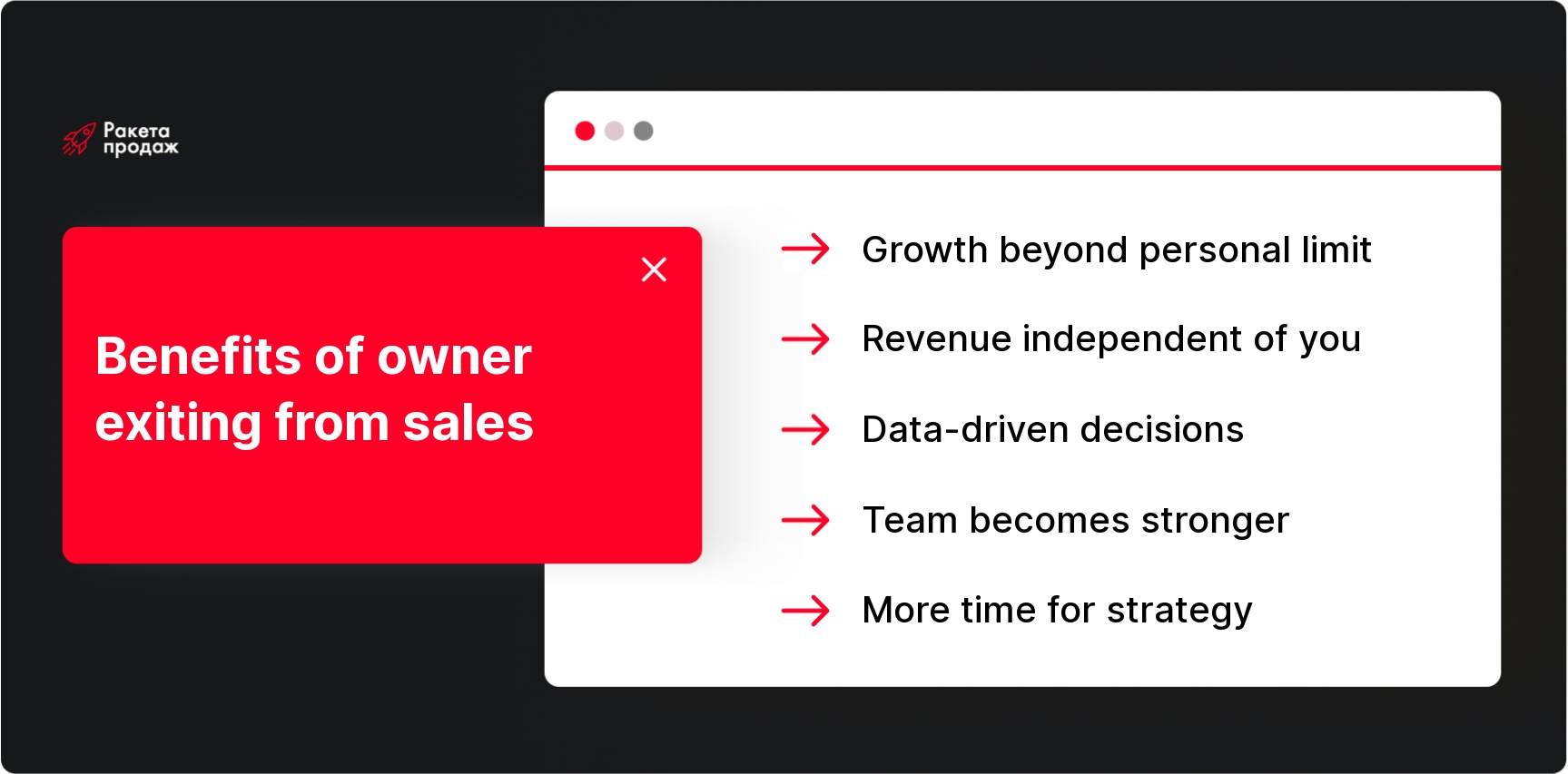
What Benefits Does a Business Gain After the Owner Stops Managing Sales Operations

A properly executed exit from daily sales operations opens up new growth and development opportunities for a business that weren’t accessible when all functions were concentrated in one person’s hands.

The main benefit is scalability without a proportional increase in the owner’s workload. When sales no longer depend on the number of hours you personally spend on negotiations, the company can grow faster: hiring more managers, opening new directions, entering additional markets. Your time is freed up for higher-level tasks – strategic planning, product development, building partnerships.

The second benefit is increased business resilience to external shocks and internal changes. When revenue isn’t tied to one person, the company weathers illnesses of key employees, shifts in the owner’s priorities, or changes in market conditions much better. The sales system keeps working even in your absence, which reduces stress and allows for planning long-term initiatives.

The third benefit is improved quality of managerial decisions thanks to data and analytics. When the CRM is maintained diligently and reporting is set up systematically, you get an objective picture of the state of sales instead of subjective impressions. This lets you catch problems early, make decisions based on facts rather than intuition, and forecast results more accurately.

The fourth benefit is the development of a management team and corporate culture. When managers get real responsibility for results and the ability to make decisions, they grow professionally and become more engaged in their work. This improves talent retention and lays the groundwork for further company growth. In Ukrainian conditions, where competition for qualified specialists is fierce, a strong corporate culture becomes a significant competitive advantage.

Stepping back from day-to-day sales operations isn’t just about delegating tasks – it’s about building a working system that generates predictable results regardless of the owner’s personal involvement. However, implementing all the described processes on your own can take months or even years, especially without experience in systematic sales-building. “Rocket Sales” specializes in a comprehensive solution to this problem: we don’t just consult, we build complete, turnkey sales departments. Our methodology includes an audit of current processes, developing a sales funnel, setting up CRM, creating regulations, selecting and training a Sales Director, and setting up a KPI and management reporting system. Over 8+ years of work, we’ve built 208 sales departments across 14+ industries that consistently hit 150% of plan every month. Our clients get not only an average revenue increase of +35%, but also complete freedom from operational sales management. Don’t waste years experimenting with an uncertain outcome.

Build a sales system that works without you - order a turnkey sales department build!

Conclusion

image

The owner stepping back from sales management is a sign of business maturity and readiness for the next stage of development. If you feel like you’ve become the main bottleneck in sales, spend your time controlling small details instead of doing strategic work, and your team can’t make decisions without your involvement, it’s time to think about systemic changes. Knowing how to hand over the sales department to a Sales Director properly will not only free up your time for more important tasks, but will also make the business more resilient, more scalable, and less dependent on a single person. The key to success is consistency in delegation, building a transparent metrics system, and patience during the team’s adaptation period to the new rules of the game.

In this article:
See more
Book a FREE sales funnel audit
CONTACT US
Frequently Asked Questions
How should an owner step back from daily operations?

Step by step: first describe and standardize processes, then find a suitable Sales Director, set up a KPI system, and gradually transfer functions while monitoring results. It’s important not to rush and not to try to delegate everything all at once.

What does it mean to step back from daily operations?

It’s a shift from the role of chief executor to the role of strategist and system architect. The owner stops personally handling most deals and making operational decisions, but retains control through metrics and management of the Sales Director.

What are daily operations in sales?

The everyday routine tasks of managing a sales department: monitoring manager activity, approving discounts, resolving ongoing client conflicts, checking CRM discipline, running meetings, and reporting.

How do you hand over the sales department to a Sales Director?

Prepare a description of processes and regulations, choose a suitable candidate, conduct a detailed onboarding, organize a transition period with a gradual transfer of authority, and set up a control system through KPIs.

SUBSCRIBE TO MY TELEGRAM CHANNEL
The most valuable sales information right on your phone!
icon

LOTS OF USEFUL INFORMATION, FREE TEMPLATES, AND CHECKLISTS ON MY INSTAGRAM

Materials and practical advice on sales growth in our blog: