Key Takeaways
- Companies often confuse roles and search for a “lead generator” without understanding who they actually need: a research specialist, an outbound executor, an SDR with qualification duties, or a Lead Generation Manager with strategic responsibility.
- Weak candidates demonstrate knowledge of tools (Apollo, Sales Navigator), while strong ones explain how they choose an ICP, qualify interest, and hand off leads to sales based on clear criteria.
- Your interview should test research logic and process thinking, not just a rundown of tools and the number of emails sent.
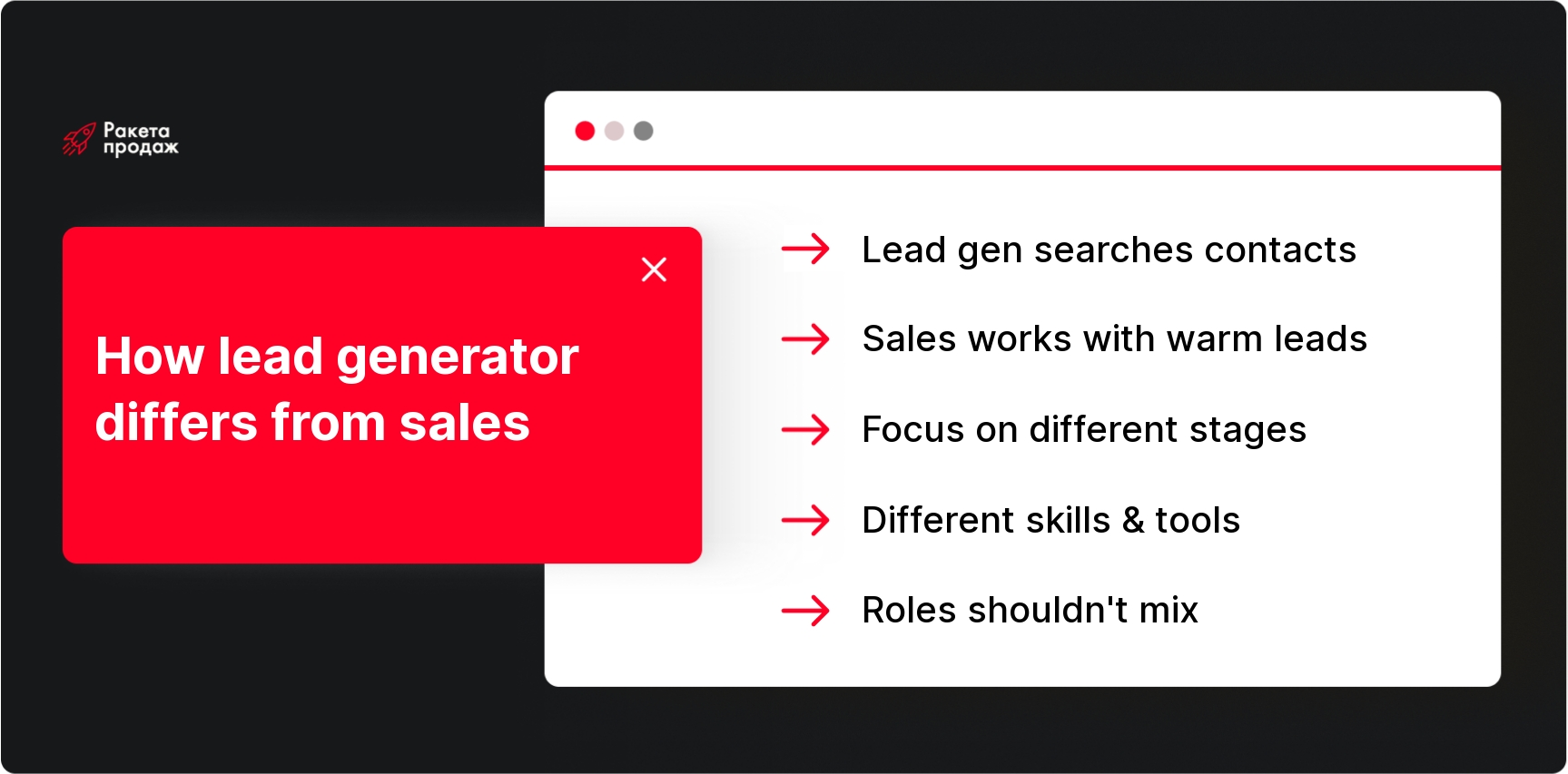
- A lead generation specialist owns the top of the funnel (search, initial touch, qualification), while a sales manager works with warm leads and closes deals – mixing these roles breaks the process.
- Data discipline in the CRM, understanding of key metrics (reply rate, meetings booked, accepted leads), and the ability to test hypotheses separate a systematic specialist from a simple activity executor.
In the article below, you’ll find a detailed checklist for evaluating candidates, specific interview questions, and red flags that will help you avoid a costly hiring mistake 👇
The problem is that the lead generation role can vary dramatically depending on the company and its needs. In one place it’s a research specialist, in another an SDR with qualification functions, and in a third a Lead Generation Manager responsible for strategy and the quality of the lead flow. Without clear lead generation specialist requirements, you risk hiring the wrong person.
This article will help you understand the skills of a Lead Generation Specialist that actually matter, which responsibilities you can assign to this role, and how to use a ready-made checklist when hiring. Understanding how to hire a lead generation specialist and how to choose a lead generation specialist with the right competencies will help you avoid costly recruiting mistakes.
Who Is a Lead Generation Specialist and Why Is One Needed
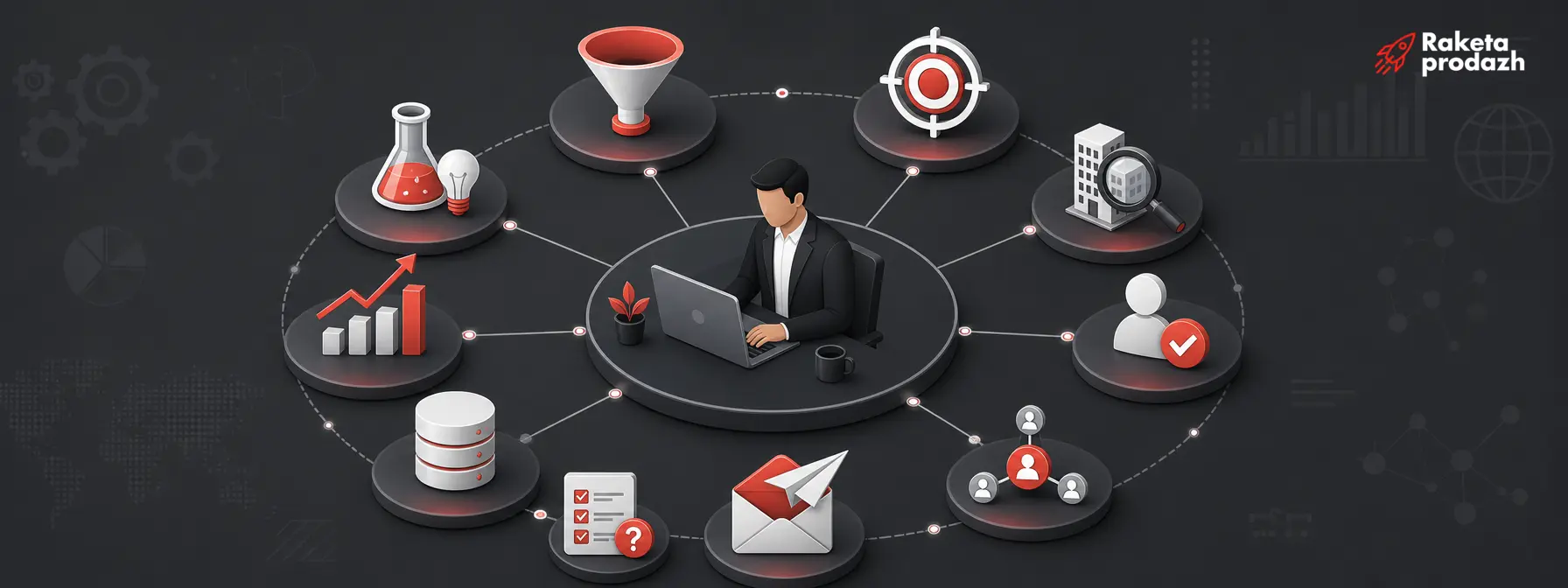
A lead generation specialist is responsible for finding potential clients and building the top of the sales funnel. In B2B, this means finding target companies, identifying decision-makers, gathering contacts, launching outbound campaigns, working with email and LinkedIn, qualifying initial interest, and passing leads to the sales team.
Depending on the company, the role can range from simple data collection to complex multi-channel campaign management. In some places, the specialist only handles market research and contact sourcing. In other companies, they take on SDR functions – running initial conversations, qualifying leads, and booking meetings for managers. In more advanced teams, a Lead Generation Manager is responsible for strategy, tools, processes, and the quality of the entire lead flow. Lead Generation Manager skills include not just hands-on lead work but also strategic campaign planning.
The core task of any lead generation specialist is to turn a cold market into a manageable stream of interested clients. Without this function, a company depends on random inquiries, word of mouth, or expensive advertising. A good lead generation specialist makes sales predictable and scalable, which is especially important in B2B, where every client can bring in significant revenue.
Do you recognize yourself in this scenario: you keep hiring lead generation specialist after lead generation specialist, but you still don’t get a quality lead flow? Either the person can only build contact lists, or they send thousands of unpersonalized emails with minimal response, or they hand the sales department “junk” leads that never turn into deals. The problem is that 70% of companies don’t understand the difference between simple contact collection and systematic lead generation integrated into the overall sales funnel. At “Rocket Sales,” over 8+ years we’ve built a comprehensive approach to constructing an entire sales department – from funnel audit and design to hiring and onboarding staff. Our methodology includes developing ideal candidate profiles, multi-stage interview systems, onboarding programs, and KPIs for every role, including lead generation specialists. The result of our work is sales departments that consistently generate an average revenue increase of +35%, with the best result being +$10,907,403 in 4 months.
Get a sales department where lead generation runs like clockwork - order a free consultation!
How a Lead Generation Specialist Differs from a Sales Manager
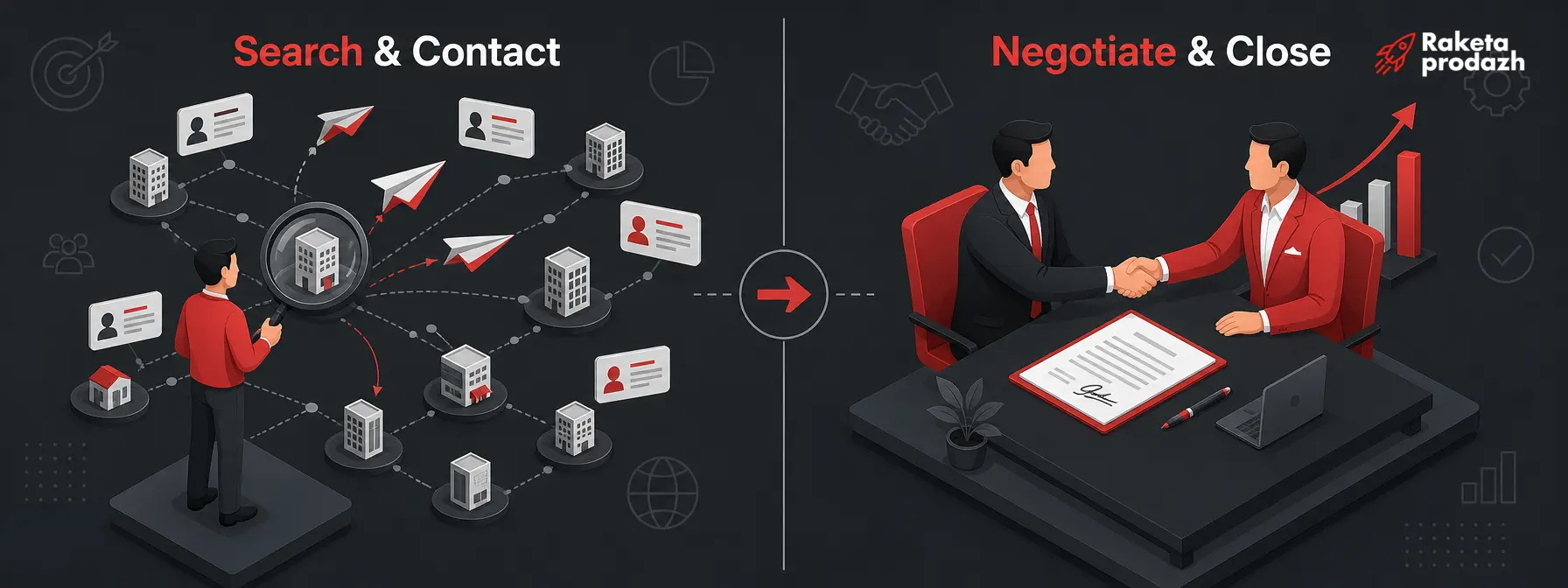
Many people confuse the roles of lead generation specialist and sales manager, but there’s a fundamental difference between them. A Lead Generation Specialist focuses on finding and attracting potential clients – building lists, sourcing contacts, outreach, initial touches. A sales manager works with already-qualified leads – conducting negotiations, giving presentations, preparing commercial proposals, and closing deals. Requirements for a Lead Generation Specialist differ significantly from requirements for salespeople, since these are different stages of the funnel.
The lead generation specialist is responsible for the quantity and quality of contacts at the top of the funnel. They need to understand who a potential client could be, where to find them, how to reach out, and how to spark their interest. A sales manager takes already “warm” leads and brings them to a close, using negotiation skills, product presentation, and objection handling.
In practice, the boundaries sometimes blur. In small teams, a lead generation specialist may combine contact sourcing with initial sales. In larger companies, an SDR (Sales Development Representative) sits between them, qualifying leads and passing them on to account managers. But the basic division remains: lead generation is about finding and making first contact, sales is about negotiating and closing deals.
Understanding this difference is critical when hiring. If a company needs someone to find contacts and launch outreach campaigns, there’s no point looking for a candidate with experience closing complex B2B deals.
Responsibilities of a Lead Generation Specialist
The responsibilities of a lead generation specialist need to be clearly defined before hiring, otherwise the company risks a mismatch of expectations. One candidate might expect strategic work, while the company is looking for simple email-address hunting. Or the opposite – a company searches for a “lead generation specialist” when what they actually need is a full-fledged SDR with qualification and meeting-booking functions.
Typical responsibilities include finding target companies based on set criteria, ICP (Ideal Customer Profile) analysis, identifying decision-makers and influencers within companies, collecting and verifying contacts, and building databases. Next comes launching email outreach campaigns, working with LinkedIn, making initial contact with potential clients, and qualifying their interest and needs.
Operational tasks include maintaining the CRM system, handing off qualified leads to managers, following up with contacts, analyzing campaign results, testing new hypotheses, and updating message scripts. In more advanced roles, this expands to multi-channel campaigns, ABM (Account-Based Marketing), integration with marketing tools, and participation in GTM strategy planning.
The key point is that all these responsibilities need to be prioritized and structured. If a company expects a lead generation specialist to handle 15 different tasks simultaneously, effectiveness will suffer.
Key Skills of a Lead Generation Specialist
Skill 1. Understanding B2B Sales and the Lead Generation Funnel
A good lead generation specialist should understand how the B2B funnel works from start to finish. This includes understanding the ICP (Ideal Customer Profile), the process of selecting target accounts, finding decision-makers, making initial contact, qualifying needs, handing the lead off to the sales team, and the further path to closing the deal. The core competencies of a lead generation specialist start precisely with understanding the full sales cycle.
Without understanding the full funnel, a lead generation specialist measures their work only by quantitative metrics – how many contacts were found, how many emails sent, how many replies received. Meanwhile, they don’t think about lead quality, ICP fit, the probability of closing the deal, or the impact of their work on final revenue. The result is a lot of activity but few sales.
Understanding the funnel helps the specialist make the right decisions at every stage: which companies to include in the search, which contact roles to prioritize, how to qualify interest, when to hand off the lead to a manager, and how to measure the effectiveness of their own work. This is the foundation of professionalism in lead generation.
Skill 2. Ability to Work with ICP and Target Segments
Quality lead generation starts with correctly choosing the target audience. The specialist should be able to work not “across all companies indiscriminately,” but according to a clearly described ideal customer profile. They need to understand which industries, company sizes, geographic regions, contact positions, and signs of solvency match the product.
Working with ICP includes analyzing existing clients to identify common characteristics, understanding the pains and needs of the target audience, signs of purchase readiness, seasonality, and decision-making triggers. A good lead generation specialist can explain why a specific company made it onto their list and predict the likelihood of their interest.
If the ICP is chosen inaccurately, even the most active work will produce weak results. The specialist will waste time on unsuitable companies, get low response rates, and pass the sales team leads that don’t turn into deals. The ability to correctly segment the market and choose target accounts is the foundation of effective lead generation.
Skill 3. Research and Finding Target Companies
Research skills separate a professional lead generation specialist from a mere “contact collector.” The specialist should be able to find companies not just by basic criteria (industry, size, region), but also by more complex signals – tech stack, recent investments, personnel changes, company news, job openings, and other triggers.
Quality research includes analyzing the company website, social media, news, financial reports, client lists, partnerships, and the competitive landscape. A good lead generation specialist can determine whether a company is in a growth phase, whether it has budget for solving specific problems, and what events could serve as a reason for contact.
Modern tools – LinkedIn Sales Navigator, Apollo, Crunchbase, industry databases – help automate part of the research work. But understanding what to look for and how to interpret the information found remains the specialist’s key competency. In B2B, what matters isn’t the volume of the contact database, but its relevance and potential for converting into real deals.
Skill 4. Finding Decision-Makers and Verifying Contacts
Finding the right company is only half the job. A lead generation specialist should be able to identify the right people within the organization – decision-makers and influencers who can make or influence a purchase decision. Depending on the product, these could be a CEO, founder, Head of Sales, CMO, HRD, CTO, CFO, or department specialists.
Finding decision-makers requires understanding the organizational structure of companies, the specifics of decision-making across different industries, and the roles and responsibilities of various positions. A good lead generation specialist analyzes LinkedIn profiles, studies the company team, maps out the hierarchy, and finds multiple potential entry points into the company.
Equally important is verifying the contacts found – checking whether the email address is current, whether the contact’s position is accurate, their connection to the company, and the correctness of the LinkedIn profile. Using invalid data hurts email campaign deliverability, wastes tool budgets, and can damage sender reputation. Contacts shouldn’t just be collected in large numbers – they need to be suitable for effective outreach.
Skill 5. Working with LinkedIn and Professional Networks
LinkedIn remains the primary platform for B2B lead generation, but working effectively with it requires understanding not just the technical capabilities but also the ethics of professional communication. The specialist should be able to use LinkedIn to find companies, analyze roles, verify decision-makers, study context, and build trusting relationships.
Skillful work with LinkedIn includes optimizing one’s own profile for credibility, using Sales Navigator for precise targeting, studying the activity of potential clients, and finding mutual connections and points of contact. It’s important to understand the platform’s limitations, algorithms, and rules to avoid blocks and reputational risks.
LinkedIn helps you understand a company’s structure, employees’ career changes, their professional interests, and possible reasons for contact. But aggressive mass outreach via LinkedIn can lower brand trust and complicate further work with the audience. Effective LinkedIn lead generation combines automation with a personal approach and respect for message recipients.
Skill 6. Email Outreach and Writing Personalized Messages
Email remains one of the most effective B2B communication channels, but the quality of the messages determines the campaign’s outcome. A lead generation specialist should be able to write short, relevant, and effective emails that grab attention, demonstrate value, and motivate a response.
The structure of an effective outreach email includes a personalized subject line, a relatable opening line, a brief value hypothesis, a clear call-to-action, and a professional signature. A good lead generation specialist tests different personalization approaches, message variants for various roles and segments, and follow-up sequences to boost response rates.
Personalization doesn’t mean simply adding the recipient’s name to a template. Quality personalization is based on research: mentioning recent company events, relevant industry pain points, and specific challenges of the recipient’s role. This takes time and effort, but it significantly increases conversion compared to mass mailings.
It’s important to remember compliance and reputation: adherence to personal data legislation, an opt-out option, appropriate communication tone, and respect for recipients. Lead generation should never turn into spam.
Skill 7. Initial Lead Qualification
Getting an interested reply doesn’t necessarily mean you’ve got a quality lead. A lead generation specialist should be able to conduct initial qualification: understanding whether the contact fits the ICP, whether there’s a real need for the product, what role the respondent plays in decision-making, and whether it’s worth passing them to the sales team.
Qualification includes asking about the company’s current challenges, the solutions they’re currently using, their plans and budgets, decision timelines, the purchasing process, and other stakeholders involved. A good lead generation specialist knows how to ask open-ended questions, identify pain points, assess the contact’s urgency and authority, and determine the fit between the need and the proposed solution.
Passing unqualified leads to sales wastes managers’ time, reduces their trust in lead generation, and worsens overall conversion metrics. Quality initial qualification protects the sales team from irrelevant opportunities and helps them focus on promising prospects. This is especially important in B2B, where a manager’s time is costly.
Skill 8. Working with CRM and Data Discipline
The CRM system is the primary tool for managing lead generation, and careless data handling quickly turns the process into chaos. The specialist should be able to create lead records, fill in all necessary fields, note sources, statuses, funnel stages, interaction comments, next steps, and responsible managers.
Data discipline includes timely information updates, record deduplication, format standardization, correct use of tags and fields, and maintaining interaction history. This allows for tracking the effectiveness of different channels, analyzing campaign conversion, planning follow-up activities, and ensuring continuity when leads are passed between employees.
Quality data in the CRM is critical for analytics and management decision-making. If it’s unclear where a lead came from, what actions were taken with them, or why they were qualified or rejected, it’s hard to optimize the lead generation process and forecast results. A good specialist understands that careful CRM maintenance is no less important than the number of contacts found. Read more on the significance and approaches in our article on using CRM systems for leads.
Skill 9. Analytics and Working with Metrics
Lead generation isn’t just a creative communication process – it’s also an exact science with measurable performance indicators. The specialist should understand key metrics: number of target companies, valid contacts, messages sent, open rate, reply rate, positive reply rate, meetings booked, accepted leads, and conversion to opportunity.
Analytics helps you understand which segments respond better, which messages work more effectively, which data sources yield quality contacts, and which days and times are optimal for outreach. A good lead generation specialist doesn’t just execute an activity plan – they analyze the reasons behind successes and failures, test hypotheses, and continuously optimize the process.
It’s important to track not just activity (how much was done) but also effectiveness (what quality). If the reply rate is high but meetings booked is low – the problem is in qualification. If meetings booked is good but accepted leads is poor – the ICP might be misidentified, or the initial qualification isn’t being done thoroughly enough. Analytics turns lead generation from chaotic activity into a manageable and predictable process.
Skill 10. Ability to Test Hypotheses and Improve the Process
Lead generation requires constant experimentation and adaptation. Markets change, audiences become more demanding, competitors copy successful approaches, and platform algorithms get updated. A good specialist should be able to formulate and test hypotheses about every element of the process.
Testing subjects include target segments and contact positions, communication channels, message subjects and structure, timing and frequency of touches, offers and calls-to-action, and qualification criteria. Every test should have clear conditions, measurable results, and conclusions for further application.
The capacity for systematic improvement separates a strong specialist from a mere activity executor. Such a lead generation specialist doesn’t just follow instructions – they understand the logic of the process, see bottlenecks and opportunities, and propose data-driven changes. They can explain why a particular campaign didn’t work, what needs to change in the next iteration, and how to measure improvements.
This approach is especially important in dynamic markets, where successful tactics quickly lose their effectiveness, and new opportunities require creative thinking and a willingness to experiment.
Soft Skills: What Personal Qualities Matter for a Lead Generation Specialist
Technical skills are the foundation, but personal qualities determine whether a specialist can actually apply them in practice. Lead generation combines research work, communication, analytics, and a significant amount of routine tasks, which requires specific personality traits.
Attention to detail is critical at every stage – from company research to CRM record-keeping. An error in an email address, an inaccuracy in a company description, or missing information about a contact can ruin a campaign or create an awkward situation in communication. Being systematic helps manage multiple campaigns at once without losing context or compromising process quality.
Curiosity and analytical thinking drive continuous improvement and a deep understanding of clients. The best lead generation specialists are genuinely interested in their prospects’ businesses, study their industries, and understand their challenges and trends. This not only improves personalization quality but also helps with strategic conversations with the sales and marketing teams.
Resilience to rejection and routine is an essential quality for daily work. In outreach, most contacts don’t respond, and those who do often say “no.” The ability to take this professionally, learn from feedback, and maintain a positive attitude determines long-term success in lead generation.
Finally, communication skills and the ability to collaborate with sales teams are crucial for integration into the overall process. The lead generation specialist should be able to explain the logic behind their decisions, receive feedback from managers, adapt their approach to business requirements, and participate in strategy planning.
What Tools a Lead Generation Specialist Should Know
Modern lead generation is impossible without the right technology stack. Tools can be divided into several categories, each solving specific tasks in the process of finding and developing leads.
CRM systems serve as the central hub for managing the entire process. The specialist should be confident working with popular solutions – HubSpot, Salesforce, Pipedrive, or local alternatives. LinkedIn tools include Sales Navigator for advanced search, automation solutions for scaling outreach, and tools for data extraction and activity monitoring.
Email outreach platforms allow you to manage large campaigns with personalization and follow-up automation. Email search and verification services help find and validate contacts, reducing bounce rates and protecting sender reputation. Company databases and people search engines provide access to structured data for building target lists.
AI tools are increasingly used for research acceleration, content creation, and data analysis. ChatGPT-type solutions help with industry research, email templates, company analysis, and other time-consuming tasks. Business intelligence and analytical platforms are necessary for measuring performance and identifying optimization opportunities.
It’s important to understand that knowledge of specific tools is useful, but it doesn’t replace understanding the underlying processes. Technologies change quickly, but principles remain. A good candidate can master a new service if they understand the logic of ICP, outreach, qualification, and sales handoff. When choosing a candidate, it’s worth evaluating not just experience with specific tools, but also the ability to adapt to new technologies.
How to Evaluate a Lead Generation Specialist in an Interview
An effective interview should test not just experience with tools, but also the candidate’s thinking process. It’s important to understand how they approach problem-solving, analyze results, and adapt strategy.
Start with questions about experience and process: “Which B2B segments have you worked with? How do you define ICP for a new campaign? What research do you do before outreach? How do you build target lists?” These questions reveal depth of understanding and a systematic approach to lead generation.
Operational questions test practical skills: “How do you find decision-makers within a company? Which channels do you use for first touch? How do you measure campaign success? What do you do if the reply rate is low? How do you know a lead is ready for sales handoff?” Answers should demonstrate concrete experience and methodology.
Analytical questions reveal the ability to learn and improve: “What mistakes were made in previous campaigns? What hypotheses have you tested? How do you analyze the performance of different segments? What would you change in the current process?” Strong candidates can articulate specific examples, explain reasoning, and show a growth mindset.
Scenario-based questions help assess problem-solving: “How would you build lead generation for [specific industry/product]? What challenges do you expect? How would you measure success?” This shows the ability to apply knowledge to new situations and think strategically about business needs.
Checklist: How to Choose a Good Lead Generation Specialist
Use this checklist to evaluate candidates and ensure comprehensive assessment of all critical areas. The candidate should demonstrate an understanding of the B2B sales funnel and the role of lead generation in the overall process.
Check their ability to work with ICP and target segmentation, and their experience finding relevant companies and decision-makers. Confirm their practical skills – the ability to find and verify contacts, experience with LinkedIn and email outreach, and the ability to write effective personalized messages.
The assessment should include qualification skills – the ability to conduct initial qualification, determine prospect readiness, and knowledge of BANT or similar frameworks. Technical competency includes CRM proficiency, data discipline, understanding of key metrics, and the ability to analyze campaign performance.
A process improvement mindset is critical – the candidate should show examples of hypothesis testing, campaign optimization, and learning from failures. Soft skills assessment should cover attention to detail, resilience, communication abilities, and collaboration with sales teams.
Finally, check cultural fit and growth potential. A strong candidate not only meets current requirements but also shows interest in professional development, industry learning, and taking on additional responsibilities as the business grows.
The selection process can be integrated in more detail into an overall system of professional hiring of sales department specialists, to improve recruitment effectiveness and reduce the risk of mistakes at the selection stage.
Properly hiring a lead generation specialist is only the first step toward creating a predictable stream of clients. But even the best candidate won’t be able to deliver maximum results without systematically built processes, integration with the sales department, and clear KPIs. “Rocket Sales” solves this challenge comprehensively – we don’t just help you find a lead generation specialist, we build an entire ecosystem of effective sales. This includes auditing current processes, designing an optimal funnel, developing regulations and scripts, setting up the CRM system, creating a hiring and onboarding system, and continuous monitoring of results. Our clients get not just new employees, but full-fledged sales departments that operate without the business owner’s involvement. Over the years, we’ve built 208 sales departments across 14+ industries, and among our clients are Mitsubishi, Yamaha, and Naftogaz. Don’t waste months on experiments with an uncertain outcome.
Build a sales department that generates predictable profit every month - get a free audit now!
To hire a strong lead generation specialist, a company must first define specific role requirements: do they need contact research, outbound campaign management, lead qualification, or comprehensive funnel ownership? The clearer the expectations and KPIs, the higher the chances of finding a candidate who will deliver not just activity metrics, but quality opportunities for sales success.
To build an effective lead generation team, it’s important not just to hire well, but also to organize the workflows of the entire department structure. Read more about how to build a sales department with modern requirements in mind in our article.
Don’t forget the importance of further onboarding sales department employees, so that new lead generation specialists not only get up to speed quickly but also effectively develop their competencies to help the team grow.


 Time to read: 9 min.
 17 July 2026