Key Takeaways
- Ukrainian companies lose deals not due to lack of leads, but due to chaos: managers maintain CRM for show, clients wait for responses for days, while competitors move faster.
- Systematization begins with honest diagnostics. Implementing CRM without understanding where clients are lost is like buying an expensive notebook.
- Weak contractors promise quick results without audit, strong ones fix KPIs, take responsibility for results and stay after implementation.
- Your team won’t maintain CRM if it’s not tied to compensation. Technology without discipline and motivation wastes budget.
- The right approach choice depends on real pain points: some need regulations, others hiring and training, third ones complete department building turnkey.
In the article below, you’ll see specific sales department systematization approaches of Ukrainian companies and learn how to choose a solution for your situation 👇
Sales department systematization helps make sales manageable: understanding where clients come from, at what stage deals are lost, how managers work, and what needs improvement. It’s a transition from “hoping for the best” to “knowing and controlling.” In wartime conditions and high competition, such control becomes not a luxury, but a survival necessity.
Familiar picture with chaotic sales? When managers work differently, CRM is maintained irregularly, and you don’t see the real picture of deals? At “Raketa Sales” we understand this pain – in 8+ years of work, we’ve transformed exactly such sales departments into systematic growth machines for 208 companies across 14+ industries. Our comprehensive methodology begins with deep audit of all processes, then we implement clear regulations, set up CRM for business specifics, and train the team to work by unified standards. As a result, chaos transforms into a predictable system: owners see the complete sales picture through dashboards and reports, managers work more efficiently thanks to clear processes, and plans are fulfilled consistently. Among our clients are Mitsubishi, Yamaha, Naftogaz, and hundreds of other companies that achieved average revenue growth of +35%.
Transform chaos into a managed sales system in 6-8 weeks - get free consultation on systematization!
Why Ukrainian Companies Start Systematizing Sales
Owners are tired of personally controlling every deal and answering the question “where’s my money?” with vague promises from managers. Leads get lost between Excel sheets and notebooks, managers don’t maintain CRM or fill it “for show,” plans aren’t met without clear reasons. Clients remain unanswered for several days, and when they’re finally reached, it turns out competitors have already succeeded.
There’s no clear reporting – it’s difficult to understand which attraction channels work and which “eat” budget wastefully. Scaling the team becomes a problem because new managers can’t get up to speed for months, while experienced employees guard their “secrets” like commercial information.
The Ukrainian market adds its own specifics: high competition requires quick lead processing, companies work with different channels simultaneously (website, Instagram, marketplaces, Telegram), and the transition of part of the team to remote format makes control even more complex. In such conditions, systematization becomes the only way not to get lost in chaos and maintain business control.
Main Sales Department Systematization Approaches
Ukrainian companies use different strategies to solve one task – transform sales into a manageable process. Some start with technology, others with people, third ones with processes. Everything depends on where it hurts the most.
Sales audit helps understand what happens “under the hood”: how managers actually work, where clients are lost, which processes exist only on paper. Building a sales department turnkey is relevant for companies that are growing or radically changing their business model – here they create structure from scratch.
CRM and analytics setup solves the “black box” problem – when it’s unclear how many deals are in progress and at what stage they are. Development of regulations, scripts, and standards helps managers work equally well, regardless of mood and experience.
KPI implementation and motivation system connects results with rewards, manager and sales director training raises the team’s professional level. Hiring and adaptation solve personnel issues, implementation support and control guarantee that changes take root. Remote sales department management becomes increasingly relevant – when you need results but can’t hire a sales director in-house.
Each approach has its own logic and application area, so successful systematization projects often combine several directions.
Examples of Ukrainian Companies and Their Sales Department Systematization Approaches
This is not a rating or comparison of “who’s better,” but an overview of companies that publicly offer sales department building, optimization, or systematization services in Ukraine. Each has its own specialization and approach to solving tasks.
One approach that business owners often discuss is the universal approach, where attention is paid to standardizing manager communication, conversion predictability, and deal stage control.
The company focuses on a comprehensive approach to sales systematization with emphasis on analytics in decision-making, technology and automation, organizational structure change without additional hiring. They start with deep analysis of target audience and competitors, then design department structure and processes. They offer audit of current processes, not to tell you what doesn’t work, but to analyze, find and show you influence levers instead of the usual “we’ll write you regulations,” CRM systems setup with integrations, sales funnel development and team training to work with new tools, implementation of skill models for sales team employees. Special attention is paid to analytics and reporting setup so owners can make decisions based on data, not intuition.
Dia consulting specializes in strategic approach to sales and building departments for specific business goals. They offer services for hiring and adapting managers, developing motivation systems and KPIs. They work with both small companies and large projects requiring multi-level sales departments construction.
Formula prodazh concentrates on training and developing sales skills of existing teams. They offer training on sales techniques, objection handling, negotiation. Besides training, they consult on personnel motivation issues, sales funnel building, and CRM implementation. The approach is oriented toward increasing each manager’s personal effectiveness and creating sales culture in the company.
Buro prodazh offers outsourcing services for hiring and remote sales department management. Suitable for companies that need results but don’t have resources to maintain a full in-house department. They also consult on building internal sales departments and transferring processes to staff. The company founder is Andrey Krupkin, who specializes in building remote sales departments, sales function outsourcing, and systematizing manager work.
GDC consulting specializes in comprehensive systematization projects for medium and large companies. They offer a full cycle of services: from audit and strategy to technology implementation and team training. Special attention is paid to CRM integration with other business systems (ERP, marketing, finance) and creating unified information space. They work with different industries and adapt solutions to business specifics. Some users also use the shortened query g dc when searching for information about consulting companies that deal with sales systematization and automation.
Choosing the right partner depends on company size, budget, current sales department state, and desired result.
How to Compare Different Companies' Approaches
Companies can’t be compared only by price or loud promises – in sales systematization, implementation details matter. It’s better to look at the approach: does work begin with diagnosing the real situation or do they immediately offer a “universal solution”? Does the company have a clear methodology or do they work “by intuition”?
It’s important to understand who will lead the project – an experienced consultant or a beginner learning from your mistakes. Does the contractor work with CRM systems or limit themselves to theoretical recommendations? Do they help with technical implementation or just give advice? Do they train the team in practical skills or conduct general lectures?
Does the contractor fix specific KPIs and take responsibility for results? Do they provide support after implementation or disappear after receiving payment? Do they have experience working in your niche and understanding of industry specifics?
Compare contractors by criteria: diagnostic quality, strategy presence, implementation experience, CRM competencies, training programs, control system, industry expertise, regular reporting, and post-project support. These factors determine whether you get a working system or a beautiful presentation.
How to Understand What Your Company Specifically Needs
Choosing the right approach starts with honest diagnosis of the current situation. If it’s unclear where clients are lost and why plans aren’t met – start with an audit. There’s no point implementing new tools without understanding problem causes.
For instance, if you want to avoid typical sales department mistakes, it’s important to pay attention not only to technology but also to personnel work, motivation, and standards.
If leads exist but managers work however they want – you need CRM, regulations, and a clear sales funnel. When everyone invents their own approach, results become unpredictable. Process standardization solves this problem.
CRM exists but nobody maintains it? Then the problem is in control, training, and motivation. Technology without usage discipline is a waste of money. You need a system that connects CRM maintenance with results and rewards. Additionally, it’s useful to study how to reduce sales department turnover to maintain a stable and productive team.
Weak team requires hiring, adaptation, and training. You can’t expect outstanding results from unprepared people. If the owner personally manages all sales – it’s time to consider a comprehensive approach or attract sales department consulting for professional support.
No sales department at all? Then consider turnkey construction – when a partner takes on structure creation, hiring people, process setup, and work launch. Proper diagnostics will help choose exactly the solution that solves your specific problems, not create new ones.
Sales department systematization is not just CRM implementation or regulation writing, it’s creating a working ecosystem where every process is thought through to the smallest detail. “Raketa Sales” specializes in exactly this approach: we don’t give general advice but create specific solutions for your business. Our team conducts comprehensive audit, identifies growth points, implements modern CRM systems with full process automation, develops personalized scripts, and trains the team to work by new standards. In 8 years we’ve built 208 sales departments that consistently show results: conversions grow by 5-86%, average revenue increase is +35%, and the best case is +$10,907,403 in 4 months. We work with companies of any size – from startups to corporations like Mitsubishi and Naftogaz. Don’t spend years on experiments with uncertain results when you can get a proven system.
Create a sales department that works like clockwork and brings stable revenue growth!
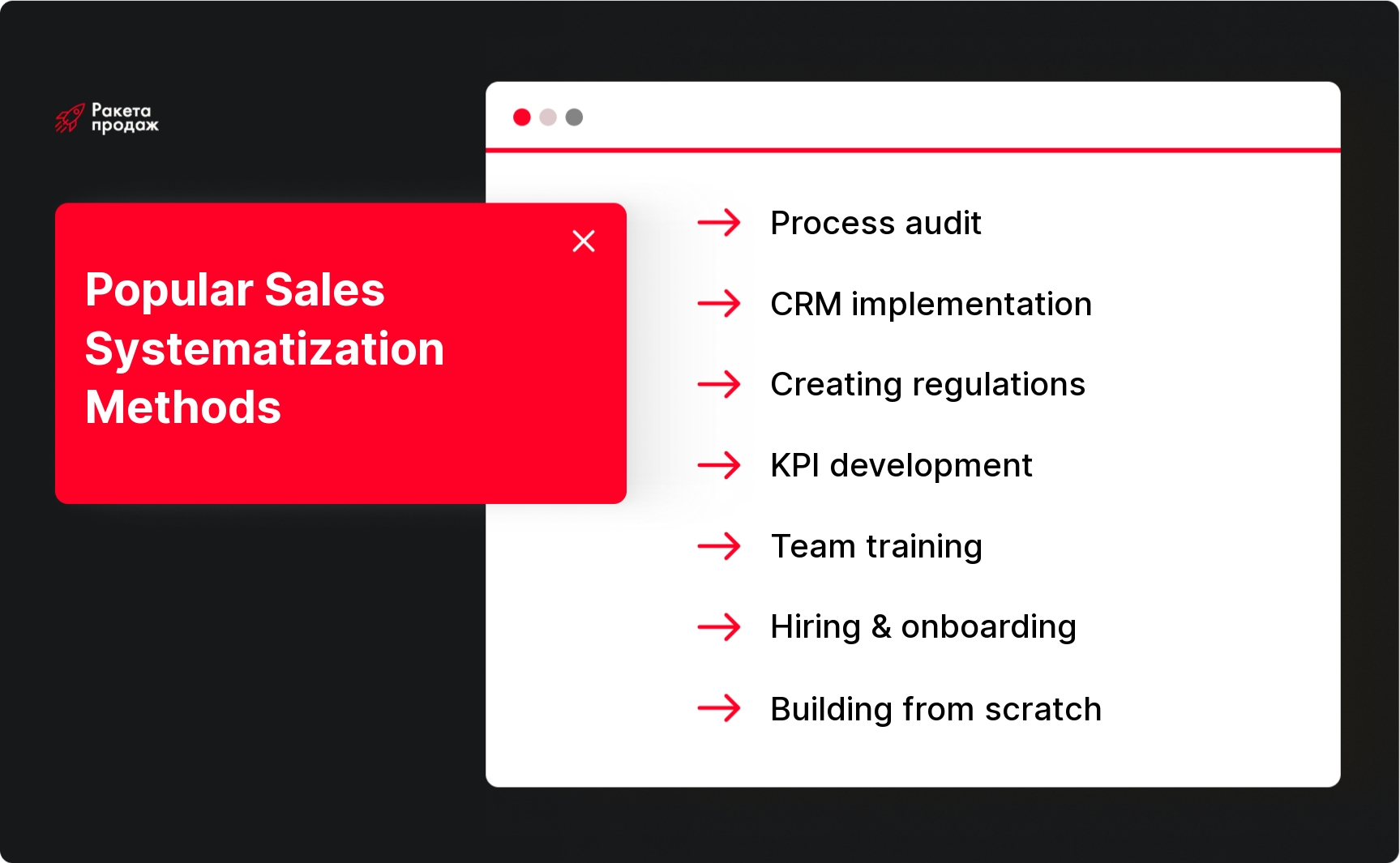
Different sales department systematization approaches are used in Ukraine: auditing existing processes, implementing CRM and automation, developing regulations and standards, setting up KPIs and motivation, team training, personnel hiring and adaptation, as well as turnkey sales department construction. Each approach solves specific tasks and suits companies at different development stages. Systematization success depends not on choosing the “best” contractor, but on precisely understanding your own problems and choosing the appropriate solution. Before choosing a partner, it’s important to honestly assess the current situation, determine priority tasks, and only then look for a company that specializes in exactly such issues.


 Time to read: 11 min.
 27 May 2026