icon

Why Sales Managers Don't Have Time to Sell: How to Cut Unnecessary Tasks and Boost Productivity

A familiar picture: the plan isn’t being met, yet managers look busy from morning till evening. Calls, correspondence, reports, meetings – there’s plenty of movement, but no deals. And that’s when the main question comes up: why do sales managers waste time not selling if their whole day is formally scheduled?


Want a high-performing sales team without the hassle?
We’ll build it for you.
Contact Us

Key Takeaways

  • A drop in quota across the entire team at once signals a systemic problem (processes, leads, product), not weakness in individual managers.
  • The typical salesperson spends only a third of the day on real conversations with clients, while the rest of the time goes to reports, correspondence, and approvals.
  • Weak lead qualification and the lack of call scripts force managers to improvise on every call instead of moving consistently through the funnel.
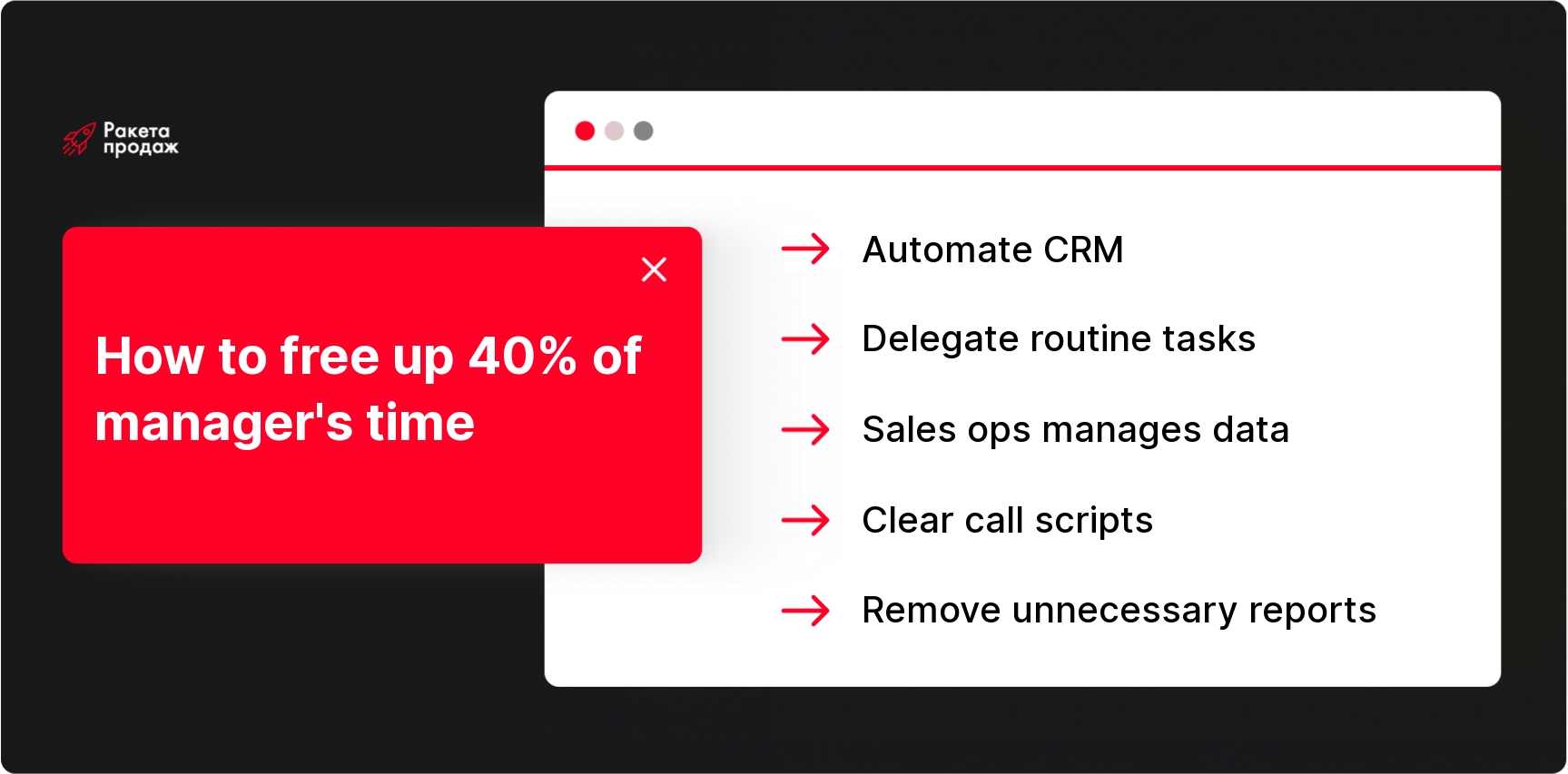
  • CRM automation, offloading routine work to assistants and sales ops, can free up to 30-40% of a manager’s working time for real sales.
  • Your manager should regularly listen to calls, give specific feedback, and update techniques – otherwise the team slides back into old, inefficient habits.

In the article below, you’ll find a precise breakdown of which tasks to remove, delegate, or automate to bring the team’s focus back to deals 👇

The answer is rarely obvious. Sometimes it really does come down to specific people, but more often the problem is much broader – it’s in processes that quietly push client work aside in favor of administrative routine. In this article, we’ll break down where the sales department’s working time actually goes, which tasks can and should be removed, and which should be handed off to other roles in the company. This will help bring the team’s focus back to where revenue is generated and boost sales manager productivity without unnecessary pressure or penalties.

Why It's Important to Identify the Real Cause: People or Processes?

Before figuring out who’s to blame, it’s worth stopping to look at the numbers. Managers often take the shortcut: no results means the salesperson is weak, unmotivated, or simply lazy. But that conclusion is rarely backed by data and almost never solves the problem systemically. It’s far more productive to compare metrics across the whole team: if conversion drops for one person, the issue really is about their skills or engagement. If the entire funnel sags, the problem lies in leads, product, market, or the company’s own processes.

This kind of diagnosis requires concrete metrics, not general impressions from meetings. You should look at conversion by funnel stage, the actual time spent on different types of tasks, and sources of extra workload like reporting or approvals. For example, if three out of five managers have equally low call-to-meeting conversion, and no call script exists at all, the problem clearly isn’t the people. But if one employee consistently lags behind the others under the same conditions, that’s worth looking into individually. Next, it makes sense to figure out exactly which causes most often eat into sales managers’ working time and why managers spend time on non-sales activities instead of deals.

Sound familiar? Managers complain about not having enough time, the plan isn’t being met, and in reality 70% of the workday goes to reports, approvals, and manual CRM work instead of calling clients. This problem is familiar to 80% of business leaders, but it can be solved systemically. At “Rocket Sales,” over 8+ years of work we’ve built a methodology that automates the routine and brings the team’s focus back to real sales. Our experts conduct a comprehensive sales department audit: they analyze the funnel, identify bottlenecks in processes, configure the CRM for your needs, and roll out ready-made scripts, templates, and automation. The result? Our clients free up to 40% of their managers’ working time from administrative tasks and get sales departments that consistently hit 150% of plan every month.

Turn chaos into an efficient system - get a free productivity audit for your sales department!

Top 10 Reasons Why Managers Don't Sell (and Where Their Time Actually Goes)

If you break down an average manager’s workday, it’s worth first checking against what an effective sales manager’s daily routine should look like, and only then looking for deviations – it turns out that employees’ abilities have almost nothing to do with it. Far more often, the culprits are habits, outdated approaches, and organizational gaps that have piled up over months. Let’s go through the ten most common causes that explain why managers don’t have time to sell even with a fully booked day.

  • Lack of clear standards and scripts. Without a unified conversation scenario, every call turns into improvisation, and part of the time goes to coming up with arguments on the fly.
  • Administrative workload. Filling out reports, manually entering data into the CRM, and endless approvals eat up hours that could have gone to calling clients.
  • Weak lead qualification. The manager spends time talking to people who will never buy, instead of working with warm contacts.
  • Abandoned sales techniques. Trained once and forgotten – a month later the team is back to old, less effective habits.
  • Fear of rejection. Some managers subconsciously avoid cold calls, replacing them with “preparation” and double-checking information; this is where techniques for overcoming fear of rejection work well and should become part of the team’s regular practice.
  • Weak product knowledge. Without confidence in the product, it’s hard to handle objections, and the conversation often ends in nothing.
  • Vague plans and a demotivating bonus system. If there’s no visible link between effort and income, motivation to sell drops on its own.
  • Burnout and personal circumstances. A tired person simply can’t physically work at the same pace as a year ago.
  • Lack of oversight and training. Without feedback, a manager doesn’t understand what they’re doing wrong and repeats the same mistakes.
  • Procrastination disguised as preparation. Endless “let me check the database one more time” and “let me finish the proposal” instead of actual contact with the client.

Each of these causes seems minor on its own, but together they form a systemic leak of working time. Next, it’s worth understanding exactly how a company’s internal processes make this problem worse.

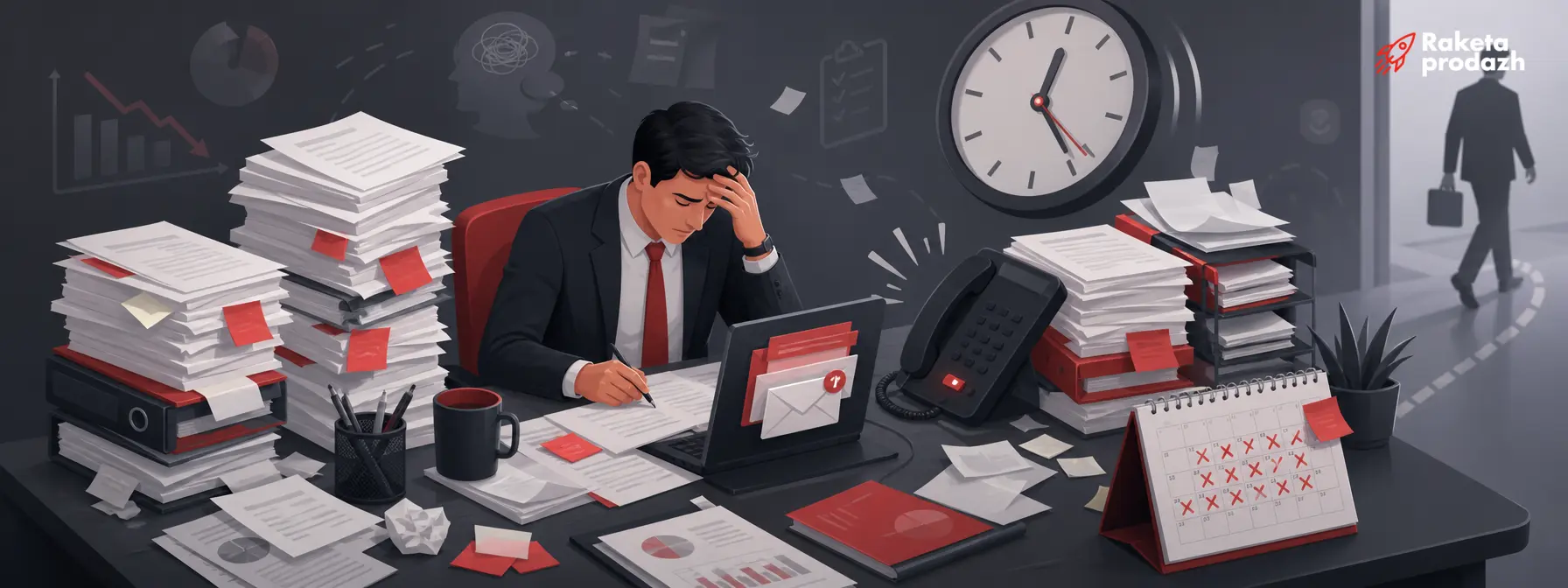
why managers don't sell — Sales manager overwhelmed by routine tasks instead of selling

How Processes Crowd Out Sales

Even an experienced and motivated manager is powerless against poorly built processes. Filling out reports, unstructured correspondence with colleagues, working with unqualified leads – all these routine tasks of the sales department fall into the “not urgent, but important” category, and it’s precisely these that quietly eat up the day. The problem is that they seem necessary, but in practice they often duplicate each other or aren’t even used for decision-making at all.

According to Salesforce’s State of Sales research, a typical salesperson spends no more than a third of the workday on actual active selling, with the rest taken up by administration, internal communications, and preparing materials. A similar picture can be seen in the Ukrainian market: companies roll out CRM and other digital tools but use them haphazardly, turning the system into an extra obligation rather than a helper. The result is a vicious circle: the more routine work there is, the less time there is for clients, and the less time there is for clients, the lower the results. This circle can only be broken at the management level, and that’s where the manager’s role comes to the forefront.

The Manager's Role: How to Change the Situation and Bring Focus Back to Sales

A sales department’s results depend not only on the people doing the work, but also on how well they’re managed. If a manager doesn’t listen to calls, doesn’t give regular feedback, and doesn’t track each employee’s individual development, sales manager effectiveness inevitably declines over time. Control here isn’t about total surveillance – it’s about systematic work with data: exactly where deals are being lost, at what funnel stage a manager stumbles, and which skills need improvement.

A good practice is regularly listening to calls and giving specific feedback rather than vague phrases like “do better.” It’s also useful to introduce individual development plans for each employee and continuously update sales techniques rather than relying on one-time manager training at the time of hiring. It’s important to keep a balance between demands and support here: strict control without development quickly leads to burnout, while softness without structure leads to chaos. Companies that build exactly this kind of culture usually notice sooner that part of the problem is solved not by strictness, but by freeing up employees’ time for real work with clients.

role of sales leader — Sales leader listening to calls and giving feedback to a manager

How to Free Up Sales Managers' Time for Real Sales

The routine tasks of a sales manager can almost always be partially handed off to technology. CRM and sales automation, algorithm-based call analysis, and chatbots for initial lead qualification take over the repetitive operations that used to be done manually. According to McKinsey’s research on sales automation, well-implemented solutions like these can free up to 30-40% of salespeople’s working time and noticeably sharpen their focus on negotiations with key clients.

Automation has a flip side too. It requires resources to implement, time to train the team, and a willingness to rebuild established processes rather than just “slapping software on top of chaos.” Still, the benefits outweigh the costs: you get transparency on every deal, and the manager sees the real workload of the team, not just final sales numbers. That’s exactly why the question of how to free up sales managers’ time shouldn’t be tackled piecemeal, but systematically – starting with an analysis of which tasks should even be left to a human in the first place.

How to Sort a Manager's Tasks into Essential, Unnecessary, and Automatable

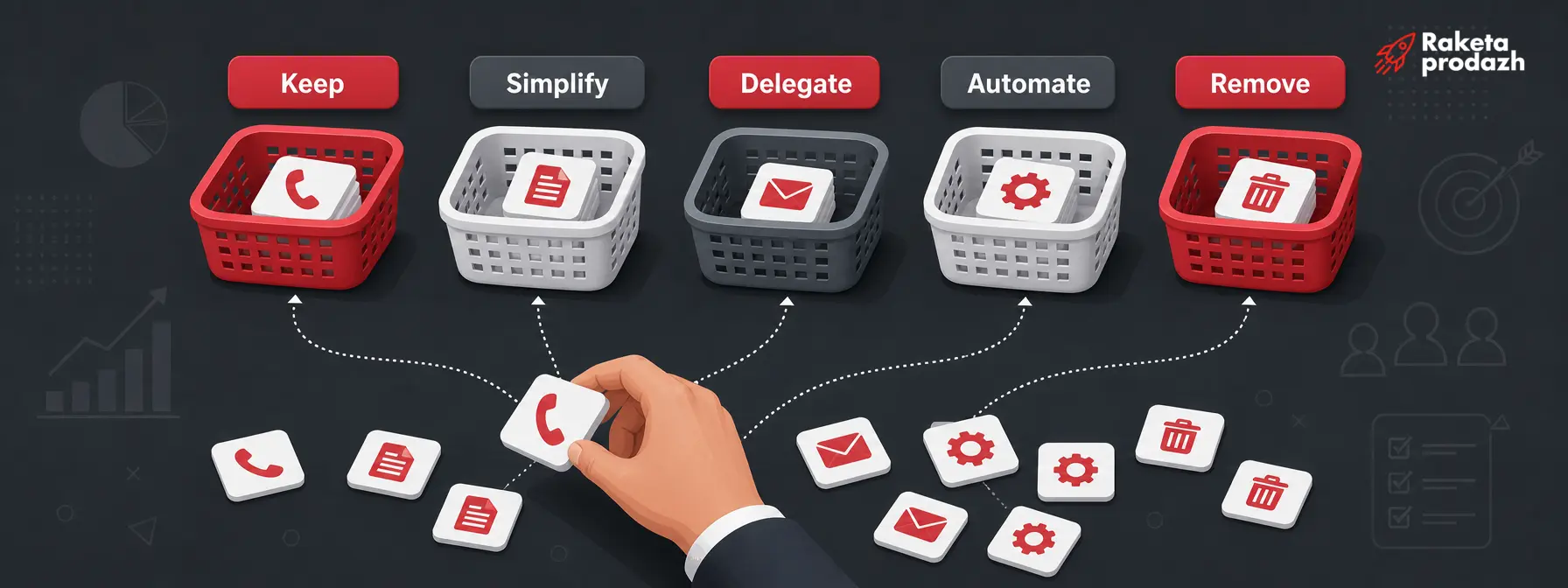
To understand where valuable work ends and dead weight begins, it helps to sort all of a manager’s tasks into five categories. This approach gives you a clear picture, helps identify unnecessary tasks of a sales manager, and lets you act with precision instead of cutting everything indiscriminately. The goal isn’t to leave the salesperson with nothing but calls, but to make sure every action has a clear connection to a deal or to revenue.

  • Keep with the manager – anything that directly affects client contact, moving a deal through the funnel, and final revenue.
  • Simplify – tasks the business needs but that take up an unjustifiable amount of time in their current form (for example, manually filling out long CRM forms).
  • Delegate – operations that an assistant, sales ops, support team, logistics, or accounting can handle.
  • Automate – notifications, deal statuses, reminders, standard email templates, reports, and lead distribution among managers.
  • Eliminate entirely – reports, actions, and approvals whose results nobody ever actually uses for decision-making.

After this kind of sorting, it becomes clear which non-core tasks of a sales manager can be handed off to other employees, automated, or removed entirely. And the freed-up time immediately becomes visible on the calendar. The next logical step is to figure out exactly who should take on the tasks a manager doesn’t need to be doing.

task categorization for sales manager — Diagram of sorting sales manager's tasks into five categories

Which Tasks Can Be Handed Off to Other Roles

Delegating tasks only works when there’s somewhere in the company to delegate them to. The good news is that most routine operations don’t require a separate, expensive hire – often it’s enough to redistribute responsibilities among roles that already exist. A sales assistant can take on preparing documents, entering data, and coordinating meetings, while a sales ops specialist can manage the CRM, monitor data quality, and set up automation.

Initial lead generation and qualification logically go to an SDR, while supporting existing clients goes to an account manager who knows how to build long-term relationships. Standard post-sale questions get picked up by the support team, order and shipment statuses by logistics, production, or finance, and preparing presentations and marketing materials by the marketing team. In the end, the salesperson should focus on where their personal skill directly affects money: live contact, negotiations, and building client relationships. Once this system is in place, all that’s left is to pull it all together and figure out what conclusions a business leader should draw from it.

Freeing up managers’ time from routine isn’t just a matter of convenience – it’s a direct path to revenue growth. But implementing all the principles described here requires expertise and experience working with different business models. “Rocket Sales” specializes in building turnkey sales departments: we don’t just analyze problems, we completely rebuild processes, roll out modern CRM systems, automate routine operations, and train the team in effective sales techniques. Our methodology includes standardizing all business processes, creating ready-made scripts and templates, setting up automated reports, and implementing a control system without excessive bureaucracy. As a result of working with us, our clients get teams that spend up to 70% of their working time on direct sales instead of administrative work, with an average revenue increase of +35%. Our partners include companies like Mitsubishi, Yamaha, and Naftogaz.

Build a sales department where managers sell instead of filling out reports - average productivity increase of +35%!

Conclusions

image

A sales decline is rarely about “bad” managers – much more often it’s about accumulated systemic failures: inefficient processes, demotivation, outdated techniques, and weak managerial oversight. To bring the team’s focus back to real sales, a manager should regularly run an honest diagnosis of working time, train employees, revisit motivation, and gradually automate the routine. Only a comprehensive approach – not one-off, isolated measures – allows a team’s resources to be freed up for revenue growth and helps a business stay competitive in tough market conditions.

In this article:
See more
Book a FREE sales funnel audit
CONTACT US
FAQ
Why do sales managers burn out?

The main causes are constant administrative workload, lack of feedback, vague plans, and working in a state of chronic uncertainty. When effort doesn’t convert into results and income, motivation drops, and fatigue builds up faster.

What shouldn't a sales manager be doing?

They shouldn’t be spending time manually filling out repetitive reports, searching for logistics information on their own, preparing standard documents, or working with clearly unqualified leads – these tasks make more sense to delegate or automate.

Which non-core tasks should be removed from sales managers' plates?

First and foremost – excessive reporting with no practical value, manual CRM data entry, approvals that nobody reads, and administrative coordination that an assistant or sales ops can handle instead.

SUBSCRIBE TO MY TELEGRAM CHANNEL
The most valuable sales information right on your phone!
icon

LOTS OF USEFUL INFORMATION, FREE TEMPLATES, AND CHECKLISTS ON MY INSTAGRAM

Materials and practical advice on sales growth in our blog: