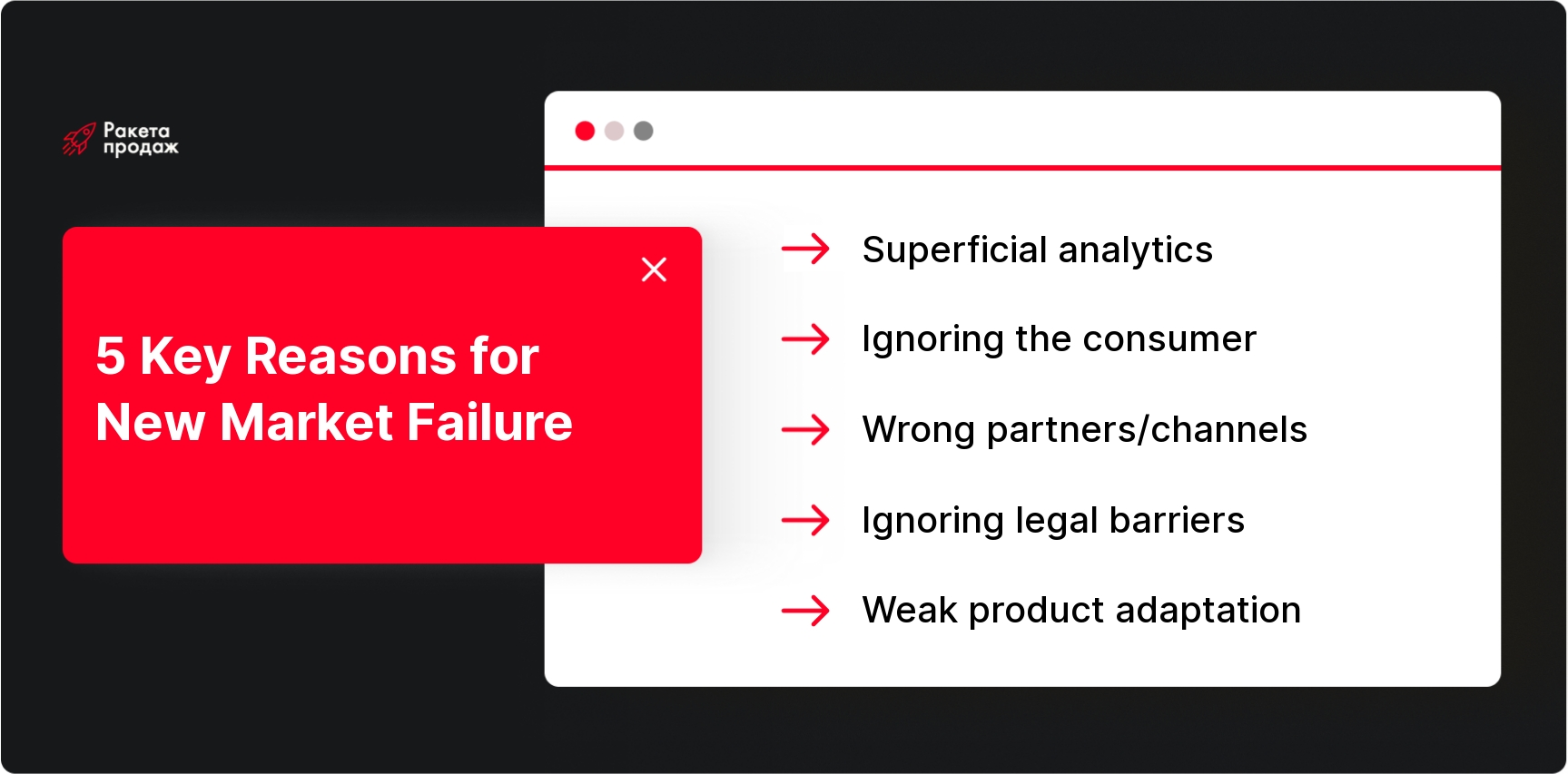
If we reduce all the previous breakdowns to essentials, we can identify five key factors that most often become reasons for failure when entering a new market. This is not a complete list, but these five factors appear in most unsuccessful cases – and working on them is critically important for any company planning expansion. Understanding what leads to an unsuccessful market entry strategy helps avoid repeating typical mistakes.
Lack of deep analytics and due diligence. Companies often decide to enter a new market based on superficial data: general industry reports, category growth statistics, competitor successes. But real analytics means diving into details: who your specific customer is, what problem they’re trying to solve, what alternatives they have, what barriers to purchase exist, how they make decisions, what channels they use to search for information and make purchases. Without this understanding, any strategy is built on sand. Due diligence includes not only market analysis but also partner verification, regulatory study, assessment of logistical and operational risks. Companies that save on this stage pay for it later – many times over.
Misunderstanding the local consumer. This isn’t just about demographics or income. It’s about motives, values, cultural codes, behavioral patterns. What’s really important to the consumer when choosing a product in your category? What inspires trust, and what raises suspicion? What brands do they already know and love, and why? Companies often project onto the new market their ideas of how a consumer “should” behave. But reality is always more complex. Misunderstanding the local consumer leads to the product, communication, price, channels – everything becoming irrelevant. And no marketing budget will save a product that doesn’t address a real need or doesn’t fit into the customer’s value system.
Wrong choice of partners or channels. Partners in a new market are your hands, feet, and eyes. If the partner is bad, the entire strategy collapses. Mistakes here vary: choosing a partner based on personal connections rather than competencies; insufficient verification of their financial stability, reputation, experience; weak contractual protection and lack of control mechanisms. Similarly with sales channels: a company may choose online when the target audience buys offline, or bet on large networks where margins are eaten up by commissions and placement conditions. The right choice of channels requires understanding not only where the customer buys but also the channel economics: what is the cost of acquisition, conversion, margin, turnover speed.
Underestimation of legal and tax barriers. This is especially relevant for B2B and international entries. Regulations, licensing, certification, data protection, tax regimes – all of these can become critical barriers. Companies often learn about legal problems after launch, when they have to spend time and money fixing mistakes or even shutting down operations. An unsuccessful market entry strategy often starts right here: the company doesn’t consult with local lawyers, doesn’t study legislative risks, doesn’t allocate time and budget for compliance. As a result, the launch is delayed, costs increase, momentum is lost.
Weak adaptation of product and marketing message. Even if you’ve researched everything correctly but haven’t adapted the product to local needs, failure is almost guaranteed. Adaptation isn’t just changing language or packaging. It’s revising functionality, format, price, service model. The marketing message also requires localization: slogans, visuals, tone of voice should resonate with the local audience, not be a mechanical translation. Companies that try to “push through” a standard product and standard campaign face low response and weak sales – and then blame the market, though the problem is in their own unwillingness to adapt.
These five factors are interconnected: weak analytics leads to misunderstanding the customer, which leads to wrong choice of partners and channels, ignoring legal risks, and lack of product adaptation. Therefore, work on minimizing risks must be comprehensive, not piecemeal.


 Time to read: 11 min.
 11 March 2026