icon

Why a Company Gets Leads but No Sales: How to Spot Problems in Your Sales Funnel

A familiar picture: the ad budget keeps growing, inquiries keep pouring in one after another, yet the company’s revenue barely moves. At this point, business owners often ask the same question – why aren’t there any sales if inquiries keep coming in at a steady pace. This is exactly what it looks like when leads aren’t converting into sales, and it hits harder than any drop in traffic. After all, marketing seems to be working, but there’s no more money coming in.

Want a high-performing sales team without the hassle?
We’ll build it for you.
Contact Us

Key Takeaways

  • A lead is not a customer, just an expression of interest. A significant share of inquiries stall out because of missed calls, forgotten chats, and lack of prioritization.
  • A slow response kills sales faster than bad advertising does. First contact within five minutes instead of two hours determines whether an inquiry ever reaches payment.
  • Your funnel leaks at specific stages, not everywhere at once. Conversion from inquiry to qualification, and from presentation to closing, shows exactly where the money is being lost.
  • Template scripts and a single touchpoint instead of a proper chain turn a hot lead into a lost opportunity. Personalization and multiple contact points solve more than half of these problems.
  • CRM and end-to-end analytics turn the funnel from a black box into a clear mechanism. Without them, you’re paying for advertising that brings clicks but not money.

In the article below, you’ll find a step-by-step algorithm for diagnosing your funnel, specific metrics to track, and tools to fix every leak 👇

The reason usually isn’t the advertising or “bad” customers. It’s hiding inside the sales process itself, in the place where an inquiry either turns into a payment or into silence. In this article, we’ll break down why leads aren’t converting, why inquiries aren’t turning into sales, exactly where the money leaks inside the funnel, and what steps can fix the situation – no magic, no miracle pills. Along the way, we’ll talk about CRM, lead qualification, and sales team organization, which are usually the weakest links. If you recognize your company in even a couple of these points, this article is for you.

Does this sound like your situation? When inquiries keep flowing in but sales stay flat, the problem is rarely the advertising or the quality of the leads. In 80% of cases, the real issue is that the sales department operates like a black box – no system, no clear processes, and no control over conversion at each stage of the funnel. At “Rocket Sales,” over 8+ years of work, we’ve helped 208 companies turn chaos in their sales department into a smoothly running system. Our experts conduct a deep analysis of the entire lead journey – from inquiry to payment – identify the real “holes” in the funnel, and set up processes so that every inquiry gets maximum attention at the right time. The results our clients get speak for themselves: an average revenue increase of +35%, with conversion growth reaching up to 86%. Our partners include Mitsubishi, Audi, Naftogaz, and other major brands that trusted us to build their sales departments.

Turn leads into steady profit with a systematic approach to sales - get a free sales funnel audit!

Understanding the Core of the Problem: A Lead ≠ a Sale

A lead is not a customer – it’s just someone who showed interest. They might have submitted an inquiry out of curiosity, compared a couple of options, or simply clicked the wrong button in an ad. Businesses, however, often treat every such contact as an almost-guaranteed sale, and that’s exactly where the first trap lies. This gap between expectation and reality is what creates the feeling that there are leads, but no sales.

According to various estimates, a significant portion of incoming inquiries literally “sits there” without any movement: the sales rep couldn’t reach the client, the customer changed their mind about responding, the inquiry got lost between chat and email. Every such loss increases customer acquisition cost, because you’re paying for traffic that never pays off. As a result, the advertising looks ineffective, even though the real problem is in the handling, not the traffic source. Next, let’s look at exactly which mistakes most often create this gap.

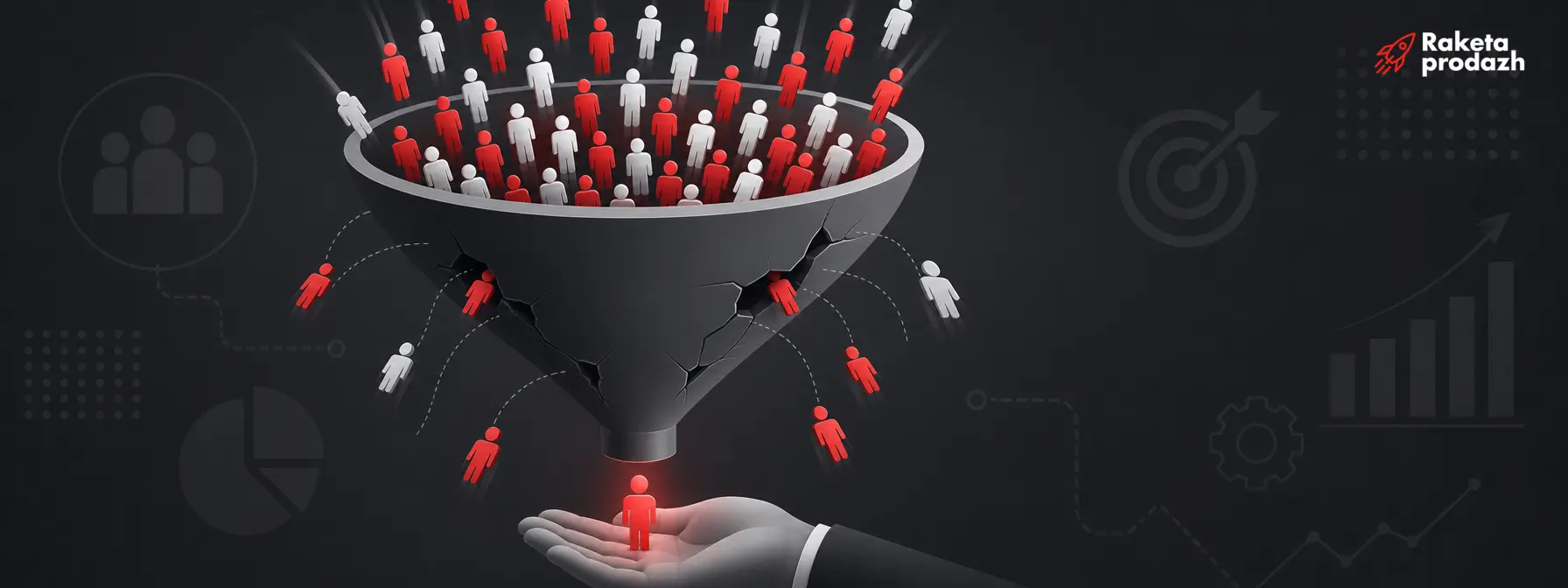
lead is not a customer — Illustration: lead funnel losing prospects before the sale stage

The Main Reasons: Where and Why Sales Are Lost

Most often, low lead conversion rate isn’t one big problem – it’s a dozen small holes in the process. A rep answers in two hours instead of five minutes, the script sounds like a robot, and an inquiry from Instagram gets lost because nobody’s watching that channel. On their own, each mistake seems minor, but together they eat up half of your potential revenue.

A separate sore spot is the lack of qualification and prioritization. When all leads get handled “in one big pile,” strong prospects get the same amount of attention as random inquiries, and end up losing out to competitors who responded faster. Proper lead qualification and scoring helps set priorities before a rep even picks up the phone. Add to that template messages with zero attempt at personalization, too few touchpoints, and no real handling of objections, and you get a picture familiar to most sales departments.

Here are the main reasons that come up most often:

  • A slow response to an inquiry, giving the customer enough time to find a competitor while you’re still preparing your reply.
  • No unified system for receiving leads, which causes some inquiries to get lost between email, messengers, and calls.
  • Template scripts that ignore the specific customer’s pain points and sound the same for everyone.
  • Too few touchpoints, when an inquiry gets forgotten right after one unanswered call.
  • A gap between marketing and sales, where no one is held accountable for the final result.

Having gone through this list, the logical next question is: how do you figure out which specific reason applies to your company?

Diagnosis: How to Find Your "Bottlenecks" in the Sales Process

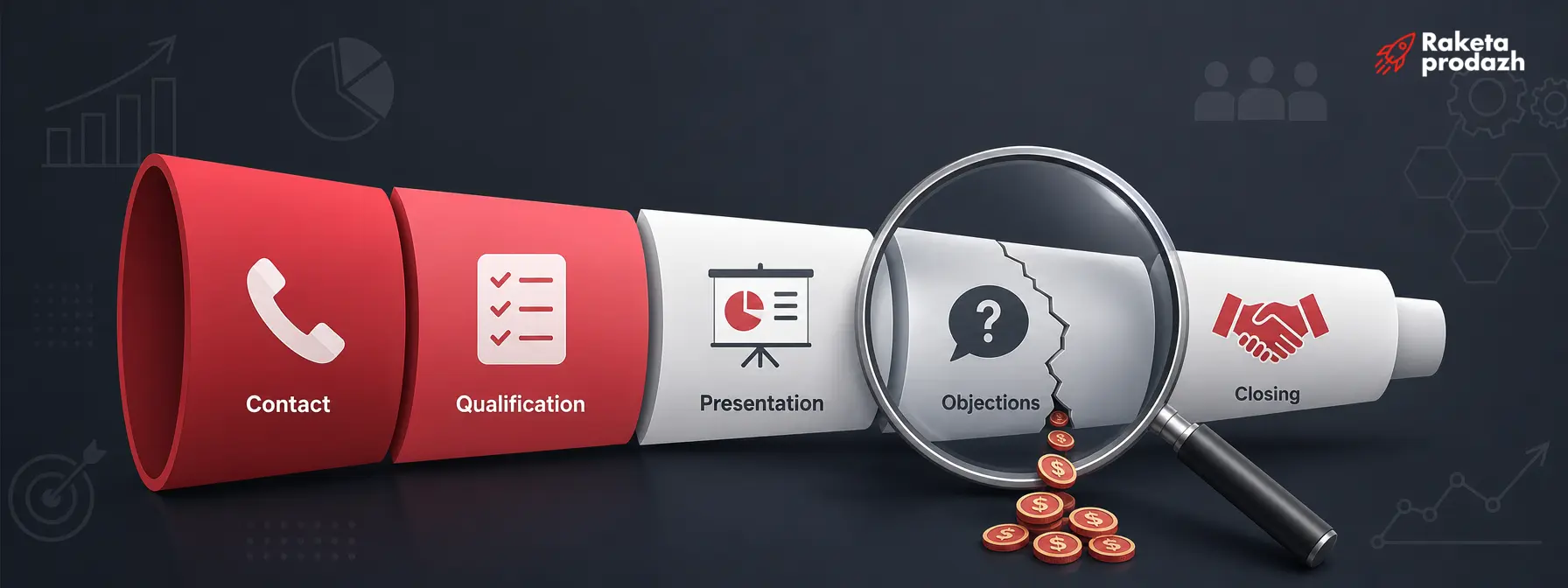
Before fixing anything, it’s worth breaking the funnel down into its components. Take the lead’s journey from inquiry to payment and split it into stages: first contact, qualification, presentation, objection handling, closing the deal. Each stage has its own conversion rate, and that’s exactly what will show you where the money is really being lost – not where you assume it’s being lost. A detailed breakdown of funnel bottlenecks helps you quickly find the exact stage where customers and money slip away.

Benchmarking against a “market average” number is pointless, since every company has its own product specifics, deal cycle, and audience. It’s far more useful to compare yourself against yourself over time: did things get better or worse over the last quarter. As shown by Harvard Business Review’s research on working with online leads, it’s the speed of first contact that most often determines whether an inquiry ever turns into a deal at all.

To make the diagnosis practical rather than abstract, it’s worth tracking specific metrics:

  • Average time to first response per channel and per rep.
  • Share of leads picked up within the first hour.
  • Average number of touchpoints per deal before payment.
  • Conversion rate for each stage of the funnel separately, not just “in-out.”

CRM reports and dashboards work like an X-ray here: within a couple of minutes, you can see exactly where the funnel “narrows” the most. From there, it’s time to move from diagnosis to concrete action.

sales funnel bottlenecks — Diagram of sales funnel stages highlighting the bottleneck

Step-by-Step Solutions: How to Increase Lead-to-Sale Conversion

The good news is that you can fix the funnel gradually, without revolutions or laying off half the sales department. Start with the simplest and cheapest thing: response speed. Then bring in qualification, personalization, and automation, and only after that move on to more complex analytics and team training.

This order makes sense because quick wins give you the motivation to keep going, while more complex changes require time and data that you usually don’t have yet at the start. Here’s a rough sequence of actions that works for most companies:

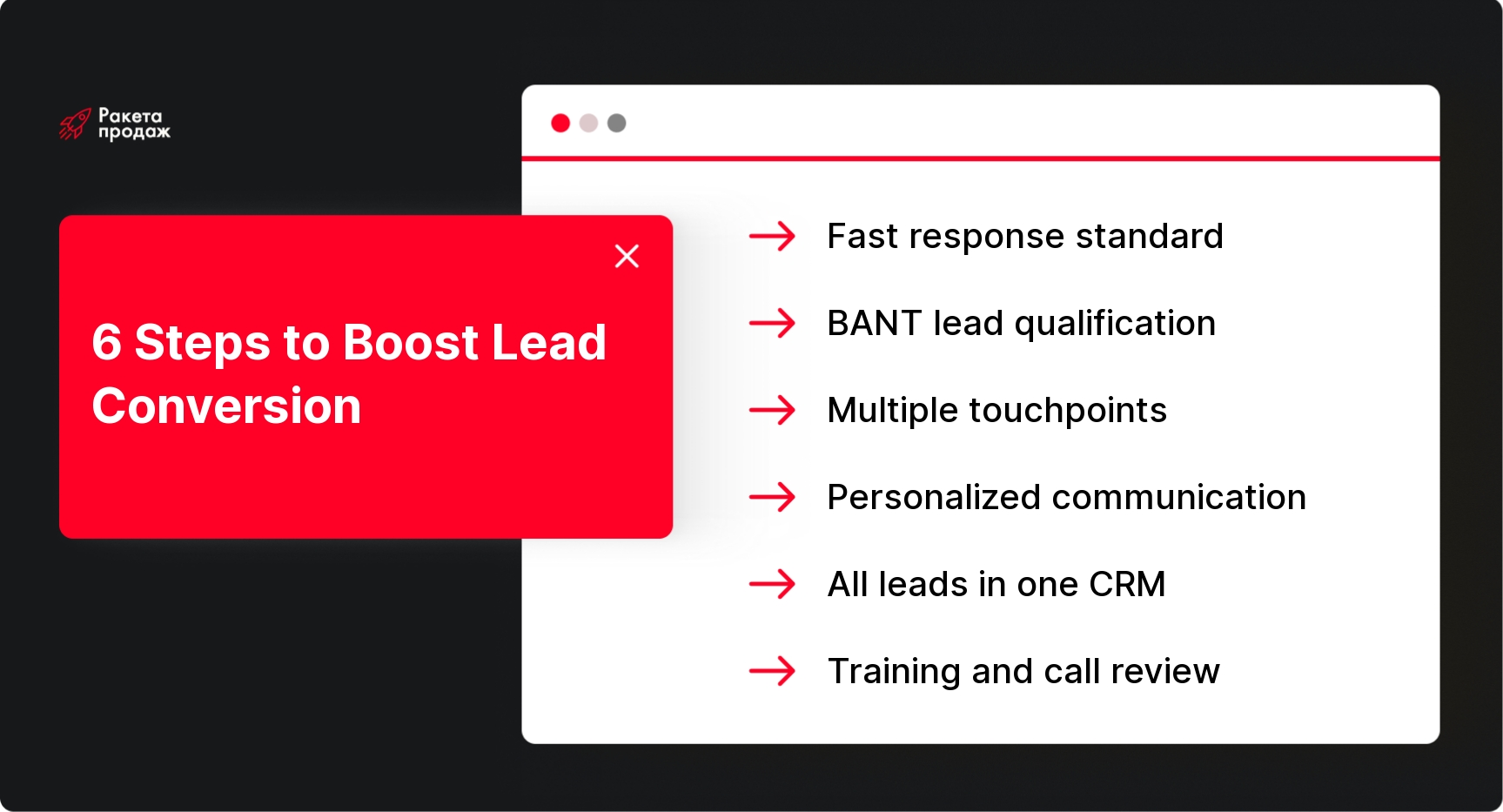
  1. Set a standard for first contact – for example, five minutes for hot inquiries – and set up automatic notifications for reps.
  2. Split leads into hot, warm, and cold using simple criteria based on the BANT model: budget, authority, need, timeline.
  3. Set up a chain of several touchpoints instead of a single call, including a phone call, a messenger message, and a follow-up email addressing common objections.
  4. Add personalization: use the customer’s conversation history and adapt the script to their specific pain point instead of just reading from a script.
  5. Bring all inquiry sources together into one CRM, so that no inquiry from chat, a form, or a call gets lost manually.
  6. Train the team: review calls, introduce KPIs for lead-handling quality, and explain why CRM even matters instead of just demanding that people fill it in.

If your sales department’s structure is still held together by a handful of enthusiastic reps, it’s worth looking at building a sales department step by step as its own project with its own stages and metrics. Each of these steps on its own adds a few percentage points to conversion, but together they can change the picture dramatically. Without the right tools, though, implementing all of this manually is nearly impossible.

Technology and Tools: CRM, Analytics, and Automation

CRM here isn’t some trendy gadget – it’s a working tool without which systematically increasing conversion is nearly impossible. A good system logs every inquiry, reminds the rep to call, stores the communication history, and shows exactly which stage a given deal is stuck at. Without it, you have to take the reps’ word for it, and as we all know, someone’s word doesn’t hold up on its own. A well-executed CRM implementation for sales growth is usually the turning point after which the funnel stops being a black box.

There’s a separate value to CRM combined with advertising campaign analytics. When you can see not just click counts but the actual path from ad to payment, evaluating ad effectiveness becomes honest. That’s exactly how end-to-end ROMI analytics works: it shows which channels bring in real money and which ones just create the illusion of activity. According to research on the Ukrainian CRM market, companies without this kind of connection often keep pouring budget into channels that generate inquiries but almost no sales.

Among practical features, it’s worth paying attention to automating repetitive tasks: call reminders, automatic lead distribution among reps, report templates for conversion at every stage. This frees up the team’s time for real conversations with customers instead of manually administering spreadsheets. Once the technological foundation is in place, all that’s left is to keep a finger on the pulse and regularly return to funnel diagnostics.

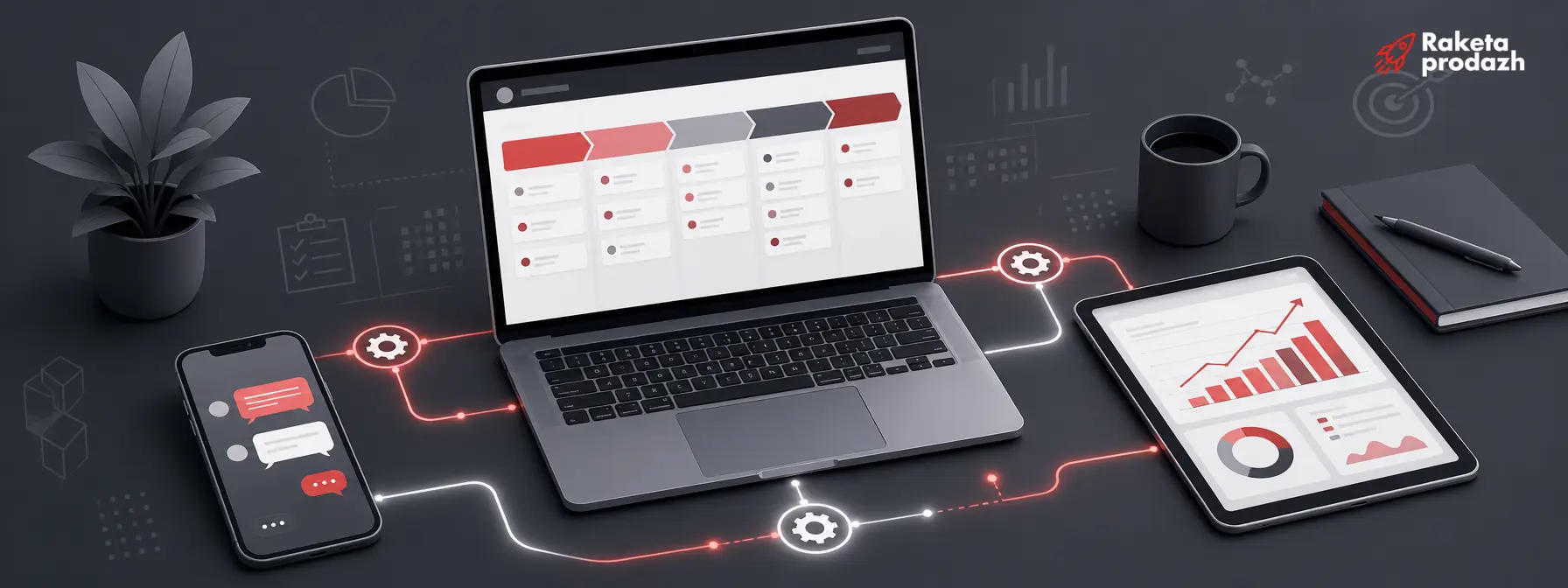
CRM and sales automation — CRM dashboard and connected devices for sales automation

Diagnosing the problems in your sales funnel is just the first step. To reliably increase lead-to-sale conversion, you need a comprehensive overhaul of your processes: from response speed to objection handling and quality control at every touchpoint. “Rocket Sales” specializes in building turnkey sales departments where every element – CRM, funnel, scripts, KPIs – works as a single system. We don’t just give recommendations – we fully implement working processes, train your team, and support you all the way through to the first results. Our methodology includes creating a personalized funnel for your niche, setting up automation for fast lead response, and implementing qualification systems and quality control for your reps’ work. As a result of working with us, our clients get sales departments that consistently exceed their targets and turn every inquiry into the maximum possible revenue. Don’t spend months experimenting with uncertain outcomes when you can get a proven system with guaranteed growth instead.

Build a sales department that converts leads into sales at maximum efficiency - order a systematic sales buildout!

Conclusion

image

The problem of leads not converting to sales is rarely explained by a single cause like bad advertising or unlucky customers. More often, it’s a combination of small failures inside the company: slow response times, weak lead qualification, scattered channels, and no unified tracking system. The good news is that every one of these points can be diagnosed and fixed without huge investments. Break your funnel down into stages, measure conversion at each step, get your CRM in order, and start with the simplest thing – the speed of first contact. If you’d like something more than theory to lean on, it’s worth checking out case studies on boosting conversion from companies with similar problems. A systematic approach to handling inquiries pays off faster than you’d think, and the first results are often visible within just a few weeks of working the new way. Start small, and low lead conversion rate will stop being a mystery.

In this article:
See more
Book a FREE sales funnel audit
CONTACT US
FAQ
Why aren't leads converting into sales?

Most often it comes down to a slow response, no lead qualification, and scattered communication channels. A lead loses interest faster than you manage to call them back.

How do you know if the problem is marketing or sales?

Compare traffic quality across channels with conversion inside the funnel. If inquiries keep coming in steadily but deals are low across all sources at once, the problem is almost always in sales.

What metrics should you watch when facing a low lead conversion rate?

Time to first response, the share of inquiries picked up for handling, the number of touchpoints per deal, and conversion at each stage of the funnel separately.

Why aren't leads buying after a consultation?

This is usually a sign of weak objection handling, lack of personalization, or not enough follow-up touchpoints after the first conversation.

SUBSCRIBE TO MY TELEGRAM CHANNEL
The most valuable sales information right on your phone!
icon

LOTS OF USEFUL INFORMATION, FREE TEMPLATES, AND CHECKLISTS ON MY INSTAGRAM

Materials and practical advice on sales growth in our blog: