Key Takeaways
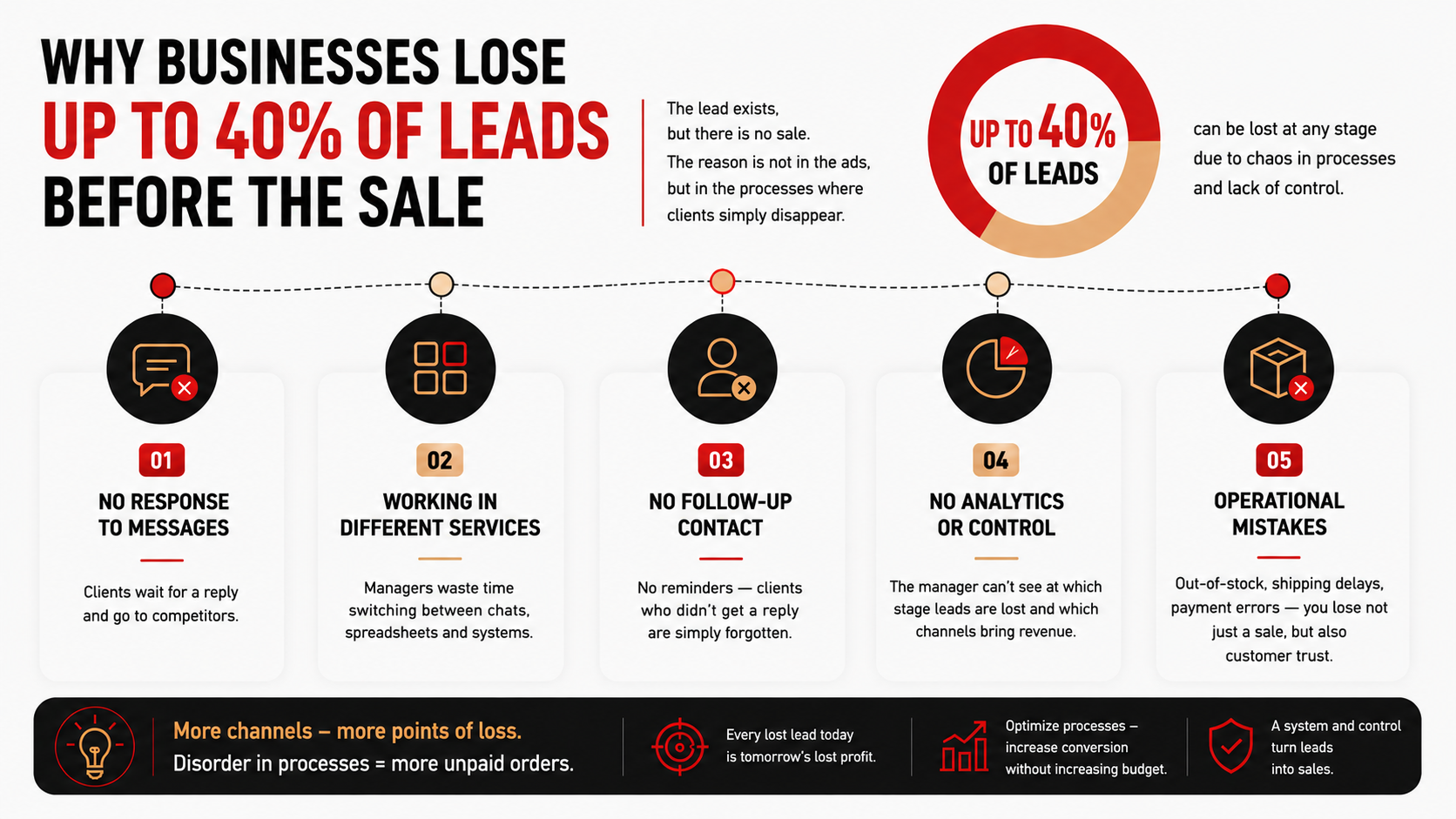
- Businesses often lose up to 40% of leads before the sale not because of weak advertising, but because of chaos in internal processes: messages get lost, managers fail to process inquiries on time, and customers go to competitors.
- As a company scales and adds more sales channels, manual control stops working. One manager physically cannot simultaneously handle dozens of chats, payments, orders, and tasks.
- The most dangerous losses are hidden. Businesses see the number of leads coming in but fail to understand at which stage customers drop off and where money is actually being lost.
- Problems arise not only in sales but also in operations: inventory mistakes, shipping delays, and process chaos destroy customer trust and repeat purchases.
- CRM systems only deliver results when they become a unified business operating system rather than “just another tool for managers.” Centralizing leads, payments, communication, and analytics removes bottlenecks and makes sales predictable.
In the article below, you’ll see why even a stable flow of leads does not guarantee sales growth, how businesses lose customers during the lead processing stage, and how process systematization helps eliminate these losses 👇
The problem starts after the lead has already entered the company.
In many businesses, leads are lost before the sale even happens: messages remain unanswered, customers never receive a follow-up, managers work across different platforms, and business owners lack a complete picture of what’s happening.
At a flow of 10–20 inquiries per day, this may go unnoticed. But once a company begins scaling, even small mistakes start costing serious money.
Why Businesses Lose Leads Before the Sale
As long as a company works through a single channel, such as Instagram or a website, the process seems manageable.
But once Facebook, Telegram, TikTok Ads, marketplaces, websites, and multiple messengers are added, the entire operating model changes. Managers are no longer focused only on sales. A significant part of their time goes into switching between tools, and this is where a chain of small losses begins.
A customer leaves a request on Instagram, the manager sees the message but postpones the reply because they are simultaneously arranging delivery for another order. After some time, the conversation drops lower in the inbox, and within an hour the customer has already purchased from another store. And the problem here is not the manager.
With a flow of 50–200 leads per day, manual control stops functioning as a system. No person can physically manage dozens of chats, payment statuses, inventory balances, tasks, and follow-up actions for every customer at the same time.
Hidden Losses Businesses Don’t Notice
There is another problem: companies often see the number of incoming leads but fail to see what happens to them afterward.
A business owner may say:
“We received 150 inquiries today.”
But much more important questions are:
- how many leads reached payment;
- at what stage customers stopped interacting;
- which channel generates real revenue;
- where exactly the biggest losses occur.
Without this data, decisions start being made intuitively.
For example, a company increases its advertising budget even though the real issue is not a lack of leads, but the fact that many of them never complete the path to purchase.
Operational Mistakes Also Impact Sales
Losses occur not only in communication — operational processes are another major issue.
A classic e-commerce scenario: a customer sees a product in an ad, places an order, and then the manager informs them that the item is out of stock.
Or another situation: the order is confirmed, but shipping is delayed because of inventory or logistics errors.
At first glance, it seems like just one lost sale.
But in reality, the business loses much more:
- repeat purchases;
- customer trust;
- recommendations;
- loyalty.
What the Ukrainian Market Shows in 2025–2026
Ukrainian e-commerce continues to grow, but at the same time it is becoming more complex.
The average conversion rate of online stores today fluctuates around 2–3%, depending on the product category. At the same time, the share of mobile purchases already exceeds 55%.
Businesses gain more customer interaction channels, but along with that come more potential points of loss.
Another trend is the increasing adoption of CRM systems and automation.
Most companies automate separate processes rather than the entire system.
For example: chats work in one service, inventory in another, analytics in spreadsheets, and marketplaces separately.
As a result, the company appears to use a CRM system but still operates manually.
Case Study: How Process Systematization Eliminated Lead Losses
A great example is Flora Shop, a store selling plants, gardening products, and related home and garden goods. During peak season, the company processes up to 200,000 plant sales, so speed and process organization directly impact business results.
At one point, the team realized the issue was no longer the number of leads — the business simply could not keep up with processing them.
The first warning sign came from Viber: more than 1,500 unread messages and orders had accumulated in chats.
Managers worked using a simple principle: they opened the latest message and started processing from there. As a result, older inquiries remained unanswered in conversations.
Other issues appeared simultaneously:
- payments had to be manually reconciled;
- customer interaction history was scattered across different services;
- managers could not see the full customer journey;
- as advertising traffic increased, the workload on the sales department became critical.
Paradoxically, the growing number of orders started creating more problems than benefits.
After centralizing processes, leads automatically started entering a single system, the team received a clear operational structure, and manual processes stopped being a bottleneck.
Today, the company’s main challenge is no longer the sales department. Due to the growth in order volume, the business now faces another issue: a shortage of warehouse staff. Meanwhile, the sales department operates steadily and predictably.
How CRM Helps Solve the Problem
Lead loss problems are usually solved not by increasing manager control, but by changing the operating model itself.
When all leads, communications, payments, and orders are collected in one place, the business gains not just a convenient tool, but a complete customer journey system.
One example of this approach is SITNIKS CRM — a system that allows businesses to combine leads from social media (Instagram, Facebook, TikTok), marketplaces (Prom, Rozetka), websites (Horoshop, Shopify), and messengers (Telegram, Viber, WhatsApp) into a single interface, manage inventory, track orders, send payment links and fiscal receipts directly in customer chats, monitor managers, and automate routine processes.
In this case, CRM becomes not just a manager’s tool, but a control system for the business.
Lead losses are rarely caused only by advertising or people. Most often, the issue lies between stages — when the business grows faster than its internal processes.
That is why before increasing your advertising budget, it is worth asking another question:
Does every lead you already paid for actually reach the sales stage?


 Time to read: 10 min.
 28 May 2026