icon

How to Use AI to Evaluate Sales Managers


Have you ever wondered why two managers with the same number of calls show drastically different results? The problem is that sales department heads often see only numbers: call count, meetings, sent proposals, and total revenue. But these metrics are just the tip of the iceberg. They don’t tell you how exactly the manager communicates with clients: whether they properly identify needs, follow scripts, handle objections professionally, record agreements, and systematically guide clients through the funnel.


Want a high-performing sales team without the hassle?
We’ll build it for you.
Contact Us

Key Takeaways

  • Call and meeting volume shows activity, but doesn’t explain why one manager with 30 calls closes twice as many deals as a colleague with the same workload.
  • AI analyzes 100% of conversations, not 5-10% like manual reviews, and identifies patterns: who asks 15 questions per call versus only 5, who talks 80% of the time versus who listens.
  • Weak managers skip key funnel stages: don’t record agreements, respond to leads after 4 hours instead of 15 minutes, and close leads without clear reasons.
  • The system shows which formulations for handling the “too expensive” objection close 40% of deals versus only 15%, becoming the basis for script adjustments.
  • AI simulators reduce newcomer onboarding by 2-3 times: employees practice dozens of scenarios in a week instead of a month of training on real clients.

In the article below, you’ll see specific methods of how to use AI to evaluate sales managers for each aspect of manager work and learn how to avoid typical implementation mistakes 👇

Imagine: you have 15 managers on your team, each making 30 calls daily. Physically listening to even 10% of these conversations is impossible – it would take all working hours. Selective checking gives a distorted picture and often subjective assessment. AI for the Sales Department changes the game: now you can analyze not just results, but the actual process of managers’ work – every call, every email, every deal stage.

Do you recognize the feeling when you understand your managers could work much better, but you physically don’t have time to control the quality of every call and analyze all their actions? AI solutions sound promising, but where to start implementation and how not to make mistakes choosing the right tools?

At “Sales Rocket,” over 8+ years working with 208 sales departments, we’ve created a comprehensive methodology for analyzing and evaluating manager performance that combines modern technology with proven management approaches. We conduct deep audits of every call, analyze CRM work, identify patterns of successful and ineffective actions, then build personalized automated control systems.

Our clients, including Mitsubishi, Yamaha, and Naftogaz, get teams that consistently show +35% revenue growth and work like precise mechanisms.

Get an objective picture of your sales department's work and learn how AI can double each manager's effectiveness!

Why Companies Are Switching to AI-Based Manager Evaluation

Traditional sales manager evaluation systems are built on quantitative metrics that are easy to measure: how many calls made, meetings held, proposals sent, deal amounts closed, whether targets were met. These numbers are important, but they only show results, not process. You can see that a manager hit their target, but you don’t know how many potential clients they “burned” with the wrong approach.

Classic call review by supervisors is selective checking. It’s physically impossible to regularly listen to all negotiations and read all correspondence. As a result, evaluation becomes fragmented and often subjective: a supervisor might catch a successful call and overestimate a manager, or conversely – hear an unsuccessful dialogue on a bad day and draw wrong conclusions. AI manager oversight solves this problem radically: the system can analyze 100% of communications, identify patterns, and give an objective picture of each employee’s work. This comprehensive approach represents a fundamental shift toward AI-based manager evaluation that delivers fairness and accuracy in performance assessment.

Methods of Evaluating Managers Using AI

Modern AI-powered sales management solutions work in several directions: speech analytics for deep call analysis, checking script compliance and communication standards, automatic client and lead scoring, generating detailed reports for each manager, comparison with benchmark sales scenarios. Unlike manual checking, which covers a maximum of 5-10% of calls, AI can analyze every dialogue and objectively determine each manager’s KPIs.

For example, platforms like Gong or Chorus analyze not only what the manager says, but how the client reacts: pause duration, voice tone, interruption frequency, question rate. Ringostat AI Supervisor for the Ukrainian market automatically transcribes calls in Ukrainian and Russian, identifies key dialogue stages, records objections, and checks compliance with corporate standards. This approach reveals that one manager asks three times more clarifying questions and gets higher quality information about client needs.

Method 1. Analyzing Manager Calls with AI

Evaluation of AI Managers’ Performance in calls is the most popular and effective way to evaluate work quality. Modern systems don’t just record conversations but conduct deep analysis of each dialogue: automatically transcribe speech, determine key stage duration (presentation, needs identification, objection handling), count manager questions, record client objections, and check if the manager proposed next steps.

Imagine: the system analyzes a call and shows the manager spoke 80% of the time, asked only 2 questions in 15 minutes of conversation, and didn’t record a single client objection. This is a clear signal of dialogue technique problems. Meanwhile, another manager in a similar situation spoke 40% of the time, asked 12 clarifying questions, and professionally handled 3 objections – the result is predictable.

AI-powered sales manager evaluation helps supervisors quickly identify problematic dialogues without needing to listen to them completely. The system can automatically highlight calls where the manager didn’t introduce themselves, didn’t identify needs, didn’t suggest a meeting, or made other critical errors. This allows focusing on coaching problematic cases instead of spending hours searching for what needs fixing. If a supervisor wants to systematically improve manager work efficiency, AI tools help find real reasons for low conversion and build personalized employee development plans.

If supervisors want to systematically improve manager work efficiency, AI tools become indispensable assistants for collecting accurate data and building individual development trajectories.

call analysis for sales managers — AI-powered analysis of sales manager call quality

Method 2. Checking Script and Communication Standards Compliance

AI can compare managers’ real dialogues with approved scripts or quality call checklists. The system checks: did the manager introduce themselves and the company correctly, did they find out contact information, ask key questions about needs, present the solution in correct sequence, handle objections, agree on next steps, thank for time.

It’s important to understand: this isn’t about forcing everyone to speak identically like robots. AI-powered sales manager evaluation focuses on following key stages of effective conversation, not exact text reproduction. The system understands meaning: if a manager said “What tasks are you currently solving in this area?” instead of “Tell me about your needs,” the “needs identification” stage will be counted as completed.

Such checking is especially valuable for companies with large sales teams where it’s difficult to control approach uniformity. AI can identify managers who systematically skip important stages: don’t present product value, don’t work with budget, or don’t record decision-making timelines. This data becomes the basis for targeted training and conversion improvement.

Using AI together with sales manager certification helps formalize quality criteria, identify employee strengths and weaknesses, and build a maximally transparent control system.

Method 3. Evaluating Lead Processing Quality

AI-based manager evaluation covers not only conversations themselves but overall lead work: first contact speed, number of touches until getting results, quality of guiding clients through the funnel, discipline in recording CRM results. The system can track how quickly a manager contacted an incoming lead, how many attempts they made, whether they moved the lead to the next stage or left it “hanging” without a clear action plan.

AI is especially valuable at finding situations where managers formally work but actually lose clients. For example: responding to applications after 4 hours instead of recommended 15 minutes, making only one call and immediately moving leads to “not answering” status, not recording agreements for follow-up contact, closing leads as “not relevant” without clear reasons or detailed comments.

Analyzing such patterns helps identify managers who perform well in calls but are poorly organized in systematic database work. Or conversely – disciplined in CRM management but underperform in communication quality. AI manager oversight gives a complete efficiency picture, not just a slice of one channel or activity. In practice, such tools are especially effective if companies simultaneously conduct step-by-step sales department audits and systematically eliminate weak points in the funnel and communications.

This stage should be considered as part of a comprehensive process, for example, relying on step-by-step sales department audits to identify bottlenecks in lead work and systematically improve metrics.

lead processing quality — Evaluation of lead processing speed and quality by managers

Method 4. Analyzing Objections and Refusal Reasons

AI collects and groups typical client objections: “too expensive,” “need to think,” “already working with another supplier,” “not relevant now,” “no budget,” “delivery times don’t work.” The system doesn’t just record these phrases but analyzes context: at what conversation stage the objection arose, how exactly the manager responded, whether this led to dialogue continuation or deal closure.

Such analytics reveals which formulations and approaches in objection handling actually work. For example, the system might show that with the “expensive” objection, managers who shift conversation to value and savings close deals in 40% of cases, while those who immediately offer discounts – only 15%. These insights become the basis for improving scripts and methodologies. After identifying typical errors, companies often implement sales manager training to quickly strengthen objection-handling skills and improve communication quality.

Analysis of AI Managers’ Performance in handling objections also helps identify “blind spots” in manager preparation. If most of the team poorly handles a specific objection, it’s a signal for targeted training or product positioning correction. If an individual manager consistently “loses” certain objection types, they need personal work on this skill.

It’s worth noting separately that timely organized and methodically structured sales manager training helps improve quality of working with typical and complex objections.

Method 5. Evaluating Managers' CRM Discipline

AI analyzes not only communications but CRM work discipline: does the manager fill client cards completely, set tasks for next contacts, update deal statuses timely, correctly indicate refusal reasons, observe established follow-up call deadlines. These metrics are critically important for sales funnel transparency.

Poor CRM discipline creates “black holes” in reporting: supervisors can’t see the real deal picture, can’t properly forecast revenue, and make informed management decisions. A manager might communicate excellently with clients, but if they don’t record agreements and set tasks, some potential deals simply get “lost” in the chaos of unplanned activities.

Evaluating managers’ CRM discipline through AI shows who on the team manages data systematically and who works “under the table.” The system can identify managers who update deal statuses late, don’t fill required fields, duplicate contacts, or incorrectly indicate lead sources. This information helps build personal work on improving each employee’s discipline and organization. At the same time, it’s important to analyze not only managers but also conduct sales department head evaluation, since the sales head shapes control standards and team management.

Additionally, for a comprehensive picture, it’s recommended to also conduct sales department head evaluation – to identify how organizational and management decisions affect CRM work quality within the entire team.

Method 6. Comparing Managers by Quality Metrics

Comparing managers by quality metrics allows evaluating teams not only by revenue but by action quality. AI shows who more often identifies client needs, who asks more clarifying questions, who better handles objections, who responds faster to incoming leads, who more often moves clients to the next funnel stage. This data helps understand why some managers consistently show high results while others don’t. Additionally, AI excellently complements sales manager certification, allowing employee evaluation not subjectively but based on specific data and real communications.

For example, the system might show that a top manager asks an average of 15 clarifying questions per call, while a low-performing manager asks only 5. Or that successful employees spend 60% of call time on needs identification and only 40% on presentation, while ineffective ones do the opposite. Such analytics gives clear understanding of which specific skills need development for each employee.

Quality manager comparison also helps identify internal mentors and experts. AI can determine who best handles specific objection types or works with certain client segments. These managers can become internal trainers and transfer their experience to colleagues through mentorship systems.

Long-term, a competent approach to team management and addressing “bottlenecks” achieves sustainable results, while examples of real cases of reducing sales turnover show how implementing AI evaluation can improve employee retention.

AI Simulators and Personalized Learning: Modern Standard of Manager Preparation

AI sales simulators work as a “virtual client” and simultaneously as a personal mentor for each manager. Such systems imitate realistic client dialogues, including complex emotional scenarios: aggressive clients, indecisive buyers, clients with limited budgets or tight deadlines. The simulator doesn’t just “play” a role but adapts to manager actions: if the salesperson identifies needs well, the client becomes more open; if they pressure on price, they might “close off” or become confrontational.

After each dialogue, the system gives structured feedback on each response: notes successful questions, points out missed objections, evaluates argumentation quality. AI simulators help develop empathy – managers learn to “read” client emotional states and adjust communication style. They also standardize learning quality: each employee goes through equally challenging scenarios and receives objective evaluation.

In practice, companies use simulators for accelerated onboarding of new managers: instead of a month of “learning on clients,” employees practice dozens of typical situations in a week. The system tracks progress: shows how presentation skills, objection handling, and deal closing improve. This reduces adaptation time by 2-3 times and increases manager confidence when working with real clients.

AI sales simulators — Personalized training of managers using AI sales simulators

Advantages of AI Evaluation for Managers and Business

Implementing AI evaluation radically changes sales culture and overall team effectiveness. Communication standardization ensures every client receives quality service regardless of which manager they interact with. This reduces client loss risk due to individual employee unpreparedness or errors, especially critical in B2B sales where error cost can be thousands of dollars.

Accelerating new employee training and adaptation processes gives companies competitive advantage in high sales market turnover conditions. AI systems can “level up” a newcomer’s skills to experienced manager level in a month, providing personalized training on weak points. Practice shows that transparent employee evaluation and development systems directly affect team retention, confirmed by real cases of reducing sales turnover. Objective statistics for each employee make KPIs and bonus systems fair: managers see clear connection between work quality and compensation.

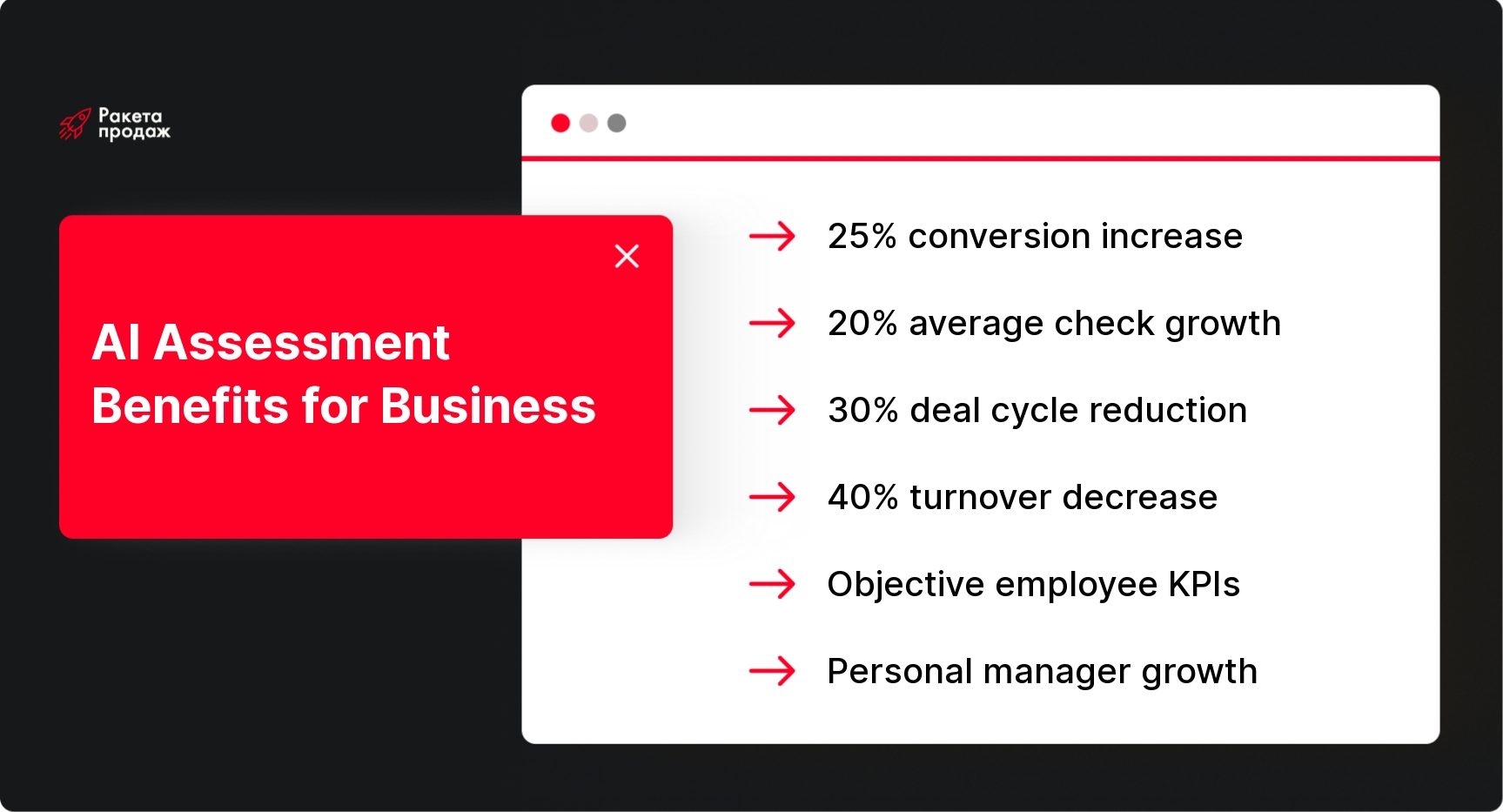
AI evaluation helps make informed personnel decisions without emotions and subjectivity. Data shows who needs development, who can be promoted to leader positions, and who should be let go. From experience of companies implementing conversation intelligence systems, sales funnel conversion grows 15-25%, average check increases 10-20%, deal cycle shortens 20-30%, and personnel turnover decreases 30-40% thanks to fairer and more transparent evaluation systems.

Ethics and Data Security Considerations

When analyzing calls and correspondence, it’s critically important to follow personal data processing principles, internal privacy policies, and Ukrainian legislation requirements. Employees must be notified that their communications are analyzed by AI systems and understand how this data is used. It’s important to predetermine who has access to call recordings and evaluation reports, establish data storage and deletion rules.

Evaluation criteria transparency helps avoid personnel resistance and create system trust. Managers should understand what parameters they’re evaluated on, how scores and ratings are formed, what actions lead to evaluation increases or decreases. It’s also necessary to provide appeal possibilities: employees should have the right to dispute AI analysis results and receive explanations from supervisors.

Ethical aspects of AI evaluation include preventing discrimination based on irrelevant characteristics: systems shouldn’t penalize accents, speech features, or communication styles if they don’t affect performance. It’s important to regularly check algorithm fairness and correct them when identifying biases. AI should remain a development tool, not just control – most focus should be on training and supporting managers, not “punishing” for mistakes.

CTA Block 2 (for end of article)

Implementing AI for manager evaluation isn’t just technological modernization but a radical change in sales management approach. However, to get real results, it’s not enough to simply buy software – you need systematic integration of tools with processes, team training, and management culture.

“Sales Rocket” specializes in comprehensive “turnkey” sales department transformation: we not only implement analysis and control systems but completely rebuild client work processes, train teams to new standards, configure CRM, and provide constant change support. Our methodology includes detailed analysis of each sales funnel stage, creating personalized manager development plans, implementing KPIs and dashboards for objective result control.

During our work, we’ve helped companies achieve conversion growth up to 86%, reduce deal cycles, and get predictable sales. Among our partners are leaders like Mitsubishi, Yamaha, and Naftogaz – they chose systematic approach over chaotic experiments.

Create a sales department where every manager works like a top performer thanks to AI and systematic approach!

Conclusion

image

Artificial intelligence isn’t just trendy technology but the key to building a truly strong, systematic sales team. It automates routine control, strengthens evaluation objectivity, but most importantly – helps develop each employee personally, build client trust through quality communications, and stay ahead of competitors. Even small Ukrainian companies can afford AI tools that were recently available only to large international businesses – and you’ll feel results within 1-2 months after implementation. Start small: analyze your team’s work through objective AI evaluation lens, and you’ll see how not only sales numbers change, but entire corporate culture.

In this article:
See more
Book a FREE sales funnel audit
CONTACT US
FAQ
What is AI manager evaluation?

AI manager evaluation is an automated system for analyzing salespeople’s work using artificial intelligence. The system analyzes calls, correspondence, CRM work, and other activities, evaluating communication quality, standards compliance, and each employee’s effectiveness by objective criteria.

What data is needed for AI analysis of manager work?

For effective AI analysis, you need call recordings, messenger and email correspondence, CRM data about deals and activities, sales results information. The more digital traces a manager leaves in client work, the more accurate the analysis and evaluation will be.

Can AI control call quality?

Yes, AI can analyze 100% of manager calls: check script compliance, needs identification quality, objection handling, dialogue structure. The system automatically identifies problematic calls and gives improvement recommendations, saving supervisor time on manual control.

What mistakes happen when implementing AI control?

Main mistakes: lack of transparency for employees, focusing only on control without training, ignoring ethical aspects, trying to replace live manager communication with AI reports. It’s important to position the system as a development tool, not punishment, and necessarily supplement automatic evaluation with personal coaching.

SUBSCRIBE TO MY TELEGRAM CHANNEL
The most valuable sales information right on your phone!
icon

LOTS OF USEFUL INFORMATION, FREE TEMPLATES, AND CHECKLISTS ON MY INSTAGRAM

Materials and practical advice on sales growth in our blog: