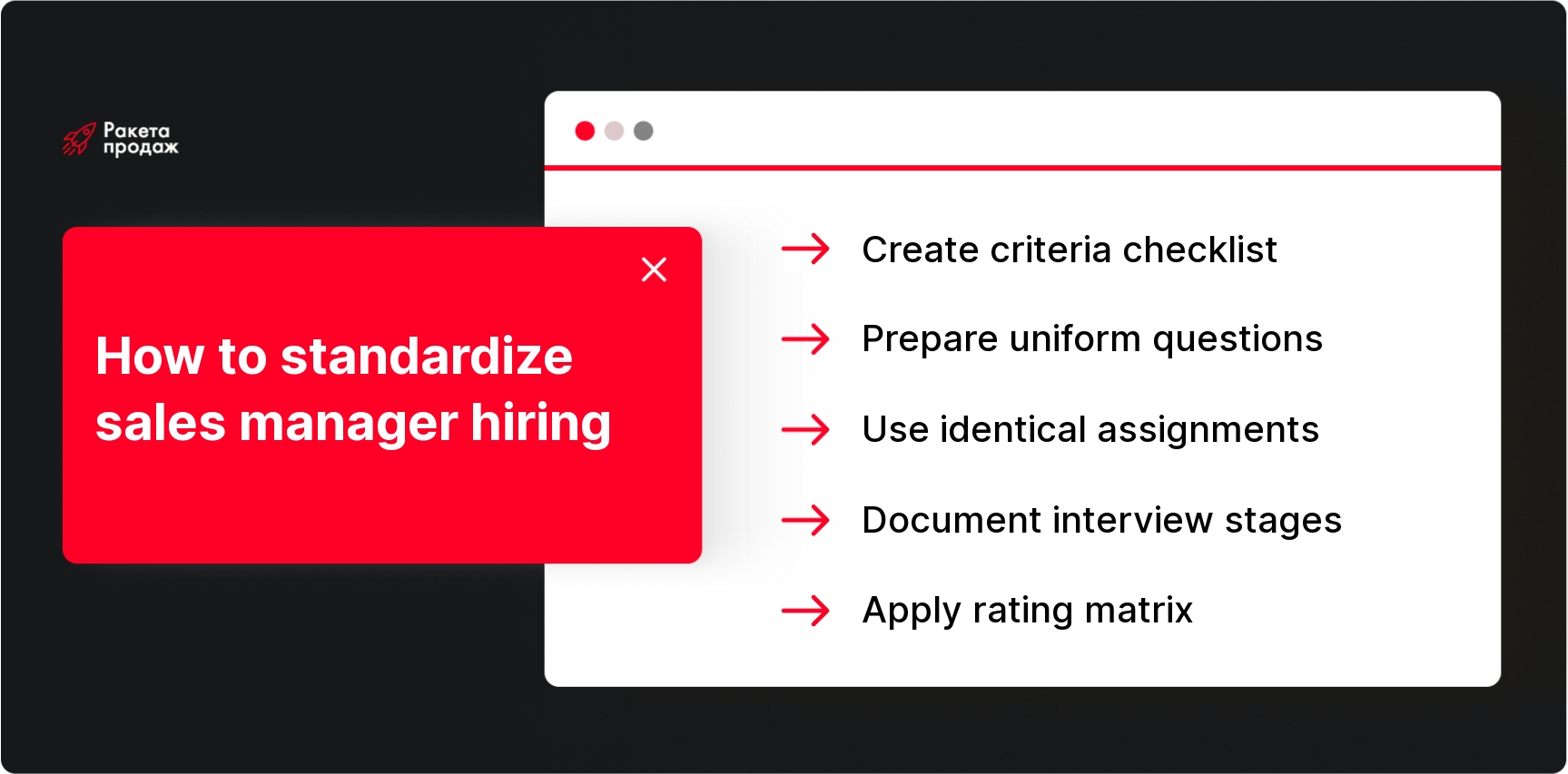
To really reduce subjectivity when selecting sales managers, it’s not enough to just define criteria – you need to use methods for evaluating candidates during interviews that allow objectively checking the candidate’s compliance with these criteria. Let’s look at several effective tools.
Structured interview is a method where all candidates are asked the same questions in the same sequence, and answers are evaluated according to predetermined criteria. This approach allows comparing candidates with each other and reduces the influence of the interviewer’s personal preferences. In a structured interview, you can use the STAR model (Situation, Task, Action, Result), which helps assess how the candidate acted in specific work situations.
Role-playing games are another effective evaluation method. You can model typical situations from your company’s practice – for example, a first call to a potential client, a product presentation, or handling objections. The recruiter or sales department manager can act as the client. This approach allows seeing how the candidate applies their skills in practice, not just talks about them.
Test calls and emails are an imitation of a sales manager’s real work. The candidate can be offered to make several calls according to a script or write an email to a potential client. What’s evaluated is not just the result (whether they “sold”), but also the process – how the candidate builds the conversation, what questions they ask, how they react to objections.
Cases are assignments that simulate real work situations. For example, you can ask the candidate to develop a sales strategy for a new product, analyze a sales funnel and find bottlenecks, or propose a plan for working with key clients. Cases allow assessing the candidate’s analytical abilities, their understanding of business processes, and creativity in problem-solving.
All these methods provide an opportunity to objectively assess the candidate’s skills, their communication style, ability to handle objections, and go through all stages of a deal. It’s important to use not just one, but several methods to get a more complete picture of the candidate’s competencies.
Additionally, it’s worth involving several people in the evaluation – for example, an HR specialist, a sales department manager, and, possibly, the candidate’s future colleagues. This will provide different perspectives and reduce the influence of individual evaluators’ personal preferences. Additional tools are revealed in our article that unveils methods for auditing a sales department.
Using structured evaluation methods not only increases the objectivity of selection but also improves the candidate’s experience. They see that they’re being evaluated based on specific skills and competencies, not subjective impressions, and this creates a sense of fairness in the process. Now let’s look at how to use KPIs and metrics for an even more objective evaluation.


 Time to read: 10 min.
 02 December 2025