Key Takeaways
- A business owner who calculates the sales department budget based on salaries alone runs into a cash gap, because the real cost includes leads, CRM, training, scripts, and the time it takes to close the first deal.
- Weak candidates are cheaper, but they burn through leads faster than they earn back their salary, one bad hire can eat up an entire month’s worth of potential profit.
- A department without CRM, regulations, and quality control operates chaotically, leads bounce between managers, get lost, and go to competitors simply because they were handled poorly.
- The B2B model requires more qualified managers, SDR functions, and personalized outreach, so the budget here runs one and a half to two times higher than in simple B2C sales.
- Planning a budget three months ahead with a reserve for mistakes and replacements turns launching a sales department from a risky gamble into a manageable project with a clear payback point.
Below you’ll find a detailed breakdown of every expense category, signals for where you can save without harm, and where cutting corners will backfire, plus a ready-to-use checklist for calculating your real startup budget. Read the full article 👇
In this article, we break down the true cost to build a sales department from scratch, explain how to build a sales team step by step, and show why there’s no one-size-fits-all number. We draw on real case studies of companies where the full cost of a sales department turned out to be two or more times higher than initial estimates. If you break expenses down in advance, building a sales team stops being a risky gamble and becomes a manageable project with a clear payback point.
Why You Can't Calculate Sales Department Cost by Salaries Alone
A manager’s salary is just the tip of the iceberg. For a sales department to actually start generating revenue, you need a steady flow of leads, a CRM to track them, documented processes, a manager who keeps the team sharp, a motivation system, and scripts that guide how people talk to customers. All of this costs money and time before the first manager ever closes a single deal.
Companies that calculate their budget based on salaries alone typically go through the same scenario. They hire two or three managers, hand them a phone and a contact list, and a month later wonder why there are no sales. In reality, there won’t be any sales because nobody handled lead qualification, training, or call quality control. The owner finds this out only after paying salaries, spending the ad budget, and saying goodbye to part of the team.
This is exactly where cash gaps usually happen: the money for salaries runs out before the system starts working. If you calculate all expense categories in advance, you can avoid this surprise, and this is precisely what determines the real cost to build a sales department.
How many times have you calculated a sales department budget and gotten one number, only to end up spending a completely different one in reality? Hidden costs, overlooked line items, team ramp-up time, all of this turns planned investment into a serious cash gap. At Rocket Sales, we don’t just help you calculate the real cost to build a sales department, we help you build it right the first time. With 8+ years of experience, we’ve built 208 sales departments across 14+ industries, and we know exactly where you can save without hurting results, and where cutting corners will cost you more in the end. Our clients get more than just a team of managers, they get a complete system: from CRM and scripts to training and quality control. The result is sales departments that consistently hit 150% of plan from the very start.
Turn your sales department expenses into a managed investment with guaranteed ROI, get a free consultation!
What Determines the Cost of Building a Sales Department from Scratch
The cost of a sales department is never the same for every company, because a good dozen variables affect it, and building a successful sales team means accounting for all of them from day one. The business model, B2B or B2C, immediately sets different requirements for the team and the budget. In B2C, the sales cycle is short and often just one person makes the decision, so a simpler structure will do. In B2B, several people are involved in the decision, the cycle stretches over weeks or months, which means you need more experienced, and more expensive, managers.
Product complexity and average deal size also directly affect the budget. The more complex the product and the higher the price tag, the greater the demands on manager qualifications, the more expensive the training, and the more important it becomes to have a sales manager overseeing deal quality. Add in sales geography, the need for outbound or SDR functions, regional salary levels, the size of the marketing budget, and whether you’re building a remote sales team, and it becomes clear why two companies with the same number of managers can spend completely different amounts.
Here are the main factors that shape the final budget:
- sales model (B2B or B2C) and product complexity;
- deal cycle length and average deal size;
- number of managers and whether you need a sales team lead;
- whether you already have inbound leads or need outbound and SDR;
- sales geography, regional salary levels, and the degree of automation;
- the timeframe within which the business expects to see its first result.
In the B2B segment, costs are usually higher because a complex product and multi-step approval processes require technical expertise and lead qualification at every stage. Now let’s take a closer look at the specific line items that make up the actual cost of a sales department.
What Makes Up the Cost of Building a Sales Department
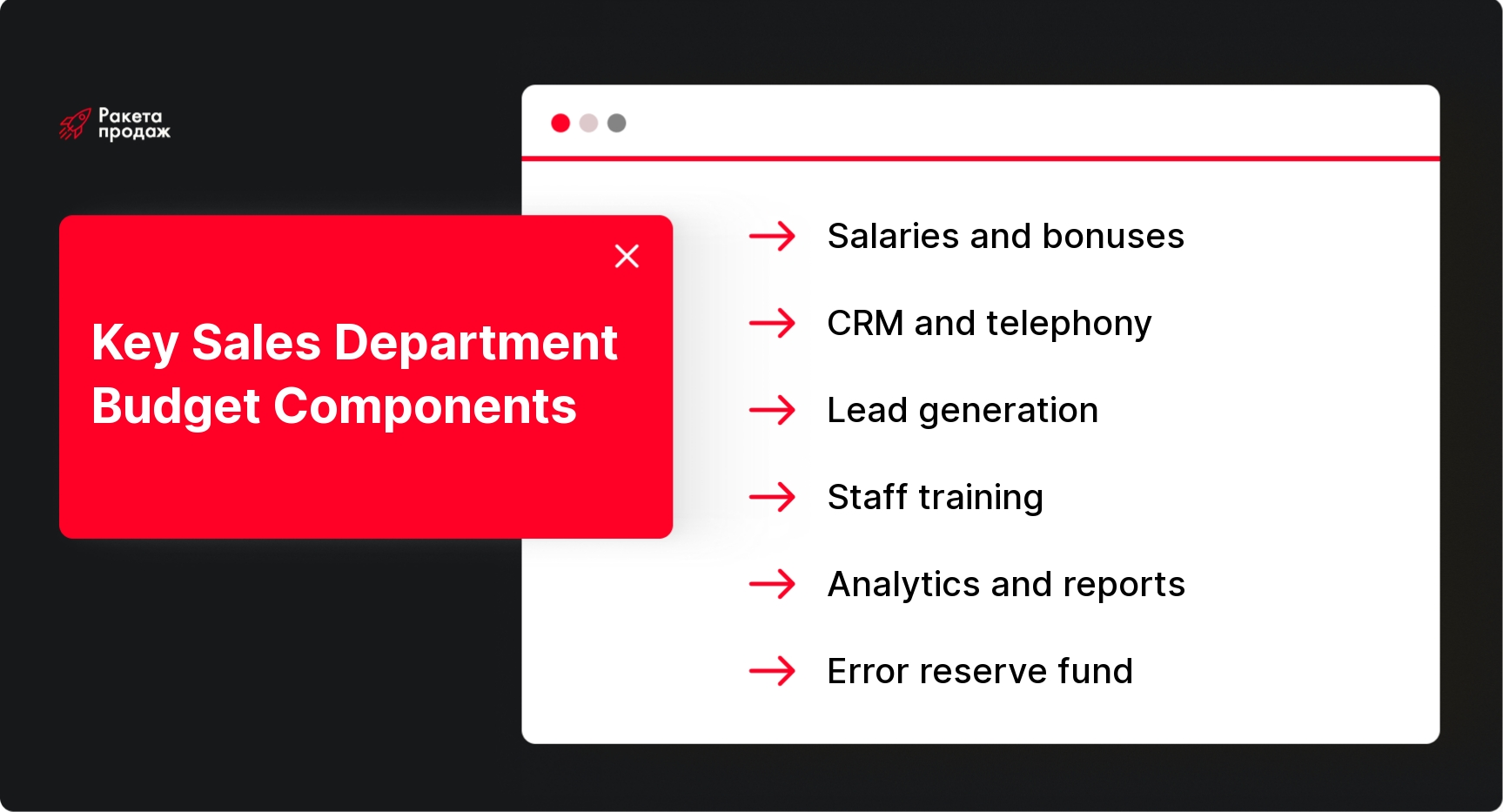
Breaking down a sales department budget into components gives you three categories of expenses. The first is direct costs, which show up in any budget sheet: manager and management salaries, hiring costs, CRM, telephony, training, and onboarding. This part of the budget is usually planned for from the start and rarely raises questions.
The second category is indirect losses, which don’t show up right away but hit profits just as hard. This includes missed sales targets, deals falling through due to lack of process, and the owner’s time spent on manual team management instead of strategy. The third category is the cost of mistakes: staff turnover, bad hires, and leads that “wander” between managers without a clear owner and ultimately just get lost.
In one consulting case in the Ukrainian market, an IT company with five managers calculated its sales department budget based on direct costs alone and arrived at around 445,000 hryvnia per month. Once management time, HR support, and losses from missed targets were factored in, the real number climbed to nearly 610,000 hryvnia. The 165,000 hryvnia difference is exactly the part companies usually don’t see until they start counting seriously.
| Metric |
Without a System |
With a System |
| Lead-to-deal conversion |
low, depends on the individual manager |
stable, tracked at every funnel stage |
| Lead loss |
high, leads get lost without CRM |
minimal, everything is logged in CRM |
| Staff turnover |
high due to chaos and lack of onboarding |
lower thanks to training and clear KPIs |
| Revenue predictability |
low |
high, with pipeline and analytics in place |
To avoid these pitfalls, it helps to break the budget down by specific line item, starting with the very first step: sourcing and hiring the team.
Hiring and Recruitment Costs
Building a sales team doesn’t start with salaries, it starts with finding people, and well-organized professional staff hiring also costs money. Recruitment expenses include job postings, recruiter or agency fees, the owner’s or HR specialist’s time spent on interviews, test assignments, and background checks. On top of that comes onboarding for new hires and, more often than anyone would like, replacing those who don’t make it through the probation period.
A bad hire for a sales manager role costs a business more than it seems at first glance. The company pays a salary to someone who can’t deliver, burns through part of the inbound leads on them, and takes up the manager’s time on oversight and feedback. While this “trial and error” learning is happening, some potential customers go to competitors simply because they were poorly handled early on.
Specific figures here depend heavily on the market, city, manager seniority, and hiring format (full-time employee, freelancer, or agency support), so it’s best to look at ranges relevant to your specific niche. Next, it makes sense to figure out how much you need to budget for actual team salaries.
The salary budget for a sales department depends on the number of managers, their seniority, product specifics, and the company’s motivation model. At launch, a business rarely needs just a “phone reader” who follows a script word for word. You need someone who can work in a CRM, qualify leads, negotiate, follow up, and bring a deal all the way to payment.
It’s easy to get this wrong in either direction. Too low a base salary attracts weak candidates who either leave quickly or fail to hit targets. Too high a fixed salary without KPI ties, on the other hand, reduces manageability, why try hard if the base pay already covers basic needs?
A working structure that performs well in practice, when built around solid sales team motivation system design, looks like this: a modest base salary plus a bonus for hitting sales targets plus additional KPIs for process metrics like number of calls, meetings, or CRM data quality. This model balances stability for the manager with growth incentives for the business, and it’s often the starting point when calculating the cost to build a sales department from scratch. In short, building a strong sales team starts with getting this compensation structure right. The next question you can’t avoid is who’s going to manage this team.
Cost of a Sales Team Lead or External Management
A separate, and often underestimated, budget line is sales department management. If the owner runs the team personally, they save money but spend their own time, time that could go toward strategy, partnerships, or product development. That’s a cost too, it’s just not visible in the accounting books.
If the business hires a full-time sales team lead, expenses arise for their salary, bonuses, onboarding, and building a management structure around them. An alternative is to bring in an external sales manager or consultant on a project basis, with payment either monthly or tied to specific launch milestones. This format is often chosen by companies that need an experienced manager during the launch period but don’t want to commit to a full-time hire right away.
The absence of management has its own cost too, it just shows up gradually. Managers work chaotically, each interpreting the sales process their own way. The CRM either isn’t used at all or gets filled in half-heartedly, just for show. Leads get lost, nobody tracks KPIs, and the owner only learns about problems once the sales target has already been missed. A sales department budget must include a management role, even if the business owner temporarily takes on that function early on. Ultimately, building a winning sales team depends as much on strong leadership as on the managers themselves. Next, let’s look at what the technical foundation for the team’s work will cost.
CRM, Telephony, and Basic Automation
Tools are what modern sales departments simply can’t operate transparently without. The basic toolkit includes CRM and telephony implementation with call recording, integrations with the website, application forms, messengers, email, and calendar. A separate line item is call tracking, which shows where calls are actually coming from, plus tools for email campaigns and basic analytics.
At launch, you don’t need to buy the most complex, expensive system with a dozen modules. For the first few months, a mid-tier CRM is plenty, as long as it covers the basics: leads land in the system automatically, and every deal has a stage, an assigned manager, a source, and a history of correspondence or calls. This is the bare minimum without which managing sales becomes nearly impossible.
If you cut corners on CRM entirely and track everything in spreadsheets or a notebook, the owner will have to manage sales manually, personally figuring out who called whom and at what stage a deal is stuck. Some leads inevitably get lost in this model, simply because human memory and Excel can’t keep up with the flow of inquiries. Once the technical foundation is in place, the next question is where the leads for this team will actually come from.
Lead Generation and Marketing Costs
A sales department without a flow of leads is just an expensive team with nothing to sell. Lead generation expenses usually include a website or landing page, paid advertising, SEO and content marketing, tools for working with LinkedIn and other outbound channels, target company databases, email campaigns, participation in industry events, partnerships, and preparing marketing materials.
The cost of launching a sales department depends heavily on whether the company already has an established flow of inquiries. If there are no inbound leads at all, the budget will need to cover not just managers but also acquiring customers from scratch, which is a separate, and often substantial, expense category. Companies that launch sales without simultaneously investing in marketing usually end up with a team sitting idle for the first few months.
For the B2B segment, lead generation looks even more complex. Here you often need a dedicated SDR (a specialist for qualification and first contact), research into target companies, and personalized outreach instead of mass mailings. This approach requires more time and resources but delivers higher-quality, more predictable leads entering the funnel. Once leads start coming in, the team needs clear rules for how to work with them, which brings us to the next section.
Scripts, Regulations, and Sales Materials
Building out a sales system takes time and often requires a dedicated specialist. This includes first-call scripts, lead qualification scripts, objection-handling and follow-up scripts, proposal structure, presentation materials, CRM usage guidelines, rules for handing leads between managers, deal statuses, and a knowledge base on the product and competitors.
Without these materials, every manager will sell their own way, relying on personal experience and intuition. Some pull it off, but most don’t, and in this situation it’s extremely hard for a manager to control call quality or understand why one rep closes deals while another wastes the exact same leads.
Some materials can genuinely be put together in-house, especially if the product is simple and the sale is quick. But for complex B2B sales with multiple approval stages, you’ll usually need help from a methodologist, an experienced sales manager, or an outside consultant who has already built similar processes. Once the materials are ready, the question becomes how quickly new managers can put them to use.
Manager Training and Onboarding
Few new managers start selling effectively in their first week. The sales department budget should account for full training: on the product, the market, the customer profile, CRM usage, scripts, competitors, deal stages, common objections, and communication standards.
You also need to factor in the onboarding period, when an employee is already drawing a salary but not yet delivering consistent results. A well-designed sales team onboarding process can noticeably shorten this period, which can range from a few weeks to a couple of months depending on product complexity, and it can’t just be left out of the calculations on the hope that “the person will figure it out.” Some companies also invest in sales team building activities to help new hires bond quickly and adapt to the culture faster; if you bring in an outside specialist, factor in the team building facilitator cost as part of this budget line.
Quality training directly reduces the cost of mistakes. Managers who go through a structured onboarding program reach their targets faster, handle inbound leads better, and are less likely to blow potential deals with awkward phrasing or lack of product knowledge. The next step is figuring out how to measure whether this whole system actually works.
Cost of Analytics and Reporting
A sales department that can’t be measured can’t be improved. From day one, you need reports on lead volume, traffic sources, response speed, the sales funnel, individual manager performance, conversion at each stage, reasons for lost deals, revenue plan vs. actual, and forecasts for the coming months.
Costs here include setting up reports and dashboards inside the CRM, and with a more mature approach, end-to-end analytics, integrating marketing and sales data, and sometimes bringing on a dedicated analyst or sales ops specialist.
Without reporting, the owner is essentially flying blind: it’s unclear whether the sales department is actually working, exactly where leads are getting lost, and when the team can reach self-sufficiency. Often it’s precisely the lack of analytics that prevents catching a problem in time and fixing it before it costs the business too much. Now that we’ve covered every expense category, let’s move on to the key practical question: how much money you actually need for the first few months.
How Much Money You Need for a Sales Department in the First 3 Months
You need to budget for a sales department at least three months out, and this isn’t a preference, it’s simply the reality of sales. A department doesn’t hit its stride instantly: first comes hiring and training, CRM setup, script testing, launching lead generation, the first calls and proposals, and only then do stable deals with real money start coming in.
If you only budget for one month of salaries, launching a sales department turns into a gamble. The money will run out before the team has a chance to show its first results, and you’ll either have to scramble for additional funding or shut the project down halfway through, losing the money already invested.
It’s convenient to structure the calculation into major blocks, without tying it to specific mandatory amounts, since these vary widely by niche and region:
- payroll for managers and management over three months;
- costs for managing the department (in-house or external sales lead);
- CRM, telephony, and other tools;
- marketing and lead generation, including test ad budgets;
- training and onboarding for new hires;
- setting up processes, scripts, and regulations;
- a reserve for mistakes, replacements, and unforeseen expenses.
Each of these blocks deserves its own line in the budget, otherwise it’s easy to overlook something important at launch. Next, let’s look at how these blocks relate to each other in percentage terms.
Example Sales Department Budget Breakdown
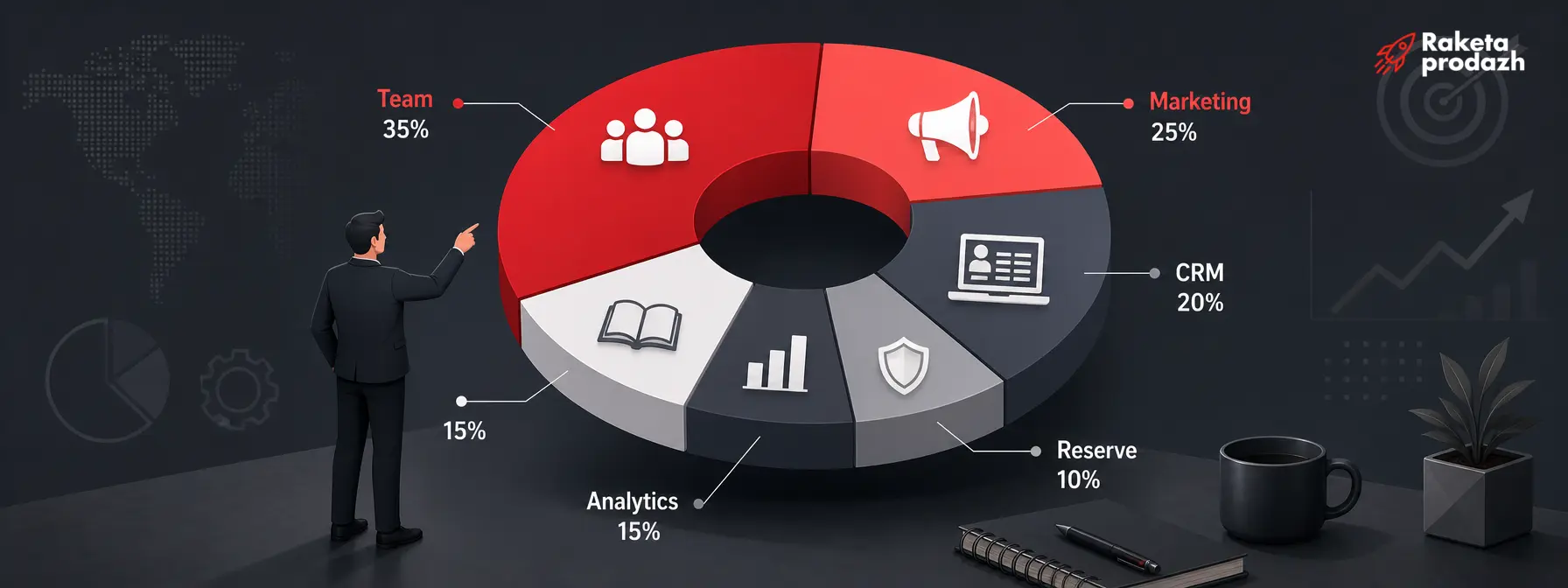
Once all expense categories are gathered into one table, it’s useful to look at them as percentages of the total budget. This helps you quickly check whether the plan is skewed in one direction, for example, toward tools while lead generation gets almost no budget at all.
An approximate breakdown of a sales department budget looks like this:
- team and manager salaries, 35-50%;
- sales management (team lead, oversight, reporting to leadership), 15-25%;
- lead generation and marketing, 20-35%;
- CRM, telephony, and tools, 5-10%;
- training and sales materials, 5-10%;
- analytics and reporting, 5-10%;
- reserve for unforeseen expenses, 5-10%.
These proportions aren’t set in stone and depend heavily on the business model. In B2B companies with active outbound efforts, more money usually goes toward SDR, target company research, and specialized contact-finding tools. In an inbound model, where customers come in on their own through the website and ads, the bulk of the budget shifts toward marketing and response speed, because here what matters isn’t finding the customer but how fast you respond first. Once the budget is allocated, the next strategic choice arises: build the department in-house or outsource part of the functions.
Outsourcing or an In-House Team: Which Is More Cost-Effective?
Building a sales department in-house or bringing in a turnkey sales department outsourcing solution is a question every growing business eventually faces. Both approaches have their strengths and weaknesses, and the right choice depends on company size, how quickly you need results, and your willingness to invest in a long-term asset.
An in-house sales department gives you more control over processes, customer communication quality, and the long-term value of the team as a company asset. But it takes longer to launch and requires the full range of expenses we covered above. Outsourcing, by contrast, speeds up market entry and removes some fixed costs, but reduces control over the team’s day-to-day work and customer experience quality.
For small businesses testing a new product or market, outsourcing is often the better fit: lower barrier to entry and less risk if the launch doesn’t pan out. Medium-sized businesses with an established product are usually better off building their own team, especially if sales involve long-term customer relationships. Larger companies tend to keep their core team in-house and use outsourcing selectively, for example, to enter a new region.
| Criterion |
In-House Department |
Outsourcing |
| Launch speed |
slower, requires hiring and training |
faster, team is already ready |
| Quality control |
high |
limited |
| Long-term cost |
higher upfront, but the asset stays with the company |
lower fixed costs, but no accumulated asset |
| Best for |
medium and large businesses, complex sales |
small businesses, testing hypotheses |
Regardless of which model you choose, some expenses can be cut without hurting results, and some cost you far more than the money you save.
What Expenses You Can Cut at Launch, and Where Cutting Corners Is Risky
Not every budget line is equally important in the early stage, and some expenses really can be postponed without hurting results. Complex custom automation with a dozen integrations can safely wait until you actually understand your team’s real processes. Expensive presentation materials, unnecessary “just in case” subscriptions, and an oversized team of managers at launch often create the illusion of readiness rather than real value. A large analytics staff in the first few months is also usually overkill while there isn’t enough data to analyze yet. Cosmetic extras like custom team names for sales department, branded merchandise, or elaborate offsite events can also wait, they’re nice touches once you build a successful sales team, but they won’t determine whether it succeeds.
But where cutting corners is genuinely dangerous is on basic CRM and quality lead handling. If inquiries get lost or handled too slowly, no amount of savings on tools will make up for the lost customers. It’s just as risky to skimp on basic department management, manager training, quality lead generation, funnel tracking, the motivation system, and call and correspondence quality control.
A well-executed sales department launch isn’t about having the maximum budget from day one. It’s about the right sequence of actions: start with a minimal but well-managed system with CRM, scripts, and oversight, then expand the team and tools once you’ve validated your first hypotheses with real data. A handful of specific ROI metrics help you check whether this system is actually working.
How to Know Your Sales Department Budget Is Paying Off
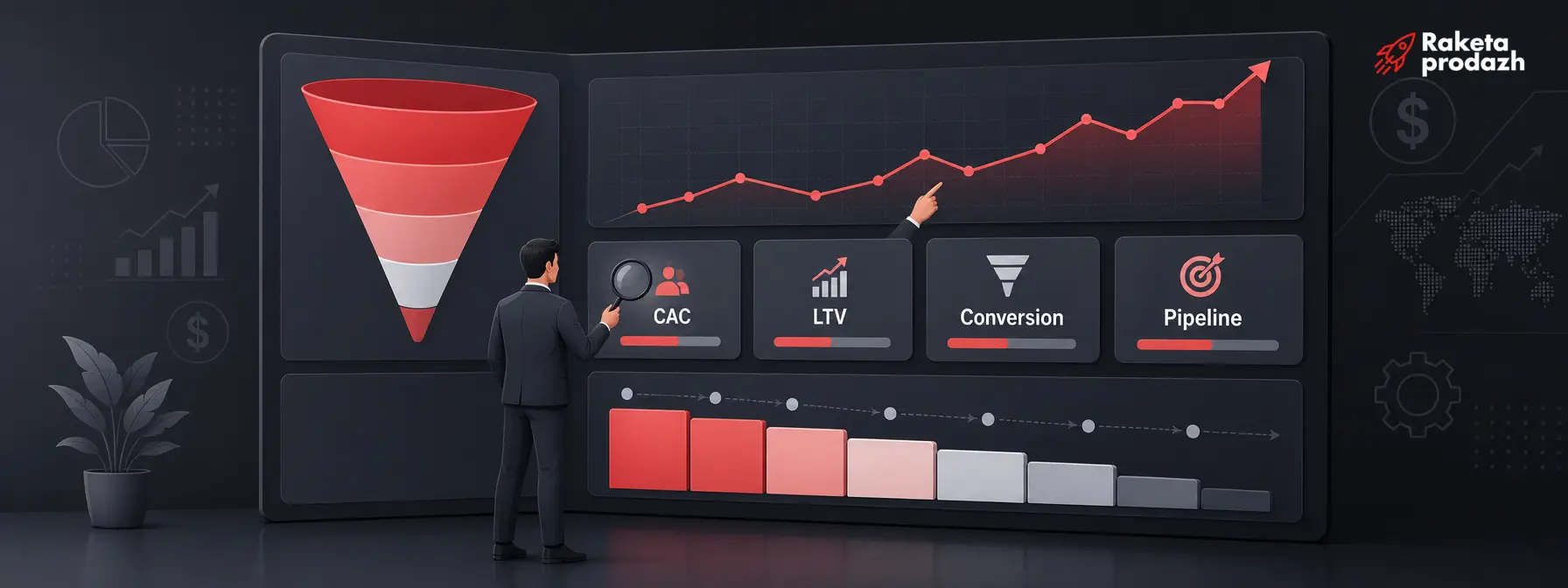
Payback for a sales department is rarely visible in the first month, especially in the B2B segment with a long deal cycle. That’s why it’s worth evaluating not just current revenue, but a whole set of metrics that reflect the overall health of the sales system.
Key metrics worth tracking regularly:
- customer acquisition cost and cost per lead;
- lead-to-deal conversion at each funnel stage;
- average deal size and deal margin;
- deal cycle time from first contact to payment;
- repeat sales rate and LTV (customer lifetime value);
- customer acquisition cost payback period (CAC payback);
- sales target achievement and pipeline volume for the coming months.
If a sales department hasn’t yet paid for itself financially, but lead quality is improving, conversion is rising, and a solid pipeline is building up for the coming months, that’s a normal growth stage, not a reason to panic and shut down the project. The real problem starts when none of these metrics move for months on end. To avoid getting lost in all these calculations, it helps to have a simple checklist on hand.
Checklist: How to Calculate the Cost of Building a Sales Department from Scratch
To calculate the real cost to build a sales department, it helps to go through a short checklist and make sure you don’t skip any expense category. It doesn’t replace a detailed financial plan, but it helps you not forget key budget items at the start.
- determine your sales model (B2B, B2C, short or long deal cycle);
- calculate the number of managers you need at launch;
- budget salaries and bonus components based on market and region;
- decide who will manage the department, owner, in-house, or external sales lead;
- calculate costs for CRM, telephony, and basic automation;
- budget for lead generation and marketing;
- set aside money for training and onboarding new hires;
- prepare scripts, proposal templates, and work regulations;
- set up basic analytics and reporting;
- calculate all expenses for at least three months ahead;
- add a reserve for mistakes, replacements, and unforeseen situations;
- estimate the realistic deal cycle length in your niche;
- forecast your pipeline for the coming months;
- calculate the department’s breakeven point;
- revisit the budget once you have real conversion data.
Keep this list handy when preparing any budget, and revisit it after the first few weeks of work to adjust the numbers to reality.
Now you understand that building a sales team isn’t just about hiring managers and buying a CRM, it’s a systematic project with many interconnected elements. Building a department on your own often stretches out over months of trial and error, with the final budget ending up 2-3 times higher than initial estimates. Rocket Sales offers an alternative: turnkey sales department construction with guaranteed results. We handle the entire cycle: from audit and design to team training and analytics setup. Our clients see an average revenue increase of +35%, with the best result reaching +$10,907,403 in 4 months. Our partners include Mitsubishi, Yamaha, and Naftogaz. Instead of months of experimentation and unpredictable costs, you get a ready-made sales system that works from the very first weeks. Don’t risk your time and budget on experiments with uncertain outcomes.
Build a sales department that pays for itself from the first few months, order a complete turnkey solution!
There’s no universal answer to the question of what it costs to build a sales department, because the budget depends on niche, sales model, average deal size, deal cycle length, region, and each company’s specific goals. But if you break expenses down into categories in advance, from salaries all the way to a reserve for mistakes, launching a sales department stops being a risky gamble and becomes a manageable project with a clear payback point. The cost to build a sales department comes from the team, management, lead generation, CRM, training, processes, analytics, and a buffer for the first few months, and each of these line items affects the final outcome just as much as manager salaries themselves.


 Time to read: 9 min.
 12 August 2026